
I find personality tests quite fascinating although I am sure that most are flawed in some way. The My Personality badge from Book 3 sounded really interesting and I decided to give it a go in January.
To gain the badge, I had to complete at least five different personality tests, analyse the results, and think about their accuracy.
My starting point was an article on VeryWellMind, What is personality testing?, which was very interesting.
Myers-Briggs Type Indicator (MBTI)
I took this test a few years ago so I’ve known for a while that I’m an INFJ (Introverted, Intuitive, Feeling, Judging). Apparently this is the rarest MBTI type. I’m very strongly introverted, but the other aspects are a bit more balanced.
The strengths of INFJs are: Sensitive to the needs of others, reserved, highly creative and artistic, focused on the future, values close, deep relationships, enjoys thinking about the meaning of life, idealistic.
The weaknesses are: Can be overly sensitive, sometimes difficult to get to know, can have overly high expectations, stubborn, dislikes confrontation.
I think that all describes me pretty well. Interestingly, popular INFJ careers include librarianship – I used to be a librarian until I moved sideways into e-learning.
Apparently I’m most attracted to ENFPs. This makes sense as I definitely get on well with extroverts, as I find we complement each other and I can bounce off their energy.
Enneagram Test
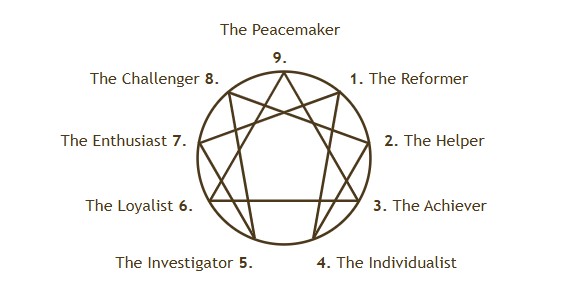
I’d heard of the Enneagram test but hadn’t looked deeply into it. Apparently I am an Ennegram Type 5 with a wing of 4. Type 5s are “thinkers who tend to withdraw and observe”. Honestly, this was spookily accurate. I do tend to use books as a substitute for real life (ironically less so since I joined RBC).
HEXACO Personality Inventory

This was another test I hadn’t heard of, but the answers seemed pretty accurate. For me the most striking were H, X and O. H stands for honesty-humility and high scorers are fair, non-manipulative and law-abiding. I like to think that I am a fair person and I don’t like lying or manipulation – I haven’t wanted to sign up for any Rebel Traitors weekends as I hate the idea of lying to people! My low extroversion score definitely makes sense (I’ve always thought my strongest personality trait is introversion) and my high openness score suggests that I am intellectual, inquisitive and imaginative. I like to think I am!
Apparently, my score suggests I prefer a partner who is similar to me. This contradicts what my MBTI test said about preferring extroverts, but it’s not like I don’t have and appreciate introverted friends, and the other values (particularly honesty-humility and openness) are really important to me.
Sixteen Personality Factor Questionnaire
This test felt particularly complicated and I’m not sure about the answers, however the ones that jump out at me are my high self-reliance, openness and sensitivity scores. I have a low social boldness score – not surprising!
DISC Assessment
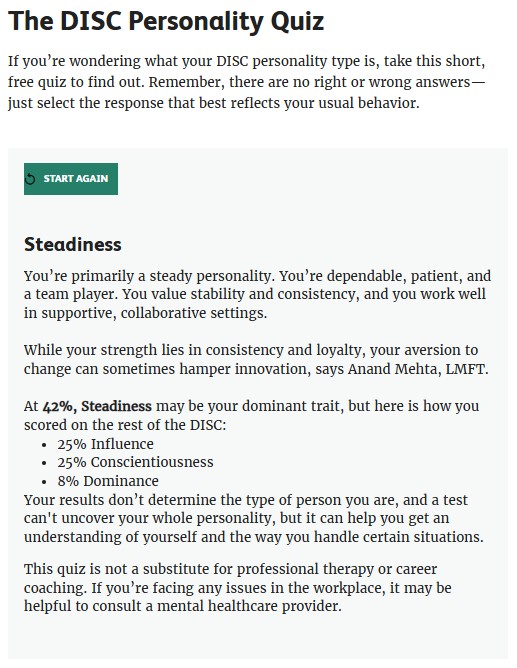
DISC definitely felt more work-orientated than the other tests I took. In terms of work, it is fairly accurate: I show patience, loyalty and consistency in a work setting (I am not particularly patient in everyday life!) and am suspicious of change. I’m not sure it would be so accurate outside of a work setting.
Completing these tests has highlighted areas in which I’d like to improve. I can definitely be stubborn, and I hate confrontation. I also have a tendency to retreat from real life, which means I don’t always make the most of life. I’d like to work on these aspects of my personality.
Finally, I had to learn about the origins of these tests, how widely used they are, and any criticisms they have faced.
MBTI: Based on Carl Jung’s approach to personality, and developed by Isabel Myers and her mother Katherine Briggs during World War II, this test categorises people into one of 16 different types. It is one of the most widely-used personality tests in the world, but has been criticised for unreliability and oversimplification. It is not accurate at predicting careers, but is still used by many employers as part of the recruitment process.
Enneagram Test: This has roots in Sufism but was popularised in the West by Russian philosopher Gurdjieff. The word “enneagram” comes from the Greek “ennea,” meaning nine, and “gramma,” meaning something drawn or written. The Enneagram Test is fairly popular, but has also been described as pseudoscience and “an assessment method of no demonstrated reliability or validity”. Despite this, it is sometimes used by employers as part of the hiring process.
HEXACO Personality Inventory: Developed in 2000 by Canadian psychology professors Kibeom Lee and Michael C. Ashton, this test measures six key areas of personality: honesty-humility, emotionality, extraversion, agreeableness, conscientiousness, and openness to experience. The test originates from research on the Big Five personality types. It has been correlated to predict certain behaviours and has been used to map differences in personality traits between different academic majors. However, it has been criticised because of the subjectiveness of its answers and the potential for test-takers to choose options reflecting social desirability instead of accuracy. Neither does the test consider cultural differences. HEXACO can be used by employers as part of recruitment, but there is a chance applicants could distort their responses based on what they think employers are looking for.
Sixteen Personality Factor Questionnaire: This test is based on Raymond Cattell’s trait theory of personality, and was developed from the 1940s using statistical techniques. Sometimes used in recruitment, it is subject to the same criticisms of other personality tests, such as oversimplification.
DISC Assessment: This identifies four main personality categories: Dominance, Influence, Steadiness, and Conscientiousness. It is often used by employers because it focuses more on actions. The test is based on psychologist William Moulton Marston’s DISC emotional and behavioural theory, first published in 1928, but has been criticised as pseudoscience.
The criticisms of most personality tests seem to be along similar lines: that personality is not fixed, these tests oversimplify personality traits, and they have not been scientifically tested. I personally think that they are fine for personal use and for use by psychologists and other professionals (who actually understand them) but I wouldn’t be comfortable with a potential employer wanting me to take any of these tests.
Date completed: 23 January 2025
One thought on “Rebel Badge Club: My Personality”