
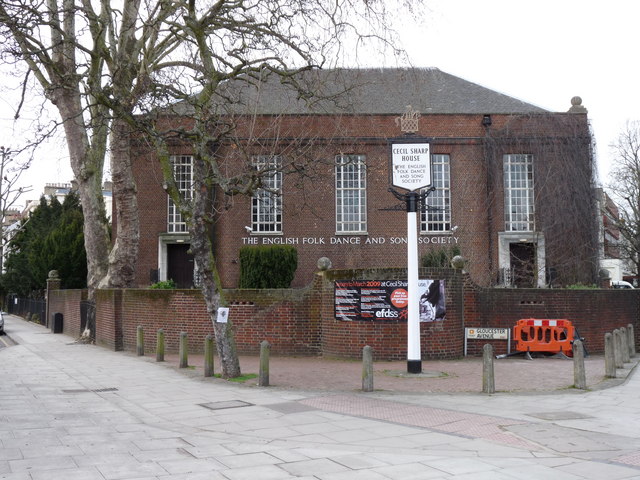
It might not sound like the most exciting way to spend a Saturday, but I decided to attend the Historical Pageants Day and Evening at Cecil Sharp House, and I really enjoyed myself. I booked to attend because I’m interested in history, but I didn’t really know anything about historical pageants. By the end of the day, I not only knew a lot more, but I had a strong urge to attend a pageant myself.
The introduction to the day was provided by the enthusiastic and informative Paul Readman from King’s College London. He explained how historical pageants were popular from the early to mid-20th century, with the first pageant of this type generally held to be the Sherborne Pageant of 1905. Further pageants were held around the country in subsequent years, some of them written by and starring local dignitaries, others featuring the likes of E. M. Forster and Ralph Vaughan Williams, but all of them featuring local people as part of the wider cast. Pageants told stories of the local area, typically from the ancient Roman and medieval periods; many of them were painstakingly researched, often by actual historians, but they also included myths and legends from the locality, and rewriting of history was common. My favourite example of this was a photograph from Birmingham’s 1938 pageant featuring Egbert the dinosaur surrounded by cavepeople – even at the time people knew that humans and dinosaurs did not roam the earth together, but why let that get in the way of an amusing scene? Queen Elizabeth I often made an appearance in pageants, even when her presence was historically anachronistic – perhaps because her name was linked with an idea of ‘Merrie England’.
Pageants were particularly popular in the cities of the midlands and the north such as Carlisle and Birmingham. They were hugely popular to watch, attended by millions of people. Many pageants made use of modern technology, such as film: in fact, one pageant, the Glastonbury Pageant of 1922, was created as a film rather than a live experience. Later in the century, pageants used amplification and recording tech, as well as advertising to get the word out.
Some aspects of pageantry could be seen as fairly conservative, with the past viewed through rather rose-coloured glasses, but pageants were popular all along the political spectrum – even the Communist Party had one. Often the aim was to bring people together by acting out a shared history, but even at the time there were discussions about inclusion, and these attempts were not always successful.
Pageant-making was less popular in the latter half of the century, although some pageants did take place. They rarely happen now, but Axbridge in Somerset has established a tradition of a pageant every ten years (the next one is set for next year, rescheduled from 2020 for pandemic-related reasons). I would very much like to attend!
After this introduction, Parker Gordon from the University of St Andrews gave a talk on pageant music, which served a variety of functions including creating drama, cueing speakers and simply passing the time – one instruction found in a sheet of pageant music advised the musicians to continue playing the motif over and over while a bunch of horses and their riders made their way down the hill. Military bands were often deployed during pageants, as their music carried, but some pageants featured piano music and some with less of a budget even used gramophones. Following this talk, Angela Bartie from the University of Edinburgh discussed oral histories of pageants at Bury St Edmunds and Carlisle. The most memorable anecdote featured a former participant describing how, dressed as a redcoat soldier, he found himself in the dungeons of Carlisle Castle (where Jacobite soldiers were formerly held) and felt rather spooked.
Next we saw some video footage: firstly of Bury St Edmunds pageants in 1907, 1959 and 1970, and then of the St Albans millenary pageant of 1948. It was interesting to see how styles and focus changed over a period of half a century, and the aspects of life each pageant chose to illustrate. After lunch there were more short talks, with subjects including David Clarke, ‘the last pageant master’, the 1910 Saffron Walden pageant, and experiences of researching historical pageantry.
Throughout the day, information boards and exhibition items concerning pageants (such as photographs, postcards and souvenirs) were on display around the hall. After a break, it was time for the evening part of the programme which featured scenes from the forthcoming Axbridge Pageant (which were great fun) as well as pageant music by composers such as Ralph Vaughan Williams and Martin Shaw. After an interval there were performances of folk songs by the Boyd-Shaw trio which were accompanied by archive film from the Carlisle and St Albans pageants. I left knowing a lot more about historical pageants, and I definitely hope to attend one some day.