
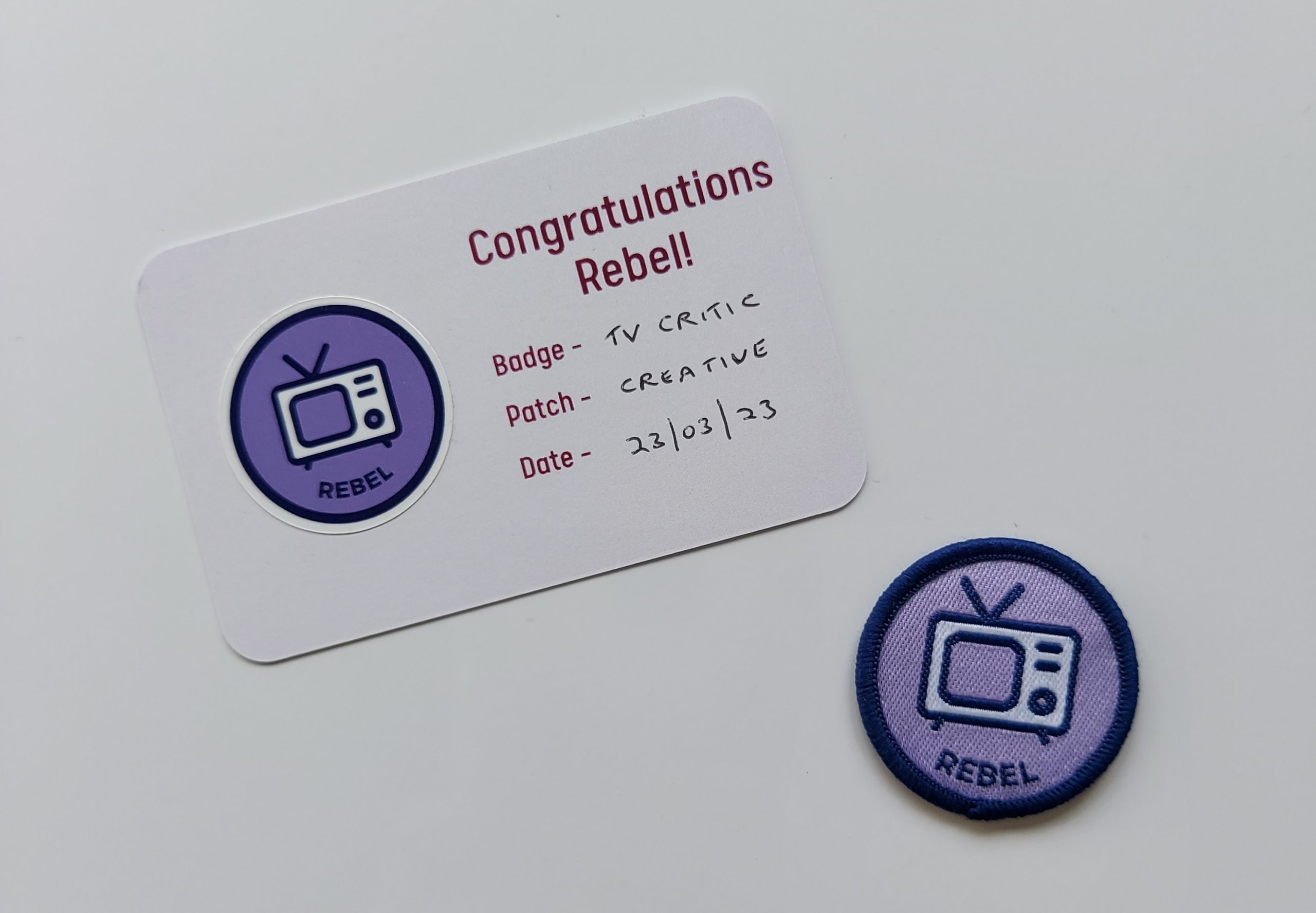
As part of the Happy 2023 challenge, I had to complete a badge of my choice that made me happy. There were a few that I could have chosen, but in the dark cold months of the year I love curling up with a good TV show and a cross stitch project. So I chose TV Critic.
Choose five different TV shows to watch over a four week period. Write reviews of each show.
Red Rose
Red Rose is a BBC/Netflix series created by The Clarkson Twins (Michael and Paul Clarkson) and released in 2022. The show is about and aimed at teens, but even as someone well outside of this demographic I really enjoyed it. The themes of friendship and the importance of loyalty are universal, and the mystery gripped me from the start.
The show is a mystery with a horror slant making use of modern technology – the ubiquitous mobile phone. Red Rose is a smartphone app that offers to help the user achieve all their heart desires, but it soon takes a sinister turn, demanding that users follow its orders – or else. It is well paced, with the story unfolding over the course of eight episodes, and the final mystery wasn’t predictable.
We meet this group of teenagers as they celebrate the end of their GCSEs and the long summer break before they start college. Watching them begin to think about the rest of their lives made me feel quite nostalgic, as did the soundtrack – brilliant pop remixes that I remember from my youth. I don’t know if modern teens actually listen to this music – if so, they’ve got better taste than I give them credit for, or else the music I like is so old that it is now considered “retro” and cool. The show was filmed in Bolton, so northern accents abound, which I liked, and there was a good mix of scenery, from the housing estates inhabited by the characters to the beautiful countryside where the teens party.
The characters are a strength in this show, led by Roch (Isis Hainsworth) – the first of the group to download the app – and her best friend Wren (Amelia Clarkson), who is worried for her pal. I loved the banter between Princess Diana-obsessed Ashley (Natalie Blair) and Taz (Ali Khan). Some parts were very funny – such as when a scared Antony asks if he can walk with a group of cheery older ladies on a night out – but other parts I found quite frightening, especially the shadowy figures only visible on the mobile phone screen. The ending answers many questions but leaves open the possibility of a second season.
Wreck
Many years ago, some friends and I took the ferry to Amsterdam. At one point on the wine-fuelled trip we were chased down the corridor by a giant blue parrot. At the time we assumed the parrot costume was inhabited by a broke student trying to break up the monotony of their summer job, but maybe we should have been more suspicious?!
Wreck attracted me because of the premise of a serial killer dressed like a duck. This comedy murder mystery seemed fresh and unusual, and it has a dreamlike, surreal feel from the start. Shy teen Jamie (Oscar Kennedy) has registered to work on the Sacramentum, a luxury cruise liner, under a false name in order to investigate the disappearance of his sister PIppa. Official word is that she died by suicide, but Jamie doesn’t believe it. He is helped by Vivien, a friend he makes aboard ship, and potential love interest Olly, but he ends up uncovering much more than he bargained for.
The show’s strengths are its likeable protagonist and strong characters, with plenty of LGBTQ+ representation. The twists and turns of the story kept me engaged and new revelations kept me on my toes. I did think the big reveal seemed a bit cliched based on other shows I’ve seen, but I feel like there’s a reason so many shows these days are making this kind of point.
Wreck is often very funny, which helps to break up the tension. It is sometimes brutal, but the scenes with the most potential for gore are cut sensitively – which I appreciated, as I’m pretty squeamish. It might sound odd, but the coming together of different people to investigate dastardly doings has a bit of a Famous Five-like feel. Overall, Wreck is about class, modern society, capitalism and the power of collective action – and the ending leaves things open for a second series, which I will definitely be watching.
1899
I first became aware of 1899 when one of my favourite actresses from the theatre world (Rosalie Craig) got a part in it, and posted on social media about filming in Berlin. Everything I heard about the show intrigued me, but with one thing and another I didn’t get around to watching it until now, by which time I’d already heard that it had not been renewed for a second season. This is a shame, but even though some questions are left unanswered, after watching the whole thing I feel that it does follow a satisfying arc in itself.
Created by Baran bo Odar and Jantje Friese, 1899 is set on a ship in the year – you’ve guessed it – 1899. The Cerberus is on its way across the Atlantic, making for New York. An atmosphere of discomfort is already in the air as the steamer’s sister ship, the Prometheus, went missing without a trace four months earlier. In the middle of the crossing, a signal is received from the missing ship, and the mystery only deepens from there.
1899 starts off as a period drama and a mystery, but soon reveals its sci-fi slant. It has a truly international cast: the series is headed by Maura Franklin (Emily Beecham), a doctor, and Eyk Larsen (Andreas Pietschmann), the ship’s captain. The two work together to try and unravel the mystery. Along the way, they are helped and hindered by other passengers and crew, including a Portuguese priest, a young French couple, a devout Danish family, a young woman from Hong Kong and a Polish stoker.
Some things I wasn’t too keen on: the amount of times characters spoke in their own language, and seemed to be understood by those around them, seemed far too good to be true. Too many individuals used the phrase “This doesn’t make sense” far too often. However, I remained intrigued. Despite the large cast of characters, they were all individuals and many had interesting backstories. Each episode contains one or more flashbacks: despite their different backgrounds, everyone on the ship has something to hide.
I did find the show confusing, but also compelling. I’m disappointed it won’t be extended, but I’m still glad I made the effort to watch this series.
Our Flag Means Death
I first heard of this show when several Instagram friends posted about it. I thought it sounded appealing: a comedy about pirates with strong LGBTQ+ representation. When it came to BBC iPlayer in the New Year, I decided to give it a go.
The show stars Rhys Darby as Stede Bonnet, an eighteenth-century aristocrat who decides to follow his dream and become a pirate. Instead of raping and pillaging his way through the high seas, he pays his crew a salary and encourages them to talk about their feelings. His ship the Revenge has room for a library and a secret wardrobe – I wouldn’t mind living there myself. While the historical context , in terms of slavery, race and colonialism, is important, the show has a very modern sensibility, most notably when it comes to the crew’s non-binary member (who, refreshingly, is accepted for who they are) and in the treatment of Bonnet’s wife.
I must admit to being disappointed with the show at first. It didn’t seem very funny and I wondered what the hype was about. However, I stuck with it and it seemed to improve – or perhaps I just got used to it. The presence of Taika Waititi’s gloomy, crisis-hit Blackbeard definitely makes things more interesting, and his developing relationship with Bonnet is the highlight of the show. One of the best episodes sees the pair invited to a posh dinner party, which really shows how different they are and allows the show to send up rich white colonising Europeans.
By the time I came to the end of the series I was a definite convert to Our Flag Means Death. It’s a gentler kind of humour than I originally expected, but it’s sweet and funny, and I can definitely see why people rave about it.
Babylon Berlin
My parents have been nagging me to watch Babylon Berlin for months, so I decided to choose it as my final show for this badge. I watched the first two seasons (originally screened in 2017), which cover the events of the first book by Volker Kutscher on which the show is based. The show is German, and subtitled, but don’t let that put you off.
Set in inter-war Berlin, the series is reminiscent of Cabaret and the works of Christopher Isherwood in the sense that it conveys the intriguing, boundary-pushing atmosphere of Berlin’s inter-war nightlife as well as being a fascinating mystery.
The main character is Gereon Rath (Volker Ruth), a detective who has been sent to Berlin from Cologne after an incident in the police force there. He soon begins to investigate an extortion ring which appears to have links with a Russian Communist plot and secret German air bases. Along the way he is assisted by Lottie (Liv Lisa Fries), a resourceful young woman and part-time prostitute who has ambitions to join the police. The shadow of the First World War is always present – Rath suffers from PTSD and consequently has a morphine habit, while the aftereffects of the war and the Treaty of Versailles are always hanging over this Berlin like a cloud. At the same time, the rise of the Nazis is looming – faintly at first, but becoming more of a factor as the series moves on, particularly in a shocking twist at the end of season 2.
The best thing about Babylon Berlin is the atmosphere, how it immerses you into Weimar Berlin and lets you imagine yourself there. Some of the best scenes take place in a crowded nightclub where hedonistic young things, seemingly aware that their time is running out, attempt to dance their troubles away. I will definitely be watching the next two seasons of this show, and recommend it to anyone interested in historical or crime drama.
Read a written review of one of the shows. Look at Twitter. Do you agree with these other opinions?
I found this review of Red Rose but I don’t agree with its negative assessment of the show. I thought it was quite harsh. Maybe if I’d seen more of this type of show I would agree, but as it is, I had a much more positive experience with the show.
I looked at Twitter and found varying opinions about the show, but they seemed to be mostly positive. I agreed with one user’s assessment as a “tense, supernatural-yet-authentic teen drama”. There were many positive comments on the soundtrack and several clamours for a second season.
Agree to watch a show with a friend, family member or fellow Rebel, either in person or at the same time.
I watched The Last Of Us at the same time as my family. We watched the first episode together and then carried on watching it separately after I came back to London. It was interesting comparing our thoughts: my brother and I really enjoyed it, while our parents were unsure. It was particularly interesting to hear my brother’s perspective as someone who is familiar with the game, whereas I hadn’t even heard of it before the TV show came out.
I liked how each episode was different: they almost felt like different shows at times. I also liked the occasional references to period products which would be one of my own priorities during an apocalypse! I don’t think my parents were too keen on how the episodes were all different styles. My brother liked how it stuck closely to the game, with some scenes more or less taken straight from the game.
Choose a drama series with at least 3 parts.
For this final clause I chose The Terror: Infamy, a ten-part drama series that premiered in 2018. I watched the first series of The Terror, a period horror set in the Arctic, and loved it, and this series was designed to continue the concept as an anthology show: it has no connection, either in characters or situation, to the first series, but shares the horror theme.
The Terror: Infamy is set in 1940s USA, focusing on a Japanese internment camp in World War II. It uses Japanese horror tropes to explore a story featuring a yūrei (Japanese ghost/spirit) haunting members of the camp, with a particular focus on one character, Chester Nakayama, whose connection to the spirit is explored during the show. Throughout the ten episodes he matures and takes responsibility for his family, including his partner Luz (a Catholic of Mexican heritage) and learns to show an appreciation and understanding of his Japanese heritage. I was also interested in the story of another character, Amy Yoshida, who is a loyal secretary to the white commander of the camp but whose loyalty is strongly tested. Another majorly impactful character is Yuko, the young woman whose tragic fate leads to her haunting the Nakayama family.
A main theme of the show seems to be that you cannot escape the past, and injustice and cruelty will continue to have an impact years down the line. The need to respect family and honour ancestors is also crucial.
Another strong theme is the injustice of the Japanese internment camps. I was aware of these camps but the show really brings home the inhumanity of them. American citizens of Japanese descent were sent to live in these camps in appalling conditions but were still expected to show loyalty to the USA. After the war, many who left the camps found their homes and jobs had vanished, and they were faced with the task of rebuilding their lives.
The show poignantly combines the two themes in the end credits of the final episode, when photographs of cast and crew members are shown alongside pictures of their ancestors who were interred in these camps: including George Takei who was himself interred in a camp as a boy.
I found The Terror: Infamy slow to start and disappointing at first, but the pace picked up towards the end and it had a real impact on me. It was good to see Asian Americans take centre stage in a major drama and I also liked the combination of Japanese and Latin American magic and folklore.
Date completed: 23 March 2023
One thought on “Rebel Badge Club: TV Critic”