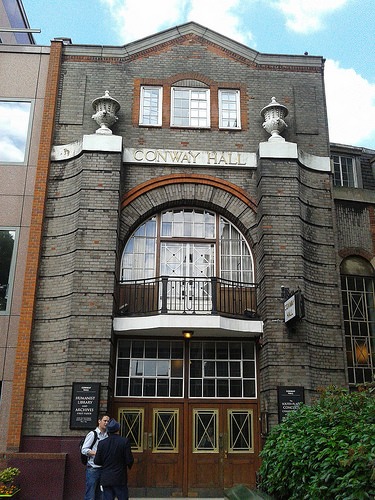
On Saturday I attended the Boring Conference, held at Conway Hall near Holborn. This was the fourth such conference, although the previous ones had been numbered 1 to 3 while this one has been given the appellation IV – a move to Roman numerals (as was explained to us at the beginning of the conference by founder James Ward). The conference aims to celebrate the mundane and the everyday, finding fascination in supposedly dull and boring things.
James Ward (@iamjamesward) gave the first presentation of the day, looking at highlights from the 1990s Saturday night ITV show You Bet!. I had never heard of this show, but I have clearly been missing out. Participants attempted bizarre challenges which included identifying cast members of The Bill by only their ears or noses, and balancing an egg between an engine and a carriage. One particularly bizarre stunt showed a couple of boys identifying their friends by looking at their belly buttons.
Continuing the media theme, Martin White (@martylog) spoke about film titles translated into German. These hilariously literal interpretations of English language humour included such gems as “A Magical Nanny in a Further Adventure” (Nanny McPhee and the Big Bang), “Unbelievable adventures in a crazy aeroplane” (Airplane!), “The City Neurotic” (Annie Hall) and, perhaps best of all, “The Annoying Man” (The Cable Guy).
Valerie Jamieson (@valeriejamieson), former particle physicist and current features editor at New Scientist, talked about ‘boringology’, or the “science of boring”. She spoke about the science of watching grass grow and seeing paint dry, as well as the accuracy of the phrase “as dull as ditchwater”. Her talk proved very interesting: we learned that grass grows from the root up, that ditchwater is actually full of life, and that most of the action in drying paint happens during the first twenty minutes.
Next up was the Wolverhampton-based dentist Toby Dignum (@dignut), speaking on the subject of calendars. He talked about how the ancients measured the calendar, how Caesar introduced leap years, and how Pope Gregory rejigged the calendar again in 1582, ‘resetting’ it after centuries in which the few minutes left over each year gradually added up moving the calendar out of its original place. I’ve always been slightly confused about the Julian and Gregorian calendars, so it was good to finally have this cleared up. Another fascinating fact I learned was that the Best Before date on a packet of crisps is always a Saturday.
Another of my favourite talks came from Ali Coote (@alisouthsea), based in Southsea, who shared her memories of working in an ice cream van. The trials and tribulations of the job proved very interesting, and I enjoyed her clear enthusiasm about ice cream, including the right way to make a 99!
Martin Zaltz Austwick (@martinaustwick), a lecturer at UCL, spoke on the unusual topic of eggs. Eggs are very versatile and the science behind them is really quite exciting. Martin mentioned the #eggchat topic he started on Twitter, to encompass facts about eggs and recipes involving them, and the resulting Twitterstorm involving angry vegans!
Before lunch, there was time for one more presentation, this time from George Egg (@georgeegg) – an interesting egg-theme seemed to be developing – who gave a talk on the meals you can make using the equipment provided in hotel bedrooms. From toasting pitta bread in the trouser press, to boiling pasta in the kettle and frying eggs on irons, there is little limit to what you can make. I am not sure how thrilled hotel staff would be, though, to go into a room and find an eggy iron!
After lunch (super-cheap salads from Waitrose… score) it was time for the afternoon presentations. The PM session kicked off in fine style with Rhodri Marsden (@rhodri) demonstrating the similarities between 198 of the world’s national anthems. The crucial fact I took away is that many, many of them have the same three chords at the end.
Next, Francesco Tacchini (@RuffNuff), Julinka Ebhardt and William Yates-Johnson from the Royal College of Art showed us their Space Relay project: “a hovering object that explores and manipulates transitional public spaces with particular acoustic properties”. To be honest I wasn’t all that excited about this at first, but I actually really enjoyed the presentation: it was interesting to see the public’s reaction to the sphere, and the different references it suggested, including The Prisoner.
As a librarian, I was looking forward to Andrew Male’s (@AndrewMaleMojo) session on Eric Clapton’s bookshelf; the actual talk was very different to what I had expected, yet very entertaining in its own way. Male developed a bizarre obsession with Clapton’s bookshelf after seeing it in a number of documentaries. He identified the books that Clapton had and tried to work out what they said about Clapton himself, in a very funny talk.
Ben Target (@bentarget), with French accent and a packet of cream crackers, delivered a presentation supposedly about his family while continually stuffing crackers into his mouth. To be honest I didn’t really ‘get’ this one. It wasn’t particularly funny or interesting – I know this is the ‘boring’ conference but I don’t think this kind of ‘boring’ is the kind that was meant!
Emerald Paston (@emeraldpaston), an assistant producer, talked about a list she made as a child, ambitiously consisting of “every boy’s and every girl’s name ever”. In total her list encompassed 523 girls’ names and 572 boys’ names – an impressive count! What I liked about this list was what it revealed about the psyche of a child/young teenager: the names ranged from Noddy and names taken from Harry Potter to the names of Greek gods.
Another of my favourite presentations came from John Grindrod (@Grindrod), author of Concretopia: A Journey Around the Rebuilding of Postwar Britain, who revealed “the secret modernist agenda hidden in Ladybird books”. This was very funny and some of the images shown were brilliant: “a cross between Swallows and Amazons and North By Northwest”, as he said. Ladybird books included pictures of high-rise flats and prefab schools, as well as airports, roads, and a disturbing number of nuclear power stations.
Marc Isaacs could not make it to the conference so his award-winning documentary was shown instead. Lift, made in 2001, was filmed in the elevator of a tower block in the East End of London. It captured the lives of those who live in the tower block, and was by turns funny, touching and illuminating.
A discussion of inkjet printers from the 1990s followed, facilitated by Mark Dean Quinn (@markdeanquinn). He had a seriously impressive knowledge of these printers and got into conversation with another printer enthusiast in the front row.
Nathaniel Metcalfe (@natmetcalfe) talked about being a fan of the actor Deep Roy. His was a touching talk describing how he maintained a fan site for the actor for years, until his popularity shot up after he starred in Charlie and the Chocolate Factory.
The penultimate presentation was delivered by Helen Zaltzman (@helenzaltzman), who gave a very funny talk on the sociological lessons which can be learned from cookbooks of the 1950s and 60s. This was hilarious and I couldn’t help thinking that it was no wonder everyone was thin in the 50s – the food was too disgusting to eat!
Finally, and perhaps most impressively, Vincent Connare (@VincentConnare), an American typographer, spoke to us about his most famous creation, Comic Sans. Comic Sans is the font we all love to hate, but Connare’s talk on how it came about was very interesting, and I was intrigued to learn that it was inspired by the Watchmen comic.
I really enjoyed the day: despite the name, it was a really interesting conference. I learned a lot and if I can, I would like to go back next year, to Boring 5, or V…