
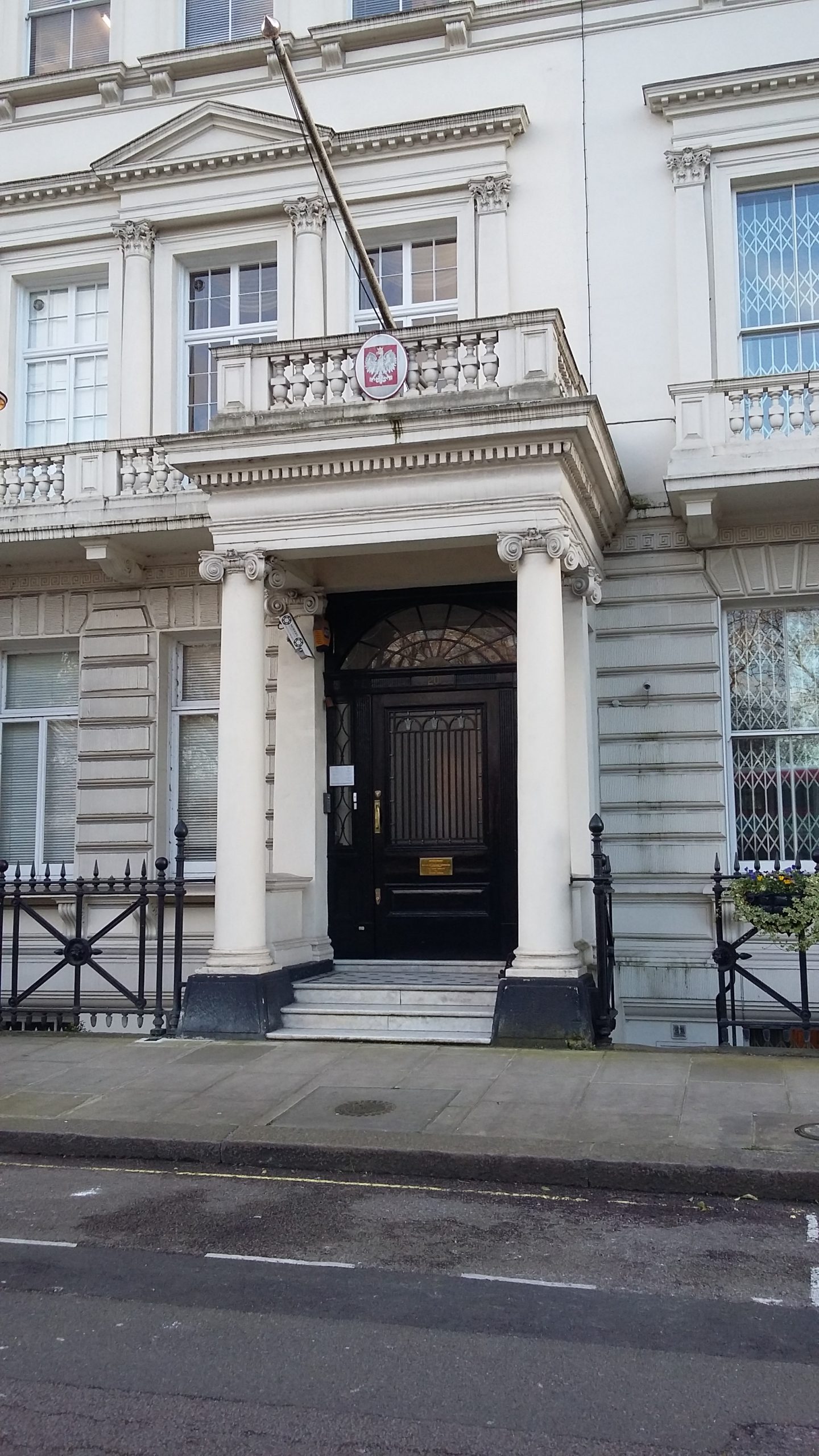
The Polish Institute and Sikorski Museum is usually open only on weekdays, but it is also open to the public on the first Saturday of every month. I turned up – having caught the bus to the Royal Albert Hall just down the road – and immediately hit a snag as no one was answering the bell. Luckily, another couple arrived shortly after me and had the bright idea of ringing the museum. So finally we were let in.
The museum is much bigger than I had expected. It encompasses numerous rooms over three floors; there is also an archive in the basement, and the Institute operates as a publisher, printing works of interest in Polish history. Many of the artefacts and displays relate to the Second World War, but others hark back to older Polish history, such as the bust of Jan Sobeski, a king who helped liberate Vienna in 1683. Most of the labels are, naturally enough, in Polish, but a few are in English.
What made the visit especially interesting was the guide, who started explaining a few of the exhibits to a group of English-speaking visitors and ended up taking us around the whole museum – I was there about two hours.
The Institute was set up in May 1945, following the end of the Second World War. With the imposition of a Soviet Communist government in Poland, many of the Polish nationals who had been living and fighting in Britain and elsewhere realised they would not be able to return. They turned their attention to the preservation of artefacts and records from this era and earlier, and these found a home in the Institute, which was named after General Wladyslaw Sikorski, Polish Prime Minister during the period of the war. During the later period of Communist rule in Poland, the Institute functioned as a hub for cultural and educational pursuits, and even after the collapse of Soviet rule, the Institute has continued to function as an independent institution.
One section of the Institute, the Sikorski Collection, is focused on the life, papers, documents and belongings of General Sikorski. A large proportion of the Institute’s acquisitions comprises the Military Collection, mainly focusing on World War II but also featuring artefacts from earlier periods in history. One significant item is a flag, quickly sewn together and raised above the ruins of Monte Cassino when Polish soldiers took the monastery in May 1944. Another is the Anglo-Polish Military Agreement, dated 5 August 1940 and signed by Prime Ministers General Sikorski and Winston Churchill as well as their respective foreign ministers. Aside from these two key collections, there are also a number of artworks, sculptures and miniatures.
FACTS
Address: 20 Prince’s Gate, London, SW7 1PT
Website: pism.co.uk
Opening Hours: Tuesday-Friday 2-4pm, first Saturday of the month 10:30am-4pm
Price: Free