
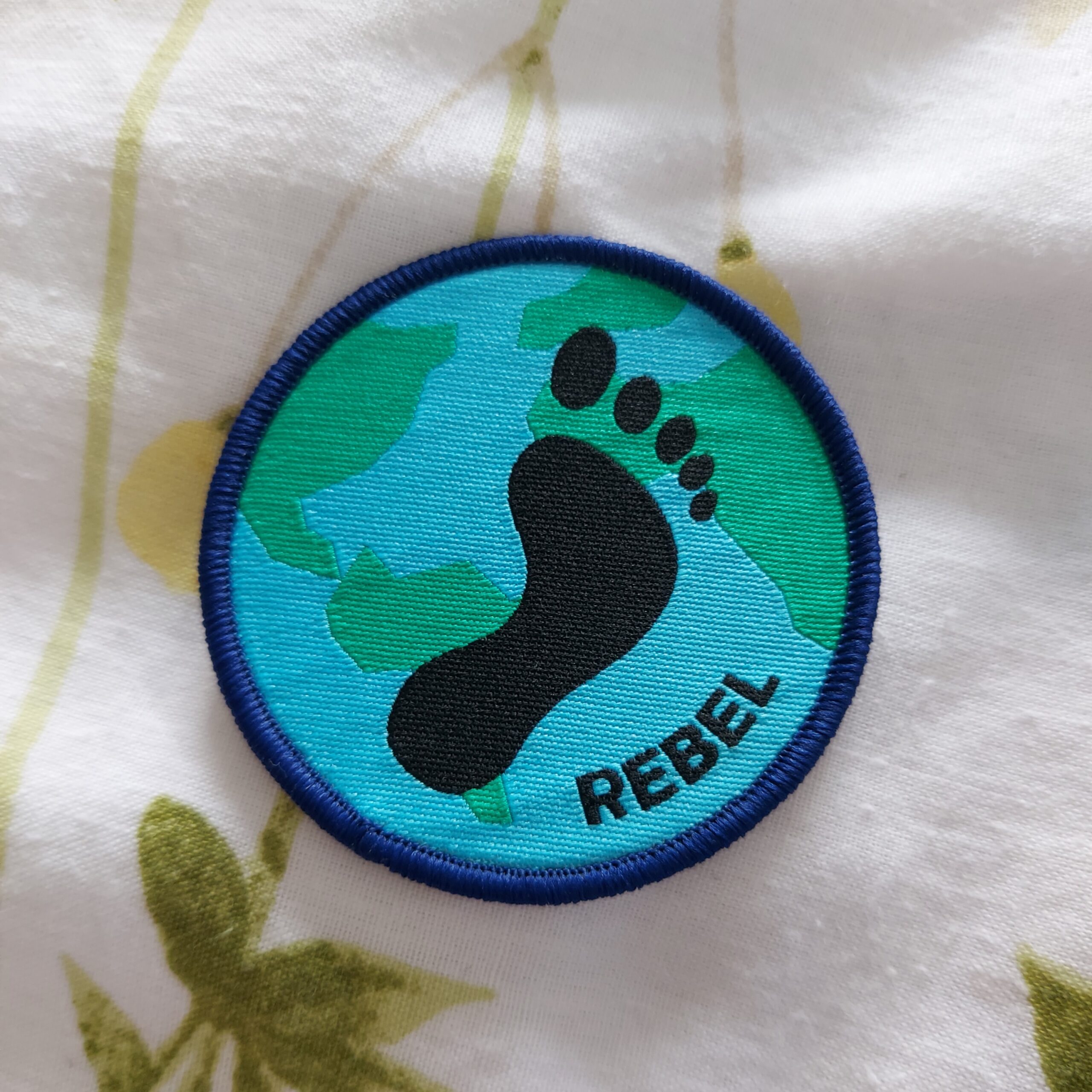
June’s monthly badge is Carbon Footprint, and requires Rebels to learn about the origins of the concept and then either look at individual ways of reducing one’s footprint, or look at the wider community impact. I’ve chosen to do the latter, mainly because there’s a limit to what I can do as an individual – I already produce fairly little waste, use public transport, don’t eat meat, and live in a shared house so can’t change bill suppliers.
Learn about the origins of the Carbon Footprint concept, and how and why it was brought into public usage.
The term carbon footprint was first used in a BBC vegetarian food magazine in 1999, deriving from the broader concept of an environmental footprint which had been around since 1979. It was popularised in 2005 when fossil fuel company BP hired an advertising company to promote the idea of a carbon footprint for individuals.
These origins are disappointing, but not really surprising, and makes me glad I have chosen to look at the wider community impact, as I do think there is too much emphasis on individual responsibility.
COMMUNITY IMPACT
Research the impact of clean air zones in cities.
Cities with clean air zones include Bath, Birmingham, Bradford, Bristol, Portsmouth, Sheffield and Tyneside (Newcastle and Gateshead). Not to mention, of course, London which has its own ULEZ (Ultra Low Emission Zone).
In London, “concentrations of air pollution have declined across London due to the ULEZ, but remain above the safe limits set by the World Health Organization.” The linked article suggests that the ULEZ is having a positive impact.
Research some of the natural alternatives to trees for reducing carbon dioxide levels.
Restoration and maintenance of peatlands can help create carbon sinks, as well as agricultural soils more generally. Biochar (a charcoal-like biomass by-product) also helps enhance carbon held in soil.
In the ocean, carbon-storing habitats include: kelp forests, salt marshes, seagrass beds, cold-water coral reefs, flame shell and mussel beds, and maerl.
Find out the difference between carbon-offsetting and carbon zero.
Carbon offsetting or carbon neutral means that any CO2 released into the atmosphere from a company’s activities is balanced by an equivalent amount being removed.
Carbon zero or net zero mean that an activity releases net zero carbon emissions into the atmosphere.
This article explores the differences further.
Research new technology to reduce the amount of carbon in the atmosphere.
Many such technologies exist and are being developed, though they are not without controversy. More research is needed to see how well they work.
Technologies include carbon-based concrete, carbon-eating crops, carbon-sequestering fertiliser and trapping carbon in rock. The section on Reversing existing damage in this article discusses them in more depth.