
I did Geography A level so this badge was a really nice refresher of several topics I used to know something about. I tried to pick a range of clauses across the different geographical areas and covered a variety of parts of the world.
Understand the difference between physical, human and environmental geography.
- Human geography is the study of societies, cultures and economies.
- Physical geography is the study of landscapes and environments.
- Environmental geography is the study of how humans impact the Earth.
Understand the water cycle.
The water cycle is the process by which water is transferred between the surface of the earth and the atmosphere.
Evaporation/transpiration/sublimation
Water at the surface of the earth (e.g. in oceans) is heated by the sun, turns to liquid or gas and becomes water vapour, rising into the atmosphere. At the same time, plants and trees release water vapour from their leaves into the atmosphere via transpiration. Ice can change straight into water vapour by a process called sublimation.
Condensation
As air rises and cools in the atmosphere, often forming clouds, the water vapour is forced to condense from a gas into liquid water droplets.
Precipitation
Within clouds, liquid water droplets often merge together over time. At some point, they may get large enough to fall from the sky, resulting in hail, rain, sleet or snow.
Once the water reaches the surface, it may flow into bodies of water (e.g. rivers), soak slowly into the soil (eventually reaching a river), collect on ice caps or glaciers or soak into plant or tree roots. The cycle then begins again.
With the help of the UCAR website I drew a diagram of the different cloud types.
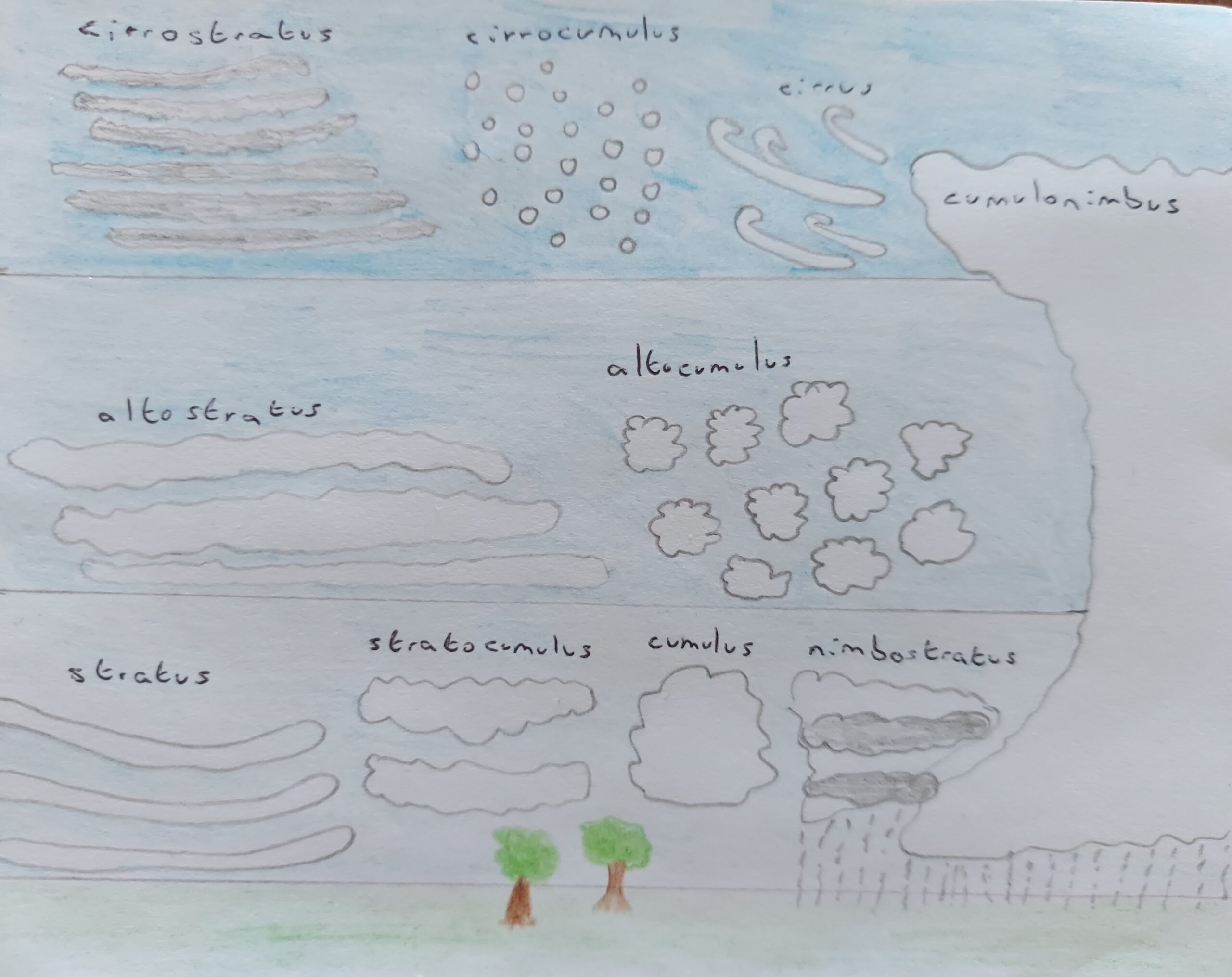
Cloud cover is measured in oktas, or eighths. This involves visually assessing how much of the sky is covered by clouds, ranging from 0 oktas (no clouds) to 8 oktas (full cloud cover).
The Met Office often uses terminology to describe how cloudy it is: for instance, scattered cloud usually means 3 or 4 oktas, broken cloud is 5 to 7 oktas, and overcast is 8 oktas.
Learn about the three different types of rock.
Sedimentary rock forms when particles accumulate in layers. These particles are often former living organisms. The pressure of the layers eventually squeezes them together to form solid rock.
Metamorphic rock forms when existing rocks are changed by heat, pressure or reactive fluids (but not melted). These rocks can be igneous, sedimentary or even metamorphic.
Igneous rock forms when magma or lava cools and solidifies.
I made models of the different kinds of rock using chocolate shavings, but there are no photos as I ate the evidence!
I also completed an OpenLearn course on An introduction to geology.
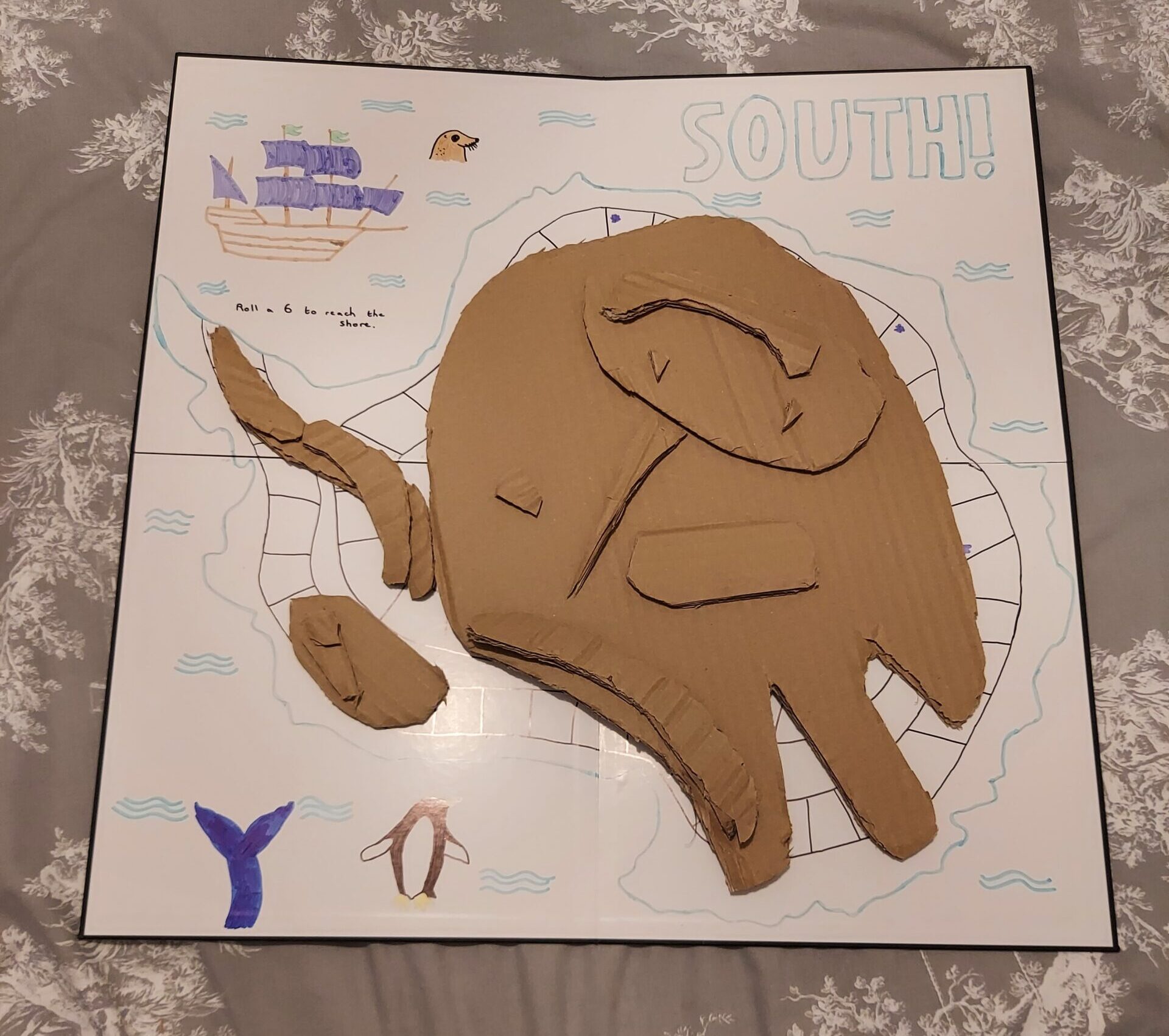
Make a 3D representation of a 2D map.
Inspired by the release of a new map of the landscape beneath the ice of Antarctica, I made a 3D representation.
Pick a continent and find out how the boundaries, languages spoken, and names of countries have changed over time.
I decided to learn about Asia, and found a brilliant YouTube video exploring the history of this continent over time.
Choose a continent you are not totally familiar with. Learn the names and capitals of all the countries or states, and be able to identify them from location and shape.
I chose Africa and used this map to help me.
What are the characteristics of a rainforest?
- Tropical rainforests have distinct characteristics which support biodiversity. They have a consistent climate with a hot and humid atmosphere, and an average temperature of 28°C. They are very wet, with over 2,000 mm of rainfall per year.
- Soils are not very fertile, although there is a thin fertile layer on the surface where the dead leaves decompose, red in colour and rich in iron. The high rainfall means that nutrients are quickly washed out of the soil.
- There is a wide range of plant species supporting many different animals, birds and insects.
Rainforests can be found in the tropical climate region, near the equator. Regions include central America, central Africa and south-east Asia.
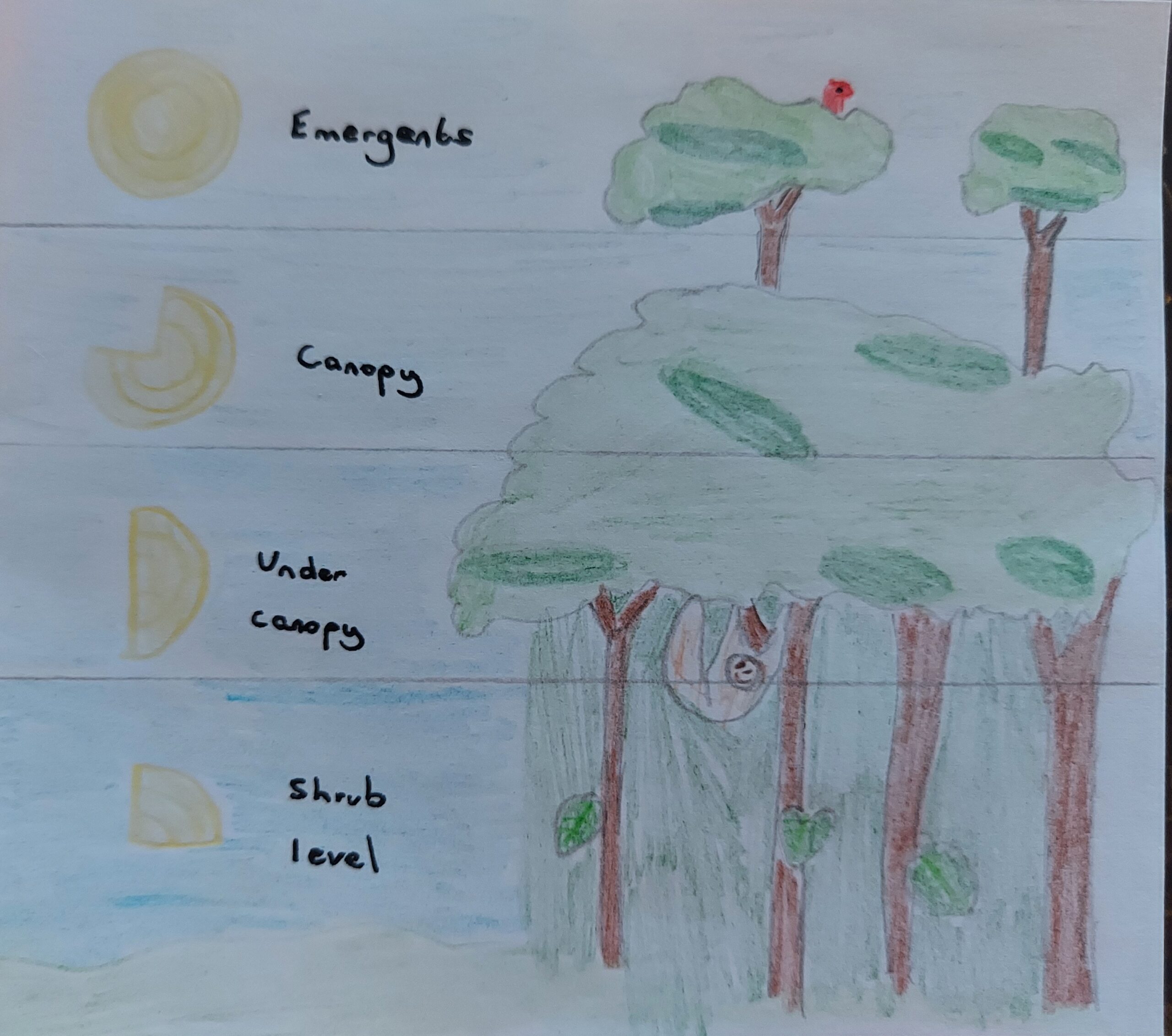
I drew a diagram of the different rainforest layers. The emergent layer has the tallest trees in the forest. They are supported by buttress roots so that they don’t blow over. The canopy is a bit more sheltered, has fruit all year round, and is home to most wildlife including insects, tree snakes, birds and mammals such as howler monkeys, jaguars and sloths. The under canopy is shady and cooler, and seedlings lie dormant here until plants and trees die, leaving a space for them to grow. Lianas (vines) take root in the ground and climb up trees to reach sunlight. The shrub layer is dark, and is covered with dead and decaying roots and leaves (humus); it is prone to flooding during torrential rainfall.
Deforestation is the removal of trees and forests. It is done for purposes of farming, logging, mining and road creation, as well as clearing land for population growth and the creation of hydroelectric power stations. Deforestation results in soil erosion, loss of biodiversity and climate change but often also results in economic development.
Understand the evidence for and against climate change. What are the natural and human causes of climate change?
It is pretty clear that climate change is happening. The Royal Society has a very useful page on how it works.
Natural causes include:
- Orbital changes – the Earth has natural warming and cooling periods caused by variations in the tilt and orbit of the Earth around the Sun.
- Volcanic activity – during a volcanic eruption carbon dioxide is released into the atmosphere.
- Solar output – there can be fluctuations in the amount of radiation from the Sun. A high amount results in an increase in Earth’s temperatures.
Human causes include:
- Burning fossil fuels, eg coal, gas and oil – these release carbon dioxide into the atmosphere.
- Deforestation – trees absorb carbon dioxide during photosynthesis. If they are cut down, there will be higher amounts of carbon dioxide in the atmosphere.
- Dumping waste in landfill – when the waste decomposes it produces methane.
- Agriculture – agricultural practices lead to the release of nitrogen oxides into the atmosphere.
What is the UN, and how is it working to protect the planet?
The United Nations is an intergovernmental organisation that aims to maintain international peace and security, develop friendly relations among states, promote international cooperation, and serve as a centre for coordinating global action.
The UN holds a Climate Change Conference each year in order for world leaders to meet and assess progress on climate change goals. The Paris Agreement was set out in 2015 at COP21. It is a legally-binding international treaty and 195 parties (194 states plus the EU) have joined. The Agreement set goals for all nations to reduce greenhouse gas emissions, periodically assess collective progress and finance developing countries to help them mitigate and adapt.
Choose a country you do not live in. Evaluate the positive and negative impacts of tourism on that country.
While not strictly a country, Antarctica has experienced growing tourism in recent years and it’s a topic I’m very interested in, particularly as I would love to visit myself. It does seem as though the negative impacts can outweigh the positive, although many can be mitigated by following all the rules in place to protect the continent. The positive impacts should not be overlooked, however.
Positive Impacts
- Tourists become ambassadors for Antarctica – able to speak up in favour of protecting the continent. Why should anyone care about a place no one knows about or visits?
- As Antarctic tourists are more likely to be wealthier, better-educated and influential, they are more likely to be receptive to the message of conservation.
Negative Impacts
- Oil spills from ships and boats are a continual risk.
- Erosion or disturbance of fragile environments from many tourists exploring the same small areas.
- Spreading diseases from pathogens carried on footwear.
- Impact on breeding birds if the presence of numerous people causes them anxiety.
- Invasive species brought in as cargo, or on food or clothes.
Learn about natural disasters.
I completed a course on FutureLearn called Extreme Geological Events, which covered earthquakes, volcanoes, floods and tsunamis, the countries affected by them, and mitigating measures.
Date completed: 31 May
One thought on “Rebel Badge Club: Geographer”