
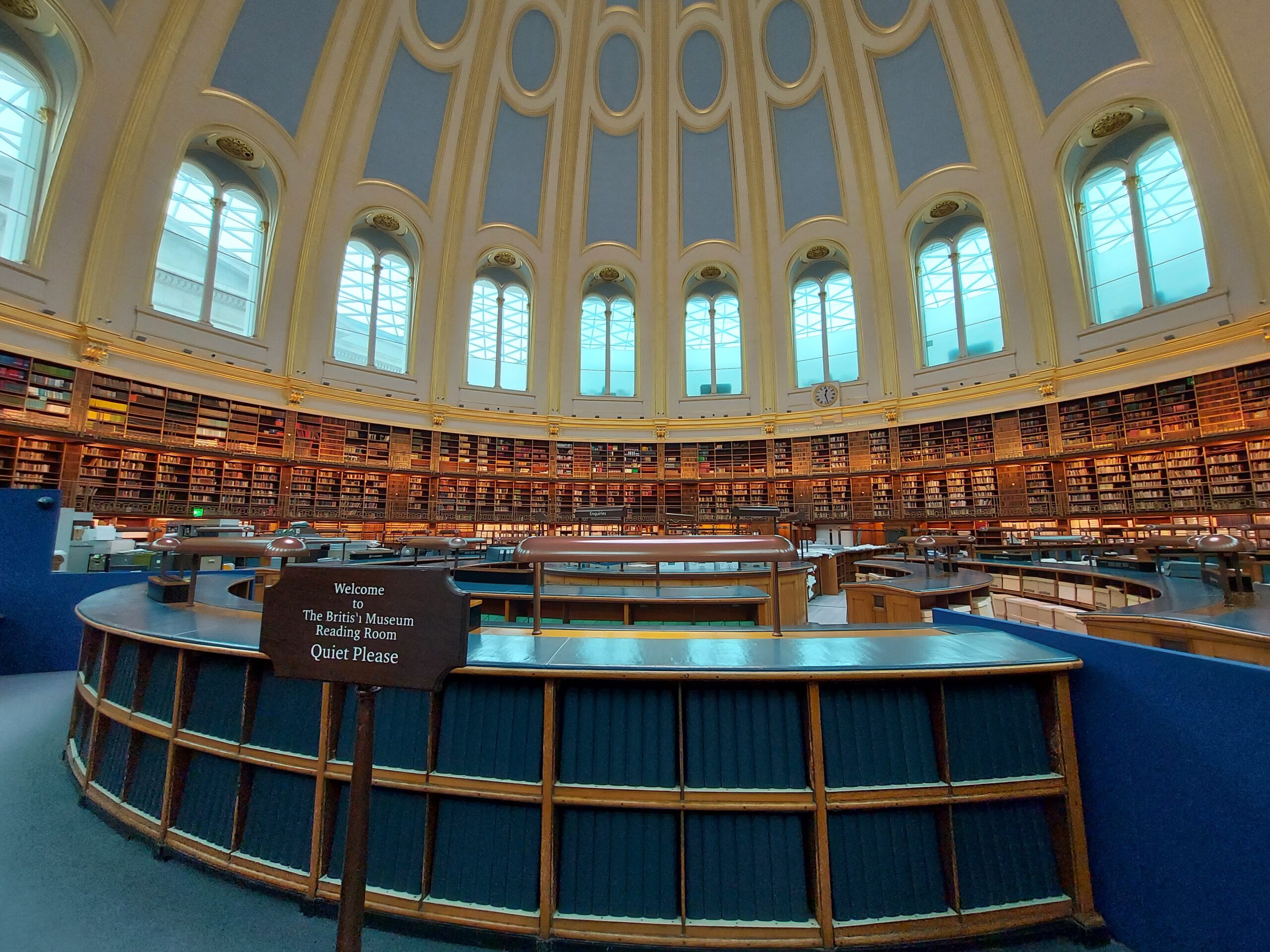
After Rebel Summer Camp I took an extra day off and went along to the British Museum. Recently, tours of the famous Reading Room have been made available at 11 and 12 on Tuesdays. Accessed via the Great Court, the Reading Room has a rich history.
The tour explored the history of the Room, how it evolved over decades, and some of the famous people who studied there. The British Museum itself opened in the 1820s but by the 1850s it could be seen that the Library needed a larger reading room and more storage for books. The Principal Librarian Antonio Panizzi suggested building a round room, surrounded by shelving, in the then-empty courtyard. The architect, Sydney Smirke, created a pioneering design with a concrete floor, modern heating and ventilation systems, and a domed ceiling supported by cast iron. After opening in 1857, over 62,000 people came to visit the new Reading Room in the first ten days.
In the beginning, the space supported a maximum of 302 readers, with 2 of the 38 long tables reserved for women. The room had underground heating, leather chairs and over 40km of shelving. To consult a book, a patron would examine the General Catalogue of Printed Books in the centre of the room, fill out a request form, and wait for around an hour. In 1979, the Reading Room became one of the first public places in London to have electric lighting, having previously relied on natural light and gas lanterns, which meant that it was impossible to work in the darkness of winter or when London was enveloped by fog, which was frequently. Some of the notables who made use of the Reading Room include Karl Marx, Lenin, Sylvia Pankhurst, Oscar Wilde, Gandhi and Beatrix Potter.
In 1997 the British Library, which had formally detached from the British Museum in 1973, moved to a purpose-built building near St Pancras. The Reading Room was open to visitors between 2000 and 2007, and for the following decade hosted a number of special exhibitions. It was then closed to the public once again, until 2023 when these tours resumed. I’m glad I got a chance to see this historic Reading Room and I hope visitors can continue to access it in the future.