On the first Saturday of the New Year I went to the British Museum with my friend to see the exhibition Troy: Myth and Reality. The exhibition looks at the myths surrounding Troy and the Trojan War before exploring the evidence for the real existence of Troy and how the legend has been interpreted over the centuries.The first object on display is a magnificent urn painting, dating from approximately 530BC. It shows Achilles at the instant he kills Penthesilea, leader of the Amazons: a dramatic moment showcasing the violence of the Trojan War. Homer’s Iliad and Odyssey, as well as Virgil’s Aeneid, tell stories of characters such as Achilles both real and mythical, and are hugely well known in the Western world and beyond.
Most people know the basics of the myth: Trojan prince Paris runs off with Helen, wife of Menelaus, king of the Spartans. But was she abducted or did she go willingly? Whas she as beautiful as legend suggests – “the face that launched a thousand ships” – or was she simply an excuse for the Greeks to declare war? The contemporary and near-contemporary artefacts in the exhibition offer a variety of perspectives and interpretations.One aspect I found fascinating was the gallery exploring the discovery of Troy as a real place:
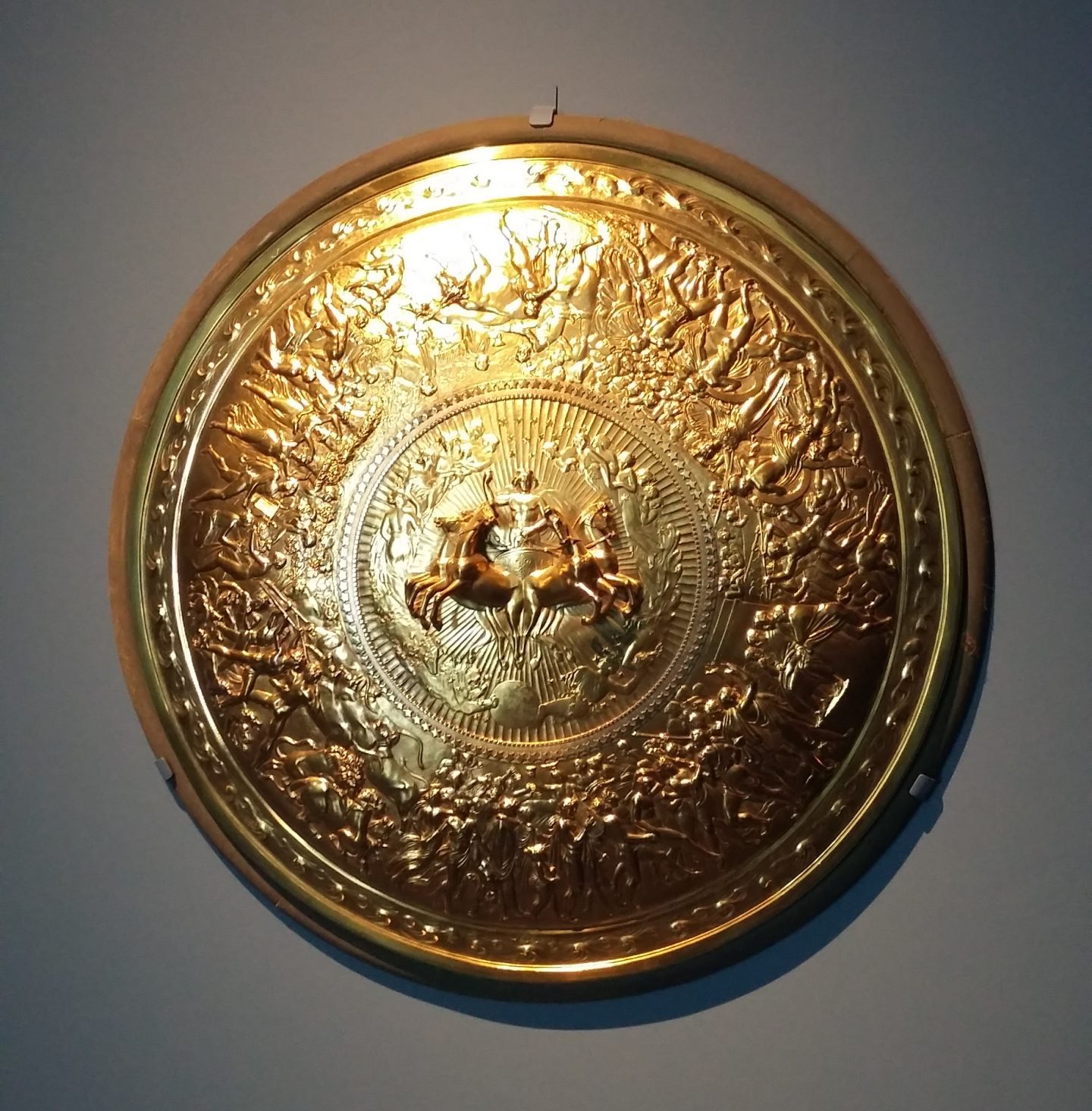
Homer’s Iliad references the northern Turkish city of Ilium, and for many years Troy was thought to be at a place called Bounarbashi. In the nineteenth century the focus changed to Hisarlik. Many objects excavated during this period are displayed here. The second half of the exhibition focuses on differing interpretations of the Trojan War over the centuries, and it’s fascinating to see how these changed over time. It ends with a 19th-century interpretation of Achilles’ shield, symbolising how the myth has inspired artists and creators for years and years.