In the Bargehouse near the Oxo Tower, The Arts Catalyst embarked on a rather odd project called the Republic of the Moon. It incorporated lunar-based works from a number of artists and was designed to explore our relationship with the Moon.
This was an odd experience to say the least, particularly the dark and silent room created by Liliane Lijn who plans to project the word SHE onto the surface of the Moon. Moon Vehicle was an interesting project based in India, where students designed their own lunar vehicles.
I really liked Leonid Tishkov’s Private Moon, which was a series of beautiful images showing him and his own small Moon in various settings. My favourite work, though, was Katie Paterson‘s Earth-Moon-Earth. Paterson sent messages in Morse Code which were reflected from the surface of the Moon and then received again on Earth. Some parts of the messages were lost, absorbed by shadows or vanished into craters. One of the messages she sent was the score of Beethoven’s Moonlight Sonata – the resulting score plays on a self-playing grand piano. Listening to the result is eerie: it is recognisable as the famous sonata, but with unsettling differences.
The top prize for weirdness has to go to Agnes Meyer-Brandis and her documentary Moon Geese Analogue: Luna Bird Migration Facility. Inspired by bishop Francis Godwin’s 1638 book Man in the Moone, in which the protagonist flies to the Moon in a chariot towed by migrating ‘Moon geese’, Meyer-Brandis has raised eleven geese from birth, given them astronauts’ names (one is called Neil!) and embarked upon a training programme designed to prepare them for travel to the Moon. This was one of the strangest things I have ever seen, and the documentary was oddly compelling.
I visited a very intriguing exhibition at the Serpentine Sackler Gallery at the weekend. Jake and Dinos Chapman are artists who work in a variety of mediums, creating models, sculptures and images that comment on consumer culture, morality and past art. Their exhibition Come and See incorporates many of these, and is absolutely fascinating.
I loved the miniature scenes of carnage and war, incorporating dinosaurs, skeletons, Hitler and Ronald McDonald. The detail of these models was incredible.
Hitler with balloonsCrucified Ronald McDonaldCreepy figures and a spaceshipSkeletons and burnt-out carsMcDonalds characters on a boat
The exhibition also had some rather frightening sculptures, like this one of a familiar figure.
Terrifying!
The Chapmans also create paintings and other images. Some of them, painted over pages from books, reminded me of Guillermo del Toro’s films.
Others were inspired by the craze for portraiture among the upper classes of several hundred years ago, and comment on the futile quest for immortality these people sought.
Some of the other items in the exhibition included cute little figures and even dinosaurs, like these ones below.
Sadly the exhibition has now finished, but I will certainly be looking out for more of the Chapmans’ work in the future.
The Serpentine Sackler Gallery opened in 2013. It is located in a former 1805 gunpowder store, divided from the original Serpentine Gallery by the Serpentine Bridge, with an extension by Zaha Hadid. Both galleries showcase temporary exhibitions of contemporary art.
I headed to the Barbican Art Gallery for the first time last week. I visited in order to check out the exhibition on Pop Art Design, which sounded interesting.
Pop Art flourished mainly in the mid-20th century, and grew up as a reaction to the austerity of the wartime era and the dawn of the media age. Artists like Roy Lichtenstein, Andy Warhol and others created iconic works inspired by advertising slogans and incorporating bright and bold colours and designs. I don’t know if Pop Art is really ‘me’, but I found the exhibition interesting nevertheless.
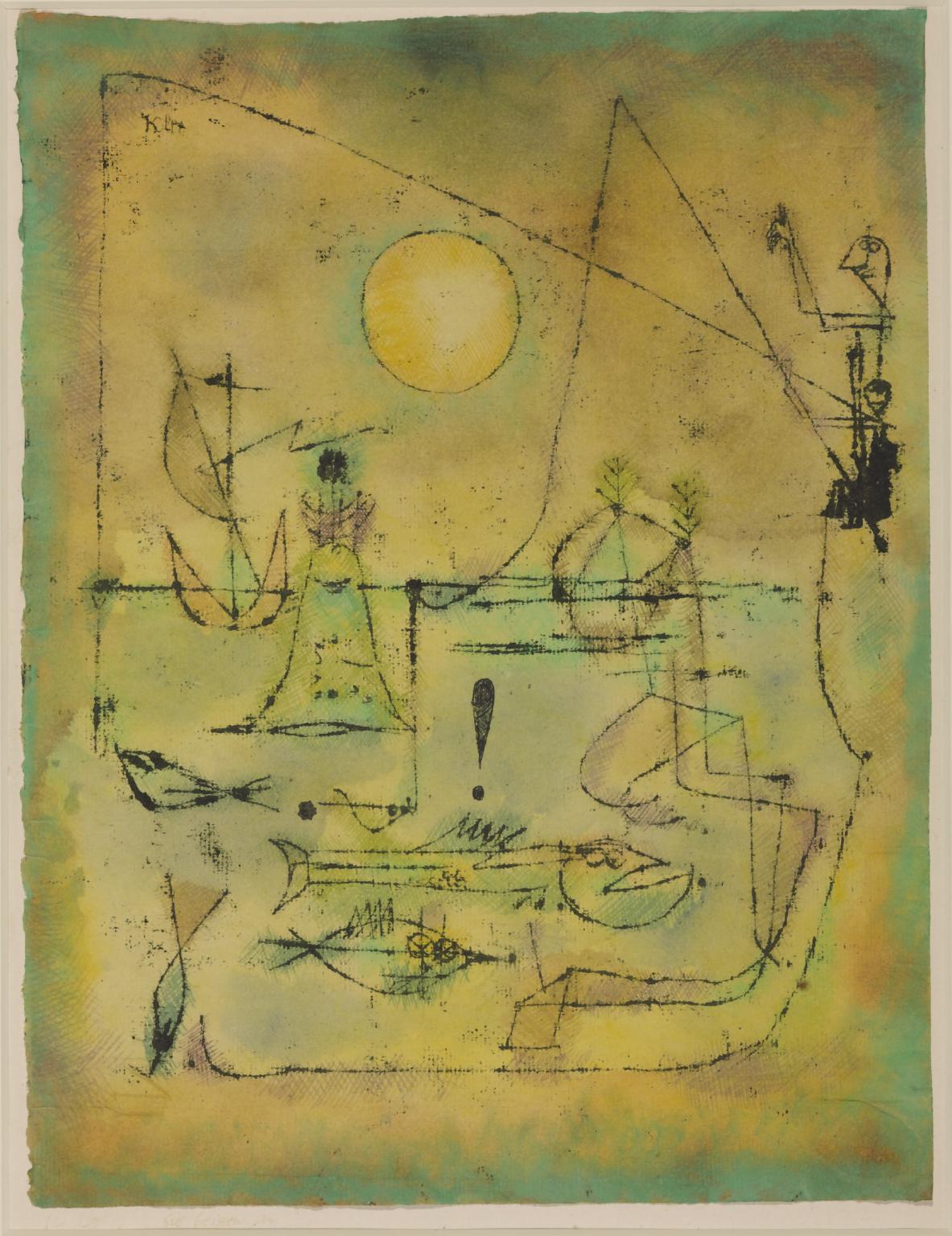
The EY exhibition at the Tate Modern is Paul Klee: Making Visible, until the 9th of March. I didn’t know a great deal about the artist, so took a chance and headed down to Bankside to check the exhibition out.
Klee is an important figure of 20th century art. His breakthrough came during the First World War, following which he taught at the Bauhaus before moving to Düsseldorf and subsequently being dismissed from his teaching position by the Nazis, who labelled his works ‘degenerate’. Though I’m not a particular fan of twentieth-century art, anything labelled negatively by the Nazis gains merit in my eyes!
Paul Klee, They’re Biting, 1920 (Tate Modern)
Most of Klee’s works are very small; this came as a surprise to me as for some reason I always imagine modern works of art to be huge. I saw a lot of them as ‘cute’ – this might sound like an odd thing to say about art, but many of the works were warm, attractive, with a sense of humour – something drew me into them and made me interested. I particularly liked the fish pictures, and the related ‘They’re Biting’. I loved the way his later works seemed to comment on Nazism and contemporary culture, and his late works – such as ‘Walpurgis Night’ and images of witches – had a distinctly darker tone. Despite my initial misgivings, I really enjoyed the exhibition and admired the variety in Klee’s work.
Somerset House, the magnificent 18th century building on the banks of the Thames, is home to a variety of art exhibitions and other interesting facilities. I paid a visit to check out some of the exhibitions they had going on.
I began in the Terrace Rooms in the South Wing, with Stanley Spencer: Heaven in a Hell of War. Spencer experienced the First World War and painted from his experience, both as a hospital orderly in Bristol and as a soldier on the Salonika front. This exhibition displays canvas panels on loan from the National Trust’s Sandham Memorial Chapel, as well as a projection of the altarpiece which was too fragile to remove. The Chapel was designed specifically for the panels, and was built by Spencer’s friends, John Louis and Mary Behrend. Here, they have been arranged in a way that echoes their original layout, and gives a good impression of how they look within the Chapel.
The paintings took six years to complete, and were finally finished in 1932. Unusually for images of war, they represent the domestic side of wartime life – scrubbing floors, washing clothes, making tea and inspecting kit. Spencer wanted to show how these ordinary chores became miraculous in the face of wartime danger – creating “a heaven in a hell of war”. It’s an intriguing idea, and I like it – seeking something positive in the face of such horror is a kind of defiance.
Next I ventured into the intriguingly-named Lightwells & Deadhouse, reached via the South Wing and taking me below the Somerset House courtyard, to explore Julian Stair: Quietus – The Vessel, Death and the Human Body. This unusual exhibition was made up of ceramic works in the form of coffins, jars and funerary urns. The strangest exhibit was a white urn containing the ashes of Stair’s uncle, shown alongside video and audio snippets from his life.
Finally, I went to the Courtauld Gallery to see the exhibition The Young Dürer: Drawing the Figure. This was an interesting take on the artist’s journeyman years, when he honed and developed his style.
I never did get to see the Spice Girls live, and they were my favourite band once upon a time so this saddens me. Most of them aren’t even making music any more, but Melanie C (‘Sporty Spice’) has had a steady solo career since leaving the band, which in recent years has even encompassed musical theatre – she had excellent reviews for her role as Mrs Johnson in Blood Brothers and has recently been touring as Mary Magdalene in Jesus Christ Superstar.
In a move that made me feel very old indeed, Mel announced on Twitter that she was about to turn forty and was hosting a one-off concert at Shepherd’s Bush Empire to celebrate. I thought it might be fun to see Mel sing live, so I went ahead and bought a ticket. Just as well I bought it when I did, as the concert was sold out.
I wasn’t sure what I would think of the concert: I know of Mel’s early solo stuff (Northern Star, I Turn To You) and I have her most recent album The Sea, but I hadn’t paid much attention to her solo career in between. I needn’t have worried, though: I knew most of the songs she sang, and even the ones I didn’t know were catchy enough for me to like them instantly.
Mel sang with several guests during the night, including Ben Forster and Chris Moyles from the recent Jesus Christ Superstar production, and collaborators such as Adam Argyle. The biggest surprise came when she sang Pure Shores with Natalie Appleton – given the big rivalry between the Spice Girls and All Saints back in the day, this is something I never thought I’d see. Right at the end, Emma Bunton, who’d been watching the show from the circle all night (and waving to fans below) came on stage to sing 2 Become 1 with Mel. Maybe I never got to see the Spice Girls, but at least I got to see the next best thing!
Setlist
Think About It
Stupid Game
Weak
Northern Star (featuring Andy Burrows)
Burn
Loving You (featuring Ben Foster)
Be The One (acoustic)
Don’t Let Me Go (featuring Adam Argyle)
Four to the Floor (featuring James Walsh)
One By One (featuring James Walsh)
Only Girl (In The World)
You’ll Get Yours (with Peter Vetesse)
Drown
Ga Ga
Beautiful Intentions
Never Be The Same Again
When You’re Gone (featuring Chris Moyles)
Goin’ Down
Next Best Superstar
Enemy
Pure Shores (featuring Natalie Appleton)
I Turn To You
2 Become 1 (featuring Emma Bunton)
I loved the show and it has inspired me to buy Mel’s other albums. Another awesome thing about the show was the chocolate cake we all got at the end, handed out by aproned staff as we left the venue!
Ever since I moved to London at the beginning of 2011, I have been trying to complete a project which involved visiting every single Underground station. More specifically, I wanted to visit every station on the Underground map, which included the DLR, the Overground network and the cable car as well as the Tube itself. On Friday 29 November, I finally completed my challenge.
I went to Northfields station, on the Piccadilly line, last and celebrated with friends in a local pub. I felt so happy to have finally completed my challenge, but now I need a new one for 2014. Someone suggested bus stops, but I don’t think that is a particularly good idea…
Back in August, I went up to Scotland for a week on the Caledonian Sleeper train. I didn’t want to go for a standard class cabin as they are for two people and I didn’t want to stay with a stranger. So I decided to compromise – on the way up I went for the super frugal option and sat in the normal carriage (which wasn’t as bad as it sounds) while on the way back I splashed out on first class!
Caledonian Sleeper at EustonReady to get into the carriage
It’s a shame the Caledonian Sleeper goes from Euston, as it’s possibly the ugliest station in London. Still, this didn’t stop me from being excited. I didn’t sleep very well on the way up, but I didn’t mind as watching the sun rise over the Highlands was amazing. I could hardly believe that I’d gone to sleep in crowded London and woken up surrounded by hills and deer.
The train got into Inverness at eight o’clock in the morning which gave me a whole day before I had to go and check in to my B&B. I left my luggage in the station lockers and decided to go on a Loch Ness cruise. This was fun but it was windy out on the loch – I’m definitely glad I took a coat! As part of the trip we also had a look around Urquhart Castle and the Loch Ness Centre, which was a kind of multimedia exhibition looking at the story of Nessie. This was surprisingly well done and fairly balanced, looking at all the possible explanations for ‘Nessie sightings’ in an interesting way. Needless to say I didn’t spot Nessie myself!
Loch NessNessieBoat trip on Loch NessUrquhart CastleExploring the castle
Later that day I visited Culloden, which is a short bus journey out of Inverness. It’s essentially just a field, but the visitor centre is excellent. It has an exhibition which is presented on two sides of the corridor, looking at events from the English and the Scottish points of view. There is also a room where you can stand and be surrounded by a filmed re-enactment of the battle, as if you were really there – this was rather frightening!
Culloden Visitor CentreCullodenLooking around CullodenExploringLooking around
I walked through Inverness to reach my B&B. It’s a relatively small town and I liked it a lot. Some bits were slightly run-down but there was a Victorian market and some attractive buildings, and down by the river it was really nice. I also took the chance to go to the theatre while I was there. I found out that there was a National Theatre of Scotland/RSC co-production called Dunsinane, a sequel to Macbeth, being performed that week at the Eden Court Theatre in Inverness. I enjoyed it even though it took some liberties with the original – such as Lady Macbeth turning up alive and well.
I was hampered during my stay by not having a car. I could have explored much more of the surrounding area if I’d been able to drive around and stop at will. However I managed to see a lot via the train! I had a day trip to Aberdeen, which was very… grey. The Maritime Museum was fairly interesting and I had a look around the Tolbooth and the art gallery.
Aberdeen Maritime MuseumTolbooth MuseumBeer cocktail in BrewdogAnother cocktail – well, I was on holiday!Aberdeen Art Gallery
Back in Inverness, I went to the Gellions pub where William McGonagall once recited his poetry.
The Gellions PubPlaque commemorating the momentous event
I went on a day trip to the Orkney Islands. This was amazing! It involved an incredibly early start and a long coach journey but it was worth it.
At John O’GroatsLooking out to sea from John O’Groats
We visited the capital of the Orkney, Kirkwall.
St Magnus CathedralKirkwall Harbour
I got to see the prehistoric village of Skara Brae, which was just incredible. It has been really well preserved and though you can’t walk through it (or it wouldn’t be well preserved any more) they have made a replica that you CAN walk through so you can picture how it all used to look.
Skara BraeSkaill House
Also on the tour I visited the Ring of Brodgar, which is a stone circle a bit like Stonehenge, though the setting is much more atmospheric, I think. It reminded me of Diana Gabaldon’s ‘Outlander’ books, in which the heroine goes through a stone circle in Scotland and ends up in the middle of the Jacobite rising – I could almost imagine I could travel back in time with the stones myself!
Ring of Brodgar
As the coach went past some of the lagoons which lie between the islands, I could see rusty skeletons of old ships poking out of the water.
Ghostly WW1 ships
Our guide told us that they were old WWI ships that had been decommissioned and brought here during WWII in order to create a barrier preventing German U-boats from getting through. Only, one did manage to get through and sunk a ship, killing hundreds of seamen. Apparently, years later, the widow of one of the men who died was granted her last wish on her death – to be buried with her husband. So her ashes were taken down into the sea. It’s a sweet, but very sad story.
The tour also found time to stop at the Italian chapel. This was a beautiful little Catholic church built by Italian prisoners of war during the 1940s.
Italian churchInside the church
I travelled on a lot of trains during my trip. As well as taking the train to the west coast and going on to Skye, I had a ride on the Strathspey steam railway. It stopped at the station which was used on the BBC drama Monarch of the Glen.
Aviemore StationStrathspey RailwayInside the trainBoat of Garten StationBoat of Garten Station‘Glenbogle’ aka Broomhill StationSteam trainBeautiful view of the countrysideBack at Aviemore
The same day, I also went up the Cairngorm Mountain on the furnicular railway. It was freezing on the top, but there were some spectacular views.
At the foot of Cairngorm MountainLooking aroundFurnicular railwayGetting on the railwayLovely viewStunning viewsAmazing view going down
I also went to Dundee for the day. It took about three hours on the train, but I was dying to go for two reasons. Firstly, because it was the hometown of William McGonagall. I saw the Tay Bridge (Mark 2) with my own eyes – it was so long and the river so wide that it really brought home just how terrifying it must have been for the passengers who died when it collapsed.
The second reason was to visit Discovery Point, where Captain Scott’s Antarctic exploration ship RSS Discovery is kept. I’m really interested in Antarctica and especially the ‘heroic age’ of exploration. I loved the museum – the ship itself has been sympathetically restored and the exhibitions inside the building have been really well thought out.
Penguins at Discovery PointDiscovery PointRRS DiscoveryAntarctica mosaicRather creepy videoOn deck
You can’t go to Scotland without visiting a whisky distillery. I chose to visit Glen Moray, mainly because it was the only one I could reach via train.
Plaque on the wallVats of grainMash TunInside the distillerySurrounded by whisky barrelsSampling some whiskyThe whisky I tried
I came back with a lot of alcohol, particularly beer.
I didn’t mean to buy so much, honest…
I had a great time on the way back in my first class cabin – sadly grey and modern rather than the wood-panelled warmth I always associate in my mind with sleeper trains – but it was great having my breakfast brought to me in the morning!
Relaxing with some wineYummy breakfast
I didn’t get a chance to go to Glasgow or Fort William, or travel on the famous West Highland Line, but I may be going back next year with my mam. I hope so – I had a brilliant time and I’d love to see some more of Scotland.
I have my friend Elisa to thank for persuading me back to Amsterdam. She’d never been; I had spent a few days there when I was a student, having travelled over on the ferry from North Shields. Perhaps I still wouldn’t have gone back if it hadn’t been for the reopening of the Rijksmuseum – Amsterdam’s national art museum that had just undergone a ten-year refurbishment.
Church in Amsterdam
Unlike last time, I was to travel to Amsterdam by plane; I came up to Newcastle on the train the day before. Elisa picked me up at an unearthly hour the next morning; we drove to Newcastle Airport, parked the car in Car Park K (“K for Kardashian”) and began the tedious process of checking in, leaving our bags and navigating the maze that is the airport. I couldn’t decide whether I was horrified or impressed at the number of hen parties already dressed in matching pink T-shirts and accessories.
View from the hotel window
Though we felt pretty tired, we did recognise the advantages of getting such an early flight. Even after we’d landed, got the train to the city centre, taken the tram to our hotel and then packed, we still had most of the day left. The first stop was the aforementioned Rijksmuseum – I’d said that I would only go to Amsterdam if we could go here!
RijksmuseumInside the RijksmuseumGoing to see the classical paintingsSculpture roomRijksmuseum Library
I was impressed by the building: it was huge, and stunning. There was a bit of a queue to get in, but once inside, there was lots of space and a huge amount to see. The great attraction is Rembrandt’s ‘Night Watch’ but there are lots of other paintings from the likes of Vermeer and Van Gogh. There is also a modern art section, which I found rather bizarre, particularly the ‘womb tomb’, a brightly-coloured, coffin shaped, fluffy object with a hole in the middle.
Rembrandt’s ‘The Night Watch’The ‘Womb Tomb’Nineteenth-century costumesBeautiful cabinetGorgeous cabinet for booksPainting of a windmill (unfortunately I can’t recall the artist)
I got separated from Elisa and ended up wandering around the ground floor – which had the medieval art and the costumes – on my own. When I got back to the foyer she’d been sitting in the café with a glass of wine, having given up on the museum some time ago.
The Heineken ExperienceVintage Heineken posterInside the museum
We still had plenty of time, so we decided to head to the Heineken Experience. Now, this was not somewhere I would have thought of going; I’m not the biggest fan of Heineken, and it would never have occurred to me to go here. Elisa wanted to, though, and I’m so glad she did, because I loved it! There was so much to see and do. The experience began with a short exhibition on the history of Heineken, followed by a look at the old brewing equipment and a look at the creation process. We got to taste some Heineken and then experience a kind of interactive presentation where you could ‘be’ the beer on its journey from creation to bottling!
Inside the old breweryPretending I’m a DJA nice bike ride by the canal!
The best bit, though, was when – slightly tipsy by now – we reached the interactive part of the experience. We got our photo taken on some Dutch bikes against a background of an Amsterdam street, and sang along to a music video showing us on a canal boat – which I promptly emailed to my mam!
On the canal trip
We then had a free canal boat ride up to the Heineken Brand Store. Obviously this is all just a big ploy to get people to buy Heineken products, but it was fun nevertheless! We had a great day altogether, actually. It ended with drinks and Chinese food and frozen yoghurt covered in lots of amazing toppings.
Church near the Anne Frank House
The next day, we had planned to go to the Anne Frank House. Elisa set the alarm on her phone, but unfortunately hadn’t realised that it was still on UK time. So by the time we got up and went out, we were an hour later than we should have been.
Looking down the canalCute little car
Still, it was such a lovely morning that we took our time getting to the museum, having a slow walk along the canal with bagels. When we got to the museum there was a massive queue, as expected, but although we had to wait an hour, it didn’t seem that long. The museum is small, but as moving as I remembered.
Sex Museum
Later we visited the Sex Museum. Again, this was somewhere I had already been, although it was just as entertaining this time around. The moving flasher in the foyer was still there, and I recognised several of the exhibits. This museum also has one of the fanciest bathrooms I have ever seen – it is inspired by Mucha and the Art Nouveau movement and the sinks are shaped like flowers. Afterwards we went on a canal boat trip which was really relaxing. We went for a walk in the evening, had some tea, and then went back to the frozen yoghurt store – naturally.
Amsterdam from the waterMain square in AmsterdamI came across the hotel we stayed in last time I was in Amsterdam – and the New York Pizza beside it that was turned into a breakfast room in the morning!
We didn’t have time to do anything the next day, as we had to go to the airport. I would definitely go back, though – even after two trips to Amsterdam, there’s so much to see and do there, and it’s such a lovely place, that I’d be happy to see it again.
I visited the Normansfield Theatre in the Langdon Down Centre a couple of weeks ago to attend a performance. I reviewed the production here, but I wanted to post something on the theatre and the building itself, as it has a history much more interesting than most.
The centre was founded as a private home and hospital/care facility by Dr. John Langdon Down, who specialised in the care of people with learning disabilities. Many had the condition which now bears the Doctor’s name – Down’s syndrome. Langdon Down’s approach was radical for the time, with his emphasis on education and sympathetic care.
The theatre itself is utterly stunning. It’s rare to find such a beautiful surviving example of a private Victorian theatre; completed in 1879, it was built as an entertainment venue by Langdon Down as somewhere for his patients and students to explore drama and music. The performance I attended was a music hall-style revue telling the story of Langdon Down and one of his patients, James Henry Pullen, whose incredible creative ability is still evident in the ‘Giant of Earlswood’ which is still on display in the Centre, and the stunningly detailed ships he constructed from wood, on display in the museum.
Normansfield Theatre – proscenium archNormansfield Theatre – side wallNormansfield Theatre – ceilingNormansfield Theatre – back of the theatreThe Giant of Earlswood