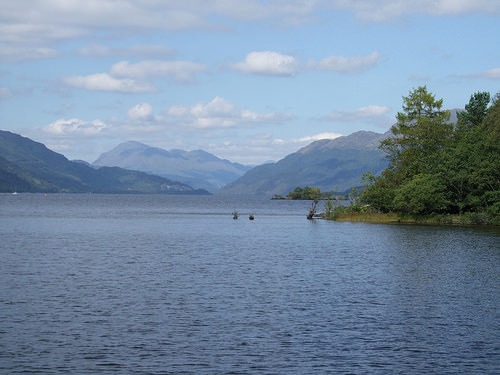
Today we went on a trip to Loch Lomond, taking a boat trip into the middle of the Loch and spending some time in Luss, a small village on its banks. My mam absolutely loved it, and it was certainly a stunningly beautiful place. Luss itself was small, but we enjoyed looking around the graveyard (yes, another one) belonging to the local church: it had graves dating from the 6th and 7th centuries, including Viking burials.
Loch LomondLussChurchTea and whisky cake
We were both exhausted once we got back in the evening, so we went for a pub meal with some wine before going back and going to bed!
Our original plan was to spend our first full day in Glasgow on the sightseeing bus. However, by the time we’d had breakfast and made it to the bus stop, there was a huge queue and we decided just to walk to the Cathedral, which was Stop 2 on the bus route anyway.
Glasgow CathedralGates leading into the courtyardThe Bridge of Sighs
The first thing we did was to explore the Necropolis. Opened in 1833, this huge graveyard on the top of a hill overlooking the city was inspired by the Père Lachaise Cemetery in Paris, and was designed to provide a burial solution for the quickly growing population of Glasgow. It is reached via a “Bridge of Sighs” and it is stunning. My mam and I both loved it.
Looking at the Cathedral from the Necropolis
Afterwards we paused to take a look around the Cathedral, including the lower level where St Mungo is supposed to be buried. By this time we were completely exhausted so we stopped for a cup of tea at the St Mungo Museum next door.
Inside the Cathedral
On our way out Mam noticed an old-looking house called Provand’s Lordship across the road. We decided to go in, which proved a good decision. Entry to this house is free, and it is the oldest building in Glasgow, with a great deal of history.
Provand’s Lordship
We walked back into town and went to Buchanan Street to visit the Willow Tea Rooms. These are a reconstruction of the original Willow Tea Rooms designed by Charles Rennie Mackintosh. They consist of the White Tea Room and the Chinese, or Blue, Room, where we were seated. Our tea was yummy but we had to go for a lie down afterwards!
Willow Tea RoomsInside the Chinese RoomInside the Chinese Room
Our yummy afternoon tea
In the evening we visited Glasgow’s Theatre Royal to see a play called April in Paris. We both enjoyed it – I wrote a review here. Afterwards we went for a drink before heading back to the hotel.
I enjoyed my trip to Inverness last year so much that I decided to go back to Scotland this year. This time, however, I decided to go to Glasgow, as I’d never really explored the western part of Scotland. My mam came too, and we decided to travel up separately – me from London, she from Newcastle – and meet at the Travelodge.
Ruari the Reindeer on the train!
I had a ridiculously early train from King’s Cross, and I had to change at Edinburgh, but my journey was mostly uneventful. At Glasgow, I got a bit lost on the way to the Travelodge, but I managed to find it eventually.
Queen Street Station
After we’d unpacked, we went for a walk around Glasgow to try and get our bearings. It reminded me a bit of Newcastle, with streets laid out in an orderly fashion. We had tea in Wetherspoon’s and then went for a drink. We didn’t stay out long, though, as we wanted to get a good night’s sleep the better to enjoy the following day!
Back in August, I went up to Scotland for a week on the Caledonian Sleeper train. I didn’t want to go for a standard class cabin as they are for two people and I didn’t want to stay with a stranger. So I decided to compromise – on the way up I went for the super frugal option and sat in the normal carriage (which wasn’t as bad as it sounds) while on the way back I splashed out on first class!
Caledonian Sleeper at EustonReady to get into the carriage
It’s a shame the Caledonian Sleeper goes from Euston, as it’s possibly the ugliest station in London. Still, this didn’t stop me from being excited. I didn’t sleep very well on the way up, but I didn’t mind as watching the sun rise over the Highlands was amazing. I could hardly believe that I’d gone to sleep in crowded London and woken up surrounded by hills and deer.
The train got into Inverness at eight o’clock in the morning which gave me a whole day before I had to go and check in to my B&B. I left my luggage in the station lockers and decided to go on a Loch Ness cruise. This was fun but it was windy out on the loch – I’m definitely glad I took a coat! As part of the trip we also had a look around Urquhart Castle and the Loch Ness Centre, which was a kind of multimedia exhibition looking at the story of Nessie. This was surprisingly well done and fairly balanced, looking at all the possible explanations for ‘Nessie sightings’ in an interesting way. Needless to say I didn’t spot Nessie myself!
Loch NessNessieBoat trip on Loch NessUrquhart CastleExploring the castle
Later that day I visited Culloden, which is a short bus journey out of Inverness. It’s essentially just a field, but the visitor centre is excellent. It has an exhibition which is presented on two sides of the corridor, looking at events from the English and the Scottish points of view. There is also a room where you can stand and be surrounded by a filmed re-enactment of the battle, as if you were really there – this was rather frightening!
Culloden Visitor CentreCullodenLooking around CullodenExploringLooking around
I walked through Inverness to reach my B&B. It’s a relatively small town and I liked it a lot. Some bits were slightly run-down but there was a Victorian market and some attractive buildings, and down by the river it was really nice. I also took the chance to go to the theatre while I was there. I found out that there was a National Theatre of Scotland/RSC co-production called Dunsinane, a sequel to Macbeth, being performed that week at the Eden Court Theatre in Inverness. I enjoyed it even though it took some liberties with the original – such as Lady Macbeth turning up alive and well.
I was hampered during my stay by not having a car. I could have explored much more of the surrounding area if I’d been able to drive around and stop at will. However I managed to see a lot via the train! I had a day trip to Aberdeen, which was very… grey. The Maritime Museum was fairly interesting and I had a look around the Tolbooth and the art gallery.
Aberdeen Maritime MuseumTolbooth MuseumBeer cocktail in BrewdogAnother cocktail – well, I was on holiday!Aberdeen Art Gallery
Back in Inverness, I went to the Gellions pub where William McGonagall once recited his poetry.
The Gellions PubPlaque commemorating the momentous event
I went on a day trip to the Orkney Islands. This was amazing! It involved an incredibly early start and a long coach journey but it was worth it.
At John O’GroatsLooking out to sea from John O’Groats
We visited the capital of the Orkney, Kirkwall.
St Magnus CathedralKirkwall Harbour
I got to see the prehistoric village of Skara Brae, which was just incredible. It has been really well preserved and though you can’t walk through it (or it wouldn’t be well preserved any more) they have made a replica that you CAN walk through so you can picture how it all used to look.
Skara BraeSkaill House
Also on the tour I visited the Ring of Brodgar, which is a stone circle a bit like Stonehenge, though the setting is much more atmospheric, I think. It reminded me of Diana Gabaldon’s ‘Outlander’ books, in which the heroine goes through a stone circle in Scotland and ends up in the middle of the Jacobite rising – I could almost imagine I could travel back in time with the stones myself!
Ring of Brodgar
As the coach went past some of the lagoons which lie between the islands, I could see rusty skeletons of old ships poking out of the water.
Ghostly WW1 ships
Our guide told us that they were old WWI ships that had been decommissioned and brought here during WWII in order to create a barrier preventing German U-boats from getting through. Only, one did manage to get through and sunk a ship, killing hundreds of seamen. Apparently, years later, the widow of one of the men who died was granted her last wish on her death – to be buried with her husband. So her ashes were taken down into the sea. It’s a sweet, but very sad story.
The tour also found time to stop at the Italian chapel. This was a beautiful little Catholic church built by Italian prisoners of war during the 1940s.
Italian churchInside the church
I travelled on a lot of trains during my trip. As well as taking the train to the west coast and going on to Skye, I had a ride on the Strathspey steam railway. It stopped at the station which was used on the BBC drama Monarch of the Glen.
Aviemore StationStrathspey RailwayInside the trainBoat of Garten StationBoat of Garten Station‘Glenbogle’ aka Broomhill StationSteam trainBeautiful view of the countrysideBack at Aviemore
The same day, I also went up the Cairngorm Mountain on the furnicular railway. It was freezing on the top, but there were some spectacular views.
At the foot of Cairngorm MountainLooking aroundFurnicular railwayGetting on the railwayLovely viewStunning viewsAmazing view going down
I also went to Dundee for the day. It took about three hours on the train, but I was dying to go for two reasons. Firstly, because it was the hometown of William McGonagall. I saw the Tay Bridge (Mark 2) with my own eyes – it was so long and the river so wide that it really brought home just how terrifying it must have been for the passengers who died when it collapsed.
The second reason was to visit Discovery Point, where Captain Scott’s Antarctic exploration ship RSS Discovery is kept. I’m really interested in Antarctica and especially the ‘heroic age’ of exploration. I loved the museum – the ship itself has been sympathetically restored and the exhibitions inside the building have been really well thought out.
Penguins at Discovery PointDiscovery PointRRS DiscoveryAntarctica mosaicRather creepy videoOn deck
You can’t go to Scotland without visiting a whisky distillery. I chose to visit Glen Moray, mainly because it was the only one I could reach via train.
Plaque on the wallVats of grainMash TunInside the distillerySurrounded by whisky barrelsSampling some whiskyThe whisky I tried
I came back with a lot of alcohol, particularly beer.
I didn’t mean to buy so much, honest…
I had a great time on the way back in my first class cabin – sadly grey and modern rather than the wood-panelled warmth I always associate in my mind with sleeper trains – but it was great having my breakfast brought to me in the morning!
Relaxing with some wineYummy breakfast
I didn’t get a chance to go to Glasgow or Fort William, or travel on the famous West Highland Line, but I may be going back next year with my mam. I hope so – I had a brilliant time and I’d love to see some more of Scotland.
I have my friend Elisa to thank for persuading me back to Amsterdam. She’d never been; I had spent a few days there when I was a student, having travelled over on the ferry from North Shields. Perhaps I still wouldn’t have gone back if it hadn’t been for the reopening of the Rijksmuseum – Amsterdam’s national art museum that had just undergone a ten-year refurbishment.
Church in Amsterdam
Unlike last time, I was to travel to Amsterdam by plane; I came up to Newcastle on the train the day before. Elisa picked me up at an unearthly hour the next morning; we drove to Newcastle Airport, parked the car in Car Park K (“K for Kardashian”) and began the tedious process of checking in, leaving our bags and navigating the maze that is the airport. I couldn’t decide whether I was horrified or impressed at the number of hen parties already dressed in matching pink T-shirts and accessories.
View from the hotel window
Though we felt pretty tired, we did recognise the advantages of getting such an early flight. Even after we’d landed, got the train to the city centre, taken the tram to our hotel and then packed, we still had most of the day left. The first stop was the aforementioned Rijksmuseum – I’d said that I would only go to Amsterdam if we could go here!
RijksmuseumInside the RijksmuseumGoing to see the classical paintingsSculpture roomRijksmuseum Library
I was impressed by the building: it was huge, and stunning. There was a bit of a queue to get in, but once inside, there was lots of space and a huge amount to see. The great attraction is Rembrandt’s ‘Night Watch’ but there are lots of other paintings from the likes of Vermeer and Van Gogh. There is also a modern art section, which I found rather bizarre, particularly the ‘womb tomb’, a brightly-coloured, coffin shaped, fluffy object with a hole in the middle.
Rembrandt’s ‘The Night Watch’The ‘Womb Tomb’Nineteenth-century costumesBeautiful cabinetGorgeous cabinet for booksPainting of a windmill (unfortunately I can’t recall the artist)
I got separated from Elisa and ended up wandering around the ground floor – which had the medieval art and the costumes – on my own. When I got back to the foyer she’d been sitting in the café with a glass of wine, having given up on the museum some time ago.
The Heineken ExperienceVintage Heineken posterInside the museum
We still had plenty of time, so we decided to head to the Heineken Experience. Now, this was not somewhere I would have thought of going; I’m not the biggest fan of Heineken, and it would never have occurred to me to go here. Elisa wanted to, though, and I’m so glad she did, because I loved it! There was so much to see and do. The experience began with a short exhibition on the history of Heineken, followed by a look at the old brewing equipment and a look at the creation process. We got to taste some Heineken and then experience a kind of interactive presentation where you could ‘be’ the beer on its journey from creation to bottling!
Inside the old breweryPretending I’m a DJA nice bike ride by the canal!
The best bit, though, was when – slightly tipsy by now – we reached the interactive part of the experience. We got our photo taken on some Dutch bikes against a background of an Amsterdam street, and sang along to a music video showing us on a canal boat – which I promptly emailed to my mam!
On the canal trip
We then had a free canal boat ride up to the Heineken Brand Store. Obviously this is all just a big ploy to get people to buy Heineken products, but it was fun nevertheless! We had a great day altogether, actually. It ended with drinks and Chinese food and frozen yoghurt covered in lots of amazing toppings.
Church near the Anne Frank House
The next day, we had planned to go to the Anne Frank House. Elisa set the alarm on her phone, but unfortunately hadn’t realised that it was still on UK time. So by the time we got up and went out, we were an hour later than we should have been.
Looking down the canalCute little car
Still, it was such a lovely morning that we took our time getting to the museum, having a slow walk along the canal with bagels. When we got to the museum there was a massive queue, as expected, but although we had to wait an hour, it didn’t seem that long. The museum is small, but as moving as I remembered.
Sex Museum
Later we visited the Sex Museum. Again, this was somewhere I had already been, although it was just as entertaining this time around. The moving flasher in the foyer was still there, and I recognised several of the exhibits. This museum also has one of the fanciest bathrooms I have ever seen – it is inspired by Mucha and the Art Nouveau movement and the sinks are shaped like flowers. Afterwards we went on a canal boat trip which was really relaxing. We went for a walk in the evening, had some tea, and then went back to the frozen yoghurt store – naturally.
Amsterdam from the waterMain square in AmsterdamI came across the hotel we stayed in last time I was in Amsterdam – and the New York Pizza beside it that was turned into a breakfast room in the morning!
We didn’t have time to do anything the next day, as we had to go to the airport. I would definitely go back, though – even after two trips to Amsterdam, there’s so much to see and do there, and it’s such a lovely place, that I’d be happy to see it again.
I’ve just got back from a weekend in Luxembourg. I realised I hadn’t been abroad since I went to Portugal in summer 2011, so I decided to rectify this. I also thought it would be a good time to tick London City Airport DLR station off my tube station list. City is the only airport in central London and the only one (apart from Heathrow) to be located on a tube map. After using it, I would encourage everyone to fly from City at least once. The view over central London – taking in the Thames, the O2, the London Eye and the famous bridges – is not to be missed.
Cercle Municipal
Luxembourg is the world’s only Grand Duchy. It is a tiny little state bordered by Belgium, Germany and France. The inhabitants speak Luxembourgish (yes, that is a real language), French and German and there are several temporary and permanent immigrants contributing other languages and cultures to the place – a real melting-pot.
St Michael’s Church
Friday
The flight from City took an hour and twenty minutes. It left at eight so I had to get up ridiculously early in the morning – I actually caught the first Tube train of the day out of Ealing Broadway, which made me feel oddly thrilled. I was surprised at how many people were actually around at that time of the morning. Luxembourg is an hour ahead of the UK, so by the time I arrived and caught the bus into the centre of town it was getting on for eleven – which still left me with practically a full day ahead of me.
One thing I wasn’t prepared for was the temperature. It is mid-March after all, and I had assumed that the weather would have been vaguely spring like. This was not the case. It was colder than in Britain (although the temperature did improve over the next couple of days), and there was snow on the ground, though it didn’t actually snow while I was there.
I walked into the centre and picked up a Luxembourg Card from the tourist information office. This card is amazing and I recommend it to anyone who visits. For 27 Euros (for three days; one-day and two-day cards are cheaper) you get unlimited travel on public transport, plus free admission to most of the museums in the country, and discounts on the rest. I used mine constantly and, with the exception of the 2 Euros I paid to take the bus from the airport, didn’t spend another penny on sightseeing or transport throughout my trip.
This first day, I spent some time wandering around town and getting a feel for the place. There seemed to be a lot of scaffolding, so I suspect they are jazzing the place up in preparation for the summer. The Old Town – which is UNESCO-listed – reminded me of Bruge, although I didn’t think it was quite as nice.
Looking towards the Bock Casemates
The first thing I did was visit the Bock Casemates, down towards the eastern edge of the Old Town. These are fortifications built into the rock several hundred years ago which were designed for defence at a time when the castle on the hill was chosen for its suitability in this respect. I found them interesting to explore but got rather spooked at some points and had to make a hasty exit – or would have, if I hadn’t had trouble finding it.
After a quick stop off for a Panini and a cup of coffee, I headed to the Musée National d’Histoire et d’Art (National Museum of History and Art). This huge museum was well laid-out and fascinating, with five floors below telling the story of Luxembourg from prehistoric times to the present day, and five above, displaying the fine art collection and temporary exhibitions. There was an English guide available for the information boards on the lower floors, which came in handy, and I particularly liked the impressive Roman mosaic on display.
Roman mosaic at the National Museum of History and Art
Unfortunately the medieval galleries were closed, but I enjoyed the others, including an in-depth prehistoric section with details of archaeological discoveries. The fine art collection was wide-ranging and varied: there were even a couple of Turner watercolours there, as well as a sculpture by Rodin and an artwork by Picasso. One temporary exhibition was about Japanese art of the eighteenth and nineteenth centuries, and was fascinating, and the other was concerned with the Dutch landscape painter Barend Cornelis Koekkoek.
After my visit I walked through the town and came across an amazing café that I just had to go into. You choose a flavour of chocolate, select a block with a wooden spoon embedded into it, and dip it into a cup of hot milk. They should definitely get something like that over here. I had chilli chocolate flavour and it was delicious.
Afterwards I headed towards the station and checked into my hotel. Once I’d unpacked and had a rest, I headed out to find something to eat. I managed to find a nice Italian restaurant, not too busy but not to quiet either, and with other solo diners, so I didn’t feel too self-conscious. I am afraid I took the easy option and went for the mushroom pizza – as much as I would like to sample the local cuisine, I understand that Luxembourgish specialities tend to include meat, so they’re off the menu for me.
Whenever I go abroad, I always like to check out the supermarkets to find out what the locals like to eat. I love looking at all the weird and wonderful foods that are so like, and yet so unlike, the stuff you get in the UK. I saw one lady carrying a Dr Oetker frozen pizza with what looked like salmon on top – it looked lovely and I am disappointed you can’t get that variety here!
Luxembourgish wine
I always make a point of trying some local alcohol and chocolate. At least, I try – I don’t think the chocolate I managed to find was from Luxembourg, but I’d never seen it before, so I thought it would do. The wine was local, though.
Tasty chocolate
Not wanting to hang out in a bar full of drunken individuals, I sat in my room with a book, some chocolate and wine, and had a perfectly lovely evening.
Saturday
Stained glass window inside the railway station
The following day, I dragged myself down to breakfast and demolished some rolls with chocolate spread and jam. I also had some waffles, but since the toaster didn’t work these weren’t as nice as they might have been! Sufficiently full-up, I wandered over to the rather impressive station. I had plans to go to Vianden for the day, and knew that I had to catch the train to Ettelbruck and then a bus to the town of Vianden.
It took me some time to decipher all the signs, but eventually I got myself on the right train and enjoyed a relaxing journey to Ettelbruck. I didn’t have to wait too long for the bus when I got there – it was a relatively short journey to my destination.
Vianden
Vianden is gorgeous. It is a small compact village full of quaint little houses, with a river flowing through the centre and a curved bridge crossing it. Above it all, the castle overlooks the town high on a hill. I decided to visit the castle first, in order to get the climb out of the way. This was a good decision, as it was exhausting, and I don’t know if I’d have been able to manage it later!
Castle Vianden
Looking over the castle didn’t take ages, as there were few information boards or other things to see, but it was definitely worth it. The castle was apparently sold by its nineteenth-century owner and dismantled, leaving it in a state of disrepair not rectified until the twentieth century when it was rebuilt. It still looks pretty good, considering. The place is just how I would have imagined a fairytale castle to be, with round towers and a stunning hillside location.
Victor Hugo’s House
After a crepe vegetarienne in a local café I popped into the Victor Hugo Museum for a quick look around. The great writer stayed in the town on several occasions, and some of the letters he wrote here are on display. His study has been recreated in the room facing the castle. Unfortunately the displays were all in French so I couldn’t understand them, but it was still exciting just to be in a place connected with the man.
Museum of Military History
I caught the bus back to the town of Diekirch, which my guidebook said was full of museums. The major attraction was the Museum of Military History, covering the Battle of the Ardennes (better known perhaps as the Battle of the Bulge) of 1944-45. I knew my mam, who is really interested in the war, would have been fascinated by the museum. I had a good look round, but the place went into a lot of depth (it is used by military historians as well as the general public) and I skimmed a lot of it. The personal testimonies and modelled recreations of real-life scenes (taken from photographs) were moving and really brought home what life would have been like during the battle.
Crypt underneath Diekirch church
I popped into the town’s own museum too, but the boards were in French and German so I couldn’t actually understand anything. However, the museum is next to the church and you can actually get into the crypt via the museum, which I thought was quite exciting. I then visited a bizarre museum, home to a selection of classic cars and a selection of Diekirch beer glasses. I had planned to sample a beer in the little café, but there seemed to be some sort of event on, with lots of people arranged in chairs and sandwiches wrapped in cling film, so I made a hasty exit.
Though there was no castle, there were several quaint little streets and I grew to quite like Diekirch. Apparently the town’s mascot is a donkey, which explains the fun statue which lets you move the limbs of the donkeys into whichever position you choose.
One of the rather sweet donkeys
I had planned to eat in the Old Town when I returned to Luxembourg City, but I couldn’t find anywhere that was both quiet and cheap. On the way back to my hotel I stopped at a decent-looking place and had – you’ve guessed it – another mushroom pizza. Well, it was either that or a cheese omelette.
My evening passed much as the previous one did, with wine and chocolate and books. I had debated trying to get tickets to a concert or a theatre performance, but I couldn’t decipher the leaflets, and thought it would probably be really expensive anyway.
Sunday
The next day – my last – it was raining. I walked through the Old Town for the last time, taking in the view, and visited the Musée d’Histoire de la Ville de Luxembourg (Luxembourg History Museum). This has been cleverly built within a number of buildings from different periods of the city’s history, with stone from the old defences forming part of the basement. I loved the video installation exploring the landscape and nature of the city. I could have sat looking at it for hours.
Luxembourg History Museum
After a couple of floors exploring the city’s past, the museum began to look at different themes relating to Luxembourg, including its role in industry, within Europe and the natural world. Finally, the temporary exhibition was ‘The ABC of Luxembourg’ – exploring the national identity of the Grand Duchy through an irreverent and entertaining alphabet. I thoroughly enjoyed this excellent museum and I’m glad I made the effort to look for it, tucked away on a back street.
Musée Dräi Eechelen
I debated whether to catch the bus, but I ended up walking to the next museum, which I’d passed en route to the centre from the airport. The Musée Dräi Eechelen tells the story of this fort overlooking the city, with armour, swords and a frightening-looking guillotine all displayed. I popped into the MUDAM (Museum of Modern Art) next door, too, but the exhibitions were in the process of changing over. The building itself was very impressive, though.
I could have caught the bus back into the centre, but frankly I couldn’t be bothered, so I just went straight to the airport. I spent a couple of hours there recharging and writing up my holiday diary (which I keep religiously every time I go abroad) before going through security and spending far too much on chocolate and liqueur to bring back with me.