Jewellery brand of the month: Rosa Pietsch

After a brief December hiatus, my ‘Jewellery brand of the month’ posts are back. When I was trying to decide on a brand to showcase in January, I couldn’t believe I hadn’t already looked at:

ROSA PIETSCH

With a background in womenswear, textiles and accessories, Rosa Pietsch started making and selling her own jewellery in 2012. Her designs, inspired by vintage prints and contemporary shapes, are unique, unlike anything else in the world of acrylic jewellery. Amazingly, I only own one of her pieces, but there are several more on my wishlist, some of which I have mentioned below.

This Large Floral Pendant Necklace is beautiful.

floral pendant
Large Floral Pendant Necklace

The Engraved Arc Necklace offers understated glamour, and is available in several different colours.

engraved arc
Engraved Arc Necklace

This Crescent Moon / Full Moon Necklace is gorgeously dramatic.

moon necklace
Crescent Moon/Full Moon Necklace

I love the Art Nouveau-inspired Nouveau Flower Pendant.

nouveau pendant
Nouveau Flower Pendant

Finally, this Star Flower Statement Necklace is simply stunning.

star flower statement necklace
Star Flower Statement Necklace

Find Rosa Pietsch via the following links:

Website: rosapietsch.com

Etsy: etsy.com/uk/shop/RosaPietsch

Instagram: instagram.com/rosapietsch

Twitter: twitter.com/rosapietsch

Facebook: facebook.com/RosaPietschDesigns

Jewellery brand of the month: Smile and Make

My jewellery brand for November is a relatively new UK-based brand:

SMILE AND MAKE

Based in Newcastle-under-Lyme, the brand’s designer, Lucy, has created some absolutely stunning designs recently. They proved so popular that I wasn’t in time to get hold of any, but hopefully I will be able to get hold of some in the future!

Just to note that there aren’t any direct links to the pieces below, because they’ve all either sold out or are not yet available. I recommend following Smile and Make on Instagram to be alerted when pieces will become available on Etsy.

Christmas Flowers Necklace
Make A Wish Brooch
Make A Wish Brooch
Jovie Brooch
Jovie Brooch
London Bus Brooch
London Fireworks Necklace

Find Smile and Make via the following links:

Etsy: etsy.com/uk/shop/SmileandMake

Instagram: instagram.com/smileandmake

Jewellery brand of the month: Oh So Flamingo

My jewellery brand for October is the UK-based

OH SO FLAMINGO

So far, my only purchase from this brand has been the special poppy brooch made to commemorate the 100th anniversary of the end of World War I. All profits are donated to the Royal British Legion. I purchased the small brooch, the picture below shows the large.

Lone Soldier Poppy Appeal Brooch

What first drew me to the brand was a cute cupcake brooch I spied.

Cupcake O'Clock Brooch
Cupcake O’Clock Brooch

I also love the range of Hollywood-inspired brooches: this one was inspired by Elizabeth Taylor.

Lizzy Brooch
Lizzy Brooch

This squirrel brooch is super cute.

Squeaks the Squirrel Brooch

The brand doesn’t only produce brooches: I adore this rose necklace.

A Rose By Any Other Name Necklace

Oh So Flamingo can be found at:

Website: ohsoflamingoshop.co.uk

Etsy: etsy.com/uk/shop/OhSoFlamingo

Facebook: facebook.com/ohsoflamingo

Instagram: instagram.com/oh_so_flamingo

Carnation Collectables (UK-based stockist): carnationcollectables.com/oh-so-flamingo

Jewellery brand of the month: The Storybook Rabbit

As it’s nearly Easter, I thought it would be appropriate to pick a brand that focuses on that well-known Easter symbol, bunnies. This month’s jewellery brand, therefore, is:

THE STORYBOOK RABBIT

The brand is the creation of Kelly White, who is based in Sydney, Australia. Her designs mostly involve animals, are incredibly cute.

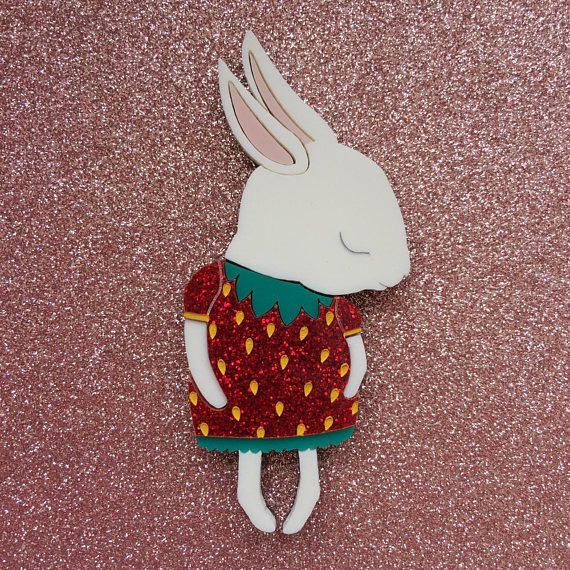
‘Shy bunnies’ are some of the best-known brooches in the Storybook Rabbit range. I particularly like this little Red Strawberry Bunny.

Red Strawberry Bunny

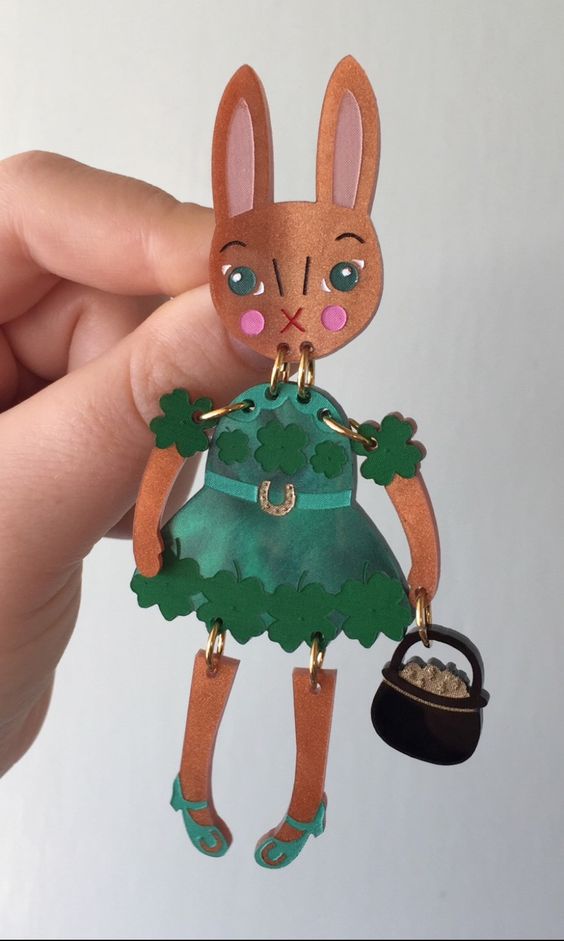
Articulated bunnies made from different acrylic pieces are also prevalent. St Patrick’s Day has just passed, but I think this Lucky Clover Bunny Buddy would be an adorable brooch for that occasion.

Lucky Clover Bunny Buddy

This Lop Rosette Bunny is made with white pearl acrylic, but he is available in lots of different colours, and matching rose brooches are available too.

Lop Rosette Bunny
Lop Rosette Bunny

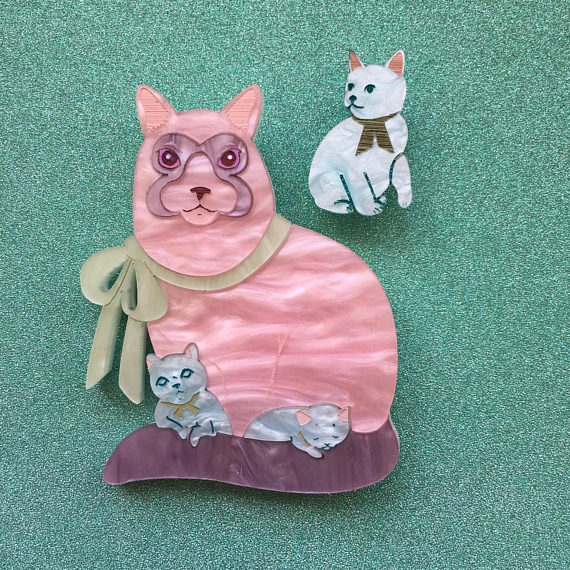
It’s not just bunnies though – this Pretty Kitty Brooch is super sweet too. Molly the cat comes with an extra, tiny kitten brooch.

Pretty Kitty
Pretty Kitty

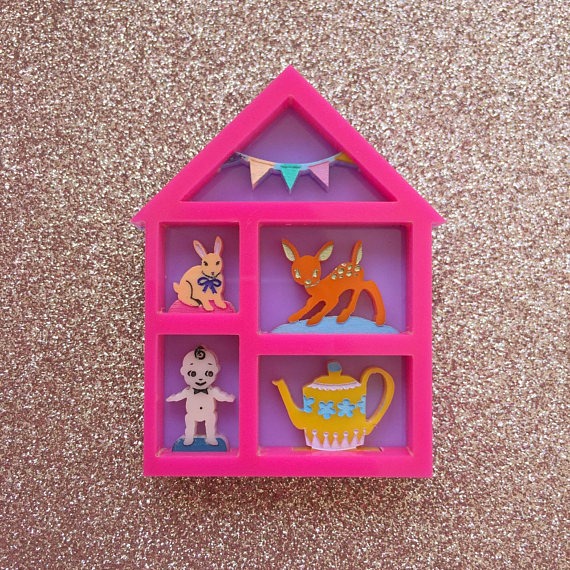
My favourite is possibly this gorgeously detailed Shadowbox Brooch.

Collectors Shadowbox

If you like the look of these creations, check out the Storybook Rabbit via the following links:

Etsy: etsy.com/uk/shop/thestorybookrabbit

Instagram: instagram.com/thestorybookrabbit

Facebook: facebook.com/Thestorybookrabbit

The Lightbox, Woking

On Saturday I visited Woking. Partly this was to go to the theatre, but partly it was to visit the museum there, which is called the Lightbox. There was one particular exhibition I really wanted to see, about vintage beauty, and as the whole museum is free, I thought I wouldn’t mind having a look at the rest of the exhibitions too.

2014_0913Lightbox01
The Lightbox

I started on the ground floor, in the Art Fund Prize Gallery, which had an exhibition on The Art of Marcel Ronay. I’d never heard of this early to mid-20th century artist before, but I liked his work, which is dark and unsettling. I also took a look at the art in the Corridor Gallery, which had a display called Art from the Vyne: Our Museum Community Project.

On the first floor, the Main Gallery had an exciting exhibition called The Giant Electronic Art Show, which had exhibits that you could touch and mess about with. I largely left these for the kids, but I enjoyed looking at the 3D-printed items on display.

Woking’s Story had a display on the history of the town, with items on the local firm Kenwood, the nearby asylum, and the Necropolis Railway which used to transport coffins from central London to Brookwood Cemetery, near Woking. I made a mental note to pay a visit to this cemetery someday.

Finally, I went up to the second floor to see the exhibition I had really come to see. In the Upper Gallery, Glamour on the Go – Compacts: The Beautiful Story of Make-Up had an incredible display of compacts and other beauty accessories ranging across the twentieth century.

2014_0913Lightbox04
Matching compacts
2014_0913Lightbox05
Comb
2014_0913Lightbox15
Compact designs
2014_0913Lightbox11
Guitar compact
2014_0913Lightbox14
Compact designs
2014_0913Lightbox13
Compact designs
2014_0913Lightbox07
Vintage magazine and beauty accessories
2014_0913Lightbox18
Amazing evening bag containing a compact, comb, beauty tools… and a pair of opera glasses!
2014_0913Lightbox09
Assorted compacts
2014_0913Lightbox20
The original Boots No. 7 range
2014_0913Lightbox25
Max Factor cosmetics

Later, while wandering around Woking, I came across a rather odd-looking sculpture – a Martian. H.G. Wells was living in Woking when he wrote The War of the Worlds, and in the novel it is in Woking that the Martians first land. In celebration of this, the sculpture by Michael Condron was unveiled in 1998.

2014_0913Woking02

2014_0913Woking01

Behind the Screen: Hollywood Glamour – Somerset House

On Sunday night I went to Somerset House to attend a talk called Behind the Screen – Hollywood Glamour: Classic Hollywood icons and how they created their signature looks. The talk was held in the Screening Room and was delivered by Jane Richardson, International Lead Stylist at NARS.

Richardson, who obviously has a great understanding of modern makeup, proved an engaging speaker who is clearly interested in the history of Hollywood glamour. She discussed how modern attempts to recreate classic styling often involve tweaking various elements of a look to make them a bit more modern, as well as using innovative phone apps such as Instagram to make a picture look older and more “vintage” than it really is. In the mid-20th century, however, cinemagoers who wanted to emulate their favourite stars usually tried to recreate the whole look: when they went to see films they wanted to be transported into a different world, and wanted to “be” that person on screen. Demos of hair and makeup would often take place at cinema screenings. On a similar note, actresses themselves would usually pick a look and stick to it throughout their career, rather than changing their image frequently like many modern-day actresses do. They were “owned” by the studio that hired them and were often taught how to do their own makeup – although these items were still called “cosmetics” as the term “makeup” was seen as vulgar, associated with women of a certain profession.

I was interested to learn how filming procedures and equipment affected the look of makeup on-screen. Nowadays we associate the Twenties with dark burgundy lipstick, but in fact actresses wore red, and it was the black and white film that made the colour appear darker (on a similar note, anything blue came out white). The advent of Technicolor changed makeup, and two firms in particular, Elizabeth Arden and Max Factor, pioneered new products. Elizabeth Arden was famous for “nuchromatic” makeup, while Max Factor launched the first “cosmetic” product in 1914, followed by “panchromatic” cosmetics in 1929 and the “pan-cake” in 1937. Actress Norma Shearer, a genius in manipulating how she appeared on-screen, would wear the lightest shade of pan-cake herself and demand that every other actress wore a darker shade, ensuring her complexion appeared brighter and fresher than everybody else’s.

During the talk we learned about the lengths several Hollywood actresses would go to in order to enhance their beauty. Margaret Sullavan was signed to Universal Studios in 1933: the studio made her endure some rather drastic procedures including the removal of a mole on her face and the removal of her entire top row of teeth, which were supposedly crooked. Greta Garbo was particularly influential: we saw some “before” and “after” shots which showed how she removed most of her eyebrows in order to fit accepted standards of beauty, as well as using makeup to change the shape of her mouth and appearance of her eyes. Marlene Dietrich, who compared her relationship with her makeup artist to that between accomplices in crime, had her back teeth removed to make her cheekbones look more lifted, and aged 43 gave herself a “temporary facelift” by twisting her hair and pulling it back so hard that it bled. Perhaps the most drastic – and horrific – procedure was undergone by the actress Carole Lombard. She had plastic surgery to reduce scarring after an accident, in itself not particularly drastic – until you find out that she had this surgery without pain relief, as it was believed that anaesthetic would reduce the success of the procedure.

It wasn’t just makeup, but hair that was an important part of an actress’s style. Rita Hayworth underwent electrolysis to raise her hairline when the studio claimed that her forehead was too low. Carole Lombard and Marilyn Monroe famously dyed their hair blonde, but the original “platinum blonde” was Jean Harlow, who used a harsh dye containing peroxide and ammonia. So influential was her hairdo that producers changed the name of her movie to Platinum Blonde.

Some actresses used rather less drastic methods to enhance their beauty. Joan Crawford became such an expert in studio lighting – knowing how it could affect her entire look – that she could supposedly tell when one of the bulbs had blown before the technicians, claiming that she could feel the cold spot on her face (studio lights were notoriously hot). Crawford would also splash her face with ice-cold water 25 times after every wash, believed to freshen the complexion but not advisable now! Vivien Leigh, believing that her hands were too big, wore gloves as often as she could get away with.

What interested me, in the face of all these rather dramatic methods of achieving “beauty”, was how several acclaimed actresses actually did their own makeup. Elizabeth Taylor actually did her own makeup for Cleopatra. Jane Russell also did her own makeup, as did Marilyn Monroe, who supposedly invented lip gloss by choosing to add shine to her lipstick. An interesting way to end a fascinating talk.