
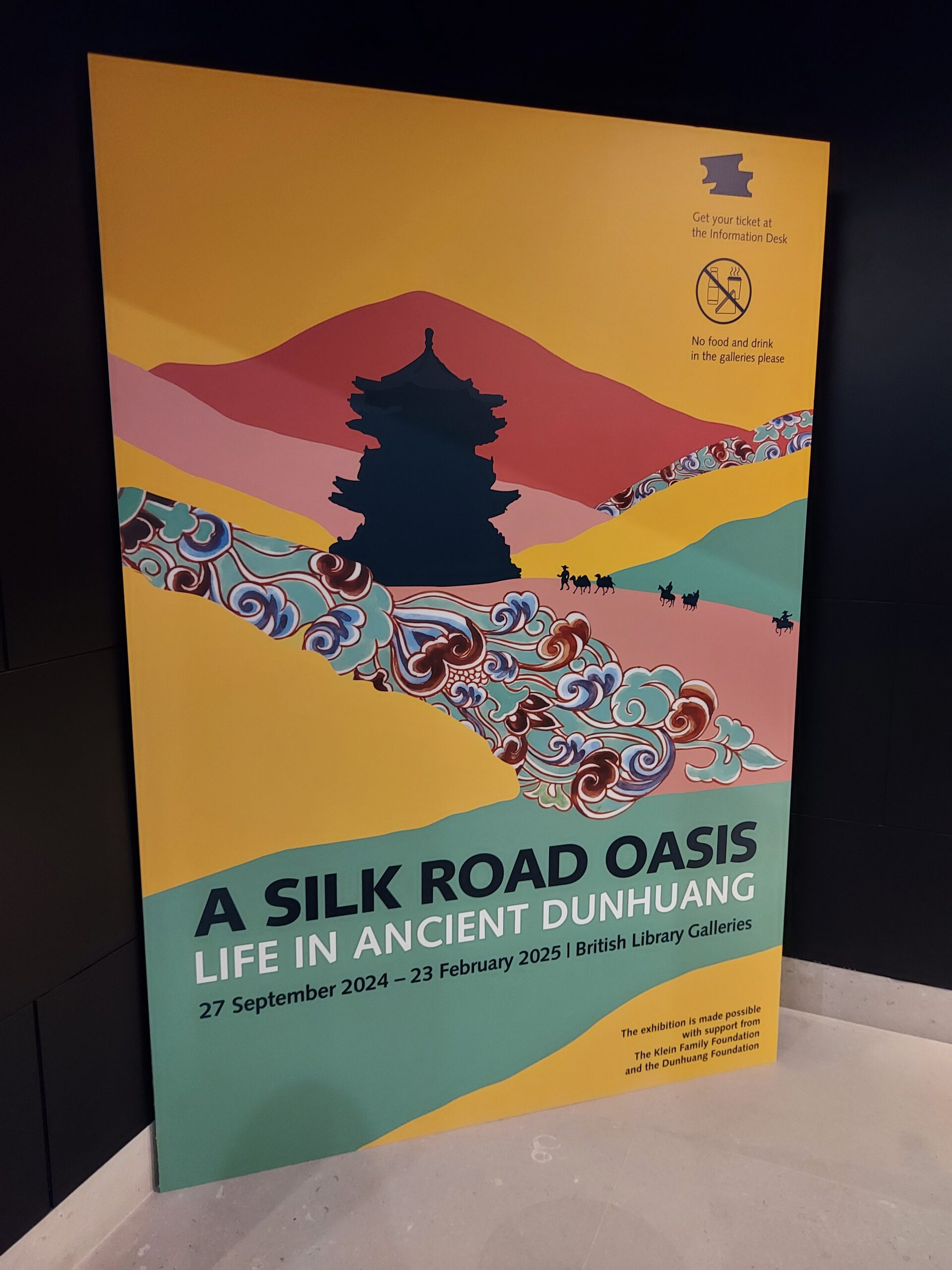
I went along to the British Library‘s new exhibition, A Silk Road Oasis: Life in Ancient Dunhuang, which I found fascinating. The exhibition looks at life in one particular settlement during the first millennium, largely based on artefacts discovered in the Mogao Caves.
Archeological research shows that Dunhuang, a Chinese city, was an important settlement on the edge of the Gobi Desert. As a frontier garrison on the Silk Road, it was fortified with defensive walls and watchtowers (the Dunhuang Limes) and was a prime example of multiculturalism: a multilingual stele from 1348 displays a Buddhist mantra in six different scripts – Sanskrit, Tibetan, Old Uyghur, Phags-pa, Tangut and Chinese.
We explore the history of this settlement via the stories of individuals who played a part in shaping Dunhuang society. For instance, ‘The Merchant’ discusses how Sogdians – an Iranian people with settlements approaching China – helped to form a network of agents and messengers spreading news such as impending attacks by the Huns. We see a letter written by Miwnay, an abandoned wife with a young child forced to serve a wealthy Chinese family while she tries to find out what has become of her husband (could he have been killed on the Silk Road?).
In ‘The Printer’, ‘The Scribe’ and ‘The Artist’ we learn how printing technology (developed in China in the seventh century) was used to print religious and other texts in Dunhuang, while scribes created manuscripts and sutras on behalf of the Tibetan empire who ruled Dunhuang between 786 and 848. A government-supported painting academy, featuring artists from all over the region, emerged in the 10th century, allowing the creation of works on silk, hemp and paper, as well as murals in the Mogao Caves.
Religion played an important part in Dunhuang life. The city was a major hub for Buddhist worship from the fourth century. ‘The Lay Buddhist’ focuses on an anonymous man in his 80s who copied a dozen small booklets of the Diamond Sutra in Chinese, using his own blood as ink. At the other end of the age spectrum, ‘The Buddhist Nun’ shows how Deng Ziyi was granted permission to become a novice nun at the young age of 10, two years before the official age permitted. Becoming a nun allowed women the chance for a role beyond that of daughter, wife and mother; between 800 and 1000 there were more nuns than monks living in Dunhuang.
In ‘The Diplomat’, we are introduced to multilingual envoy Ca Kima-sana, originally from the central Asian kingdom of Khotan, 1,800 km to the west. A wealthy Khotanese community was established in Dunhuang from the 10th century. This exchange of ideas contributed to the transmitting of medical knowledge. ‘The Fortune Teller’ showed how people like Shenzi, the monk and yin and yang master, helped both the ruling elite and ordinary people by advising on the best time and date to start a project or begin a journey. A scroll on display from 649-700 is the oldest complete star chart in existence from any civilisation.
An entire section at the back of the exhibition is devoted to the Mogao Caves. In 1900, a Daoist priest, Wang Yuanlu, discovered a small room (now known as the Library Cave, or Cave 17) containing tens of thousands of manuscripts, paintings and other objects from the fifth to the eleventh centuries. These were eventually brought to the UK by the archaeologist Marc Aurel Stein, while other artefacts were dispersed to France, Japan and Russia, as well as Beijing.
This raises questions about colonialism and who has ownership over these items. The International Dunhuang Project (now Programme) was founded in 1994 in order to provide access to Dunhuang and other collections relating to the Eastern Silk Road worldwide and help to ensure their long-term preservation. I must admit I am grateful to have been able to view these wonderful items.
