
I’ve had my eye on the Linguist badge for a while. When I was a teenager I hated languages and they were my least favourite subjects at school. As I got older my hatred started to wane and I started to see the potential in language learning. Not to mention that I don’t want to be one of those Brits who can’t speak any language other than English.
Choose a foreign language to improve over the next 3 months.
I’ve been studying Russian on and off since I was eighteen; I’ve probably fulfilled all the clauses of this badge at one time or another. However, I wanted to challenge myself for this badge, so I decided to study German – I do have a GCSE in this language, but haven’t touched it since then (20 years ago!). I have a friend from South Tyrol (the German-speaking part of North Italy) and it would be nice to be able to speak to her in her own language.
Dedicate at least 2 hours a week to practising your chosen language.
I found this fairly straightforward, usually studying for one hour on two separate days within the week.
Download an app to help with your learning.
I tried the apps Babbel and Memrise but I wasn’t keen and ended up sticking with Duolingo, the app I’ve been using to study Russian. I love Duolingo and find it really easy to use.
Have a conversation with a native speaker.
I visited Innsbruck and South Tyrol at the beginning of December and was able to have several, albeit basic, conversations with native speakers. Though I’ve still got a long way to go, I feel quite proud of this!
Choose a book, magazine or article which you will read by the end of the three months. Translate a section of it into English.
As a child I had (probably still have, somewhere) a copy of Shock-Headed Peter by Heinrich Hoffmann, the original German title of which is Der Struwwelpeter. The text is available online, so I thought I would have a go at translating one of the poems in it, a rather satisfying albeit brutal moral tale in which a cruel boy is given a taste of his own medicine by a clever dog. I had to use Google Translate quite a lot, but I understood more than I had expected.
Cook a dish from a country where your chosen language is spoken.
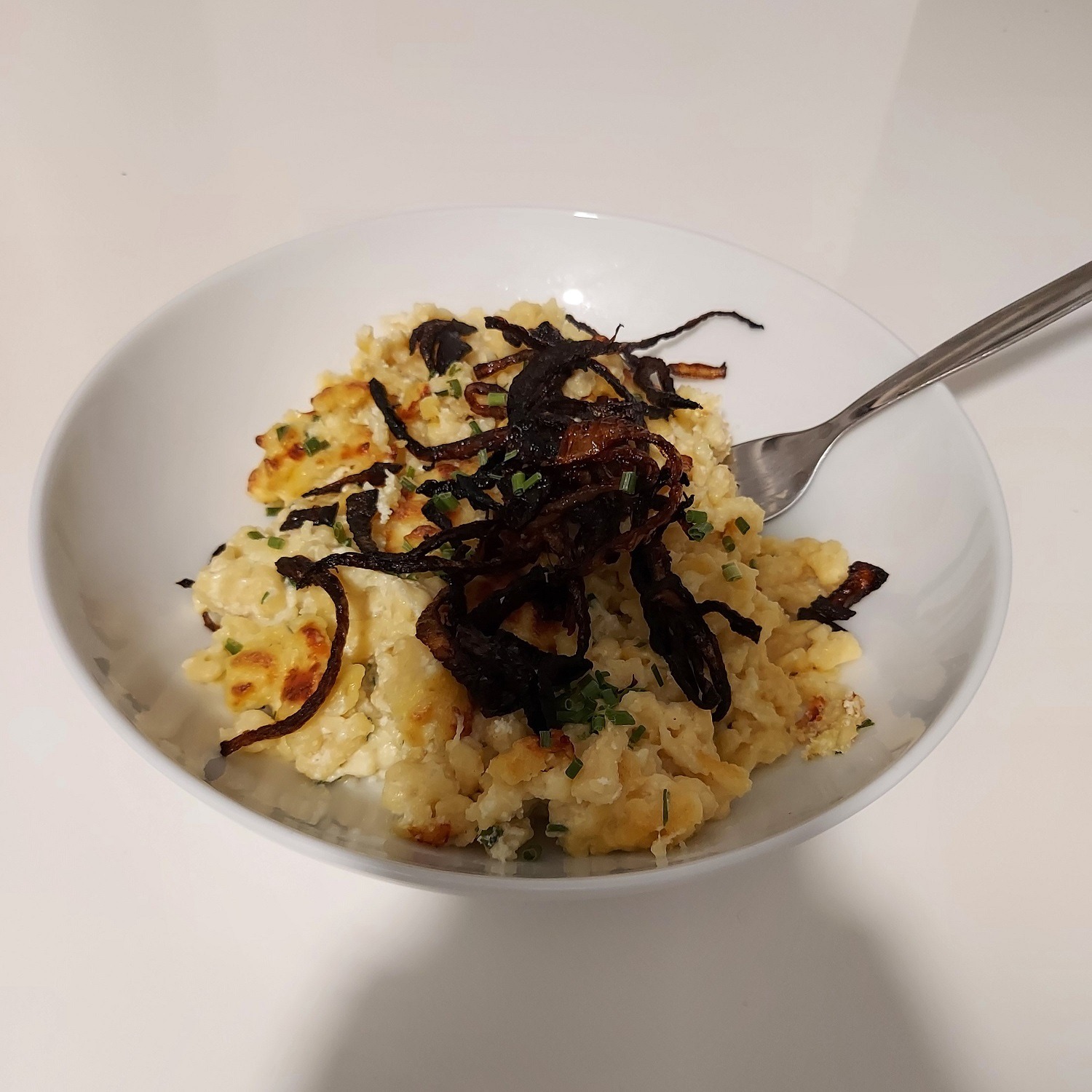
I’m vegetarian, and a lot of German cuisine is meat-heavy, so this clause was tricky. However, I found a dish called spaetzle, or spätzle, which are German egg noodles often served as a side dish. I made Käsespätzle (käse = cheese) using a recipe from Plated Cravings. It’s not something I’d eat every day, as it is full of butter and cheese and isn’t the healthiest meal, but I enjoyed it and it’s perfect comfort food after a day outside in the cold.
Watch a film or TV show in your chosen language.
I watched a German-language film called Goodnight, Mommy (2015) which was creepy but hugely enjoyable. Because the main characters are children, the speech was a bit simpler than it might have been, so it was easier to follow, although I definitely needed the subtitles!
Date completed: 7 December 2022