I visited Nunhead Cemetery several years ago, as part of my ‘Magnificent Seven’ tour, and recently went back while I was completing the Green Chain walk. This reminded me that I never did visit the crypt, and after checking the Friends of Nunhead Cemetery website I found out that Crypt & Chapel tours ran on certain dates. I therefore resolved to pop down and attend one.
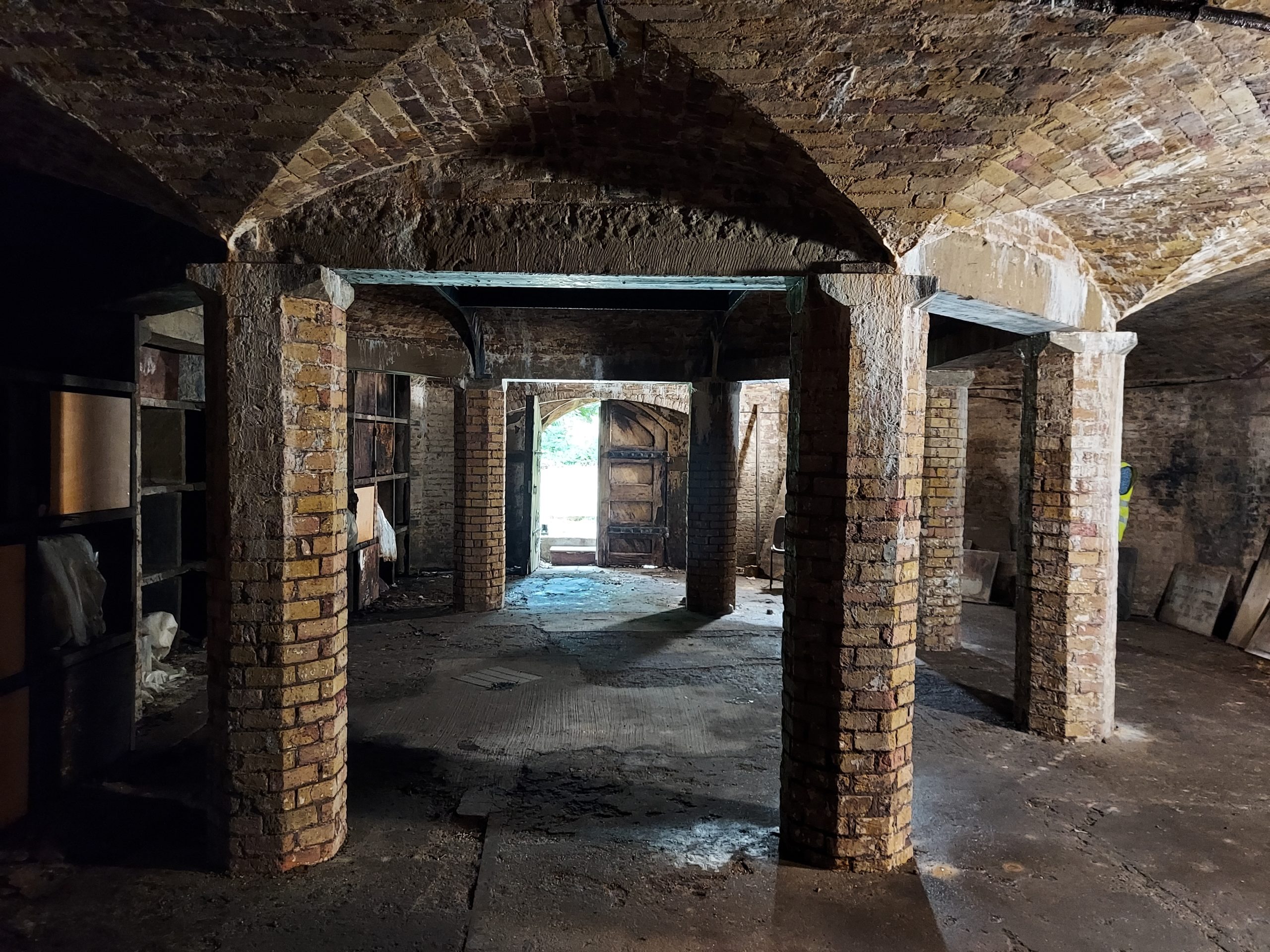
The crypt is located beneath the chapel. At one time it was considered the most prestigious place to be buried, and the most expensive. Those buried here had their own space with a metal plaque to identify them. Mourners could come down to the crypt (there is evidence of heating pipes and a space for a gas lamp) to view their loved one’s final resting place; there are two spaces either side of the main area which could have been used as waiting areas. The architecture is simple but impressive, and I imagine this could once have been quite a grand space.
Sadly, when the cemetery went out of business, the chapel burnt down due to arson and the crypt was vulnerable to the elements. It was also broken into, and thieves opened and ransacked the coffins in search of valuables, dispersing the bodies around the crypt in the process. Some years ago, there was an attempt to put the pieces back together, and the remains are now in some sort of order, but it’s no longer possible to identify which body belongs to which named individual, which seems sad. The spaces for the coffins are covered with basic wood plaques, and the atmosphere as a whole is rather damp and dingy. Personally I feel that those who chose burial in the cemetery itself, with an elaborate headstone, made the better choice – even the weathered and damaged monuments have a kind of grandeur about them.
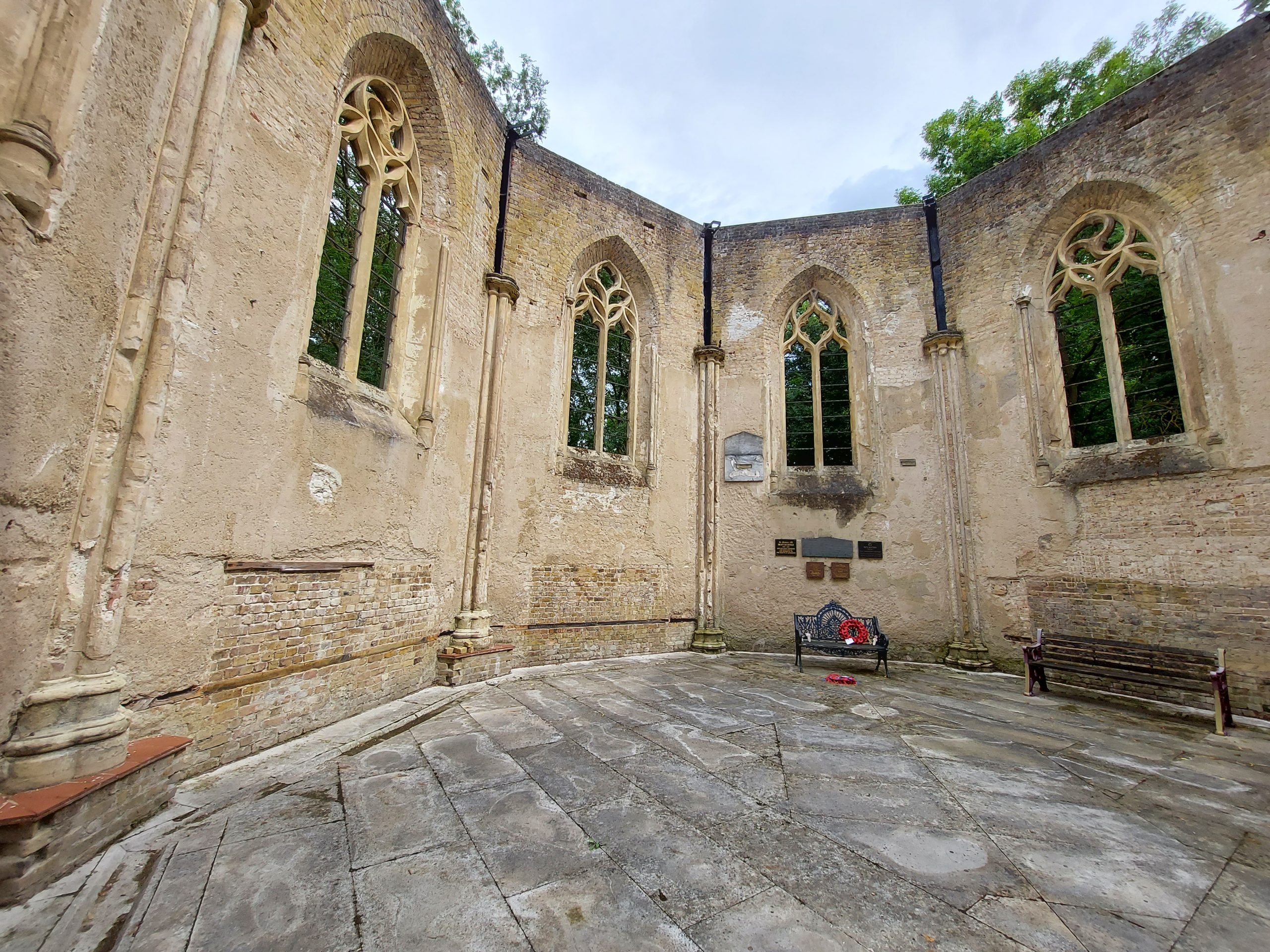
The ruined Anglican chapel, on the other hand, has a rather pleasant feel about it. The arson attack which made it into a shell is undoubtedly a shame, but the chapel is now open to the air, and is rather nice. You can still see the marks on the wall where the pews used to stand. Some of the wall decorations are rather fragile, but overall the chapel seems to be standing up pretty well.
Nunhead Cemetery, looking towards the Anglican chapel
My visit to Nunhead Cemetery marked the mid-point of my “Magnificent Seven” tour. I very nearly didn’t visit on Sunday – I lost an hour of sleep to the clock change, and when I woke up all I could hear was the sound of the wind and the rain hitting my window, which didn’t exactly make me want to leap out of bed and spend time out of doors. However, I forced myself to make the effort, and luckily by the time I reached the Cemetery the wind had died down and the rain had stopped.
Getting There
Nunhead is one of only two of the seven cemeteries to be located south of the river, the other being West Norwood. Its address is Linden Grove, London SE15 3LP, and the closest railway station is Nunhead, which can be reached from Victoria or London Bridge stations. Peckham Rye station is a little further away but as more trains stop at this station than at Nunhead (including Overground trains), it is sometimes the better option.
Approaching the Cemetery along Linden Grove
The cemetery is located very close to Nunhead station, and it is easy to reach, though you do come upon it suddenly as you step out of a housing estate. The railings are reproductions, the originals having been removed during World War II, but the neoclassical gates are original, although they have been restored. The upturned torches, which symbolise life extinguished, are common symbols in Victorian cemeteries.
The restored Cemetery gates
I was due to participate in the tour, the meeting place for which is beside the Anglican chapel.
Approaching the Anglican chapel
History
The fourth of the Magnificent Seven cemeteries to be built, in response to an overcrowding problem in central London burial grounds, Nunhead was founded in 1840 by the London Cemetery Company. It was originally called All Saints Cemetery, Nunhead. The first person to be buried here was a man called Charles Abbott, a 101 year old Ipswich grocer. The cemetery was popular, becoming nearly full by the middle of the 20th century, but was never as prestigious as Kensal Green or nearby West Norwood.
Abandoned by the company, the Cemetery fell into a state of disrepair and neglect, exacerbated by vandalism. In the early 1980s, the Friends of Nunhead Cemetery were formed to renovate and protect the Cemetery. Nunhead is now owned by the London Borough of Southwark and is a Local Nature Reserve, forming a habitat for many animals and birds. It was reopened in 2001, having been restored with funds from Southwark Council and the Heritage Lottery Fund. Nunhead is listed Grade II*.
Blue plaque
The neoclassical lodges were designed by James Bunstone Bunning, who was also responsible for the entrance gates and the landscaping. One is now occupied as a private house, while the other is sadly derelict.
One of the neoclassical lodges, now derelict, with catacombs underneath
The Gothic-style Anglican chapel was designed by Thomas Little. It fell victim to arson, but has been partially restored.
Close-up of the chapel
Side view of the chapel
Tour
Looking towards the Cemetery gates from the chapel
I attended a tour run by the Friends of Nunhead Cemetery. The tour began at the Anglican chapel, and we learnt about the history of the Cemetery. I was impressed with the height of the landscape, and the wonderful views that were apparent even on such a dull day.
One of the first graves we saw was that of Henry Daniel, a mason employed by the London Cemetery Company, buried surrounded by many of the memorials that he built.
Family vault of Henry and Charlotte Daniel
Close-up of the tomb with anchor and serpent decoration
An interesting part of the Cemetery was the Muslim section, something I had not expected to come across.
Muslim area
We noted the tomb of Bryan Donkin (d. 1855), the inventor of the tin can. His son, another Bryan, also buried here, opened a banknote factory in Russia.
Tomb of Bryan Donkin
On our way up the hill, our guide pointed out the silver granite memorial to the ship owner John Allen (d. 1865).
Heading up the hill with Allen’s tomb on the right
The tomb is a reworking of an ancient monument brought to Britain from Egypt.
Memorial of John Allen
Memorial of John Allen
Some parts of the memorial are in excellent condition, but others have decayed: the two angels that formerly flanked the head of the monument are no longer in position.
A fallen weeping angel
The Stearns family mausoleum was built in 1902 by the Doulton firm. It is similar to monuments at West Norwood.
Stearns family mausoleum
Our walk eventually brought us to the top of the hill. It was considered more prestigious to be buried at the top, because you were thought to be closer to God.
Approaching the top of the hill
However, being at the top does mean that your memorial is more exposed to the weather. This one is looking a bit wonky.
An unusually carved tomb
It is possible to see St Paul’s Cathedral from this point on the hill – a stunning view.
View of London from the very top of the Cemetery
Near the top is buried John Moritz Oppenheim, a skin and fur merchant who died in 1864 and was a generous patron of the arts, despite being blind for 20 years. His stone shows an angel touching his eyes.
Grave of John Moritz Oppenheim
The Cemetery is overgrown in parts and could do with some restoration, although I did think that this unkempt look made it more atmospheric.
Many of the graves are overgrown
The Cemetery is an important nature reserve: this pond, for example, is very important for wildlife.
Pond for wildlife
We headed back down the hill towards the entrance.
The way down
A winding path flanked by graves
The location of the former Dissenters’ chapel is marked by a clearing. The unconsecrated ground surrounding it contains graves of people belonging to non-Anglican denominations.
Location of the former Dissenters’ chapel
In the area you can see the Cemetery’s only gravestone with a Welsh inscription.
Welsh grave
Finally, we were shown the Scottish Martyrs obelisk, a memorial to 5 lowland Scots sentenced to transportation for advocating parliamentary reform.
Scottish Martyrs obelisk
Scouts
The Scouts memorial
The Scouts memorial commemorates a tragic accident that occurred in 1912. On the 4th of August, nine boys were drowned at Leysdown after their boat overturned. The tragedy resulted in huge public mourning, and a bronze life-size Scout was designed by Sir Giles Gilbert Scott and erected here in 1914. Sadly stolen in 1969, it was replaced by this marble stone in 1992.
Some Commonwealth war graves are located in the same area, soldiers who died in a nearby hospital after returning from the Front in World War I.
Commonwealth War Graves
Architecture
As with the other cemeteries I have visited so far, the architecture is varied and impressive. Many of the usual symbols are present, including angels, broken columns and crosses.
A stone angel decorating a grave
Tomb with a scroll carving
Broken column with rose design
This unusual anchor does not actually belong to the grave on which it rests. It was discovered after a period of bad weather destroyed the vegetation covering it, and bears an intriguing message.
Anchor-shaped stone
A cross
A cross covered with ivy
Nunhead is one of the least-known of the Magnificent Seven cemeteries, and its lack of fame and location south of the river might put people off visiting. However, it is a little gem: a lovely site on a hill, romantically overgrown, and a haven for wildlife.
Would I go back?
Yes – Nunhead would be a lovely place for a quiet walk. I also want to do a tour of the crypt, chapel and viewing tower, run by the Friends on various dates throughout the year.
There is an Open Day each year: in 2015 this will be the 16th of May. You can view details here.
Facts
Address: Linden Grove, London SE15 3LP
Founded: 1840
Size: 53 acres
Still in operation?: Yes
Official website: http://www.southwark.gov.uk/info/461/a_to_z_of_parks/660/nunhead_cemetery
Owners: London Borough of Southwark
Friends group: Friends of Nunhead Cemetery (FONC) (http://www.fonc.org.uk/)
Tours: General tours on the last Sunday of every month, free, 2.15 pm at the Linden Grove entrance. Special interest tours on certain dates – see the FONC website for details.