At the end of the ghost walk around Southwark, we ended up at the Cross Bones Graveyard and were able to go inside. Cross Bones may have been a burial ground for medieval prostitutes, who could not be buried in consecrated ground. Later it was used as a burial ground for the poor. The graveyard was “rediscovered” a few years ago and hosts a vigil every month to remember “the outcast dead”. Currently a memorial garden is in the process of being constructed.
Gates of Cross BonesEntrance to the gardenThe gardenGardens under constructionMemorial shrineMemorial shrine
I signed up for a Christmas ghost walk to explore Southwark, run by poet John Constable who wrote The Southwark Mysteries. The walk began near Borough Station and ended at Cross Bones Graveyard.
There was a Dickensian element to much of the walk: it began at the St George the Martyr Church, where Little Dorrit once fell asleep in Dickens’ novel of the same name.
St George the Martyr
Nearby was the site of the Marshalsea prison, in which Little Dorrit’s father lived: Dickens’ own father was imprisoned here for debt when Dickens was a child. The wall used to be the original wall from the prison, but it has been rebuilt recently.
Wall of the Marshalsea prison
We were shown a pub nearby that is supposedly haunted by the ghost of a woman murdered by her husband. The ghost of a crying baby has also been heard there, although no one is quite sure what connection the baby has to events.
Haunted pub
On the same street that Dickens lived when he was a young boy and his father was in prison, we saw the National Trust houses established by Octavia Hill.
National Trust houses
Travelling towards London Bridge, we passed the location of the inn at which Chaucer’s pilgrims set off on their travels.
Chaucer plaque
We then popped into the George Inn, London’s only surviving galleried inn, and heard a few more ghost stories.
The George Inn
We stopped off by Southwark Cathedral after walking through Borough Market.
Southwark Cathedral
By the Golden Hind, we heard a story about the land surrounding Southwark.
The Golden Hind
We stopped to admire the remains of Winchester Palace.
Antonyms are common enough, right? Yet when I came to this part of the reading challenge, I had a real struggle finding a book featuring them in the title. In the end I chose Poor Caroline by Winifred Holtby, having already read and enjoyed her South Riding.
Although I’ve worked close to The Wiener Library for the Study of the Holocaust and Genocide for several years now, I’d never actually visited. It wasn’t until a colleague told me about the weekly library tours, which take place every Tuesday lunchtime, that I thought to visit. We ended up making it a bit of a work thing: three of us went one lunchtime, to be followed by the other two a week later.
The Library, formed in 1933 by Alfred Wiener, is Britain’s Holocaust library and the oldest collection of its kind in the world. It holds over one million items, including illustrated and rare books, press cuttings, photographs and eyewitness testimonies.
Our tour included the main Library reading room, with considerable collections available on open access for the use of readers. Items stored elsewhere in the building, including photographs and fragile items, can be requested. Members of the public can use the Library, open on weekdays, free of charge, though first-time visitors do need to bring some ID. You need to become a member if you want to borrow books.
We were taken downstairs to view the stacks, and were able to see several fascinating items which our guide brought out to show us. One was a Nazi colouring book and another was a book of photographs of Hitler and assorted small children: both were bizarre and rather chilling. There were also some documents relating to Jewish refugees who came to the UK.
The Library runs a programme of temporary exhibitions on the ground floor. The current exhibition is Fragments of a Lost Homeland: Remembering the Armenian Genocide which is on until 25 February. This exhibition focuses on one particular family around 1915 who recorded their experiences before, during and after the genocide in letters, diaries and photographs.
The Wiener Library is well worth a visit, even if you don’t need to use the research facilities. Tours run on Tuesdays at 1pm, and you can visit the temporary exhibitions during regular opening hours.
I went to this discussion with Alex von Tunzelmann, inspired by the Guardian column and the newly-released book which looks like it would be an interesting read. It was lots of fun: as someone who studied history at university I thoroughly enjoyed this look at the historical accuracy – or otherwise – of movies.
I visited the British Library for a tour recently and while I was there I decided to visit the new exhibition, West Africa: Word, Symbol, Song. Running until 16 February next year, the exhibition looks at the history of the region’s 17 nations and their use of words: spoken, written and sung.
I’m afraid to say I knew very little about West African culture and history before I visited the exhibition, and I found it very enlightening. The exhibition began with an examination of the myth of the founding of ancient Mali and went on to explore the myths and legends of the various peoples of the area, the history of the various nations and the effects of colonialism. In the modern day, it looked at writers, artists and human rights activists.
The exhibition consisted of manuscripts, film and sound recordings, clothes and textiles, books and photographs. It was very different from the exhibitions I usually go and see but I really enjoyed it.
I’m a librarian, and recently I went on a visit to the British Library organised by a group I’m a member of. The visit comprised a library tour, which really interested me because although I have visited the BL several times, it’s always been as a visitor to the exhibitions: I’m not a member and I’ve never been in the reading rooms or behind the scenes.
The British Library Piazza. Source: Jack1956 on Wikipedia
The British Library, which is a relatively new institution that only came into being during the second half of the twentieth century, is the national library of the UK and the largest library in the world in terms of items catalogued. The building holds around 170 million items from numerous countries and in every language in the world. Information is held in multiple formats: print books and ebooks, manuscripts, journals, newspapers, magazines, audiovisual recordings, playscripts, patents, databases, maps, prints and drawings. The collections include around 14 million books, and the Library holds ancient historical items dating back as far as 2000 BC.
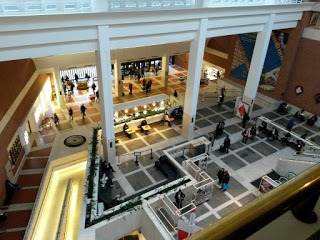
British Library Foyer
Our tour, which was delivered by a very knowledgeable and entertaining guide, began in the foyer where we learned about the library’s beginnings. The BL originally started out at the British Museum: the famous Round Reading Room is where people including Marx used to study. The British Library Act of 1972 enabled the BL to be established in 1973, although materials were dispersed around London and around the country for several years. When deciding upon a location for the eventual library site, there wasn’t much choice available: it would have to be within walking distance of the British Museum in Bloomsbury, so that the rarest and most valuable books could be carried there by hand, as they were not permitted to be transported on vehicles. Eventually the site at Euston Road was decided upon: located next to St Pancras Station, it used to be a goods yard.
The Library is a Legal Deposit Library (the others are the Bodleian at Oxford, the University Library at Cambridge, the Trinity College Library in Dublin and the National Libraries of Scotland and Wales), meaning that it receives a copy of each book produced in the United Kingdom and Ireland, including several overseas books distributed in the UK.
The Library was designed by Colin St John Wilson, and the building has met with a mixed reception (apparently Prince Charles hates it, but the Queen is a fan). Looked at from the right angle, it resembles a ship. It was made a Grade I listed building earlier this year, so it is now recognised as a landmark of design: however it is not without its problems. Wilson spent so much of the Library budget on expensive marble, containing fossils, to be laid outside on the piazza (meaning that it is extremely slippery in the rain) that there wasn’t enough left for decent shelving, resulting in some collapses as the second-hand shelves couldn’t bear the huge weight of the books.
It is impressive, however, that most of the books are stored underground: the stacks run several storeys beneath the ground, stopped only by the tube that is even further down. The Fleet River also runs nearby, so that the lowest floor does flood on occasion.
From the foyer we were taken to the Members’ Area in which you can register to become a member of the Library. Anyone can register so long as they have the appropriate ID: you don’t have to be an academic. Near here, there is a book handling system which delivers books users have ordered to the surface by means of a conveyor belt. Staff collect book requests, remove them from the shelves and send them up to the Library.
The book handling system
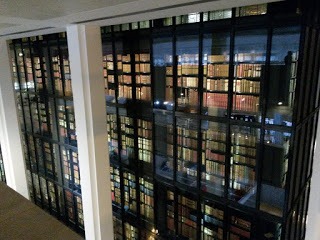
We went upstairs and were able to get a brilliant view of the King’s Library, made up of 65,000 printed volumes and numerous pamphlets, manuscripts and maps collected by George III between 1763 and 1820. The glass tower was inspired by a similar structure in the Beinecke Library in New Haven, Connecticut.
The King’s Library
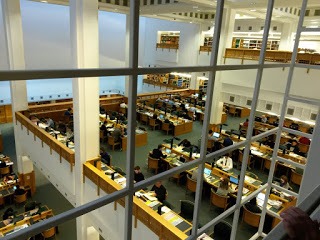
From the old to the new: our next stop was the news room where readers can view newspapers and watch a live news feed. We explored the Library considerably, taking a look at the many busy – but extremely quiet – reading rooms.
Reading Room
Before leaving, we had a quick look at a Library video in one of the quietest corners of the building – left “unfinished” to show off the brickwork.I really loved my tour: I learned a great deal about the British Library that I hadn’t known before. Public tours are available and I do recommend signing up.