
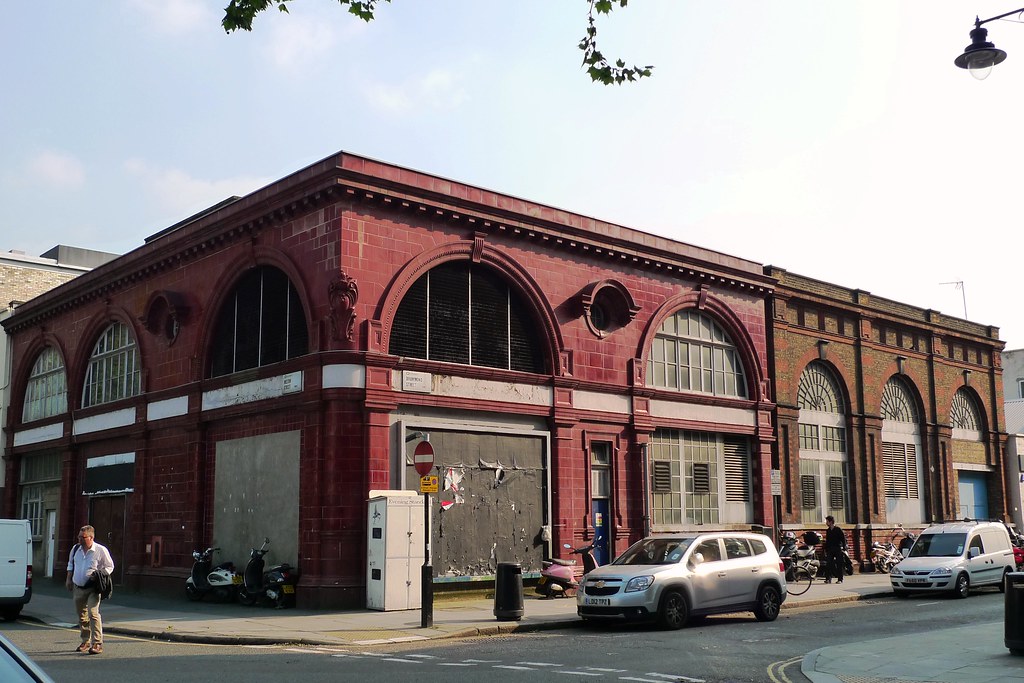
When thinking of Euston station, I suspect most people would think of the ugly 60s building that, amid much controversy, replaced the famous arch which marked the entrance to the railway station. However, in a virtual tour entitled ‘Euston: The Lost Tunnels’ I learned that there is much more going on beneath this station. There are no less than two disused stations in amongst the tracks and tunnels of Euston as it is now; some of these tunnels have not been used by passengers for over a century.
The mainline station opened in 1837, linking passengers in the Midlands to London. Companies operating the city’s tube lines wanted to take advantage of the passenger traffic from the station, and in the early 1900s the Charing Cross, Euston & Hampstead Railway (CCE&HR) and the City & South London Railway (C&SLR) had both been permitted to build stations near, albeit not directly on, the mainline terminus. They were allowed to construct a shared underground ticket hall below ground, which linked up their two stations on either side of the main station – the only such ticket hall which still survives.
The C&SLR, London’s first deep level tube line, opened in 1890 and extended to Euston in 1907. The station building was designed by Sidney Smith and the façade was green and white, Doulton’s glazed Carraraware. Today, the building no longer stands but the C&SLR is now the Bank branch of the Northern line. Like many stations on this line, the C&SLR at Euston had an island platform, but this has now been modified (this is why some platforms at Euston seem massive).
Later the same year, the CCE&HR opened its station, a typical Leslie Green design with oxblood-red tiles, with a green and cream design inside. However, passengers largely preferred the joint ticket office below ground and both station buildings had relatively low usage. By 1914, both companies were part of the Underground Electric Railways of London (UERL), aka the Underground Group, and the individual station buildings were closed.
The 1960s rebuild of the mainline station prompted a redesign and expansion of the Underground ticket hall, and the construction of the Victoria line that same decade also led to changes. The station was remodelled and rationalised, the ventilation system was upgraded, and many tunnels were closed off to passengers, remaining in use as ventilation shafts and storage areas, and acting as time capsules, with old advertising displays and movie posters fixing the tunnels in time.
With the construction of HS2, the CCE&HR station building pictured above is due to be demolished, but the disused tunnels will remain – something I’m extremely glad about.
Thanks for interesting information about the tunnel. And even though Euston Station may be an ugly one, the 23 years old singer Nancy Lynn now in April 2025 has recorded the song “Euston Station” in a great studio in Helsinki, Finland. You can hear it on YouTube and it tells about feeling the typical vibrations of heavy metal wheels on rails. And it says there must have been some celebration when Queen Elizabeth once guested the station. Well, that was in days gone by. May London have a pleasant spring!