
I really like the Queen’s Gallery at Buckingham Palace. It has rotating exhibitions which change every few months or so, and when you buy a ticket you can get it converted into a 1-year pass enabling you to go back as many times as you want over the course of the year. I had the day off on Wednesday and visited the Gallery for the third time this year, in order to see the exhibition The Northern Renaissance: Dürer to Holbein.
I studied the Reformation in Europe as part of my History A Level and many of the pictures in this exhibition were of figures I am familiar with. One painting, which appeared in the first room, was of Desiderius Erasmus, a hugely important intellectual figure and inspiration to Martin Luther who kickstarted the Reformation. In our class he was known as ‘Daddy Rasmus’.

‘Daddy Rasmus’
This painting, and many others at the beginning of the exhibition, was by Albrecht Dürer, a German painter and printmaker who is commonly regarded as one of the greatest artists of the period. I recognised several of his engravings, including the Knight, Death and the Devil, from A Level textbooks. Much of his work has a strong Gothic feel, and he utilised classical imagery in his work. He drew and painted many of the prominent figures in the Northern Renaissance.
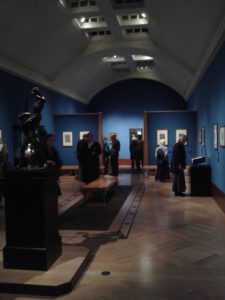
Hans Holbein the Younger is known for his work at the Tudor court; he came to England from Germany where he first developed as an artist. Sketches, drawings and paintings by him show his ability to capture in detail the expressions and personalities of the figures of the period.
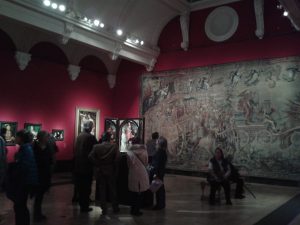
The work of other artists was also represented in the exhibition: tapestries, altarpieces and paintings all capture the important themes of the period, reflecting the turbulent age in which they were created. The fifteenth and sixteenth centuries were a time of dramatic change in Europe, with intellectual exploration, religious questioning and a shifting of the balance of power. The works of art portrayed here are interesting in their own right, but are also emblematic of the wider issues of their age.