Eastbury Manor House

Eastbury Manor House

At the weekend I visited Eastbury Manor House in Upney, east London. I’m a National Trust member so I get in for free, but an adult ticket is only £4 for non-members. There isn’t loads to see in the house, but there is some beautiful architecture and it’s fascinating to imagine how people lived in it years ago. The house is open Mondays to Thursdays in the summer months, as well as the first and second Saturday of the month.

front door
The front door

Built during the reign of Elizabeth I, completed by around 1573, Eastbury Manor House was originally situated in rural parkland but is now in the middle of a housing estate. The original owner was Clement Sysley, and over the years the house has changed hands several times. Though some of the rooms have been adapted or changed, the essential structure of the house has remained more or less the same.

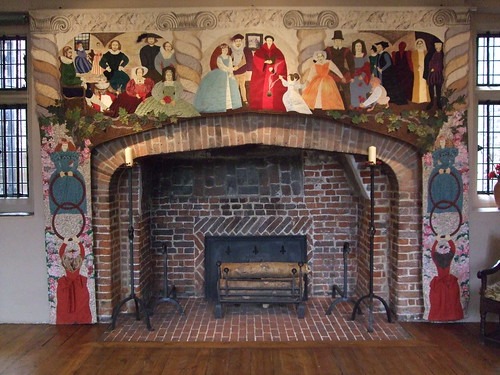
Fireplace
Fireplace with a modern surround

In the first room, an original fireplace has been complemented with a brightly coloured modern painting. This room is often used for weddings.

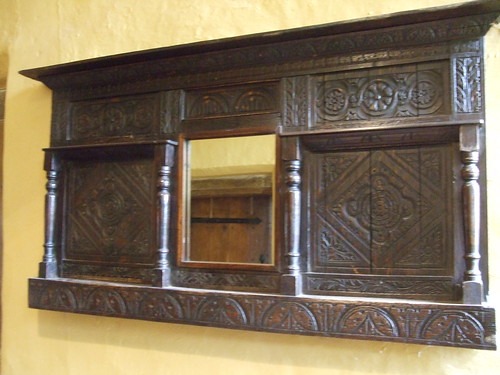
Ornate mirror
Ornate mirror

I love the ornately carved wood which is a hallmark of the Tudor style.

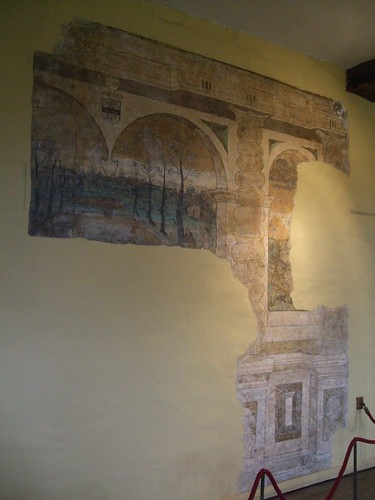
Remains of the mural

One room used to be decorated on all four walls with a beautiful mural, the remains of which are still visible.

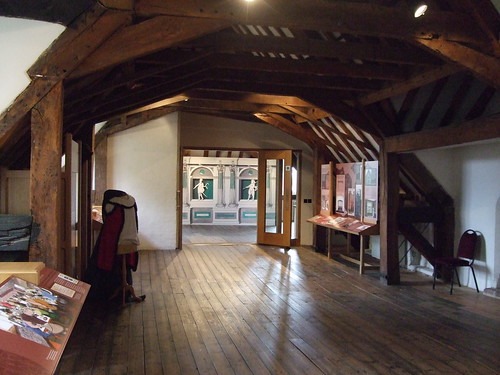
Attic
Attic

The attic was used by the family for exercise. Today it contains information boards and clothes for dressing up!

FACTS

Address: Eastbury Square, Barking, Essex, IG11 9SN

Website: nationaltrust.org.uk/eastbury-manor-house

Opening Hours: 10am-4pm Wed-Thurs; 12pm-5pm Sun

Prices: Adult £16, Concession £12.80, Child £8; under-5s free

Treasures of the Royal Courts: Tudors, Stuarts and the Russian Tsars – V&A

I was at the V&A yesterday in order to buy advance tickets for the Bowie exhibition (my parents are coming down at the end of May and my dad in particular really wants to see it), and while I was there I thought I might as well visit the new exhibition Treasures of the Royal Courts: Tudors, Stuarts and the Russian Tsars. I am very interested in history – I have a degree in the subject and actually studied the Tudors at A Level – and I am fascinated by anything to do with Russia, so this exhibition sounded ideal for me.

The background to the exhibition is that the Tudor era was when relations with Muscovy – now Russia – began to be established. The explorer Richard Chancellor reached Muscovy in 1553, while looking for the north east passage – his route took him over Norway and Sweden rather than via the Baltic – and this kick-started the diplomatic and economic relationship between the two powers. In 1556 the English Court House was founded in Moscow and from then until the end of the reign of Charles I, English ambassadors were a regular presence in the city. Relations soured during Oliver Cromwell’s rule – Russian powers were appalled that the English had executed their monarch (understandably, given what would happen in 1918!) – but were reinstated at the Restoration of Charles II.

The exhibition attempts to convey the nature of the treasures of the Tudor and Stuart courts via displays of armour (including an impressive suit worn by the portly Henry VIII), beautifully wrought jewels and miniatures, and impressive pictures. As soon as you enter you see a pair of magnificent stone leopards that once graced one of Henry VIII’s palaces – they reminded me of the two living leopards that attend Aslan in The Lion, the Witch and the Wardrobe. Just beyond are four large animal heralds belonging to the Dacre family – Thomas, Lord Dacre, fought for Henry Tudor at the Battle of Bosworth. Impressive as these riches all were, I did wonder what they had to do with the Russian Tsars (other than the fact that they were from the same time period) – I thought the exhibition title was slightly misleading. Maybe that was just me?

Eventually, I came to a selection of displays that did have a clear connection to Russia, including diplomatic gifts that have been kept in the Kremlin in Moscow for years. Interestingly, their presence in Russia ensured their survival during the English Civil War – had they remained in this country, they would almost certainly have been destroyed. Some beautiful silver was on display, and a small replica – alongside video footage – of a magnificent carriage given to the Tsar Boris Godunov (immortalised in Alexander Pushkin’s play). I also enjoyed looking at the manuscript records and sources, including a record that Shakespeare’s Twelfth Night was performed – possibly for the first time – on Twelfth Night 1601 in honour of the Russian ambassador Gregory Mikolin.

The exhibition didn’t take very long to go round, which in a way was a good thing as it meant there wasn’t too much to take in. Although I was disappointed that the connection of some of the displays to Russia was tenuous, I did enjoy it and I don’t regret going.

Treasures of the Royal Courts: Tudors, Stuarts and the Russian Tsars is on until 14 July.

The Northern Renaissance: Dürer to Holbein – The Queen’s Gallery

I really like the Queen’s Gallery at Buckingham Palace. It has rotating exhibitions which change every few months or so, and when you buy a ticket you can get it converted into a 1-year pass enabling you to go back as many times as you want over the course of the year. I had the day off on Wednesday and visited the Gallery for the third time this year, in order to see the exhibition The Northern Renaissance: Dürer to Holbein.

I studied the Reformation in Europe as part of my History A Level and many of the pictures in this exhibition were of figures I am familiar with. One painting, which appeared in the first room, was of Desiderius Erasmus, a hugely important intellectual figure and inspiration to Martin Luther who kickstarted the Reformation. In our class he was known as ‘Daddy Rasmus’.

2012 1205 Durertoholbein 01

‘Daddy Rasmus’

This painting, and many others at the beginning of the exhibition, was by Albrecht Dürer, a German painter and printmaker who is commonly regarded as one of the greatest artists of the period. I recognised several of his engravings, including the Knight, Death and the Devil, from A Level textbooks. Much of his work has a strong Gothic feel, and he utilised classical imagery in his work. He drew and painted many of the prominent figures in the Northern Renaissance.

2012 1205 Durertoholbein 02

Hans Holbein the Younger is known for his work at the Tudor court; he came to England from Germany where he first developed as an artist. Sketches, drawings and paintings by him show his ability to capture in detail the expressions and personalities of the figures of the period.

2012 1205 Durertoholbein 03

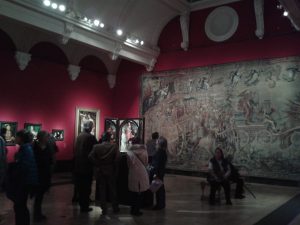
The work of other artists was also represented in the exhibition: tapestries, altarpieces and paintings all capture the important themes of the period, reflecting the turbulent age in which they were created. The fifteenth and sixteenth centuries were a time of dramatic change in Europe, with intellectual exploration, religious questioning and a shifting of the balance of power. The works of art portrayed here are interesting in their own right, but are also emblematic of the wider issues of their age.