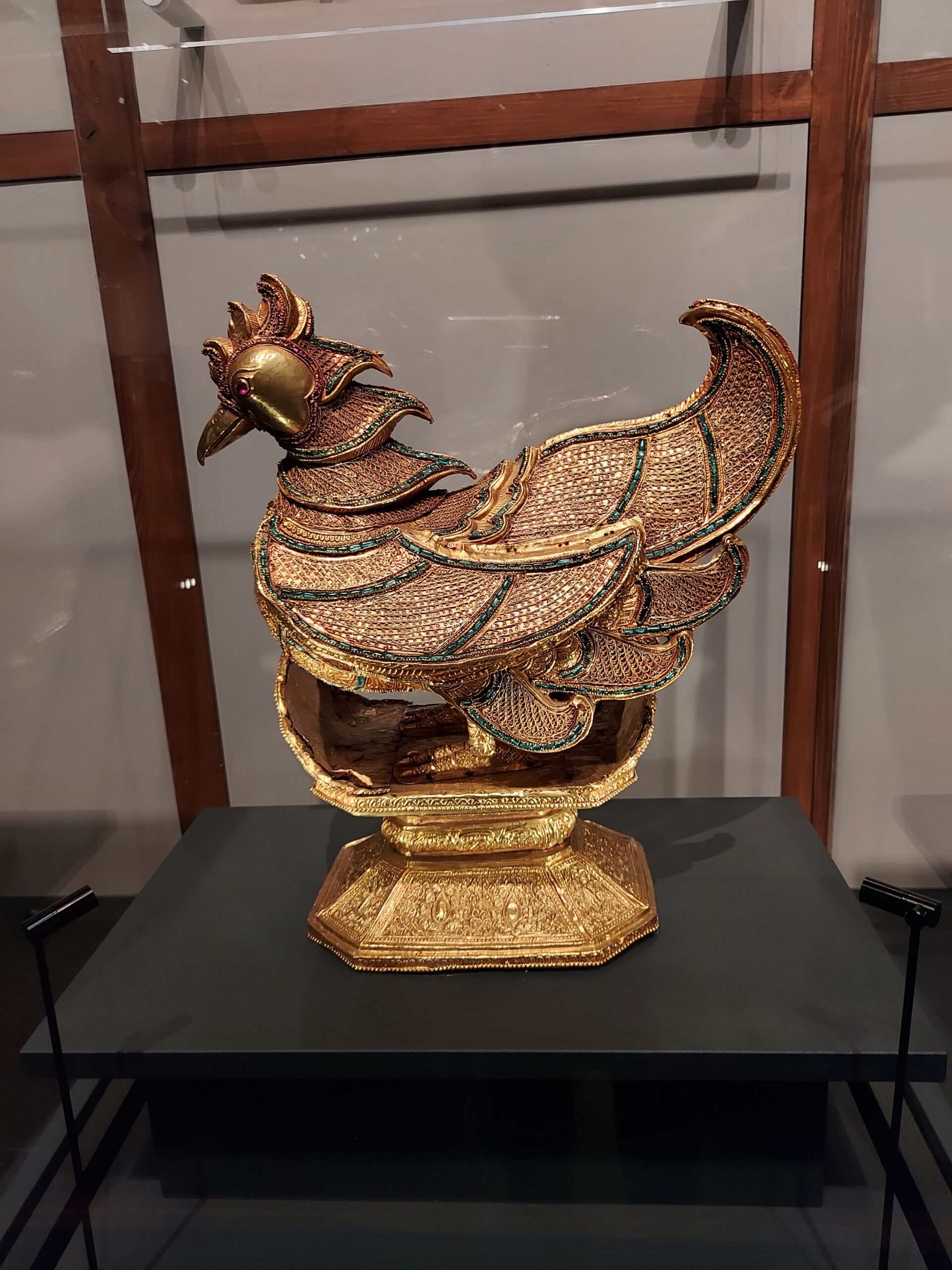
In January I visited the British Museum to see the exhibition Burma to Myanmar. My granda was posted to Burma during the Second World War so I thought I would be interested to see the exhibition.
Myanmar has experienced decades of civil war, and is once again ruled by a military dictatorship. However, the country has a rich history and the exhibition explores the last 1,500 years of that history, looking at how Myanmar’s peoples interacted with each other and with the world. Diverse cultures flourished as links with Thailand, China, Sri Lanka, and even the Middle East and Europe were established and developed.

The exhibition is particularly strong when it looks at events from the last 500 or so years. Between the 16th and 19th centuries it was the largest empire in mainland Southeast Asia. A gold and ruby-studded letter sent by King Alaungpaya to George II in 1756 shows how wealthy and powerful this empire was, but sadly (and unsurprisingly) it wasn’t respected by the British, who subsequently colonised Myanmar and contributed to its later unrest.
Despite a turbulent history, Myanmar has strong cultural traditions, and artists and other figures continue to challenge oppressive rulers. I really enjoyed this exhibition.