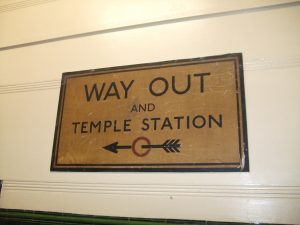
I’ve visited several “secret” stations on Hidden London tours, and recently was lucky enough to go to Down Street, also known as “Churchill’s secret station.” Down Street opened on 15 March 1907 on the new Great Northern, Piccadilly & Brompton Railway (GNP&BR), part of what is now the Piccadilly line.
Designed by Leslie Green, the station was situated on a side road called Down Street, in between two popular stations in a rich area – so it wasn’t used much from the start. The station layout was designed by Sir James W Szlumper, Chief Engineer for the railway. A dispute about the escape route led to several redesigns, and the station opened after the rest of the railway with an extra cross passage, stairs and landing. It closed on 21 May 1932, with its passageways converted to act as a ventilation shaft for the Piccadilly line.
Down Street wasn’t empty for long, though. A Railway Executive Committee was formed to coordinate British railway companies in the event of war, ensuring the smoothest possible travel for people, the military, and supplies. A headquarters was needed: the Underground was safe and this station’s central location was ideal. Plans were drawn up to convert the station: the lift shaft was capped with concrete and air filtration protected against gas attacks. The REC met in the Committee Room, while a typing pool sat just outside and a telephone exchange was situated on the now boarded-up platforms, along with dormitories for those staying overnight: the need for secrecy meant staff could not be seen going in and out all the time and they needed to stay and sleep in shifts.
Executive staff members had sole bedrooms, as well as posh furniture and good food: catering was provided on-site, as well as bathroom and toilet facilities. A team of four motorcycle despatch riders carried letters from above ground. Executive staff members who needed to leave could use the red stop signal located on the platform, stop a Piccadilly line train, and board the train in the driver’s cab.
Churchill used these rooms for 40 days from October to December 1940, at the height of the Blitz when the Cabinet War Rooms weren’t ready. He was impressed with the accommodation, unsurprisingly. One meal he shared with some REC and War Cabinet members included caviar, champagne, brandy and cigars. Later, rooms were built for him in the passageway that London Transport engineers had originally insisted be kept free for escape purposes, although he may have never used it.
These days, Down Street is still used for ventilation purposes. If you look carefully when travelling on the Piccadilly line between Hyde Park Corner and Green Park, you may catch a glimpse of this hidden station.
I was lucky enough to snap up a ticket to the Hidden LondonAccess All Areas Subterranean Shelter: Clapham South tour in association with the London Transport Museum. This was a unique opportunity to go underground and explore one of the shelters that was built during the Second World War as a refuge for Londoners to stay safe from the Blitz. I arrived at Clapham South station on Sunday morning and excitedly awaited my turn.
Entrance to the shelter
We were given wristbands and taken down the road to an imposing white cylindrical building, set into the side of a housing estate. I am sure the residents were bemused by all these people going in and out all day. We were taken around the space by several guides, all of whom were really knowledgeable and helpful. This is just as well as the shelter is a big place, and it would be very easy to get lost if you were separated from the group.
Inside the shelter
Clapham South subterranean shelter was one of eight shelters built between 1941 and 1942, 120 feet below ground and underneath even the tube itself. Previously, people had been sheltering in tube stations but even they were not safe in case of a direct hit: for instance, an bomb at Balham tube station in 1940 killed 66 people. The eight shelters together could hold 64,000 people, though in reality the total was never much more than 12,500.
One of the long tunnels making up the shelter
The shelter at Clapham South was dug out by hand by workers on 12-hour shifts, with no protection from the conditions. Once the death toll reached double figures they were finally provided with a shield. The resulting tunnels were made of cast iron and concrete, with two entrances: one at Balham Hill, the other at Clapham Common. The excavation caused a huge mountain of dirt to appear on the Common.
Photograph of a newly-opened deep shelter
Once construction work had finished, the worst of the Blitz was over and the shelters were initially used for other things, such as military occupancy. In 1944, however, the V1 and V2 raids began, and the shelters were hurriedly converted to their original purpose. Up to 8,000 people could be accommodated at Clapham South, though in practice the shelter never held more than 4,000 at once.
Former bathroom
Remains of what was once a bathroom
Clapham South shelter was well-organised. On entering, a shelterer would be allocated a ticket to a dormitory; these dormitories were typically named after admirals. The shelter had a superintendent and a small hospital, with a doctor, nursing staff and a consulting room. For entertainment, music was played over the PA system, and sometimes dances were held. Chemical toilets were provided, with an innovative air compression system to shoot waste to the surface every few days. There were eight canteens dotted around the shelter, staffed by volunteers, with food provided by London Transport. The food was off the ration, but more expensive than it was at the surface: a cup of tea, for instance, was tuppence.
Directions
This area of tunnel was once a surgery
The shelter was connected to the Underground via a tunnel designed, but never used, as an emergency exit. Sometimes, shelterers were allowed to leave this way to hop on a train and get to work in the morning. Plans to convert this and some other shelters to an express Northern Line after the war never happened, owing to lack of funds. Instead, another function had to be found for the shelters once the war had ended in 1945.
Entrance to the Northern Line
After the war, Clapham South was used as a penny hotel, cheap accommodation for those visiting London on a budget. It was also used to house some of the arrivals from the Windrush once they arrived from the West Indies. During the 1951 Festival of Britain, the shelter was transformed into the Festival Hotel, costing three shillings a night. Used mostly by young students, female guests got sheets for their beds while men had to content themselves with blankets. The shelter was also used to house troops during the funeral of George VI and the coronation of Elizabeth II.
Sleeping quarters in the shelter
After a fire took place in another shelter, it was decided that the shelters were no longer safe for accommodation. What then should they be used for? TfL took over the shelters in 1998, and many were used for archive storage. Here, the last archives left in 2008, but they are still in place in some other shelters, such as Goodge Street. Another is now used for growing micro salad for an upmarket restaurant.
I loved my fascinating tour of the Clapham South shelter. Everyone was really knowledgeable and it was amazing to be in such an atmospheric place.
Underground at Charing Cross, waiting to go through the barriers
The tube is one of my obsessions, and I’ve already toured the closed Aldwych/Strand station, so I was thrilled to have the chance to tour the disused Jubilee Line platforms of Charing Cross station. The tours, organised by the London Transport Museum and Hidden London, sold out almost as soon as they went on sale. We were told to meet by the barriers in Charing Cross underground station – this was unusually quiet for a Sunday, perhaps because the main line station was closed.
This walled-up entrance was once the way to the Jubilee line
We were issued with wristbands and taken through the barrier and down the escalator. Once we had reached the bottom, a door in the unassuming wall directly in front of us was opened and we were ushered through to find another escalator, this time switched off, so that we had to walk down it. At the bottom were the platforms, decorated with film posters left over from the Underground Film Club‘s recent residency.
Hidden London poster
The Jubilee line was first opened in 1979, two years after the Queen’s Silver Jubilee which lent its name to the line as well as the silver/grey colour of the line on the tube map. Known prior to its construction as the Fleet line, after the tributary of the Thames that also gave its name to Fleet Street, it took over what was formerly the Bakerloo line between Stanmore and Baker Street, continuing on to Charing Cross, a station with a chequered history, having originally been two separate stations that were united only when the Jubilee line platforms opened.
Poster showing the stations along the Jubilee line when it first opened
For twenty years the Jubilee line served Charing Cross, alongside the Bakerloo and Northern lines. However, in 1999 the Jubilee line was extended: the line was rerouted from Green Park to Westminster, carrying on south of the river to the Docklands area and the O2 (then the Millennium Dome), curving back up and terminating at Stratford. The Green Park-Charing Cross section of the line has been closed to regular tube trains ever since, though it is still used as a sidings and in certain circumstances trains can be sent down here to help avoid congestion – one of my friends was once on a train that was temporarily rerouted down here, and when she told me about it I was VERY jealous.
One of the platforms
Our knowledgeable and informative volunteer guides told us all about the station, its history, and how it is used today. It is often used for testing new features.
The yellow wall signifies that there is an exit on the opposite side
For the first time in this station, the name of the station was positioned lower on the wall so it could be read from the train
In case of emergency, shining a light on these yellow panels makes them glow green, so that they stand out in the darkness
The station is sometimes used for storage.
You wouldn’t get this in a normal station – it is used for moving things off and on trains
The station has a distinctive look that you can recognise if you see it on screen – so long as you know what to look for.
The open ceiling signifies air vents.
We were shown a series of short film clips featuring Skyfall (2011/12), Paddington (2013) and the TV show 24 (2014), filmed on these platforms. As I had learned at Aldwych station, historical TV programmes and films tend to be filmed in that station, whereas more modern shows tend to be shot here at Charing Cross.
This is the escalator that Bond slid down in Skyfall: thankfully with the spikes at the bottom removed!
After we had explored the platforms we were divided into two groups and taken to see more hidden parts of the station.
In the film Creep (2004) a creature comes out of this very hole.
My group visited a construction tunnel first – entering via the door that Daniel Craig pops out of in Skyfall, blending in seamlessly with the hordes of commuters.
It was dark and rather disgusting in the tunnel – but still incredibly exciting
When the Jubilee line was first being built, constructors couldn’t dig directly beneath Charing Cross station, as this would have been too disruptive for traffic. Instead, they sunk a hole next to the National Gallery – where the Sainsbury Wing is located now – and tunnelled along from there.
We were walking under Trafalgar Square at this point
An older part of the tunnel is now entirely blocked up, in a location directly beneath the Fourth Plinth.
The tunnellers used the same methods as the original Underground workers did back in the nineteenth century.
Posters comparing the construction of Underground tunnels, almost a century apart
Once out of the tunnel, we changed places with the other group, causing passing tube-travellers to look somewhat bemused as we emerged from one door in the wall only to enter another one shortly afterwards.
We had to don hard hats for this part of the journey.
This is the cooling system for parts of Charing Cross station. I had no idea, waiting for a train, that there was all this space above my head.
From here we could LOOK DIRECTLY ONTO THE PLATFORM AND THE TRAINS.
Train is gone…
Train has arrived
I had hoped that somebody on the platform would look up and get a shock, but sadly it was not to be. However, the guy in front of me later managed to frighten a tourist by waving to her from the passage.
We went off down the passage in the other direction to see where the cooling system begins. It’s possible to see it from outside the station, if you know where to look. It was raining outside and we could feel the rain on our faces.
That was the end of the tour. We were taken back to the top of the escalators to make our own way home.
I had an AMAZING time and would definitely recommend the tour to anyone who might be interested. It is sold out at the moment but there may be more tours announced in the future, so I’d recommend signing up to the London Transport Museum’s mailing list to be the first to find out about any future dates. The guides hinted that there would be more exciting tours to look forward to – I’m hoping for Down Street but I’ll have to wait and see!
I am a massive geek when it comes to the Tube and I am trying to visit every station on the London Underground map. The London Transport Museum has an events page which I check regularly and I was thrilled to see that they were opening up Aldwych Station, closed since 1994, for tours. I didn’t have to go alone – a couple of my friends were interested in visiting too. We queued up outside the station entrance last Friday night – a bit different from our usual end-of-week shenanigans.
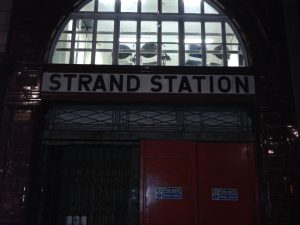
The station, on the corner of the Strand and Surrey Street, was named Strand when it first opened in 1907 but renamed Aldwych in 1915 when another station (which later became Charing Cross) was given the name of Strand. The Aldwych name was printed on a canopy extending from the front of the station, which was removed when it closed: this is why the station façade bears the name Strand.
The station was doomed from the beginning: when the Piccadilly Line was created by the merger of two separate projects, Aldwych was left as a single station on a short branch south from Holborn. Though it had two tunnels, only one was generally operated as a shuttle service; it was rarely crowded even during rush hour, and from 1917 was closed every Sunday. The second tunnel was bricked up during the First World War and used as secure storage for National Gallery paintings.
The light use of the station was such that in 1922 the booking office was closed and tickets were sold from booths inside the lifts. In 1958 the line was used only during rush hour, and in 1994 the station was closed to the public for good, owing to the prospect of replacing the ageing lifts: London Underground felt that the cost could not be justified. An extension of the line to Waterloo station was proposed on several occasions but was rejected each time owing to complicated political reasons. I feel this is a shame as if this had gone ahead I’m sure it would have been well-used.
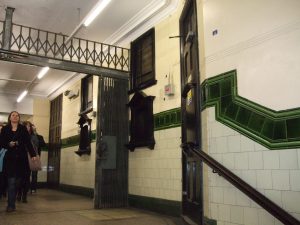
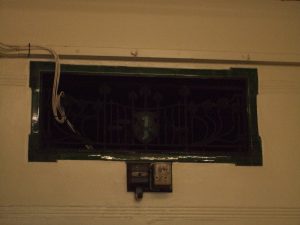
I was fascinated to learn about the history of the station during the tour. We began by meeting in the booking office, where one of our guides gave us some background information and pointed out some features of note. The ticket office itself was built in the 1980s as part of the upgrade to the ticketing system, however other ticket booths were original ones and much of the tiling and flooring dates from 1907 when the station was built. The wash basin in the ladies’ bathroom is also, apparently, an original one, and I was impressed by the Art Nouveau designs above the lifts.
After the short talk we were given a little time to look around and take photographs, a procedure which was repeated at each point on the tour. After this it was time to make our way downstairs. Long-time users of the London Underground will probably be familiar with the seemingly never-ending spiral staircases built into stations such as Covent Garden and Goodge Street. This staircase was similar but it didn’t seem to take nearly as long to reach the bottom, perhaps because I was excited about the tour!
Our second stop was by the lifts. Six lift shafts were – inexplicably, according to our guide – installed, but only two lifts were ever actually built. You can look through the railings at the dark, deep lift shafts: I found this rather spooky.
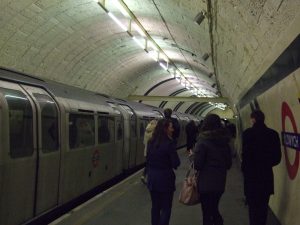
Next, we visited one of the platforms. This platform was in use as a shuttle service up until the closure of the station in 1994. A working Tube train still exists on the line. This platform is frequently used for filming, owing to its old-fashioned look and feel. The original tiles still exist, though have in some areas been painted over. Movies set in the mid-20th century are those most commonly filmed here, such as Atonement (2007) and The Edge of Love (2008). Contemporary films tend to use the old Jubilee Line platforms at Charing Cross, as they were closed more recently and therefore have a more modern appearance. Our guide told us that the posters on the wall, as well as the picture of the Tube map, were not original and were actually put up for filming.
The station was used as a shelter during World War II and played host to a large number of people. The poor facilities gradually became replaced with chemical toilets and metal bunks, and a canteen, first aid post and a library were installed. Entertainment was put on for the benefit of the shelterers and church services were even held on Sundays.
Our final stop was at the other platform, which was bricked up and used as storage during World War I. It was used for the same purpose during the Second World War, when the Victoria and Albert and the British Museum moved many valuable artefacts down here, including the Elgin Marbles. The tiling on this platform is unfinished, suggesting that heavy use of the station was not anticipated even when it was first built. The original track, including wooden sleepers, is still in place here. Filming has taken place on this platform too, and some of the posters were put up for this purpose. Others, however, were placed here to test out new forms of paste before using them on the rest of the Tube: as our guide pointed out, since some of the posters have been here since the 1970s, the paste must have been effective!
Sausage rolls with your shoes, anyone?
This platform has also been used to test designs for other London Underground platforms, including the new Victoria Line in the 1960s, and the refurbishment of Piccadilly Circus in the 1980s. However, the original Strand station name can still be seen on the tiling behind the posters.
Standing in front of the original ‘STRAND’ sign
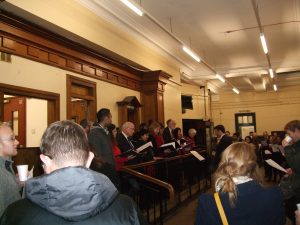
After the tour, we headed back upstairs and were given mulled wine and the chance to hear the TfL Choir in action. They sang classic music hall songs including ‘Daisy Bell’ (1892) and ‘Let’s All Go Down the Strand’ (1904) as well as several Christmas carols.
I had a brilliant time on the tour and I’m really glad I went. I feel it was worth paying the extra £5 for an evening tour (the daytime tours cost £20, the evening tours £25) for the mulled wine and the concert. Further visits to the station should be posted on the London Transport Museum’s events page, which I recommend keeping an eye on.
Thanks to the tour guides, many of whom are volunteers, for their knowledge and enthusiasm. I would like to credit the Aldwych: The Secret Station booklet handed out at the end of the tour for providing me with extra snippets of information which I used in this post.