
Granny Yaga by Vitali Vitaliev is so much fun – it mingles Russian folklore, Soviet satire and the history of London into a novel that should entertain adults and children alike. I really hope there is a sequel!
A blog about London and other things

Granny Yaga by Vitali Vitaliev is so much fun – it mingles Russian folklore, Soviet satire and the history of London into a novel that should entertain adults and children alike. I really hope there is a sequel!
Somerset House is one of the most interesting buildings in London, with a long and rich history – in terms of the site itself, not just the existing building. It’s also been used as a film set on numerous occasions. I signed up to the Shot on Site tour to learn more about this aspect of the building’s history.
Our tour guide was enthusiastic and knowledgeable and I learned a great deal about the topic. Around 40 films have been captured here to a greater or lesser degree over the years, beginning with The Long Arm (1956) and The Day of the Jackal (1973), in which Somerset House effectively played itself, as the home of birth, marriage and death records that it then was.
Those films were unusual in that they used interior shots: this is rare as Somerset House, being designed as an office building, does not have particularly lavish interiors. For instance, the exterior stood in for the Devonshire residence in London in the film The Duchess (2008). In children’s movie Nanny McPhee and the Big Bang (2010), Flyboys (2006) – about a group of American pilots – and even Sleepy Hollow (1999), with the aid of some green screen, aspects of the Somerset House courtyard stood in for various locations, including a London street and a French hospital.
Somerset House has appeared in two Bond films, Tomorrow Never Dies and Goldeneye, standing in for a St Petersburg car park in the latter. It has “played” Buckingham Palace three times – in TV series Spooks, comedy The Worst Week of My Life and in children’s sequel Agent Cody Banks: Destination London (2004). The site has appeared in X-Men: First Class (2011) and in the 19th century-set romantic comedy Hysteria (2011) with Maggie Gyllenhaal, who apparently took several takes to cycle away wearing cumbersome Victorian skirts!
For me, the most fascinating part of the tour was the visit to the Lightwells and Deadhouse in the basement. The Lightwells, narrow passages running around and underneath the courtyard, are gloomy and atmospheric and acted as a prison in the Robert Downey Jr. Sherlock Holmes movie. In the Deadhouse, so named because it is the last remaining part of the palace that once stood on the site and still contains graves of palace staff, we were informed that it stood in for a bunker below the Ministry of Defence in the World War II thriller Glorious 39.
Finally, we were shown some glimpses of forthcoming movies which used Somerset House for filming, including the soon-to-be-released Suffragette. I really enjoyed the tour and if it comes back next year – which it may well do as part of the Film4 Summer Screen season – it’s definitely worth getting a ticket.

After the slightly lurid experience of The Clink my friends and I headed to the other museum we were interested in, The Old Operating Theatre Museum & Herb Garret. This small museum, which was boarded up for years and only rediscovered 50 years ago, is located near London Bridge station – handily opposite the pub we found to have lunch in. As the oldest operating theatre in Europe, it is a unique little museum and I had been meaning to come for some time.
The operating theatre’s location in the roof of a church seems odd, until you consider that St Thomas’ Church was originally alongside St Thomas’ Hospital, now demolished. The wards of the South Wing were built directly around the church, with the operating room encroaching into the church roof. Before 1822, when the theatre was built, women (men had a different ward and operating theatre) were operated on in the ward itself, which must have been highly unpleasant for all involved. In 1815, the Apothecary’s Act stated that apprentice apothecaries must attend at public hospitals; this led to hundreds of students watching operations in this and other nearby theatres. Anaesthetics were only introduced in 1846, by which time this operating theatre had closed down. Therefore it is unique in representing a late stage in the history of surgery before anaesthetic. When St Thomas’ Hospital moved to Lambeth in 1862, the Operating Theatre was partly dismantled and the entrances were blocked up. Despite minor references in academic publications, it was largely forgotten until 1956 when a researcher, Raymond Russell, decided to investigate. Following his discovery, a fundraising plan was launched to restore the space, which was officially opened in 1962.

Entrance to the museum is not for the faint-hearted or the mobility-impaired. You have to climb up a spiral staircase, located in the church tower, to reach the tiny foyer and gift shop. We had arrived in time for the 2pm Saturday talk, Speed Surgery! – a demonstration of surgical techniques in the nineteenth century – which I’d booked in advance via email as advised on the website. It wasn’t as busy as we – or the staff – expected, possibly because the weather outside was lovely and everyone was out enjoying the sun.  The talk was fascinating, and covered many aspects of surgery before anaesthetic and germ theory. We learned that most surgeons did not wash their hands before operating, and wore aprons that were covered in blood from repeated use. We also examined the operating table, with grooves to catch the blood and boxes of sawdust underneath to absorb the gore. Trainee surgeons could watch and observe operations – in the absence of anaesthetic, a surgeon had to be fast in order to cause the minimum amount of pain possible. While surgery in general was dangerous and had a low survival rate, some minor operations, such as the removal of gallstones, were performed with good rates of success.

We were shown a variety of surgical instruments – these were fearsome-looking, though well-made: surgeons would often have a set of instruments made specially which they would carry around in a velvet-lined case. Beautiful, sure, but not particularly hygienic. I knew some of what we were told as I had studied the “Medicine Through Time” module way back in my GCSE days, but some of it I had forgotten, and I learned some new things too.

During and after the talk we had the chance to admire the operating theatre itself, which was tiny and neat. Entrance was originally through the door at the back, now boarded up, which led to the hospital – not the spiral staircase, which is reassuring. This was the theatre for women – the men were operated on elsewhere. In the absence of electric light, this operating theatre, like many of the period, was located high up with large skylight windows, allowing for maximum natural light.
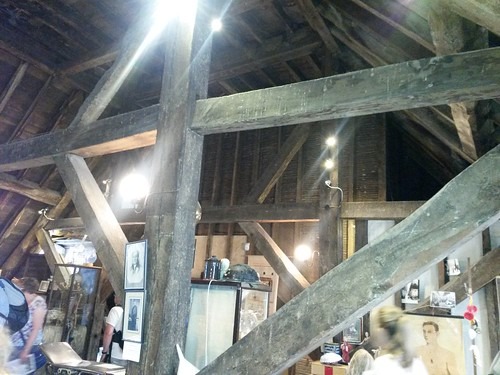
The museum itself has many interesting exhibits to do with the history of surgery and of the building, including fascinating photos of the area in the 19th and 20th centuries, and pictures of similar surgeries. There are numerous surgical instruments on display, as well as anaesthetic equipment and a section on children’s medicine, including a record of deaths in the area.
The “Herb Garret” aspect of the museum refers to the fact that when St Thomas’ Church was rebuilt in 1703, the large garret in the roof space was used by the St Thomas’ Apothecary to store and cure herbs. When the building was being restored, numerous herbs were found, including four opium poppies packed into the rafters. The exhibition includes many and varied herbs, with notes on what they were used for. There are also some notes on old-fashioned medical remedies – the most bizarre thing I learned was that in “ye olden days”, pregnancy tests were carried out by injecting a frog with the expectant woman’s hormones. If she was pregnant, the frog would lay eggs. The Old Operating Theatre & Herb Garret is a fascinating small museum that is definitely worth visiting. As well as the talks during museum hours, there are occasional special events – see the website for more details. Please note, however, though the museum has a gift shop there is no refreshment area and there are no toilets – so maybe pay a visit to the pub across the road before you go in!
Address: 9a St. Thomas Street, London, SE1 9RY Website: thegarret.org.uk Opening Hours: 10.30am-6pm Prices: £6.50 adults, £5 concessions, £3.50 children
My friends Gemma and Elizabeth, like me, are history geeks and when we got together in London we decided to go to a couple of museums. The Clink Prison Museum had been on our radar for a while, so when we met on Bankside we decided to venture over to London Bridge to check it out.
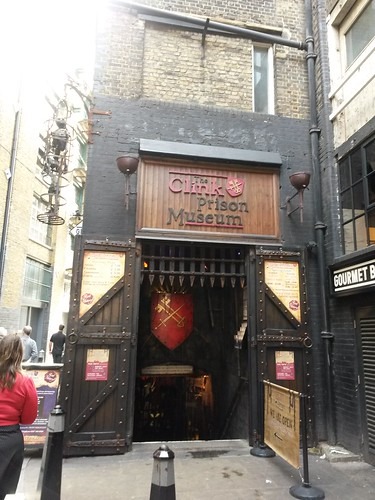
The museum is built on the site of the original Clink Prison, which dates back to 1144. The prison supposedly got its name from the clinking sound the prisoners’ chains made as they jangled together, and the name became a nickname for prisons all over the country. For over 600 years the prison housed debtors, drunkards, heretics, prostitutes and other criminals within Southwark, an area notorious for being morally dubious – everything that was banned in the more staid City across the river took place here instead.
The prison was originally established as two separate prisons, one for men and one for women, in the grounds of Winchester Palace, the residence of the Bishop of Winchester. Henry of Blois, brother to King Stephen, became Bishop in 1129 and his palace, of which only the wall of the Great Hall containing the Rose Window is still visible today, was completed in 1144. Bankside was subject to the laws of “the Liberty of the Bishop of Winchester”, later “the Liberty of the Clink”.

Notable criminals housed within the Clink at various points include Sir Thomas Wyatt the Younger, who rebelled against Queen Mary I; Royalist supporters during the English Civil War; and Puritans who ended up settling in the New World as Pilgrim Fathers. However, hundreds of ordinary people were imprisoned here, though often the only record we have is a name. The museum website lists several examples, including the wonderfully named prostitute Prusanna Carnall (imprisoned 1661) and William Albaster, imprisoned in 1599 for refusing to attend church (!).
Attempts were made to destroy the prison during the Peasants’ Revolt in 1381 and Jack Cade’s rebellion in 1450; after each occasion the Clink was rebuilt, with the final two-storey prison occupying the current site of the museum. The end came during the Gordon Riots in 1780: Lord George Gordon, angry that Catholics had been granted favours in the new “Papists Act”, gathered together members of the Protestant Association and, among other things, broke into the Clink, burned it to the ground and released all the prisoners (none of whom, thankfully, were ever recaptured). Today, the remains of the Clink consist of the Winchester Palace stonework, the passage called Clink Street, and the structure preserved within the museum itself.
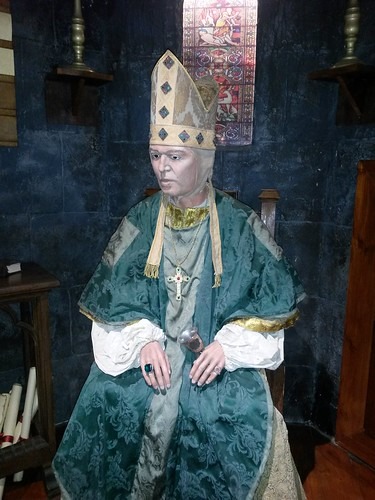
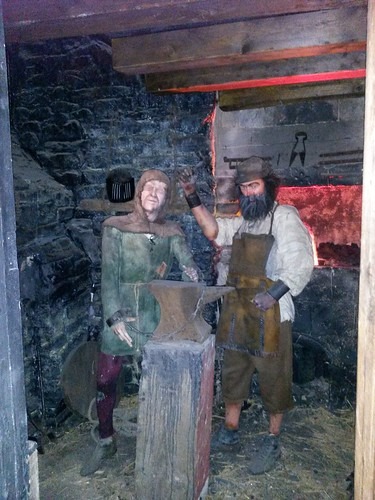
We arrived at the Clink at about eleven on a Saturday morning. We entered down the steps and were greeted cheerily by a costumed assistant (who, we found out later, was also manning the gift shop round the other side). We paid our entry fee and entered. The museum is atmospherically contained in a dingy basement; some of the structure was part of the original Clink. Evil-looking waxworks were dotted about, representing blacksmiths, gaolers and unfortunate prisoners.
Information boards displayed lots of interesting facts about the Clink, but in some cases they didn’t look very professional – there were some glaring spelling errors including, in one case, the misspelling of the word “prisoners”. Having said that, I learned a lot from them: the boards gave information about the history of the Clink, the prisoners kept here and the punishments used. As we went round the museum we noticed that the information was sometimes a little disjointed, although it did follow an approximate chronological order.
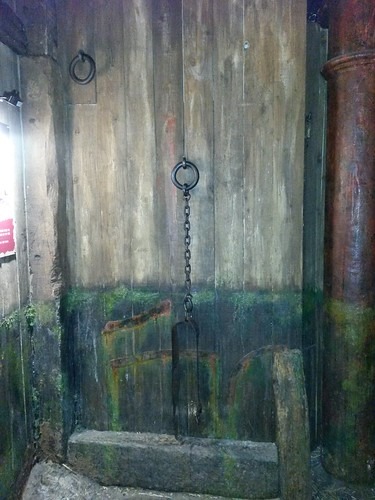
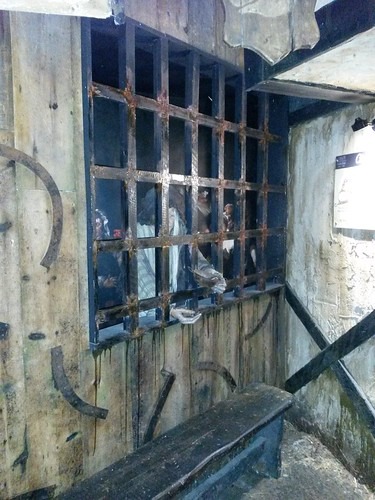
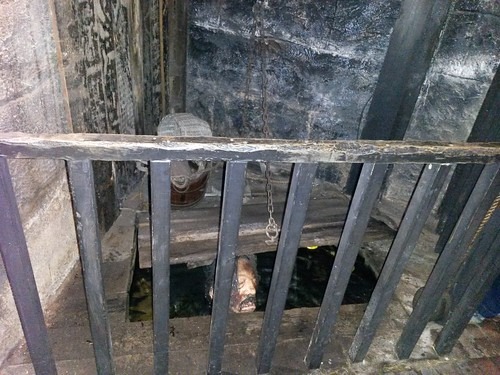
The museum concentrated on the kinds of punishments used – the oubliette, the stocks and other forms of torture – and I thought that this was rather a shame. It seemed as though the curators were trying to sensationalise the prison and turn the museum into something like the London Dungeon. I felt that they missed their chance to create a more “serious” but really worthwhile museum about the rich history of the Clink.
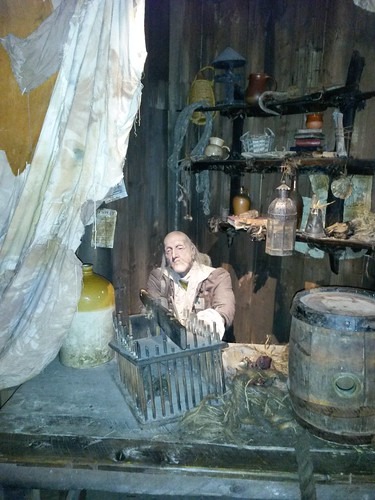

That said, I did enjoy my visit, and it was certainly an experience. I wouldn’t recommend going alone, though!
Address: 1 Clink Street, London, SE1 9DG
Website: clink.co.uk
Opening Hours: 10am-6pm (winter)/9pm (summer), 7 days a week
Prices: £7.50 adults, £5.50 children/concessions

I finally read Carrie by Stephen King, after watching the film and seeing the musical version. It was a bit disjointed, but I enjoyed it.


While I was in Stratford upon Avon recently I found the time to pay a visit to Stratford Butterfly Farm. This is located over the river from the theatre, a very short walk away. I didn’t find it too busy when I visited, perhaps because it was a sunny day – I can imagine it being a popular rainy day activity for families. It’s also popular with school groups.

The entrance to the Butterfly Farm is bright and attractive with lots of colourful wildflowers. The entrance is also the gift shop, which contains an array of toys and jewellery. After paying my entrance fee I moved into the main Flight Area, a tropical paradise full of plants, with butterflies flying overhead and a pond in the middle. There is also an iguana – thankfully there were signs directing us to look up, as he was sunning himself by the ceiling and blended in so well with his surroundings that he would have been impossible to spot otherwise!

The other rooms at the Butterfly Farm all lead off this main tropical room and I spent most of my time in here. The butterflies were gorgeous and there were lots of them to see. Naturally enough there were signs advising people not to touch the butterflies’ delicate wings. Signs displayed the kinds of butterflies that could be seen; some of them are bred here and others are imported. I have been to the summer-only “Butterflies” exhibition at London’s Natural History Museum and this experience was certainly comparable to that.


The Caterpillar Room contains several species of impressive caterpillar, as well as silk moths and pupae. Information boards explain the kinds of butterfly each caterpillar will turn into – it’s not always possible to tell from the caterpillar itself! There is also an Emerging Cage where, if you are lucky, you can spot a newly-formed butterfly emerging from its cocoon.

This room in particular, and the whole Farm in general, is also home to a family of quails. There is a sign up warning visitors not to step on or disturb these adorable little birds. The main room is also home to several brightly-coloured budgies.
I must admit I was rather worried about going into Arachnoland, as I do have a phobia of spiders. However in the end I wasn’t too worried about viewing these creatures from the safety of the other side of the glass – I was more concerned when the spider was hiding somewhere and I couldn’t keep an eye on it! If you are interested in spiders of all sizes from small Black Widows to larger tarantulas then this will be very interesting for you.
Insect City was a fascinating area, containing an incredible variety of insects from all over the world, including mantids, stag beetles, stick insects and grasshoppers. I think these creatures are amazing and I really enjoyed having a look at them. This area is also home to some impressive Giant African Land Snails, poisonous frogs and a rather cross-looking chameleon!

I spent around an hour and a half in Stratford Butterfly Farm and thoroughly enjoyed my visit. I had a great time getting away from it all in a tropical paradise for a little while. It’s definitely worth popping in here if you are visiting Stratford, particularly if you want a break from all the Shakespeare.
Address: Swan’s Nest Lane, Stratford-upon-Avon, Warwickshire, CV37 7LS
Website: butterflyfarm.co.uk
Opening Hours: 10am-5pm/6pm depending on season
Prices: £6.25 adults, seniors/students £5.75, children 3-16 £5.25

I debated whether The Land That Time Forgot by Edgar Rice Burroughs counted as “a book with nonhuman characters”, but in the end I decided that it did, as the Wieroos, unlike the other kinds of humans the main characters meet throughout the novel, are fictional. Originally published as a trilogy of short novels, the work is an entertaining account of the discovery of a lost world.

Shadow by Karin Alvtegen, like many of the popular Nordic noir novels in my experience, has a one-word title; it’s also the title of the book within-a-book that is central to the complex and intriguing plot.

A God in Ruins by Kate Atkinson is a companion piece to Life After Life and moves backwards and forwards in time between the present-day and World War II. A good read, but it was the ending that really got me.
Sir John Soane’s Museum is a unique free museum near Holborn, the former home of the neo-classical architect responsible for the Bank of England. He established the house as a museum in 1833, and it contains numerous treasures from his collection.
I booked online for the rare chance to visit the Private Apartments at the top of the house. These were originally home to Soane and his wife, and later to curators of the museum. After refurbishment, they have been made available to visit as part of a guided tour.
I turned up with my ticket and was directed upstairs, where the group of us due to tour were gathered together and taken up a further flight of stairs, normally roped off. We were told that the house was bombed during the war and was refurbished afterwards; some lovely stained glass was pointed out to us that survived because it was removed from the house before bombing on the orders of the then live-in curator.
The first room we came to was Elizabeth (Eliza) Soane’s drawing room, where she would have taken tea, written letters and received guests. The room was decorated in her own style, with paintings of her children and family group as well as pictures that she liked. These included a beautiful representation of all the flowers in Shakespeare, and several sketches of Shakespearean characters. The next room was her bedroom, kept as it was for several years after her death by a heartbroken Soane, but eventually he turned it into a magnificent display room for his architectural models. The centrepiece was a very impressive model of a semi-excavated Pompeii, and surrounding this, on a beautiful wooden frame, were several models of notable classical buildings in both cork (for ruined buildings) and plaster of Paris (for models of buildings as-new). On the bottom of the stand were models of Soane’s own buildings, emphasising the inspiration Soane took from the classical world.
Following this we entered Soane’s bathroom, an elaborately decorated room with a grandfather clock (!) in the corner. The room contained an actual bath, and there were hot water pipes on the wall, but it is uncertain exactly how the system worked. After Soane’s death, the bath was sealed up at his request, and when it was opened after some years had passed it was found to contain a number of effects, such as pictures and documents, though none of these contained anything groundbreaking.
Next to the bathroom was Soane’s bedroom, although the bed there was not an original (that had been sold) but was one that had come from Pitzhanger Manor, his country house. Finally, we were led out of the apartments via a corridor decorated with lots of art and two mummified cats, which apparently were supposed to be lucky.
Changes have recently been announced to the Tours of the Private Apartments – the number of tours has been increased and you no longer need to book online, but can turn up on the day. The tours will continue to be free, as is entrance to the museum itself. It is definitely worth making the effort to go on a tour – it’s hugely interesting.