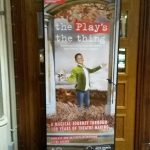
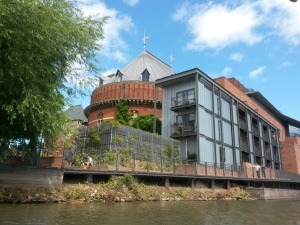
I’m a frequent visitor to the Royal Shakespeare Company, and I was excited to learn about their new exhibition, The Play’s The Thing. This new permanent exhibition covers “100 years of theatre-making in Stratford-upon-Avon.”
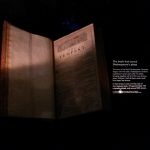
For a short time the exhibition contains the famous Chandos portrait of Shakespeare, on loan from the National Portrait Gallery. The space also displays a First Folio, dating from 1623.
The exhibition is full of costumes and props from the RSC’s history, which I loved looking at, although it made me think of all the productions I’ve missed over the years. For a more hands-on experience, you can also explore the ‘Director’s Desk’, try on virtual costumes (and some actual hats) and learn more about the history of theatre-making in the Company.
Trying on a hat
I had lots of fun in the exhibition. Tickets are £8.50 for adults, £5 for 16-25-year-olds, and £4.25 for children and disabled people. You can convert your ticket into an annual pass so if you visit the RSC often, you can go back again and again.
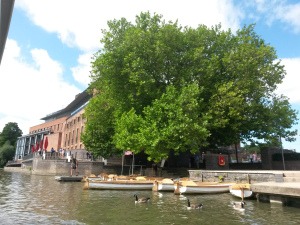
Last time I was in Stratford I went up the Tower in the RSC building, but I also took the opportunity to go for a canal boat ride. It was a gorgeous summer day and I’d been meaning to do this for a while.
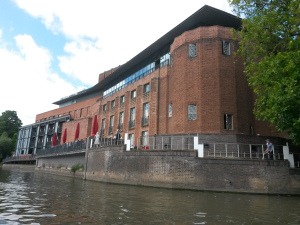
By the riverRSC TheatreSwan Theatre
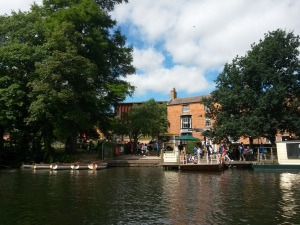
The boat takes you past the theatre and the church before turning around and heading the other way: a lovely trip on a warm day.
Entrance to the Butterfly FarmApproaching the building
While I was in Stratford upon Avon recently I found the time to pay a visit to Stratford Butterfly Farm. This is located over the river from the theatre, a very short walk away. I didn’t find it too busy when I visited, perhaps because it was a sunny day – I can imagine it being a popular rainy day activity for families. It’s also popular with school groups.
Wildflowers in the front garden
The entrance to the Butterfly Farm is bright and attractive with lots of colourful wildflowers. The entrance is also the gift shop, which contains an array of toys and jewellery. After paying my entrance fee I moved into the main Flight Area, a tropical paradise full of plants, with butterflies flying overhead and a pond in the middle. There is also an iguana – thankfully there were signs directing us to look up, as he was sunning himself by the ceiling and blended in so well with his surroundings that he would have been impossible to spot otherwise!
The main Flight Area of the Butterfly Farm
The other rooms at the Butterfly Farm all lead off this main tropical room and I spent most of my time in here. The butterflies were gorgeous and there were lots of them to see. Naturally enough there were signs advising people not to touch the butterflies’ delicate wings. Signs displayed the kinds of butterflies that could be seen; some of them are bred here and others are imported. I have been to the summer-only “Butterflies” exhibition at London’s Natural History Museum and this experience was certainly comparable to that.
ButterflyButterfly
The Caterpillar Room contains several species of impressive caterpillar, as well as silk moths and pupae. Information boards explain the kinds of butterfly each caterpillar will turn into – it’s not always possible to tell from the caterpillar itself! There is also an Emerging Cage where, if you are lucky, you can spot a newly-formed butterfly emerging from its cocoon.
Caterpillar
This room in particular, and the whole Farm in general, is also home to a family of quails. There is a sign up warning visitors not to step on or disturb these adorable little birds. The main room is also home to several brightly-coloured budgies.
I must admit I was rather worried about going into Arachnoland, as I do have a phobia of spiders. However in the end I wasn’t too worried about viewing these creatures from the safety of the other side of the glass – I was more concerned when the spider was hiding somewhere and I couldn’t keep an eye on it! If you are interested in spiders of all sizes from small Black Widows to larger tarantulas then this will be very interesting for you.
Insect City was a fascinating area, containing an incredible variety of insects from all over the world, including mantids, stag beetles, stick insects and grasshoppers. I think these creatures are amazing and I really enjoyed having a look at them. This area is also home to some impressive Giant African Land Snails, poisonous frogs and a rather cross-looking chameleon!
Mr Chameleon
I spent around an hour and a half in Stratford Butterfly Farm and thoroughly enjoyed my visit. I had a great time getting away from it all in a tropical paradise for a little while. It’s definitely worth popping in here if you are visiting Stratford, particularly if you want a break from all the Shakespeare.
While I was in Stratford upon Avon recently to see a Shakespeare play I came across a leaflet stating that tours were being offered around Shakespeare’s old school, King Edward VI School in the heart of the town. I made an impromptu visit, eager to enjoy the chance to look around.
Entrance to the building on Church Street
I was given a tour by a very pleasant and polite pupil of the school (feeling incredibly old as I write that). The building incorporates the 16th century Upper and Lower Guildhall, still used today. The school itself is still going and it is a state school, not a private school, as I’d thought at first. Shakespeare attended this school, then Stratford Grammar School, between the ages of approximately 7 and 14.
The Lower Guildhall
Wall paintings can still be seenFrom the backWay in from the back
The Upper Guildhall
More “hidden” pictures are just visible on the wallTable around which Guild members would have satThe schoolroom, where Shakespeare would have received his education
This pane of glass was kept when the rest was replaced, as it may bear William Shakespeare’s signature
The school was raising money for a forthcoming performance of John Ford’s The Lady’s Trial at the Sam Wanamaker Playhouse in London (the Jacobean playhouse at the Globe Theatre). I wish them the best of luck with their production.
The Stratford upon Avon museum known as Tudor World and The Falstaff Experience is an “interactive museum” all about the town where Shakespeare grew up. It explores life in the Tudor era and looks at where Will may have got some of his inspiration. I popped in last time I was in Stratford to pass some time in between seeing some plays.
The museum is hosted in a Grade 2 listed building on Sheep Street, in the centre of the town. Known as the Shrieve’s House and Barn, it is the oldest lived-in house in Stratford, and used to be home to an inn run by William Rogers who was supposedly the inspiration for Shakespeare’s Falstaff.
The Shrieve’s House and BarnInformative plaque on the wallEntrance to Tudor WorldVisiting
Tudor World is great fun and very child-friendly, with plenty of grim and gruesome exhibits and a “guide” in the form of a young pickpocket who pops up on information boards as you go around. The museum contains a lot of wax figures and other props which I found pretty atmospheric and creepy. There are even “smell-boxes” that let you smell what the deck of a ship or the inside of a pub would have been like! The “Falstaff Experience” part of the museum is a room with a very detailed inn replicated: it is possible that Shakespeare visited the inn and gained inspiration for his character of Falstaff.
As well as being open every day of the week (except Christmas Day) between 10.30 and 5.30, the museum is often open in the evening for ghost tours or ghost hunts (including overnight ones). Occasionally plays are performed in the Courtyard. Admission costs £5.50 for adults and £3 for children, with a family ticket and discounts for concessions available. Well worth a visit on a rainy day, with or without children.
After visiting the MAD Museum, I still had some time left so I also visited the Creaky Cauldron and Magic Alley, just up the road. This place is billed as a shop and museum and it looks as though it was inspired by Harry Potter, with Butterbeer, wands and magical-themed toys for sale. The building is also home to the Enchanted Manor Museum, which I decided to visit.
I had expected a traditional museum with magical artefacts, but I realised quickly that this was not to be, once I was handed a clipboard, a pen and a worksheet. This reminded me of school trips when I was a child, when I had to fill in the answers while exploring the museum. The idea is that you answer questions and solve puzzles as you go around the museum, which covers two floors above the shop and cafe.
The museum was very atmospheric, with a dark and spooky atmosphere. In fact, at some points when I was alone on the top floor, I genuinely felt rather scared! The museum takes inspiration from magical lore, Harry Potter, His Dark Materials and other magical stories and is full of fascinating tales and interesting facts. I think children in particular would really enjoy this – I felt a great sense of achievement when I received my certificate at the end!
Yesterday I went on one of my many day trips to Stratford upon Avon. The show I was there to see didn’t start until 3 pm, which left me a few hours to kill. I’d wandered past the MAD Museum on Henley Street a few times, and thought the time was right for me to pay it a visit.
I walked in at the right time, as a huge school party was just leaving. There were only a couple of other visitors remaining, so I had most of the exhibitions to myself.
The museum has only been in existence since 2011 (it originally occupied premises on Sheep Street) but has already won several awards, including the TripAdvisor Certificate of Excellence for 2014. MAD is short for Mechanical Art and Design and the museum showcases kinetic sculptures and art. Think marble runs, but much more varied and elaborate!
The museum is full of delights, most of which are interactive: press a button and see what happens. My favourites were the typewriter converted to a music-making machine, thanks to wires connecting each key with a glass filled with water, and the large-scale ‘marble-run’ style sculpture set in a kitchen. Several of the works are available to buy, and all display remarkable ingenuity. This museum is an ideal place to visit no matter what your age or level of interest in mechanics – though I think someone interested in how things work would get the most out of it.