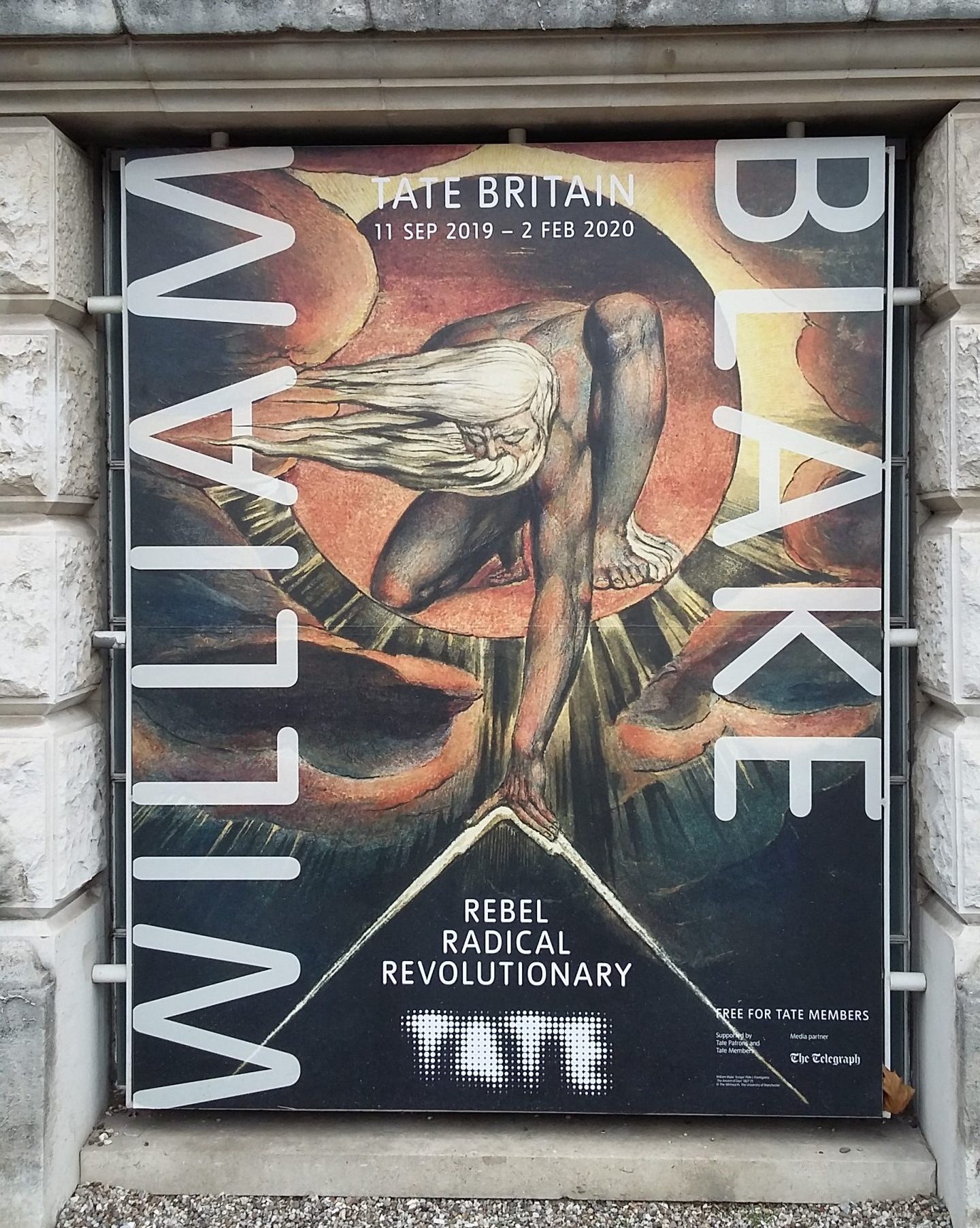
I first encountered William Blake’s work in sixth form, when I studied his Songs of Innocence and of Experience for A level. This major exhibition at Tate Britain explores Blake’s whole life, tracing his development as an artist from his beginnings at the Royal Academy through to his unique and visionary works. It acknowledges the complex questions raised by his images of slavery, and mentions the contribution his wife Catherine made to his work.
Blake was born in 1757 in London, where he lived for almost all of his life, most famously in Lambeth, south of the river. As a teenager he was apprenticed to an engraver, and later studied at the Royal Academy. He initially followed the prescribed course of study, practising by sketching the classical statues provided for this purpose, but grew frustrated with the restrictions this placed on him, and began to explore his own myths in his art. One example of this is his long poem Tiriel: he envisioned this as a combination of words and images, integrated as one whole. Much of his early work, and his images for Tiriel, are displayed in the first rooms of the exhibition.
Blake spent much of his career as an engraver and print maker. He pioneered a technique, still not fully understood, of relief etching, which he used to create beautiful illuminated books, which were not commercially lucrative but were nevertheless admired by a select few collectors. Blake would often produce images without text to sell individually. Two of his key collections, displayed here, are the pages from his famous Songs of Innocence and of Experience, and America: A Prophecy, inspired by the American War of Independence.
Patrons were crucial to Blake being able to make a living. He had several patrons throughout his life, and and a section of the exhibition is devoted to the work he produced for them. However, his relationship with them was often tense as he felt they restricted his creativity and artistic freedom. In later life Blake hosted his own exhibition, above the shop owned by his family, in 1809, however, it was poorly received by the critics.
Towards the end of his life, Blake did receive appreciation from younger artists who saw him as a radical, someone who had refused to compromise his vision. It was at this time that he began his work Jerusalem. The exhibition is a comprehensive, intelligent and engaging exploration of Blake’s work.