My veganuary experience; or, confessions of an ice cream fiend

In January, for some unknown reason, I decided to give Veganuary a go. I’m already pescatarian, but eat a vegetarian diet most of the time, so I decided to try giving up all dairy and all other animal-derived products. Here’s my verdict:

The Good

I enjoyed making interesting vegan meals. I used Cooking on a Bootstrap pretty much as a Bible and in particular grew addicted to the black bean and peanut stew. Lots of the meals I ate as a vegetarian were suitable for vegans too. Price-wise, I didn’t find my vegan diet any more expensive than my veggie one, and in some ways it was cheaper as I wasn’t buying cheese.

I loved exploring the range of plant milks. Almond milk is yummy on cereal. Coconut milk is handy for curries and other meals. In general, plant milks and non-dairy spreads last longer than dairy ones, and in the case of spreads are often cheaper. I discovered that many of the foods I love are acidentally vegan – Hobnobs, Oreos, and Tesco Value garlic bread, among others.

I have a sweet tooth and was very happy to discover this brand of Tesco dark chocolate – which I often heated up with coconut milk to make an amazing hot chocolate.

Tesco Ivory Coast 74% Cocoa Plain Chocolate

I also found Alpro chocolate and hazelnut desserts, which are amazing.

Alpro Chocolate & Hazelnut Desserts

Tesco has recently brought out a range of vegan cheeses, which are reasonably priced and taste good – I really liked the one with jalapeños.

Tesco Free From Jalapeño and Chilli Cheddar

The Bad

I seriously missed regular cheese. And ice cream. I stalked Tesco daily to see if they had any dairy-free Ben and Jerry’s, but it was never in stock. Milk chocolate was out, too. In fact, sweet snack foods were notoriously difficult to find (savoury snack foods were easier, owing to the huge variety of crisps that happen to be vegan).

Constantly checking labels for hidden dairy ingredients became a bore. I know that this becomes less of an issue as you learn to know which foods are suitable and which not, but I grew very grumpy thinking about all the foods I could no longer eat. I felt cross and deprived, and that’s not a good thing.

The Indifferent

Health-wise, I felt no different on a vegan diet. I did feel a bit fatigued at first, but after upping my quota of beans and pulses, I felt fine. I’m convinced that a vegan diet can be just as healthy as a vegetarian or omnivorous one, for the average person anyway.

I had heard that a vegan diet can help clear up eczema, which can be triggered by dairy – this happened to one of my friends. Sadly it didn’t happen to me.

To conclude…

After January was over, I went out and bought a tub of Ben and Jerry’s, and I ate the entire thing.

I believe that a vegan diet can be healthy, cheap, exciting and practical. I also believe that it’s not for me. I’m afraid that I love ice cream, cheese, and chocolate way too much. Having said that, I’m happy to incorporate more dairy alternatives into my life – plant milks, for example. So the month hasn’t been completely wasted.

Jewellery brand of the month: Lali Blue

Welcome to the first ‘jewellery brand of the month’ post for 2018! This month I’d like to share with you the Spanish brand:

LALI BLUE

Lali Blue is run by two independent designers in Castellón, Spain. Pieces are inspired by vintage style, fairytales and stories and made with wood, resin, metal and acrylic.

Top of my wishlist is this beautiful The Lion, The Witch and The Wardrobe Necklace, incredibly detailed.

Lion, Witch, Wardrobe necklace

This 1920s-inspired To the Light of the Moon Brooch is also stunning.

To the Light of the Moon Brooch

Last year’s Halloween collection featured this gorgeous Witch Brooch (which is also available as a necklace).

Witch Brooch

I love this dainty Four Leaf Clover Necklace.

Four Leaf Clover Necklace

This Mandarin Ducks Brooch is adorable.

Mandarin Ducks Brooch

Check out Lali Blue via the following links:

Website: laliblue.es

Etsy: etsy.com/uk/shop/LaliblueShop

Instagram: instagram.com/laliblueshop

Facebook: facebook.com/laliblueShop

Ramin Karimloo Back from Broadway

Another year, another Ramin Karimloo gig – something I’ve been looking forward to for months. After spending time on Broadway performing in the musical Anastasia, he has come back to the UK for a bit. His last Royal Festival Hall gig was back in 2012 – I don’t know where the time’s gone since then!

I can’t find a setlist, but Ramin sang songs from the musicals he is known for, like Phantom and Les Miserables – Music of the Night, Till I Hear You Sing, Bring Him Home – and tunes from other musicals like Oklahoma!, The Greatest Showman and Finding Neverland – Oh What A Beautiful Morning, From Now On and Neverland. He also included songs he has written himself and released previously, as well as a number of new songs. One of the reasons I love seeing Ramin live is that I am always being introduced to new types and genres of music.

It was such a good night and I only hope I don’t have to wait for another year to see Ramin live again.

London Sewing Machine Museum

Entrance to the store/museum on Balham High Road

It’s the start of a fresh new year and I really want to get on to visiting some of the many, many museums in and around London. With that in mind, on the first Saturday of 2018 I headed down to the London Sewing Machine Museum, located near Tooting Bec Station in south London.

Industrial machines
Industrial machines
Industrial machine close-up

The Museum is on the top floor of the premises of the Sewing and Craft Superstore, just round the corner of the station. You go through the front entrance and up the stairs to be confronted with – unsurprising given the name of the museum – sewing machines. There is a room full of them, in fact, all of which are examples of those used in industry (the museum owner supplied all of the machines used in the film Made in Dagenham). In a room just beyond are the machines designed for domestic use, including several miniatures, a number designed to be folded away after use, and one that can be disguised as a lion when not in use. The shop front in the museum is from the original branch of the Wimbledon Sewing Machine Co. Ltd, founded by the grandfather of the present company director, Ray Rushton. He inherited his grandfather’s passion for sewing machines and is responsible for many of the collection’s gems.

Original shop front
Original shop front
Barthélemy Thimonnier's 1829 sewing machine
Barthélemy Thimonnier’s 1829 sewing machine
Victorian sewing machine

I’ve never used a sewing machine myself – I’ve always found them to be a bit scary – but I was fascinated by the museum, in no small part thanks to the enthusiastic volunteer who gave us a short guided tour of the space. If it hadn’t been for her I would certainly have missed Barthélemy Thimonnier’s unobtrusive wooden machine, the first widely-used and practical machine, invented in 1829. More obvious was the ornate Victorian machine gifted to Queen Victoria’s eldest daughter and used by her nurse for many years.

Charlie Chaplin's mother's sewing machine
Charlie Chaplin’s mother’s sewing machine
Boy George alongside the model that helped create his costumes

I certainly hadn’t expected to come across Charlie Chaplin and Boy George in the museum. Machines associated with both entertainers can be found here: the original sewing machine belonging to Chaplin’s mother, and an identical model to that used by Boy George’s mother to sew many of his early costumes.

The museum is surprisingly interesting even for those who aren’t massively into sewing machines, and it’s free too. Well worth visiting if you have a free Saturday afternoon.

FACTS

Address: 308 Balham High Road, London, SW17 7AA

Website: craftysewer.com/acatalog/London_Sewing_Machine_Museum

Opening Hours: 2am-5pm on the first Saturday of the month

Price: Free (donations welcomed)

Author questions

1. Who are your favourite writers?
I have so many, but the ones that immediately come to mind are Charlotte Brontë, Thomas Hardy and Philip Pullman, as well as Chekhov and Shakespeare. Poetry-wise, I love John Keats, Lord Byron, Dylan Thomas and Emily Brontë.

2. Who were your favourite writers when you were a teenager? Which of them do you still like?
I particularly loved nineteenth-century writers as a teenager: the Brontës, Thomas Hardy, Jane Austen, Elizabeth Gaskell. I still love those writers, I just love even more writers now. I first discovered Terry Pratchett as a teen, and I remember especially loving his books. I also really liked Lemony Snicket’s A Series of Unfortunate Events, and I read a lot of John Galsworthy after The Forsyte Saga was shown on TV.

3. Which writers have most influenced you?
See question 1 – The writers I love tend to be the ones that influence me most. A while back I wrote a blog post about the individual books that influenced me.

4. Which writers do you wish had not influenced you?
None.

5. Which writers are you embarrassed you used to like?
None, because I don’t believe in being embarrassed by the writers I used to like. It’s all part of growing up and learning.

6. Which writers did you not expect to like, but did?
Andrzej Sapkowski was a surprise. His Witcher Saga inspired a video game, so my brother, who loves games, asked for the first book for Christmas, but ended up with two copies. I took one, willing to try anything once, and ended up loving it. The series draws on fairytales and folklore for its inspiration, and it is complex and often very funny.

7. Which writers do you think you will still read, and like, for the rest of your life?
It’s hard to predict, I can’t really imagine growing tired of any of them.

8. Who are your favourite prose stylists? Or your favourite writers on the sentence level?
Lawrence Durrell for rich, complex prose. Henry James is hard to read, but worth the effort. Raymond Chandler and P. G. Wodehouse for the most glorious sentences. Examples:
“Neither of the two people in the room paid any attention to the way I came in, although only one of them was dead.” (Raymond Chandler, The Big Sleep)
“He sat looking at it with his eyes protruding in the manner popularized by snails, looking like something stuffed by a taxidermist who had learned his job from a correspondence course and had only got as far as lesson three.” (P.G. Wodehouse, Plum Pie)

9. Who are your favourite writers of characters?
J.K. Rowling for the vivid, complex characters she writes as part of the Harry Potter series. I think the characters are the key to the popularity of the series – The plots are exciting, but once you know what happens it’s still worth revisiting the books because of the characters.

10. Which writers, alive or dead, would you invite to dinner?
Lord Byron and Dylan Thomas, though possibly not at the same time. I think Agatha Christie would be fascinating.

11. Which writers, alive or dead, would you like to know personally? And think you could be friends with?
Charlotte Brontë, as I think we’re quite similar – though maybe too similar? Neil Gaiman would be interesting to know, he always comes across so well on Twitter.

12. Do you personally know any published author?
Louise Rushton! She writes and illustrates children’s books about a dinosaur called Momo.

13. Which writers do you like/admire but generally avoid, for some reason?
I’m struggling to think of one. Generally if I like an author I’ll want to read more of their work.

14. Which writers do you like as critics/ essayists but not as novelists?
Charles Dickens – I’m really not a fan of his novels, but I love A Christmas Carol, his ghost stories, and his account of the time he spent in America. I also admire him for how outspoken he was against poverty.

15. Which writers have changed you as a reader?
Stieg Larsson springs to mind – I read his Millennium Trilogy and it kickstarted my love of Scandinavian crime fiction.

16. Who do you think are overrated?
It’s an obvious one, but Stephenie Meyer and E.L. James. Although I did kind of enjoy the Fifty Shades trilogy because it was hilarious.

17. Who do you think are underrated and should be more widely read?
I think Daphne Du Maurier is well known but she’s too often seen as a romance writer – some of her books are really dark and unsettling.

18. Who do you think are the best living writers?
This is a tough one. Margaret Atwood is one, but other than that I don’t read enough contemporary fiction to really say.

19. Which writers do you go to for comfort?
Enid Blyton, or Alexander McCall Smith.

20. Which writers do you go to for mere amusement?
I don’t like that word ‘mere’ – amusement is very important! P.G. Wodehouse definitely belongs in this category. I would also like to mention William McGonagall, who wrote poetry so bad that it’s good.

21. Who are the greatest writers that you don’t personally like/that you just don’t warm to?
James Joyce – I find most of his work pretty much incomprehensible.

22. Which writers do you hate/ strongly dislike?
Thomas Pynchon. I’m trying to read the Guardian’s 1000 Books You Must Read Before You Die. Three of his books are on there. I’ve read two of them, and let’s just say I’m not looking forward to the third.

23. Which writers are you prejudiced against?
None that I can think of.

24. Which writers do you feel you should have read by now?
Again, none that I can think of.

25. Which writers from your country would you recommend to a foreigner?
There are so many writers from Britain that I can think of and I honestly don’t know who I’d specifically recommend. It would depend on what kind of books the person was interested in.

26. Which writers do you recommend to everyone? Every serious reader?
Shakespeare!

27. Which writers do you wish you could write like?
It depends on my mood.

28. What is your favourite language to read in?
English because it’s the only one I know well enough.

29. Which foreign-language writers make you wish to learn their language in order to read them in the original?
Most Russian writers, but particularly Chekhov, Dostoyevsky, Bulgakov and Tolstoy. Every so often I try to get back into learning Russian, but it usually doesn’t last long.

30. Who is the best writer you’ve just discovered recently?
Shirley Jackson, an amazing American horror writer from the mid-20th century.

Questions taken from thelittlewhiteattic.blogspot.co.uk

What I read over Christmas

books I read at Christmas
The books I read this Christmas

For me, Christmas is a time to get lots of reading done: in bed, on the bus, or sitting on the sofa with my family. This year was no exception and I managed to read this lovely selection. From bottom left as seen in the above picture:

1. The Dark Is Rising – Susan Cooper
A children’s book that I never got around to reading as a child, I was inspired to read this by Twitter, where a Christmas read-along is happening using the hashtag #TheDarkIsReading. I haven’t actually checked out the hash tag much, but I’ve enjoyed the book, which begins on Midwinter’s Eve and comes to an end on Twelfth Night.

2. Bad Santas and Other Creepy Christmas Characters – Paul Hawkins
I’ve really got into Christmas history and folklore in recent years and this book is a fascinating look at some of the darker traditions and characters from years gone by, as well as thoroughly exploring the difference between Santa Claus and Father Christmas. My favourite creature is probably Krampus, but I also have a fondness for Iceland’s Christmas cat, who eats any children who do not get clothes for Christmas.

3. Murder on Christmas Eve: Classic Mysteries for the Festive Season – ed. Cecily Gayford
This selection of festive crime stories is great at creating an atmosphere, and I read it on Christmas Eve itself, which added to the magic.

4. The Dark Blue Winter Overcoat and Other Stories from the North – ed. Sjón
This was the only book I was a bit disappointed by. I love Nordic noir and I thought this collection of short stories might include crime tales, or else horror or folklore stories. However, with the exception of one story by Per Olov Enquist I found the collection to be slightly dull, with many of the stories too opaque for me.

5. Alice’s Adventures in Wonderland and Other Stories – Lewis Carroll
I got this as a Christmas present several years ago, but never got round to reading the whole thing. I’m familiar with the Alice stories and I love them, and The Hunting of the Snark is quite good fun. However, Sylvie and Bruno is very confusing and the two titular characters are supremely irritating – Sylvie is a typical Victorian angelic little girl, while Bruno speaks in an infuriatingly childish manner which I think is supposed to be cute but comes across as rather annoying. Much of Lewis Carroll’s work was written for his scholarly contemporaries, and has little interest for me, though there was a section on letter-writing full of good advice which I think I would do well to take.

6. Harry Potter: A History of Magic
I got this book for Christmas – a beautiful hardback published to coincide with the British Library Harry Potter exhibition.

7. Sleep No More: Six Murderous Tales – P.D. James
I haven’t read much P.D. James, but these short stories make me want to read more of her work. Along with the collection The Mistletoe Murder, which I read earlier in December, it shows that James was the master of the short story form, and the tales are clever, atmospheric, unexpected and sometimes very funny.

What did you read over Christmas?

A Moomin Winter’s Eve / Tove Jansson (1914-2001) – Dulwich Picture Gallery

exhibition poster

This year I read the Moomin books for the first time, and I also visited the Adventures in Moominland exhibition at the Southbank Centre. Continuing the theme, Dulwich Picture Gallery announced a Tove Jansson exhibition for 2017-2018, covering her artwork and illustrations from self-portraits to the Moomins and beyond.

Some friends and I booked to attend the special December event, A Moomin Winter’s Eve. This was an after-hours event that offered activities as well as a chance to look around the exhibition. When we arrived – after spending a while waiting for a bus at Brixton – we headed straight into the exhibition before it got too busy.

Tove Jansson (1914-2001) begins with the artist’s early work, striking self-portraits sitting alongside magazine illustration and magical landscapes. Her later work incorporates more traditional painting, before she turned to illustration in a bigger way. I had no idea Jansson was responsible for illustrating Swedish versions of The Lord of The Rings and Alice’s Adventures in Wonderland – her work is distinctively her own but also clearly captures the atmosphere of the stories.

Then comes her Moomin work, which forms around half of the exhibition. I love her wonderfully expressive drawings of these fantastical creatures, and it was fascinating to see them close up. As the daughter of two painters, Jansson saw herself primarily as a painter even while the world revered her for her work as a writer and illustrator, but while this exhibition helps to paint a wider picture of the artist, she is likely to remain best known for the Moomins. And why not? Her illustrations are certainly classifiable as art, and her books are children’s classics.

pom pom table

After the exhibition, we decided to check out some of the activities. First we went to make flower garlands in a Pom Pom Blossom workshop, run by Pom Pom Factory. We ended up wearing them for the rest of the evening.

My Moomin masterpiece

We then went to join the table drawing Moomin self-portraits. I am certainly no artist, but having a framework of a Moomin silhouette to work on, I managed to produce something passable.

Moomin collage

Finally we went down to the Moominvalley Photobooth, the idea here being to create a collage inspired by Moominvalley and have your photo taken, then superimposed onto your background. Sadly the camera battery ran out while we were making our collage, but it was still great fun.

The exhibition and the evening were lovely and a nice relaxing way to spend a Friday night.

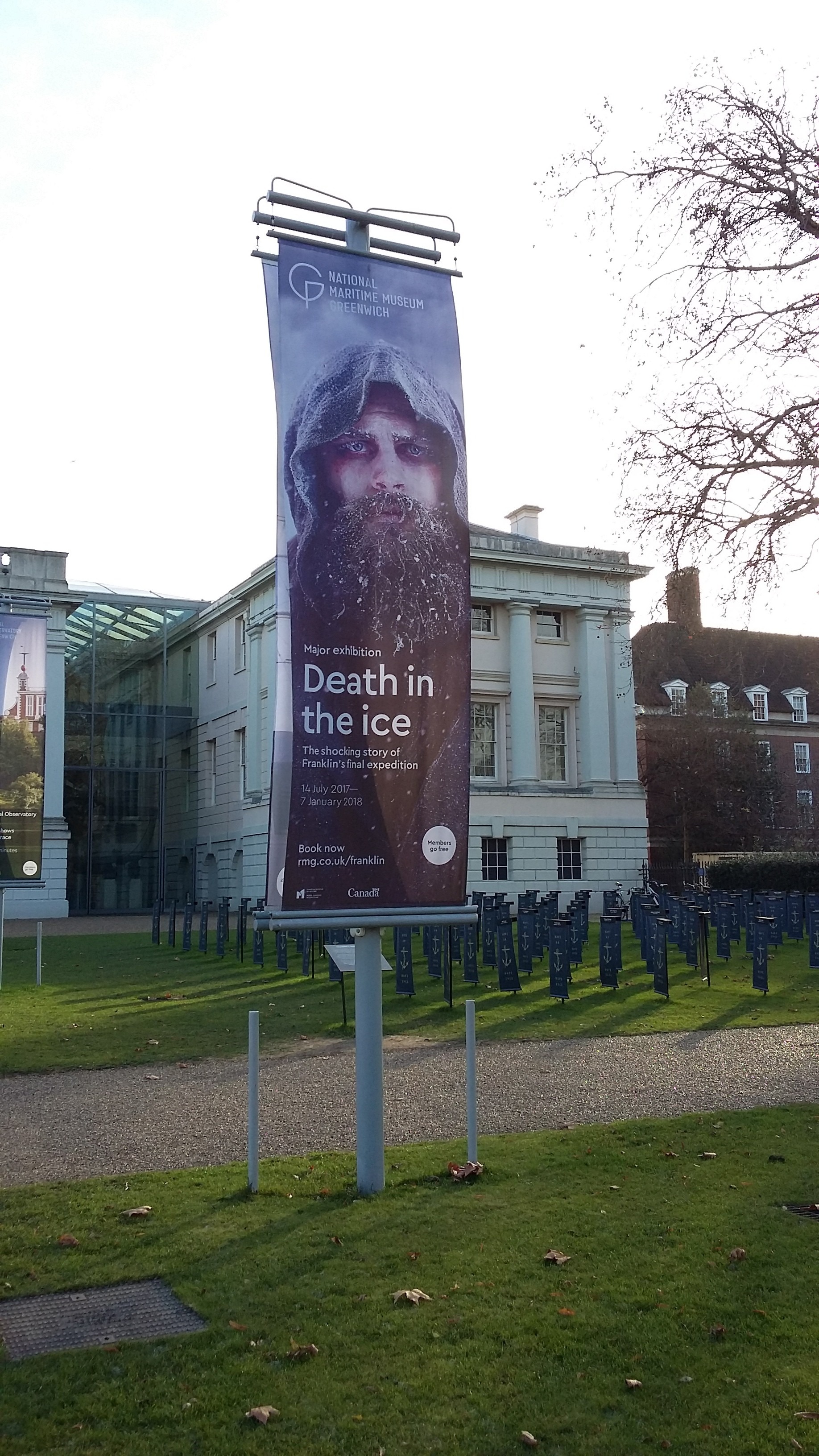
Death in the Ice: The Shocking Story Of Franklin’s Final Expedition – National Maritime Museum

National Maritime MuseumIn 1845, a Royal Navy expedition commanded by Sir John Franklin to discover and chart the North West Passage set off on its journey. None of the 129 men on the expedition were ever seen alive again. Death in the Ice: The Shocking Story Of Franklin’s Final Expedition has been developed by the Canadian Museum of History (Gatineau, Canada), in partnership with Parks Canada Agency and with the National Maritime Museum, and in collaboration with the Government of Nunavut and the Inuit Heritage Trust.
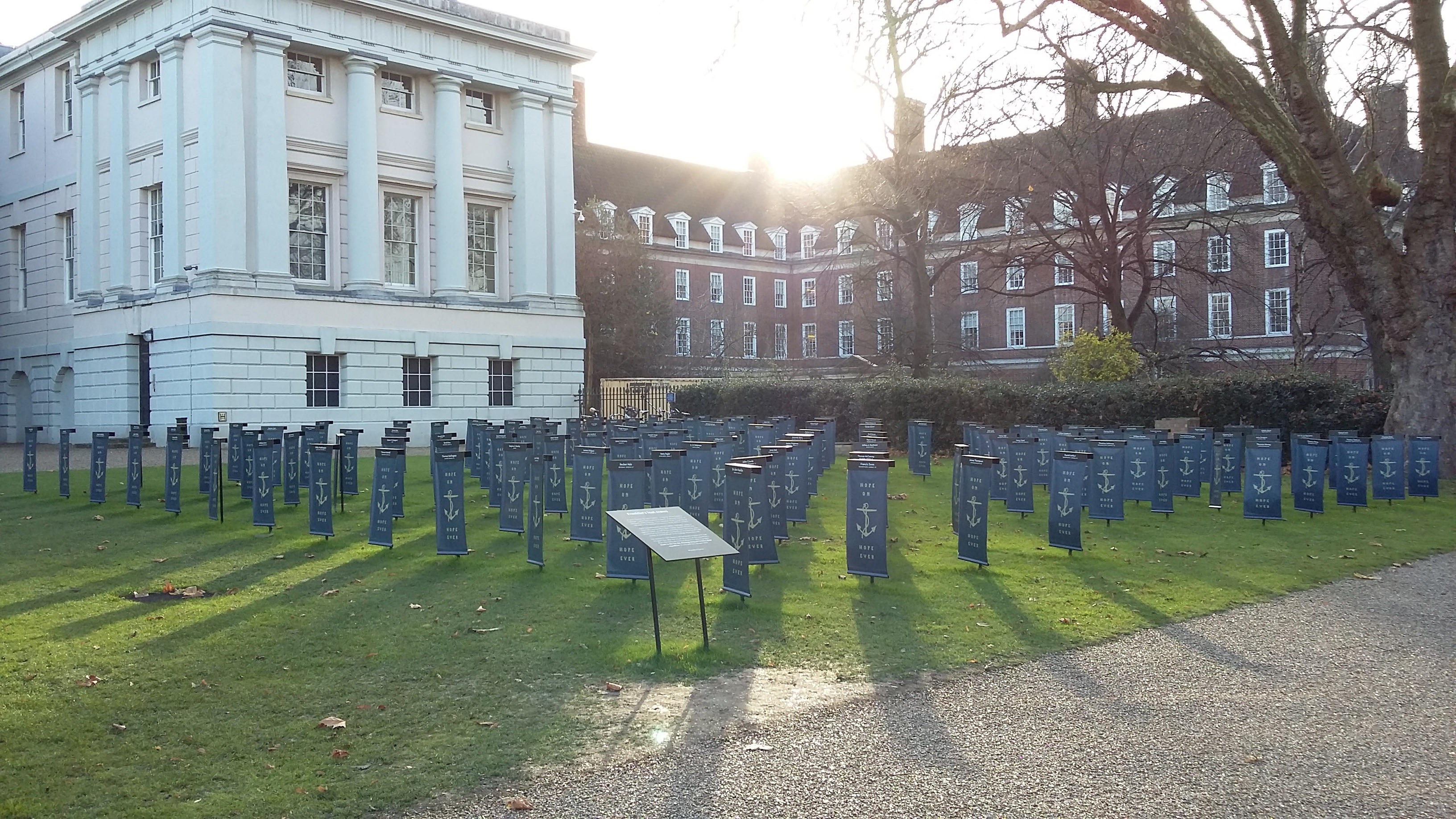
The fate of Franklin’s expedition has been a mystery for over a century: despite numerous searches, many instigated by Franklin’s wife Jane, few traces were ever found. A handful of artefacts and some human remains have been discovered, but it is only in the last couple of years that the wrecks of the flagship, Erebus, and its companion vessel, Terror, have been discovered. The ultimate reason why the expedition ended in tragedy has never been established. Approaching the National Maritime Museum, you are confronted by a sea of flags; each one represents a man lost on the expedition.

The exhibition starts with an exploration of the Arctic environment and how Inuit peoples live and thrive in such harsh conditions. Centring the Inuit experience is important for two reasons – firstly because their way of life could have – but didn’t – inspire the various British expeditions that tried to survive in the Arctic in the nineteenth century, and secondly because Inuit testimony was frequently ignored when searchers were trying to find out what had happened to the crews of Erebus and Terror.

The exhibition continues with a look at life on board ship, the role of the different crew members, and brief biographies of key figures on the expedition. It explores the route the expedition took, past Beechey Island and round to King William Island, before the trail grew cold. The expedition spent several winters on the ice, in the dark and cold, with little food other than what they had brought with them from England.

Later the focus turns to the many search parties sent out by Lady Franklin and others, before the ships were finally given up for lost. I must say that to someone like me who knows this topic quite well, much of the exhibition up until now was already known to me, and I didn’t really learn anything new. The exciting part comes towards the end, when I got to view several artefacts, recently recovered from the wrecks, including the bell from Erebus, cast at the Whitechapel Foundry specially for the voyage. It’s still possible to read the date stamp on the side. Videos allow you to watch the divers at work underwater, exploring the wreckage of the ships.

No one really knows exactly why the crew all perished, but various theories are put forward: scurvy, lead poisoning, starvation, disease and more. Two crew members who died fairly early on in the journey have been exhumed, and the evidence in their case points to tuberculosis, but this probably did not infect the others on board. Evidence of cannibalism has been found, but it’s impossible to say for certain whether starving crew members killed and ate their fellows out of desperation, or only ate the flesh of those who had already died.

The exhibition is a fantastic introduction to the Franklin expedition for those who don’t know a great deal about it, and for those already fascinated by the topic it allows you to see some incredible artefacts. What will stick in my memory is the single shoe, preserved in the ice, from an unknown crew member – a poignant reminder of the expedition’s human cost.

Death in the Ice runs until 7 January at the National Maritime Museum

Flags marking the dead

Painted Hall Ceiling Tour – Old Royal Naval College, Greenwich

Painted Hall
Outside the Painted Hall

The Old Royal Naval College in Greenwich is currently restoring the famous Painted Hall. The Hall is not, however, closed to visitors during this time: it is possible to book tours of the ceiling, climbing up on the scaffolding to get close to the ceiling and get a close-up view.

Inside the Hall
Inside the Hall

We put on our high-visibility jackets and hard hats in the room at the end of the hall, where we heard a little about the history. The Painted Hall is one of the most spectacular and important baroque interiors in Europe. Its ceiling and wall decorations were conceived and executed by the British artist Sir James Thornhill between 1707 and 1726, the period when the United Kingdom was created and became a dominant power in Europe. The end wall mural, which has already been restored, shows King George I and his large family, alongside symbols of wealth and plenty. The artist himself is in the bottom right corner of the painting.

Sir James Thornhill
Sir James Thornhill
Full mural
Full mural

We headed up the stairs to where a makeshift floor has been built with scaffolding, giving the appearance of a low-ceilinged room. Our guide talked us through the various murals and highlighted some of the key figures on the ceiling, as well as discussing the restoration work.

At the ceiling
On the scaffold(ing)

Among the figures represented are Greek and Roman gods, monarchs, and even one of the Greenwich pensioners, John Worley, who served at sea for 70 years. He is depicted with a long white beard and painted to represent the season of Winter. Over the past few centuries there have been several restorations, and many workers have left their mark on the ceiling, mostly in the corners where they have daubed their initials. One cheeky person, however, added his name and date right in the middle of Queen Anne’s chest. I did take a picture, but it doesn’t show up very well.

Queen Anne
Queen Anne
John Worley
John Worley

The tour is fascinating and well worth the effort. Tours can be booked online for days throughout the week and are due to continue for the duration of the building work.

Jewellery brand of the month: Rock Cakes

I’m back to UK brands this month, and I would like to share the delights of the following brand with you:

ROCK CAKES

The store is run by jewellery designer Sarah in Brighton. What I love about this store is the range, from affordable enamel pins and wooden brooches to more pricey fine jewellery pieces with precious stones. However, whatever the price, each piece of Rock Cakes jewellery is unusual and quirky.

I’ll start simple: this Yay Necklace is cute and colourful.

Yay necklace

This Tupperware Party Brooch Set is super adorable.

Tupperware party brooch set

The Cracker Bang Necklace would make a brilliant Christmas gift.

Cracker bang necklace

The Fortune Fish Brooch Set is a great reminder of those fortune fish cracker gifts that provide hours of fun every Christmas.

Fortune fish brooch set

Finally, this Planet Ring will be first on my list if I ever come into some money: it’s made of sterling silver and contains real precious stones.

Planet ring

Check out Rock Cakes via the following links:

Website: rockcakes.com

Etsy: etsy.com/uk/shop/RockCakes

Instagram: instagram.com/rockcakes

Facebook: facebook.com/rockcakesjewellery