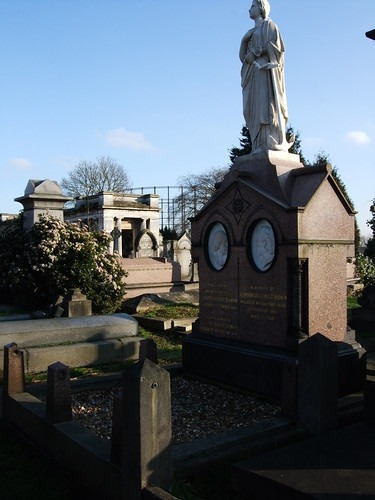
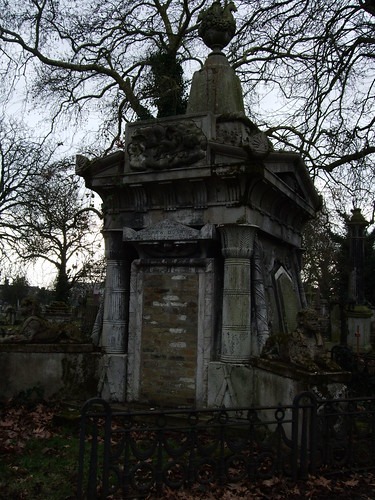
Highgate Cemetery (The “Magnificent Seven” Tour)

Highgate Cemetery is probably the most famous cemetery in London – I had heard of Highgate before any of the other Magnificent Seven. It is the burial place of some of the most famous figures ever to have graced London, and is well-known in popular culture, having appeared in novels such as Falling Angels by Tracy Chevalier and Her Fearful Symmetry by Audrey Niffenegger. I’m not quite sure how I’ve managed to live in London for four years without visiting.

Getting There

Highgate has a lovely setting on a hill in North London. The nearest tube station is actually Archway, not Highgate. From Archway, take the 210,143 or 271 bus up Highgate Hill to Waterlow Park (you can walk, but it’s better to save your energy for exploring the cemetery). You have to walk through the park, which is lovely, to reach the cemetery.
2015_0307HighgateCemetery
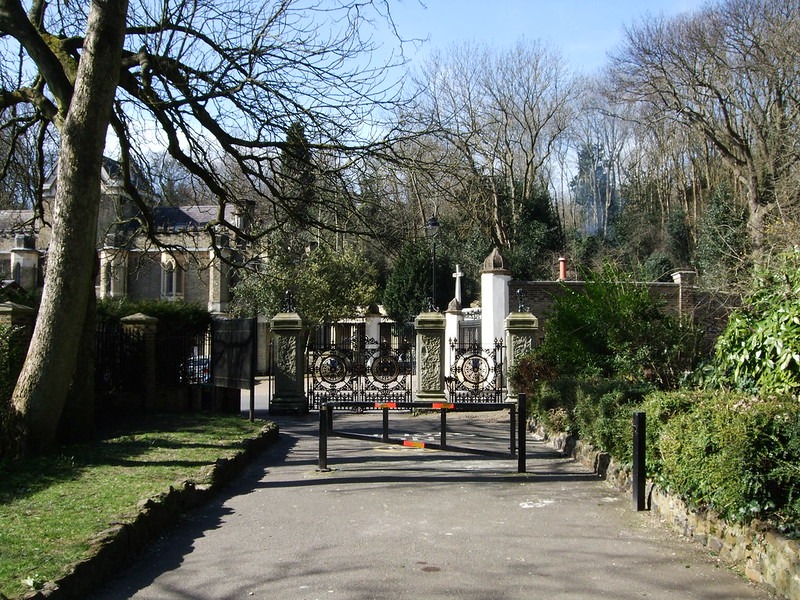
Approaching Swain’s Lane from Waterlow Park

History

The English Heritage Grade 1* listed Highgate Cemetery originally opened in 1839, the third of the “Magnificent Seven” after Kensal Green and West Norwood, part of a ring of garden cemeteries around the outskirts of central London designed to draw burials away from the overcrowded and unhygienic inner-city cemeteries. An 1836 Act of Parliament created the London Cemetery Company, which bought seventeen acres of land on the steep hillside near Highgate Village for the sum of £3,500. The original design was by architect and entrepreneur Stephen Geary whose Tudor-Gothic style is evident in the entrance and chapels, and the Cemetery was dedicated to St. James by the Right Reverend Charles Blomfield, Lord Bishop of London, on 20 May 1839. The original Cemetery is now known as the West Cemetery; the East Cemetery was an extension established in 1854 thanks to the huge popularity of Highgate.

The Cemetery was built in the grounds of the Ashurst estate, evidence of which is the presence of a magnificent Cedar of Lebanon dating from the late seventeenth century. Sadly, Highgate’s profitability declined in the twentieth century and it began to decay, with vandalism and overgrown weeds prevalent until the Friends of Highgate Cemetery Trust, set up in 1975, took over in 1981. The Friends are still responsible for the upkeep of the Cemetery and run the guided tours which are the only way to see the West Cemetery (you can walk around the East Cemetery alone but you do have to pay).

East Cemetery

2015_0307HighgateEast01
Entrance to the East Cemetery

On Saturdays, you can’t book tours in advance: you just turn up. I had a bit of time to wait until my West Cemetery tour so I decided to have a look around the East Cemetery first (entry is included in the price of your West Cemetery tour ticket). The Eastern part was built later than the original West Cemetery, but it is still worth seeing. In fact, the lady at the entrance selling tickets to other visitors summed it up nicely when she said that the West Cemetery has the famous monuments, the East Cemetery has the famous people.
2015_0307HighgateEast21
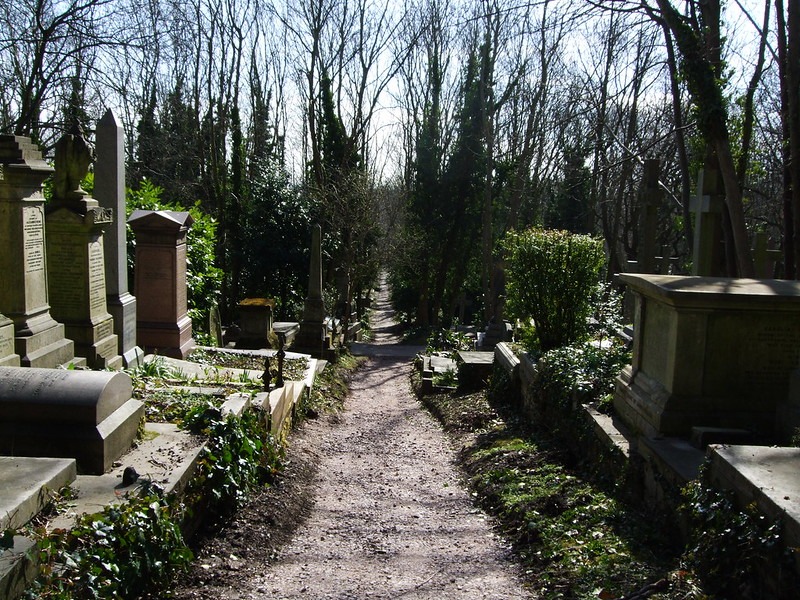
Inside the East Cemetery
2015_0307HighgateEast31
Inside the East Cemetery

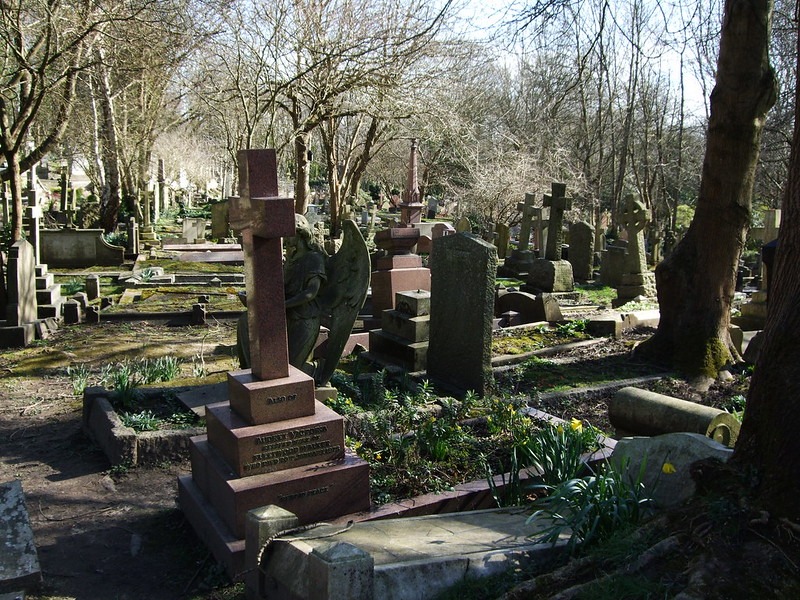
It was a lovely sunny day – warm enough to walk around without a coat – and I enjoyed exploring the beautiful Cemetery and the landscape of gravestones, with a couple of mausoleums thrown in.

2015_0307HighgateEast02
Pocklington mausoleum

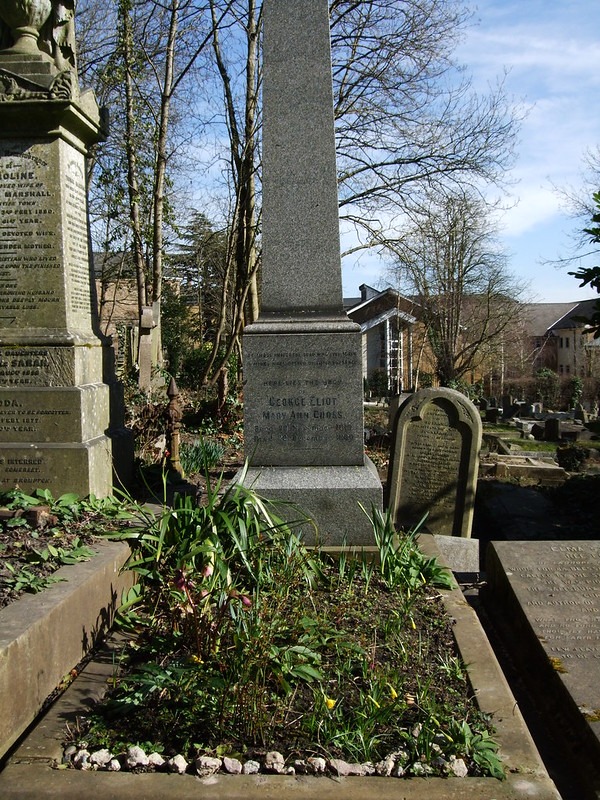
I had a good time finding significant graves, including that of one of my favourite Victorian writers, George Eliot, author of Middlemarch. Her real name of Mary Ann Cross is also on her tombstone.
2015_0307HighgateEast19
Grave of George Eliot

A more recent but equally loved writer, Douglas Adams, famed for the Hitchhiker’s Guide to the Galaxy books, was buried here in 2001. His grave is often marked with pens.

2015_0307HighgateEast12
Grave of Douglas Adams

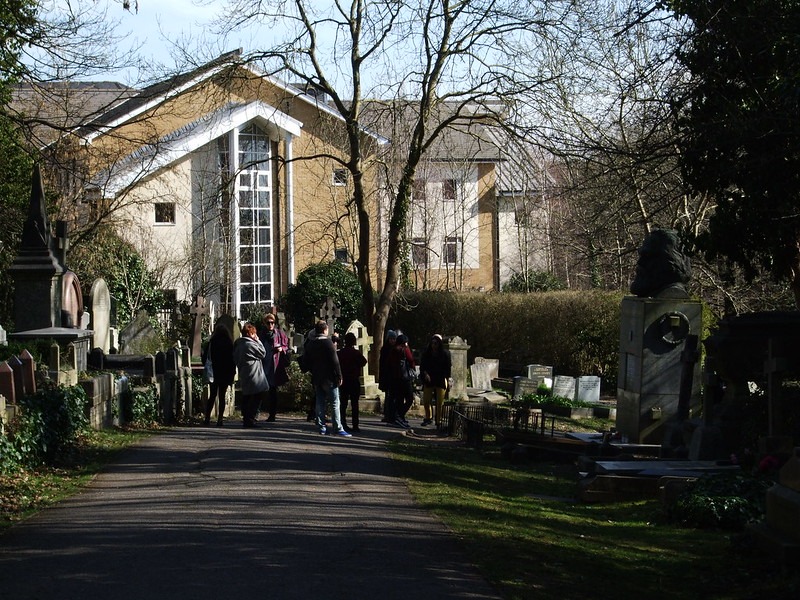
Karl Marx is probably the most famous person buried at Highgate. His grave is easy to spot because there are lots of people milling around it.
2015_0307HighgateEast18
Approaching Karl Marx’s tomb

The original gravestone, which is embedded within the newer structure, is plain and simple; the impressive tombstone, with the carved message “WORKERS OF ALL LANDS UNITE”, was erected by the Communist Party of Great Britain in 1954. The portrait bust is by Laurence Bradshaw. In 1970 there was an attempt to blow up the monument with a homemade bomb.

2015_0307HighgateEast23
Marx’s tomb

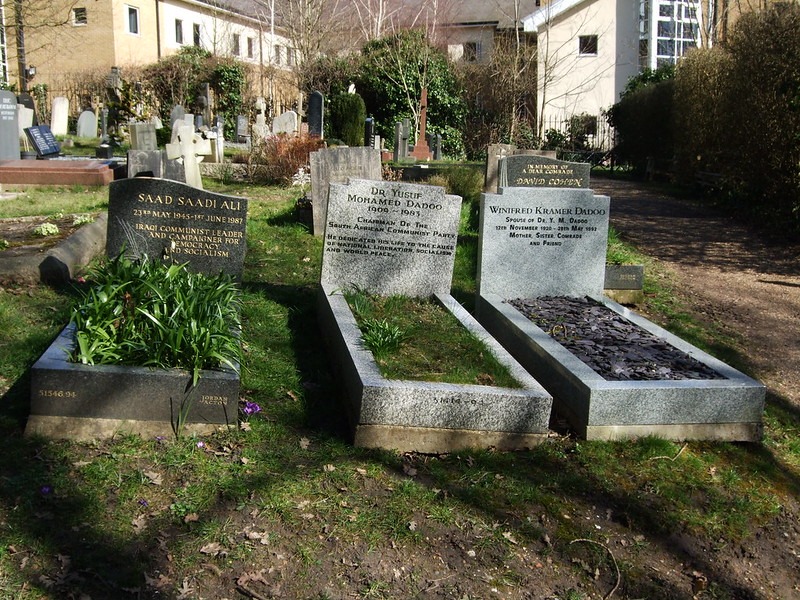
A number of other Communists and revolutionaries are buried near Marx, as is the Marxist historian Eric Hobsbawm.
2015_0307HighgateEast24
Socialist leaders and thinkers
2015_0307HighgateEast25
Eric Hobsbawm’s grave

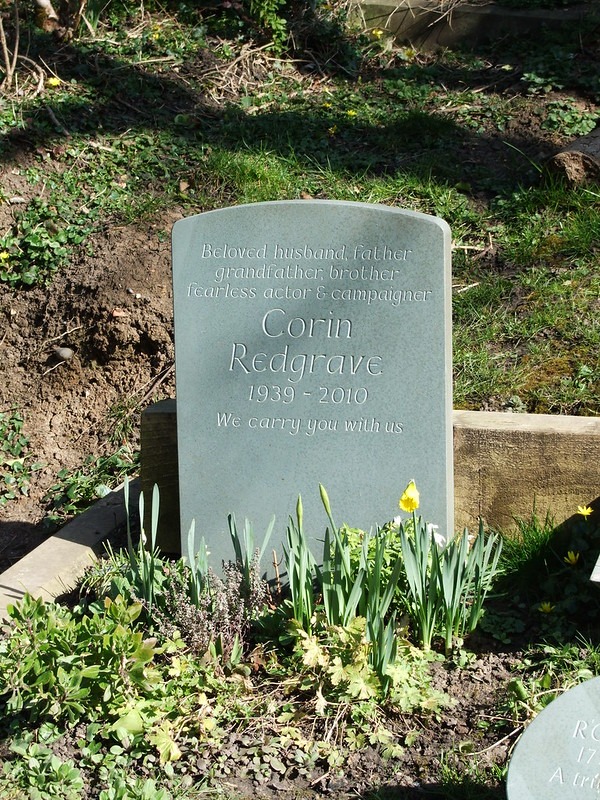
Actor Corin Redgrave is buried at Highgate.
2015_0307HighgateEast09
Burial place of Corin Redgrave

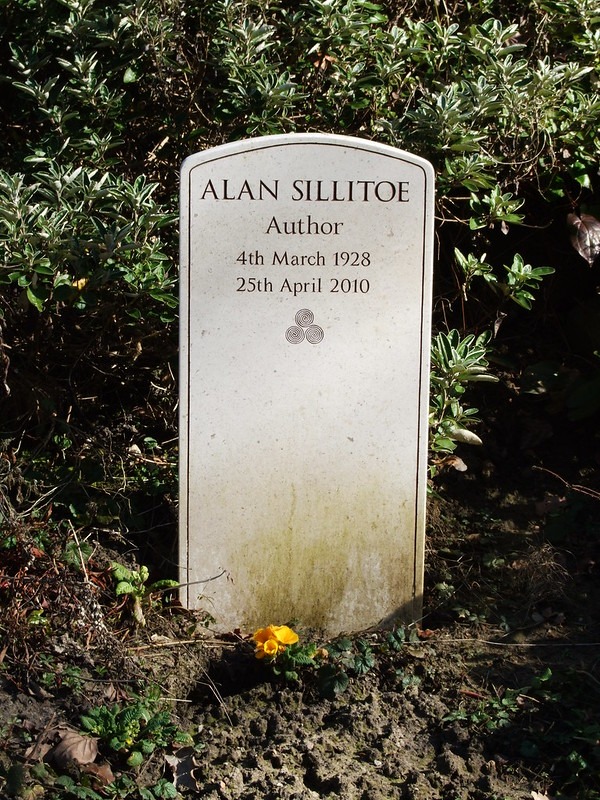
Writer Alan Sillitoe (author of Saturday Night and Sunday Morning) also rests here.
2015_0307HighgateEast42
Alan Sillitoe’s grave

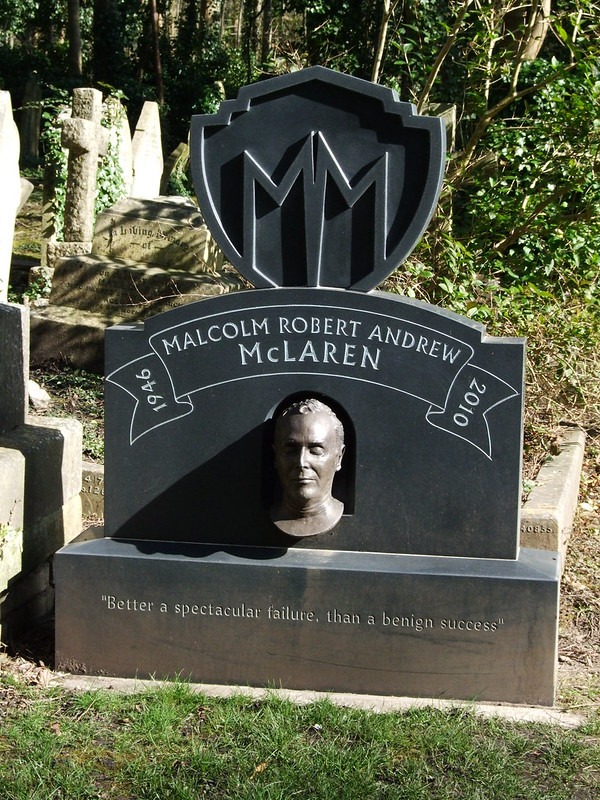
Malcolm MacLaren, manager of the Sex Pistols, musician and fashion designer, is buried in an unique grave.
2015_0307HighgateEast37
Malcolm McLaren’s grave

The artist Patrick Caulfield’s gravestone, dramatically reading “DEAD”, is one of my favourites.

2015_0307HighgateEast41
Patrick Caulfield’s tombstone

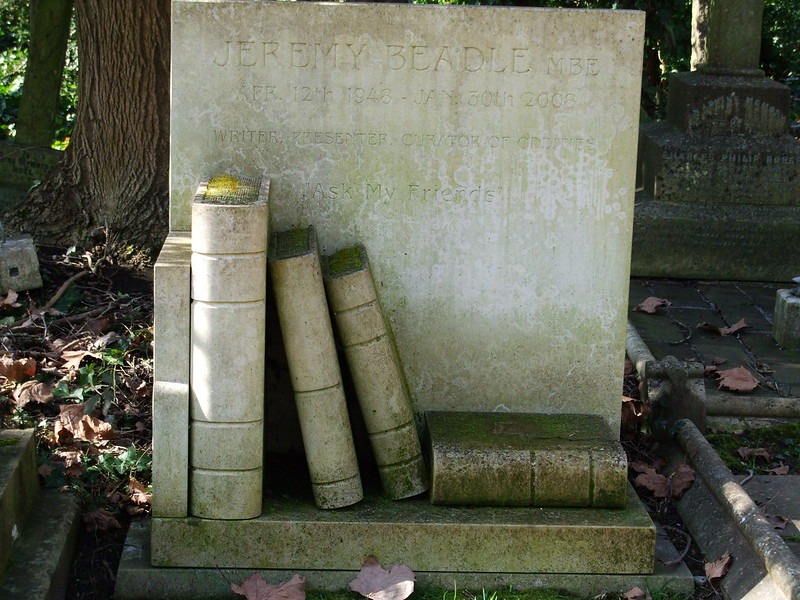
One of my most surprising finds was the grave of TV personality and presenter (of Beadle’s About and You’ve Been Framed!) Jeremy Beadle. I really liked his gravestone, which looks like a bookshelf.
2015_0307HighgateEast39
Jeremy Beadle’s grave

Aside from the famous individuals buried here, there are plenty of graves noteworthy for their architecture. A variety of styles are in evidence, including Victorian:

2015_0307HighgateEast16
Grave of Caroline Tucker

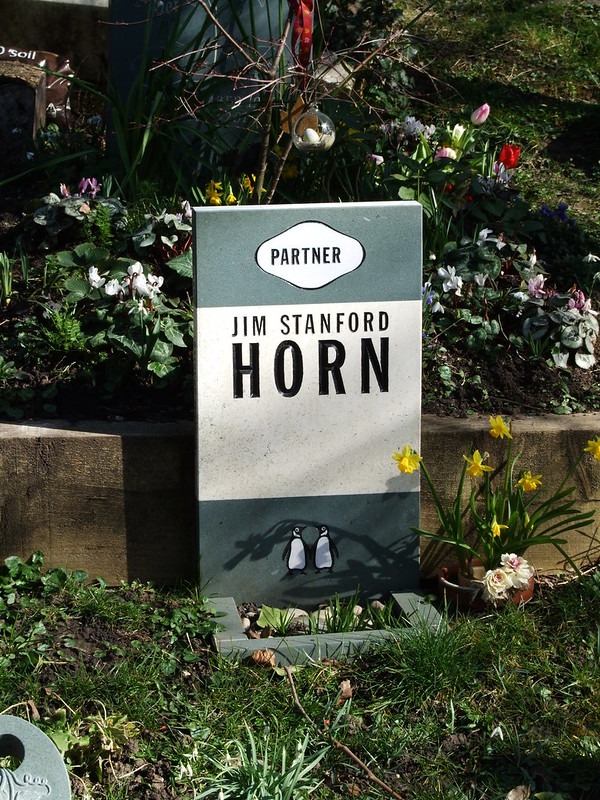
…and modern. I love this Penguin Books-themed stone.
2015_0307HighgateEast10
Jim Stanford Horn’s gravestone

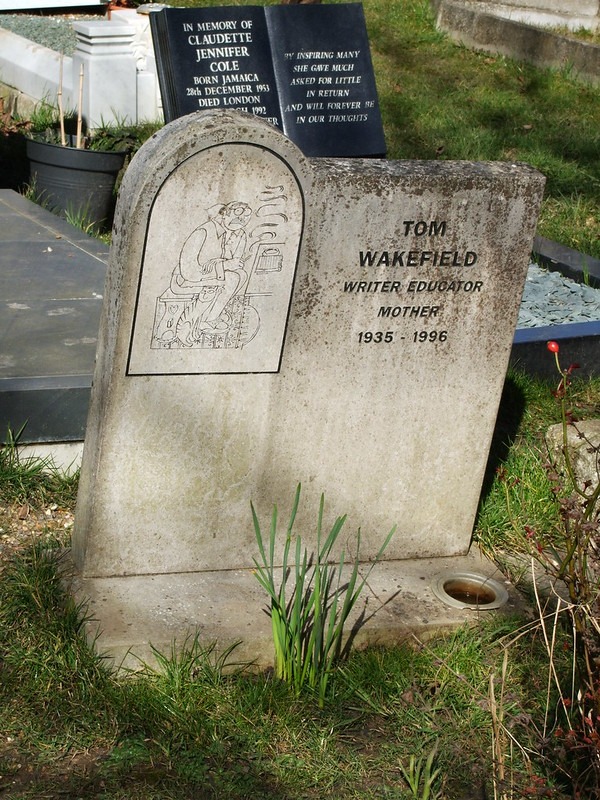
I was intrigued by this picture and description.
2015_0307HighgateEast26
Tom Wakefield’s grave

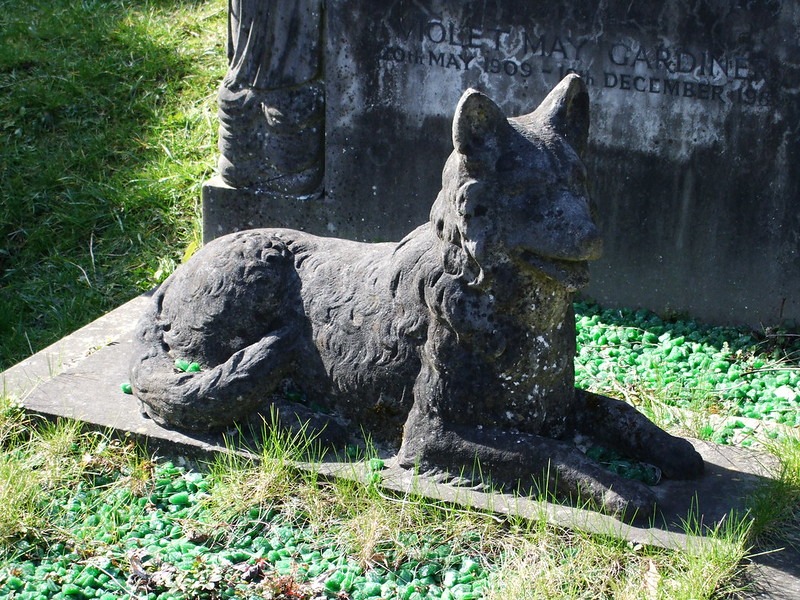
This person obviously loved their dog very much.
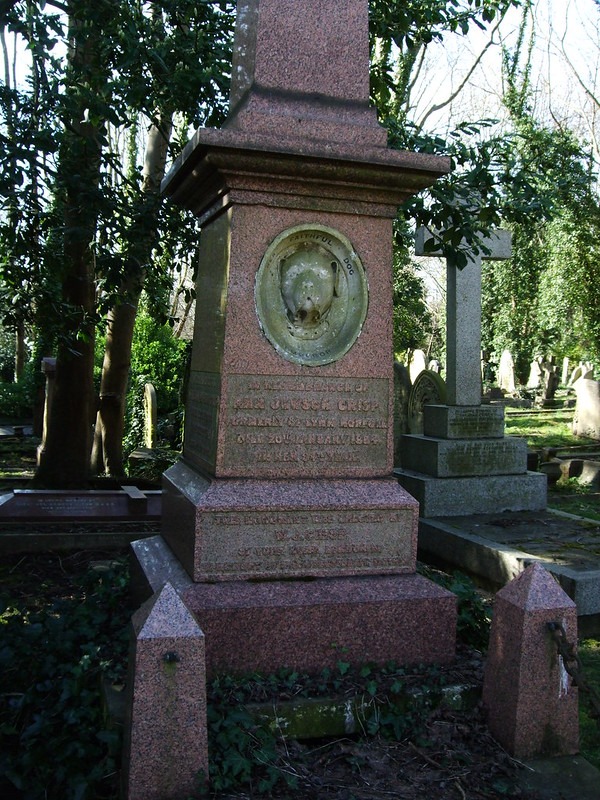
2015_0307HighgateEast32

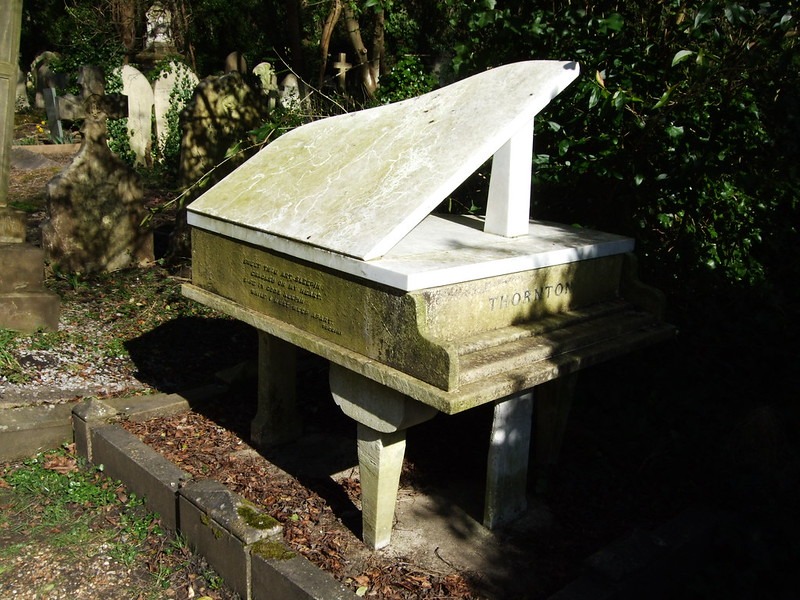
This piano is amazing.

2015_0307HighgateEast35
Tomb of Thornton

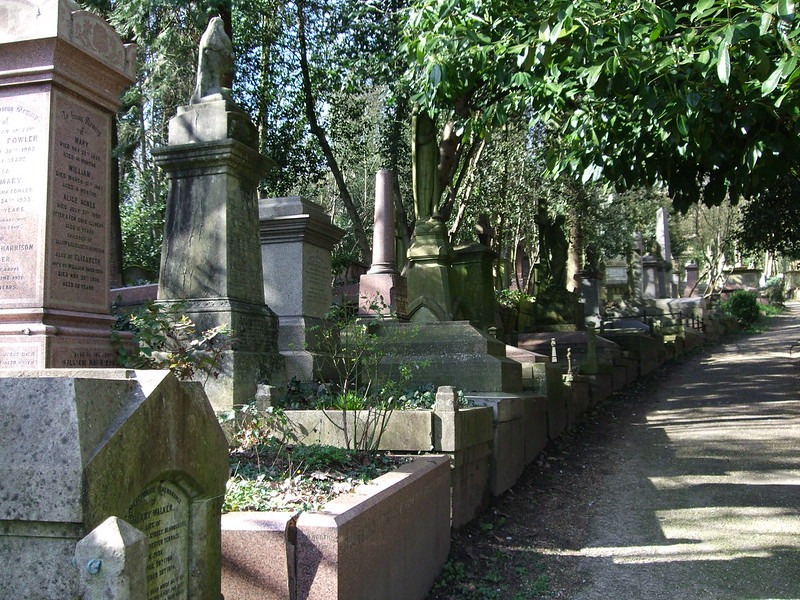
The East Cemetery is beautiful and I could wander around for hours.

2015_0307HighgateEast43

2015_0307HighgateEast45

2015_0307HighgateEast49

2015_0307HighgateEast50

However it was time to leave this side and head over to the West Cemetery for my tour.


West Cemetery
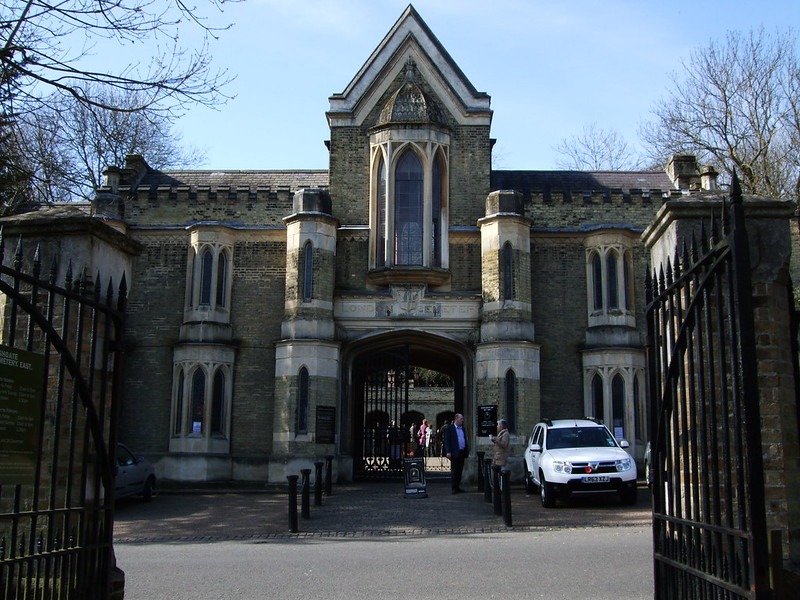
2015_0307HighgateWest01
Entrance to the West Cemetery

After waiting in the chapel for our tour guide, we were taken outside to the courtyard and arcade.
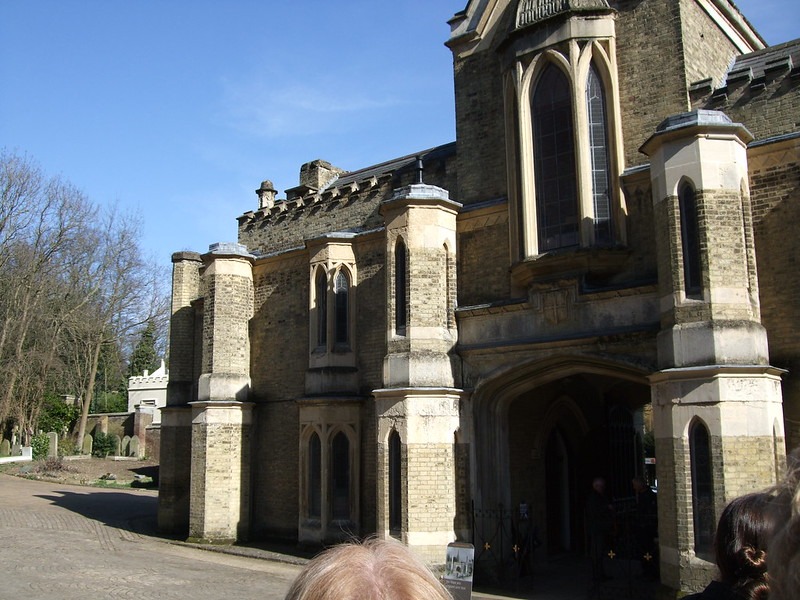
2015_0307HighgateWest07
The Chapel

The smaller part of the chapel on the left, formerly the Dissenters’ Chapel, is now the private area for staff. The larger part on the right was the Anglican chapel: it is now the visitor centre and gift shop and has been recently restored.
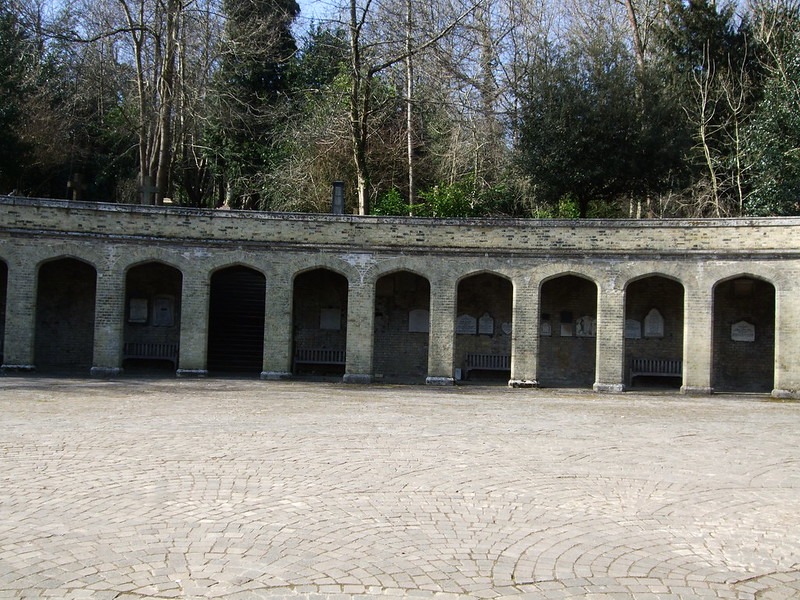
2015_0307HighgateWest02
The courtyard and arcade: the area was designed to be big enough for a coach and horses to turn around

Our guide explained the history of the site as we began our tour. Stephen Geary, the architect (and founder of the London Cemetery Company), appointed a surveyor (James Bunstone Bunning) and a garden designer/landscape architect (David Ramsey) who laid out the beautiful, winding paths. It’s a gloriously peaceful place.

2015_0307HighgateWest10
The Chapel, seen from our route into the Cemetery

2015_0307HighgateWest08

2015_0307HighgateWest09

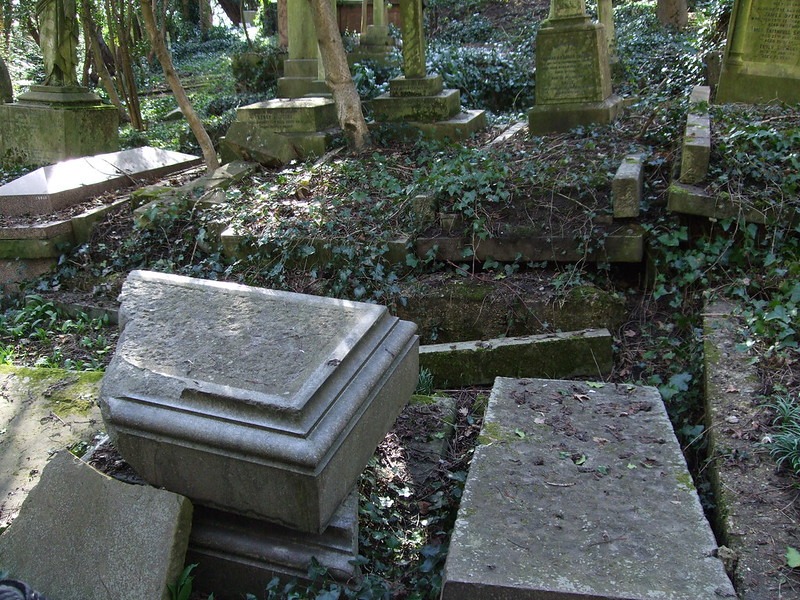
Things weren’t always so quiet: some parts of the Cemetery suffered bomb damage during World War II. The damage has been purposely left as a memorial.
2015_0307HighgateWest15
Bomb damage

In more recent history, Alexander Litvinenko, the Russian poisoned in London in 2006, was buried here.

2015_0307HighgateWest24
Alexander Litvinenko

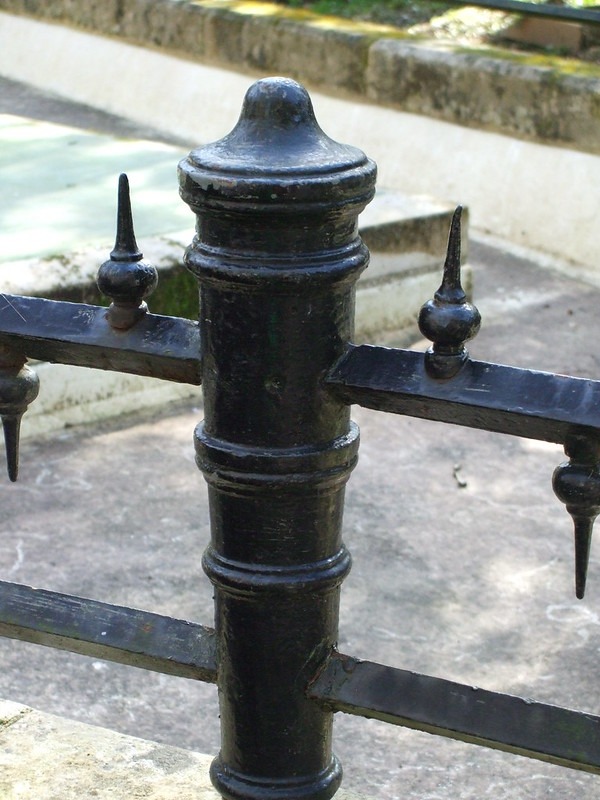
The largest plot in Highgate belongs to a military man, and the railings around his tomb are miniature cannons.

2015_0307HighgateWest21

2015_0307HighgateWest22

The oldest grave in the Cemetery belongs to Elizabeth Jackson of Little Windmill Street, Soho, who died aged thirty-six and was buried on 26 May 1839.

2015_0307HighgateWest28
Grave of Elizabeth Jackson

The Egyptian Avenue, a gorgeous structure with vaults – rather like above-ground catacombs – is located towards the top of the Cemetery. At first these vaults didn’t sell very well, as they were seen to be too “pagan” in tone, but after Queen Victoria popularised an interest in Egypt this changed.

2015_0307HighgateWest30
Leading up to the Egyptian Avenue

In recent years a colony of rare orb weaver spiders has been discovered living inside the vaults of the Egyptian Avenue. The cold, dark conditions of the vaults are perfect for the spiders. This is no doubt a good thing in terms of ecological diversity, but I for one will be staying well away from the vaults!

2015_0307HighgateWest33
Inside the Avenue

The Avenue leads to the Circle of Lebanon, which consists of twenty vaults around an inner circle; sixteen were added to an outer circle in the 1870s. The Circle was made by excavating earth from around the Cedar of Lebanon which had been present since the land was part of the Ashurst Estate. Above the Circle, a Gothic-style catacomb, known as the Terrace Catacombs as it was built on the site of the original terrace of Ashurst House, was constructed in 1842. We were able to visit the catacombs and they were fascinating, though sadly (but understandably) we were not allowed to take photos.

2015_0307HighgateWest39
Inside the Circle of Lebanon
2015_0307HighgateWest36
Close-up of some of the vaults in the Circle

Author Radclyffe Hall lies in one of the vaults.

2015_0307HighgateWest41
Resting place of Radclyffe Hall
2015_0307HighgateWest43
The magnificent Cedar of Lebanon
2015_0307HighgateWest44
Looking down into the Circle of Lebanon
2015_0307HighgateWest48
Looking down into the Circle of Lebanon

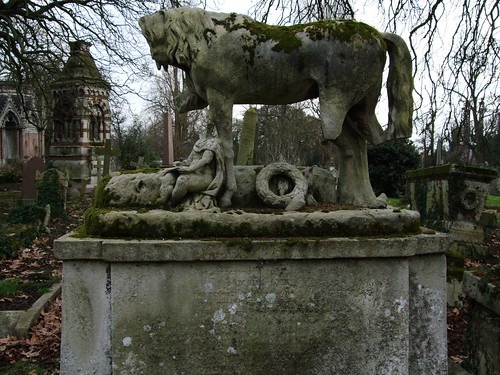
Coming out of the Circle of Lebanon and the Terrace Catacombs, we moved into the main Cemetery once again. Our first stop was the tomb of George Wombwell, the menagerie owner, who owned several exotic animals and raised the first lion in captivity in Britain.

2015_0307HighgateWest45
Wombwell’s tomb with a statue of his lion, Nero

We saw the tiny stone of Adam Worth, a well-mannered and pleasant criminal mastermind who was apparently the inspiration behind Moriarty in the Sherlock Holmes stories.

2015_0307HighgateWest47
Adam Worth’s grave

The mausoleum of millionaire newspaper magnate Julius Beer is one of the most impressive in the Cemetery. Sadly, though, he originally constructed it for his daughter Ada, who died aged eight. Apparently when the tomb was first reopened after many years, the Friends were unable to get the door open and had to send someone in through the broken top of the mausoleum. Once inside, they discovered why the door wouldn’t open – the floor was thick with bird poo. Lovely! Thankfully the structure has since been restored, although we couldn’t go inside as there was a problem with the door.

2015_0307HighgateWest49
Mausoleum of Julius Beer

Thomas Sayers was a famous English bare-knuckle fighter during the Victorian period, a time when such fighting was in fact illegal. His final fight, against US champion John Camel Heenan, took place in Hampshire and ended in chaos when the spectating public invaded the ring and the police had to get involved. A public subscription raised a retirement fund for him and he never fought again, although he died aged only 39 in 1865. Thousands of people turned out on the streets of Highgate to see his funeral, although the chief mourner was his dog, Lion, who guards his tomb in effigy.

2015_0307HighgateWest53
Grave of Thomas Sayers

Michael Faraday, the well-known scientist most famous for his work in electromagnetism and electrochemistry, is buried in the Dissenters’ area of the Cemetery.

2015_0307HighgateWest55
Michael Faraday’s grave

Charles Dickens himself is buried in Poets’ Corner at Westminster Abbey, but he was familiar with Highgate and has family connections there. His sister Frances (Fanny) Burnett is buried there along with her son Henry (Harry) Augustus, supposedly the inspiration for Tiny Tim in A Christmas Carol.

2015_0307HighgateWest56
Grave of Dickens’ sister

Dickens’ parents, John and Elizabeth, also rest in Highgate.

2015_0307HighgateWest57
Burial place of Charles Dickens’ parents

Continuing the writers’ theme, I spied the grave of author Beryl Bainbridge.

2015_0307HighgateWest58
Beryl Bainbridge’s grave

Highgate Cemetery is an absolutely fascinating place. It’s a shame about the entry charge, as it would be a wonderful place to visit again and again. Having said that, the Friends do a fantastic job of keeping everything going and the money is certainly put to good use.

I had heard horror stories about rude and grumpy staff, but I didn’t see any evidence of this at all: everyone seemed lovely and my tour guide was informative and friendly.

I really enjoyed my visit but was sad not to have been able to see the grave of Elizabeth Siddall (pre-Raphaelite muse, artist and wife of Dante Gabriel Rossetti); apparently it is in a part of the Cemetery closed to visitors.

Would I go back?

Despite the cost, yes. It’s a hugely interesting place, with lots to see. A cheaper trip could take in the East Cemetery only; this would only cost £4. I would be back like a shot if I could have a chance to see Lizzie Siddall’s grave.

FACTS

Address: Swain’s Lane, London N6 6PJ
Founded: 1839 (Eastern extension opened 1854)
Size: 37 acres
Still in operation?: Yes
Official website: http://highgatecemetery.org
Owners: Friends of Highgate Cemetery Trust (registered charity)
Tours: West Cemetery – weekdays at 2.45 pm (book online via website); weekends every half hour 11-3: £12 adults, £6 children. East Cemetery – Saturdays at 2 pm: £8 adults, £4 children (normal admission £4 adults, children free).

West Norwood Cemetery (The “Magnificent Seven” Tour)

2015_0307WestNorwood01
Entrance to West Norwood Cemetery with the war memorial and inner gates visible

At the weekend I made a visit to the second of the “Magnificent Seven” commercial cemeteries in London, West Norwood Cemetery. Once again I was lucky with the weather: it was a dry and sunny day, though a cold wind made me shiver on occasion.

Getting There

West Norwood Cemetery is, as the name suggests, in West Norwood, south London. The address is Norwood Road, London SE27 9JU and the closest railway station is West Norwood, which can be reached from Victoria or London Bridge stations.

History

Initially known as The South Metropolitan Cemetery, the cemetery was founded by its own Act of Parliament in 1836 and the first burial took place a year later. The South Metropolitan Cemetery Company purchased land from the estate of the late Lord Thurlow to create the cemetery, which was consecrated by the Bishop of Winchester.

2015_0307WestNorwood03
The Gothic inner gates designed by Sir William Tite
2015_0307WestNorwood06
Close-up of the arch
2015_0307WestNorwood07
Main office, which was rebuilt after the original was damaged in the war

In contrast to Kensal Green, which was built in the classical style, the South Metropolitan Cemetery was the first to be designed throughout in the Gothic style. The landscaping and some monuments, including the catacombs and the entrance gateway, were designed by architect Sir William Tite (1798-1873), who was eventually buried here himself. The cemetery later became known as the “Millionaires’ Cemetery” owing to the number of eminent Victorians buried here, including around 300 people with entries in the Dictionary of National Biography.

2015_0307WestNorwood08
Looking into the cemetery with the entrance gates at my back

Sadly, the 40-acre cemetery suffered bomb damage during World War II and Lambeth Council, following a compulsory purchase order in 1965, proceeded to clear thousands of monuments. Luckily, the Friends group, the Archdeacon of Lambeth and others joined to prevent this. Many monuments are listed Grade II by English Heritage. The original consecrated chapel was also damaged by a bomb during the war and was later pulled down; the Dissenters’ chapel remains and has been converted into a crematorium.

Tour

Our guide told us a little about the history of the cemetery, and took us on a fascinating walk around it, pointing out some of the more notable features. One memorial that stood out is that of James Gilbart, founder of the London and Westminster Bank (now known as NatWest).

2015_0307WestNorwood23
The J.W. Gilbart memorial, which is Grade II listed
2015_0307WestNorwood24
Spire view of the memorial

We also saw the grave of Sir Hiram Maxim, of Maxim Gun fame – the American inventor, who moved to England aged 41, holds the dubious honour of being the inventor of the first portable, fully automatic machine gun.

2015_0307WestNorwood09
The Maxim family grave

The grave of Joe Hunte, the anti-racism campaigner, rests here.

2015_0307WestNorwood25
Burial place of Joe Hunte

I particularly liked this gravestone with its striking image of an old-fashioned diving helmet. Augustus Siebe was an inventor and engineer whose contributions to diving technology earned him fame. His stone was replaced without the cemetery’s permission a few decades ago, but I don’t feel I can object as I really like this interesting design.

2015_0307WestNorwood64
Augustus Siebe’s grave

The most famous person to be buried in West Norwood is probably Isabella Beeton, of Mrs Beeton’s Book of Household Management fame. She died at 28 after contracting puerperal fever following the birth of her fourth child. I had always thought she was older, but then she did have 20 younger siblings, so she had plenty of time to gain ample experience in cooking and household management.

2015_0307WestNorwood47
Mrs Beeton’s unassuming burial place

The Reverend Charles Spurgeon was a Baptist preacher and he is still well-known and admired by Baptists around the world. Our guide told us about the time a coachload of American tourists came to the cemetery, surrounded Spurgeon’s tomb to take pictures and then left, without looking at anything else in the cemetery.

2015_0307WestNorwood53
Charles Spurgeon’s tomb just outside the crematorium (formerly the Dissenters’ Chapel)

Mrs Beeton might be better-known, but for me the most exciting person to be buried in West Norwood is Charles Pearson. He was a solicitor and a reforming campaigner who campaigned for an underground railway system and was instrumental in promoting and establishing the Metropolitan Railway, the forerunner to the London Underground. I’m a great admirer of Pearson, whose encouragement of the railway system stemmed from a sense of social justice and a belief that it would improve the lives of the working poor.

2015_0307WestNorwood52
Charles Pearson, buried in his son-in-law’s plot

Two lovely large red brick mausoleums stand out: the first belongs to Sir Henry Tate, the sugar magnate who also founded the Tate Gallery (now Tate Britain).

2015_0307WestNorwood55
Henry Tate’s mausoleum

The second is the burial place of Sir Henry Doulton, the pottery manufacturer who was instrumental in developing his family firm into the famous Royal Doulton brand.

2015_0307WestNorwood61
Tomb of Henry Doulton

Architecture

The cemetery is interesting because of the people buried here, but also because of the examples of cemetery architecture in evidence. This draped urn was typical of the period.

2015_0307WestNorwood21
Draped urn

Lucy Gallup’s grave is unusual because of the presence of a photograph of the deceased.

2015_0307WestNorwood18
Lucy Gallup’s photograph

The English antiquary John Britton designed his monument to be as permanent as Stonehenge. In fact, it looks just like a Stonehenge stone.

2015_0307WestNorwood22
John Britton’s unusual monument

Seaman John Wimble’s beautiful and intricate tomb, with its detailed carvings of ships, lent its name to Ship Path.

2015_0307WestNorwood37
A beautifully carved ship on Wimble’s monument

The tomb of Alexander Berens, designed by E.M. Barry, is one of the most impressive in West Norwood and sits in a prime spot on the top of the hill.

2015_0307WestNorwood43
Alexander Berens’ elaborate mausoleum

Here is an example of a heart plaque sometimes used in the sentimental Victorian period.

2015_0307WestNorwood49
Heart plaque

Greek Necropolis

2015_0307WestNorwood71
Looking towards the Greek Necropolis

Our final stop on the tour was the Greek Necropolis, complete with an imposing Chapel of St Stephen (architect unknown but sometimes thought to have been John Oldrid Scott). This section of the cemetery was acquired by the Greek community in London in 1842, and is filled with Greek Orthodox mausoleums and monuments commemorating members of the Anglo-Hellenic community. The Necropolis is overseen by the trustees of the Cathedral of Saint Sophia.

2015_0307WestNorwood72
St Stephen’s Chapel
2015_0307WestNorwood75
Greek monuments

The end point of our tour was the elaborate mausoleum of Edmund Distin Maddick, which had been opened up to form a little shop.

2015_0307WestNorwood10
Mausoleum of Edmund Distin Maddick

It’s not as famous as Kensal Green or Highgate, and it’s a little out of the way, but West Norwood Cemetery is well worth a visit. There are some interesting monuments to see, and the cemetery’s location on a hill is an attractive one: and there are a couple of famous graves.

Would I go back?

Yes – it’s a decent-sized site with plenty to see, and I would like to be able to take a leisurely walk around it. Visiting the cemetery is free, so well worth it. In addition, if you join the Friends group for £5 per year you get a chance to take a tour of the catacombs – which is something I definitely intend to do at some point.

Facts

Address: Norwood Road, London SE27 9JU
Founded: 1836
Size: 40 acres
Still in operation?: Cremation plots are still available but the cemetery is closed to new burials, at least for now
Official website: http://www.lambeth.gov.uk/places/west-norwood-crematorium-and-cemetery
Owners: Lambeth Council
Friends group: Friends of West Norwood Cemetery (FOWNC) (http://www.fownc.org/)
Tours: The first Sunday of every month, 11 am November-March, 2.30 pm April-October. Free, but donations appreciated.

Kensal Green Cemetery (The “Magnificent Seven” Tour)

I began my tour of all seven garden cemeteries in London – the “Magnificent Seven” – with a trip to the first of them to be established, Kensal Green Cemetery. It was a lovely day: dry and warm, cloudy at first but the sun came out later.

2015_0215KensalGreen41
Inside the cemetery, with the Anglican Chapel in the distance

Getting There

The cemetery is located in North West London; the address is Harrow Road, London, W10 4RA. Nearby Kensal Green tube station is on the Bakerloo Line.

History

A rapidly increasing population in London meant that parish graveyards were becoming dangerously overcrowded, and new solutions were sought for the burial of the dead. In 1830 George Carden, a barrister, formed the General Cemetery Company (which still owns the cemetery); an Act of Parliament in 1832 enabled the company to establish a cemetery on land beside the Grand Union Canal. It was originally known as the General Cemetery of All Souls, Kensal Green.

An architectural competition was launched in 1831 to find a design for the Anglican Chapel in the centre of the cemetery. Henry Edward Kendall’s Gothic Revival design won the competition, but the owners – who preferred the classical style – overturned the decision (at least Kendall still got his prize money). The cemetery gateway and the two chapels were eventually completed to designs by John William Griffith, a company shareholder.

2015_0215KensalGreen01
Main entrance on Harrow Road

Originally there was a division between the Anglican section of the cemetery, comprising 39 acres, and the smaller Dissenters’ area of 15 acres. This distinction was very important at the time.

2015_0215KensalGreen02
Looking towards the entrance from the inside, with the Anglican burial ground on the left and the Dissenters area on the right

Exploring

2015_0215KensalGreen10
Inside the cemetery
2015_0215KensalGreen11
View of the cemetery including the former gas towers, which are due to be demolished

I had been to Kensal Green cemetery before, but only for a quick look round. The place is so huge that I had only managed to see a relatively small part of it. I decided to go back for a proper tour, getting there a bit early to have another look round by myself. Completely by accident I came across the grave of John Cam Hobhouse, close friend of my favourite poet Lord Byron.

2015_0215KensalGreen07
Approaching the Anglican chapel
2015_0215KensalGreen04
Interesting, if damaged, monument
2015_0215KensalGreen08
Weeping statue
2015_0215KensalGreen15
The way this woman has turned to look at you is quite creepy
2015_0215KensalGreen14
The Anglican Chapel from the back
2015_0215KensalGreen12
Memorial plaque commemorating the damage done in World War II
2015_0215KensalGreen03
The grave of John Cam Hobhouse

Tours, which are run by the cemetery’s Friends group, start at the steps of the Anglican Chapel.

2015_0215KensalGreen09
The Anglican Chapel

After a quick background introduction to the cemetery and London’s garden cemeteries in general, we got to go into the chapel, which is cold and in need of some repair. The ceiling is still beautiful, though.

2015_0215KensalGreen19
Ceiling of the Anglican Chapel
2015_0215KensalGreen20
Inside the Anglican chapel
2015_0215KensalGreen18
Inside the Anglican chapel

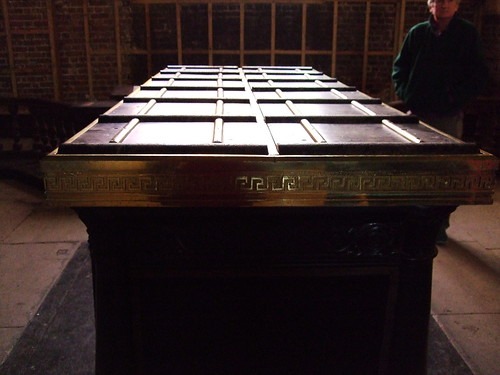
The raised platform is where the coffins are placed, and rollers help the bearers to slide it on. The platform turns around so that coffins can be taken out head first, as is custom.

2015_0215KensalGreen21
Catafalque with rollers

The raised structure also happens to be a hydraulic catafalque for lowering coffins into the catacombs. Sadly we couldn’t go into the catacombs because of Health & Safety risks (mould, apparently), but we could see the entrance from outside the chapel.

2015_0215KensalGreen22
Looking down into the catacombs

We had a comprehensive tour of the cemetery which took over two hours. The time went very quickly, however, and our guide was very knowledgeable. Even then, we didn’t see all of the notable tombs here: it is so big and there are so many significant people buried in Kensal Green.

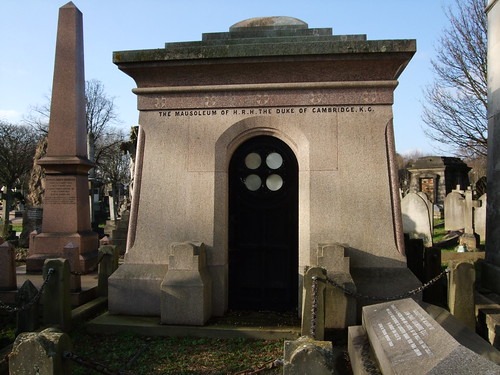
Uniquely for a public cemetery, three members of the Royal Family have been buried here: Prince Augustus Frederick and Princess Sophia, children of George III, and Prince George, Duke of Cambridge, grandson of George III and commander-in-chief of the British Army. Royal burials helped to make Kensal Green a popular and fashionable place to be buried.

2015_0215KensalGreen23
Mausoleum of Prince George, Duke of Cambridge
2015_0215KensalGreen33
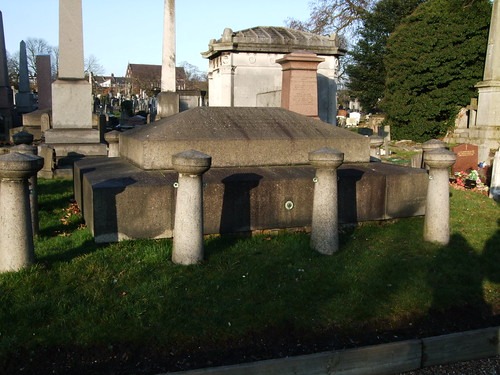
Tomb of Prince Augustus Frederick
2015_0215KensalGreen34
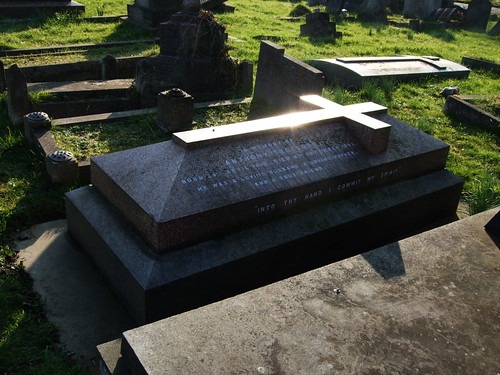
Grave of Princess Sophia

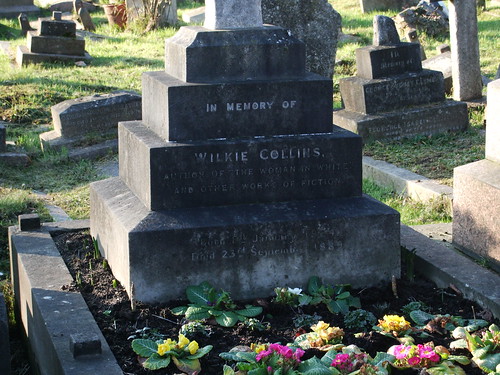
A significant number of important authors have been buried at Kensal Green, including Anthony Trollope, Wilkie Collins, Thomas Hood, Harold Pinter and William Makepeace Thackeray. As a lover of nineteenth-century literature (and twentieth-century theatre) I was thrilled to see these. My favourite was Anthony Trollope’s. I don’t know if he chose his inscription himself or if a family member selected it after his death, but either way it is astoundingly modest and deeply moving. It simply reads, “He was a loving husband, a loving father, and a true friend” – no mention of his (hugely underrated, in my opinion) forty-seven novels, written alongside his full-time job in the Post Office (he is credited with introducing the red pillar box to Great Britain).

2015_0215KensalGreen25
Grave of Anthony Trollope
2015_0215KensalGreen29
Grave of Wilkie Collins
2015_0215KensalGreen51
Burial place of Harold Pinter
2015_0215KensalGreen56
The grave with the flowers belongs to William Makepeace Thackeray

I’d already heard of many of the famous figures buried in Kensal Green, but one person new to me was Jean-François Gravelet Blondin. Blondin, who is buried with his wife, was a French tightrope walker and acrobat. His most famous and impressive feat was crossing the Niagara Falls, not once but repeatedly. On different occasions he crossed blindfolded; in a sack; and carrying a man on his back. Once, he even carried a small stove: halfway across, he stopped, lit the stove and proceeded to cook an omelette.

2015_0215KensalGreen26
Tomb of Blondin and his wife

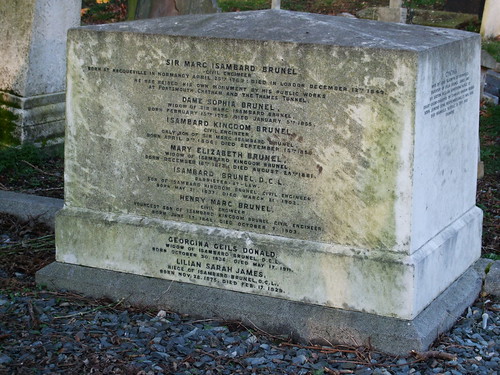
Charles Babbage, the polymath who created the concept of a programmable computer, is buried in the cemetery, as are Marc Brunel and his son Isambard, two of the most important and prolific engineers in British history. One of Marc’s great achievements was the Thames tunnel between Rotherhithe and Wapping, while Isambard’s accomplishments include the Great Western Railway and the designs for the Clifton Suspension Bridge in Bristol.

2015_0215KensalGreen40
Grave of Charles Babbage
2015_0215KensalGreen55
Burial place of Sir Marc Isambard Brunel, Isambard Kingdom Brunel, and other family members

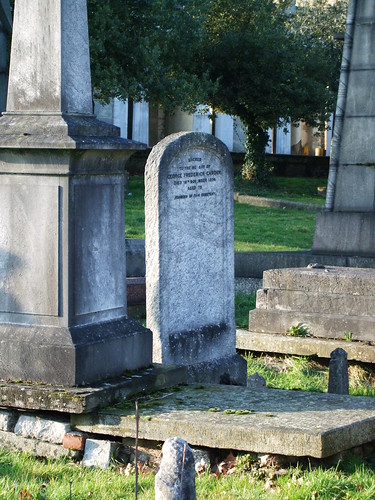
George Carden, founder of the cemetery, rests inside it.

2015_0215KensalGreen31
Grave of George Carden, founder of the cemetery

Architecture

The cemetery is of interest not just because of the individuals buried here, but because of the varied and rich architecture of the different tombs and mausoleums. One of the most significant graves in this respect is that of circus performer Andrew Ducrow.

2015_0215KensalGreen46
Andrew Ducrow’s elaborate memorial
2015_0215KensalGreen47
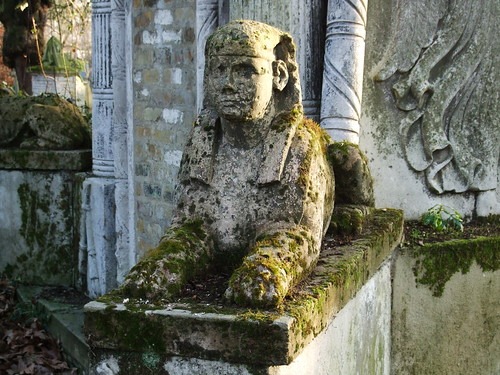
Egyptian symbolism, like this sphinx, was popular in the nineteenth century
2015_0215KensalGreen49
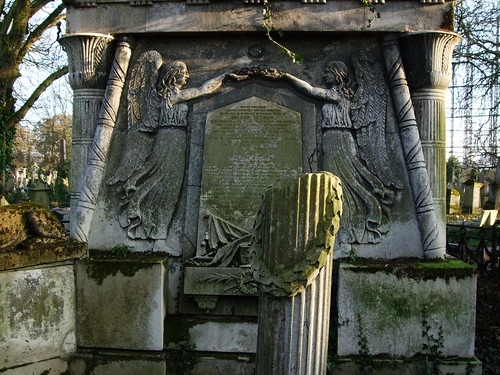
Angels and broken-off columns, symbolising life cut short, were also popular
2015_0215KensalGreen50
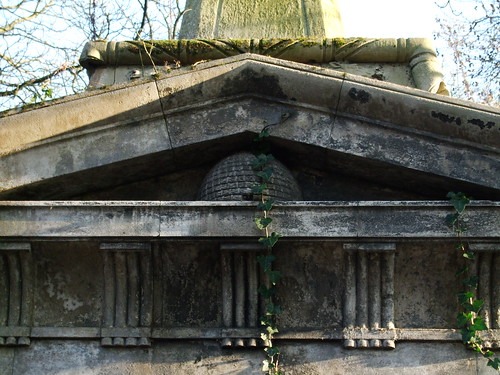
The beehive represents industriousness
2015_0215KensalGreen48
Beautifully carved hat and gloves

Dissenters’ Chapel

Our tour ended at the other end of the cemetery, with a visit to the Dissenters’ Chapel. We didn’t spend much time in this part of the graveyard, though it is interesting to me because my ancestors on my dad’s side, as Methodists, would have been classed as Dissenters, and if they had lived in London and been buried here, this is the area of the cemetery where they would have ended up. The chapel is similar in design to the larger Anglican chapel at the centre of the cemetery, but it has been restored more recently, with facilities for us to view displays and enjoy a hot cup of tea and some biscuits.

2015_0215KensalGreen58
The Dissenters’ Chapel
2015_0215KensalGreen59
Inside the chapel

Finally we were allowed to look inside the catacombs. They are smaller than those beneath the Anglican chapel, and the coffins there have been moved, but the space was still atmospheric. Plans are afoot to put on exhibitions and other events down here, which I think would be quite exciting.

We were let out of a side gate leading to Ladbroke Grove, and I made my way home.

A visit to Kensal Green cemetery is a must for anyone interested in cemeteries and the history of burials in London. It’s also a beautiful and peaceful space for a walk. Entry is free (unless you take a tour) and there is so much to see – it would be easy to go back again and again.

Would I go back?

Yes – it’s a lovely place for a relaxing walk, and I would particularly like to see Lady Byron’s grave and Terence Rattigan’s memorial stone, neither of which we had time to see on the tour. A booklet produced by the Friends, which I purchased for £2, has a map with the locations of significant graves, and this would be useful to take with me when I return.

Facts

Address: Harrow Road, London, W10 4RA
Founded: 1832
Size: 72 acres
Still in operation?: Yes
Official website: http://www.kensalgreencemetery.com
Owners: The General Cemetery Company
Friends group: Friends of Kensal Green Cemetery (http://www.kensalgreen.co.uk)
Tours: 2 pm every Sunday March to October and the first and third Sundays of the month November to February. Cost £7 (£5 for concessions/English Heritage members)

Tour of Ealing Studios

2015_0213EalingStudios01
The original entrance to Ealing Studios, with blue plaque dedicated to Michael Balcon

On Friday I was lucky enough to be able to go on a tour of Ealing Studios as part of the Ealing Music & Film Festival. The studios are the oldest continuously working film studios in the world, and have played a huge part in the British film industry for over a century, encompassing silent film, the onset of the “talkies”, the upheaval of two world wars and technological developments such as motion capture.

The site was originally occupied by Will Barker Studios from 1902, later becoming Associated Talking Pictures Ltd. Ealing Studios was built in 1931 and in 1938 Michael Balcon (who gave his name to the local branch of Wetherspoon’s) from MGM took over, issuing films under the Ealing Studios name. Many memorable films were produced in the 1930s and 40s, including documentary war films, but the studio’s heyday was during the post-war 1940s and the 1950s when celebrated Ealing comedies, including Kind Hearts and Coronets and The Ladykillers, were produced.

The studios were purchased by the BBC in 1955, leading to nearly half a century of location filming for television dramas and serials. After a transitional period late in the century, the studios entered new ownership in 2001. The five original sound stages are present, and are now listed. As well as offices and bases for modern production and related companies, the studios produce films and television shows: recent films include The Importance of Being Earnest (2002) and St. Trinian’s (2007), as well as the hugely popular Downton Abbey. In addition, the Imaginarium, a performance capture studio set up by Andy Serkis and Jonathan Cavendish, is based in one of the sound stages: famously it was used to create Gollum in The Lord of the Rings and The Hobbit.

2015_0213EalingStudios05
Inside the complex, looking towards reception

To reach the tour meeting point, which was the reception area, I had to go through the security point. There were several of us on the tour and we were taken to see the white building which was the original studio entrance in the 1950s. Famous figures including Michael Balcon and Alfred Hitchcock had offices here. It is looking slightly shabby these days but they are hoping to get the funds to restore it shortly. We were taken around the large complex and saw some of the modern companies, including a casting company and a hair and makeup studio, present on-site. One of the buildings, which includes the original sound stages, is listed but the newer building in front of it is due to be demolished and replaced with up-to-the-minute production facilities.

2015_0213EalingStudios06
The original entrance, seen from the back

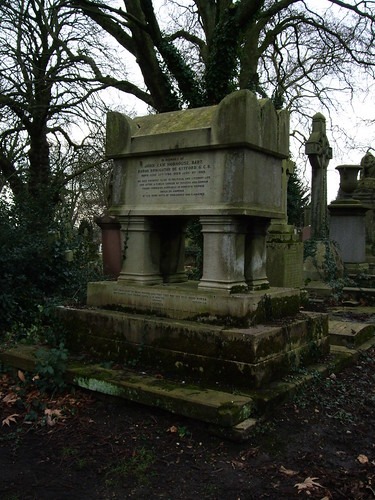
The most exciting part of the tour was being able to go on to the sound stages. On one, we saw a set being built, consisting of a theatre foyer and a staircase. This set is for a remake of the 1983 film The Dresser, and will star Anthony Hopkins and Ian McKellen. The top of the staircase leads to nowhere: a real theatre is being used for the auditorium (Hackney Empire). Thanks to a question from another person on the tour, I found out that this was the sound stage on which Scott of the Antarctic was shot. It was huge and still had some of the old safety notices on the walls.
2015_0213EalingStudios07
Listed building containing sound stages

The second sound stage was even more exciting: crew members and carpenters were preparing for the filming of Downton Abbey. Much of this popular show is filmed at Highclere Castle, but a significant proportion is filmed at Ealing Studios. As they were busy creating the set, we couldn’t see much but I could see into Lady Mary’s bedroom – which was in the process of having wooden “fireplaces” fitted – and had a peek into the servants’ corridor. We also saw the large backdrops used behind the windows, to give the illusion that it is a real room in a real house with a view. I also had a very brief glance into the Dower House sitting room.

2015_0213EalingStudios08
Plaque commemorating famous films made here

The tour was fairly short – it is a working studio after all – but very interesting. I was thrilled to have had the opportunity to visit.

Thames Tunnel Tour

It’s not very often that you get to explore the Thames Tunnel, otherwise known as the Brunel Tunnel. So when I found out that TfL were running tours through the tunnel between Rotherhithe and Wapping, I booked my ticket pronto. I was due to take the trip on the Sunday, which turned out to be the nicest day, weather-wise, of the entire bank holiday weekend, so it’s just as well I dislike the sun. I actually preferred the cool, dark atmosphere of the tunnel.

2014_0525ThamesTunnel01
Plaque just inside Rotherhithe station commemorating the tunnel

The tours began at Rotherhithe station. We put on plastic gloves – apparently you get rodents down there, not to mention an interesting variety of diseases, though luckily I didn’t see any rats during my trip. We then descended into the station, heading towards the northbound platform.

2014_0525ThamesTunnel02
On the platform at Rotherhithe, looking into the tunnel

The tunnel is used nowadays by London Overground trains, so these had to be stopped for the weekend. It was incredibly exciting to climb onto the track and make our way on foot between the rails. Our tour involved walking through the tunnel to Wapping station, then coming back the other way. During the tour we had an interesting and knowledgeable guide who told us various fascinating facts.

2014_0525ThamesTunnel05
Inside the former grand entrance hall at the mouth of the tunnel

The tunnel was begun in 1825 by Marc Brunel, father of Isambard Kingdom Brunel who also helped with the construction. Said to be the first of its kind anywhere in the world, it was a hugely ambitious undertaking, as the first tunnel ever constructed under a major river. Construction used Thomas Cochrane and Marc Brunel’s tunnelling shield technology, and the tunnel took eighteen years to build, with several workers dying during its construction: during one flood, in which six people died, Isambard himself nearly met his end, being pulled unconscious from the water just in time.

2014_0525ThamesTunnel06
One of the arches between the two tunnels

Intended for use by horses and carriages, the tunnel was actually used by foot passengers from the start. From the beginning, shopkeepers set up stalls in the archways between the two sides of the tunnel, selling assorted goods including tunnel souvenirs. Unfortunately, the tunnel also became a favourite haunt of pickpockets, thieves and “ladies of the night”.

2014_0525ThamesTunnel07
Looking ahead into the tunnel

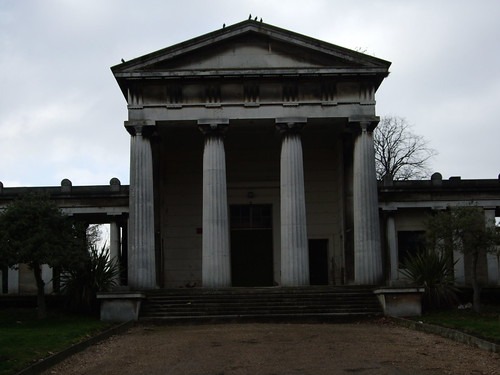
In 1865 the tunnel was purchased by the East London Railway Company for use by the new steam trains. The first few tunnel arches at the Rotherhithe end still bear the legacy of this railway, blackened by years of smoke (the rest of the tunnel was sprayed with concrete during the 20th century to strengthen it and ensure it was still suitable for use). In the space now occupied by Rotherhithe Station, there used to be a grand entrance hall, where a banquet was held on the tunnel’s opening; nowadays, the trains pass through the area frequently.
2014_0525ThamesTunnel08
Contrast between the area of the tunnel reinforced with concrete, and the original soot-blackened tunnel

The tunnel slopes gently downwards until it gets to the centre, then rises up again from that point. It’s easy enough to tell when you get to the middle; it’s an eerie feeling to be standing underneath the Thames right in the centre, in a tunnel that was built nearly two hundred years ago.

2014_0525ThamesTunnel10
Looking into the tunnel

In some ways it was a relief to reach the other side. At Wapping station we climbed up onto a platform like the one at Rotherhithe before descending again to begin the return journey.

2014_0525ThamesTunnel13
Arriving at Wapping station
2014_0525ThamesTunnel16
Looking back into the tunnel at Wapping
2014_0525ThamesTunnel17
View into the tunnel from Wapping

We headed back along the other side of the tunnel, which although it was built for foot passengers, proved perfect for trains in future years; firstly steam trains, then the modern Overground service. I am sure Brunel would be proud if he knew that the tunnel he built with such difficulty back in 1825 would still be in use nearly two centuries later.

2014_0525ThamesTunnel25
Arriving back at Rotherhithe station
2014_0525ThamesTunnel27
The end of the tour: back at Rotherhithe

London Literary Pub Crawl

A few weeks ago a friend invited me to come on a literary pub crawl around London – named, in fact, the London Literary Pub Crawl. Being a fan of both pubs and literature, I jumped at the chance.

The pub crawl is run by the Maverick Theatre Company, and led by one guide plus, apparently, ‘Charles Dickens’ and ‘Virginia Woolf’ – both of whom were absent from my tour, the actors having other commitments. However, I had a good time anyway, picking up fascinating snippets of information (and a couple of incorrect ones, which was slightly infuriating). I actually work near to the area where the tour takes place, and I had visited a couple of the pubs before, but a lot of the history was new to me.

I should point out that the photos were taken a couple of weeks later – I didn’t take any photos on the night as I was too busy taking in all the information (and drinking of course!).

The tour began at the Fitzroy Tavern in Bloomsbury, in the area once known as Fitzrovia. As it’s a Samuel Smiths pub (i.e. it sells cheap booze), I’d been here before and knew about the Dylan Thomas connection – the Welsh poet used to spend a lot of his time in London in the pub, and this was one he visited frequently. It was definitely a great choice to kick off the tour.

2014_0222LiteraryPubCrawl03
The Fitzroy Tavern

After a short walk, the Newman Arms was pointed out to us. I have never been in this pub, although I have walked past it plenty of times. I was intrigued to learn that George Orwell used it as the model for the plebian pub in 1984!

2014_0222LiteraryPubCrawl04
The Newman Arms

The building used to be a brothel, hence this rather interesting image in an upstairs window:

2014_0222LiteraryPubCrawl05
Upstairs at the Newman Arms

The nearby Duke of York was the scene of an altercation witnessed by Anthony Burgess, who was possibly influenced by it when he came to write his novel A Clockwork Orange. Again another fascinating piece of information that I’d had no idea about previously.

2014_0222LiteraryPubCrawl06
The Duke of York

On the way down to Oxford Street we passed the Wheatsheaf: this is another pub with a Dylan Thomas connection, as it is the pub in which he first met his wife Caitlin Macnamara.

2014_0222LiteraryPubCrawl07
The Wheatsheaf

Another pub we passed was The French House. This has a history of being a hangout for writers and artists including Francis Bacon.

2014_0222LiteraryPubCrawl10
The French House

The tour ended at the Coach & Horses near the Palace Theatre. This pub has enjoyed a long association with the staff of Private Eye magazine and its former landlord earned the dubious title ‘Britain’s Rudest Landlord’. It is also London’s first vegetarian and vegan pub so I certainly plan to visit soon!

2014_0222LiteraryPubCrawl11
The Coach & Horses

This is just what I remember from the tour, I highly recommend doing it yourself if you are interested in London’s literary past. We stopped for drinks in a few of the pubs, but the main focus is on the history so don’t be put off if you’re not a keen drinker. If you are, though, what better excuse than a culture-filled pub crawl?

Jack the Ripper Tour

It’s great when my friend Elisa comes to stay, as we get to do loads of fun touristy things that I wouldn’t normally think of doing. This time, one of them was a Jack the Ripper tour. If there’s anyone out there who hasn’t heard of Jack the Ripper, he’s a killer who murdered several prostitutes in Victorian London, and despite many theories and conjectures about who he was, his identity has never been confirmed.

We met outside Aldgate East station (apologies for the terrible quality of these photos: my camera’s never been great at taking pictures at night).

2014_0321JacktheRipper02
Our guide outside Aldgate East

Our costumed guide led us down alleys, up little hidden paths and beside old history-ridden buildings overshadowed by the shiny new modern office blocks that have popped up in the last few years. We stopped beside several workhouses, factories and landmarks made significant because they were the places where the bodies were found, or where the women had been last seen before their bodies were discovered.

2014_0321JacktheRipper03
Start of the tour

Our guide made pretty good use of projections to show us images of the victims, as well as pictures of the areas we were at as they would have looked back in the nineteenth century. This was really interesting and helped us compare and contrast. Seeing the faces of the murdered women helped to bring home the fact that they were actually real people. This tour is for entertainment but it also has a serious side.

2014_0321JacktheRipper09
One of JR’s victims

One of the places we passed was the Ten Bells pub, rumoured to be the place where one of the victims drank. We were also treated to a bit of theatre, as an actor playing the drunk partner of one of the women wandered past!

2014_0321JacktheRipper06
The Ten Bells

On a lighter note, one of the alleys we walked through was pointed out as being Knockturn Alley from the Harry Potter films.

2014_0321JacktheRipper08
Knockturn Alley

I probably wouldn’t have thought of going on something like this, so I’m glad my friend got me along. Definitely something a bit different for a Friday night!

Sipsmith Distillery Tour

The other week I finally got around to doing the tour of the Sipsmith Distillery that I booked back in June. The tours sell out so far in advance that I had to do this in order to get a place. I was supposed to be going with a few friends, but because of work and illness only one actually came with me on the night.

Inside the distillery

The distillery is in the middle of a residential street in Shepherd’s Bush and it is tiny – no wonder the tours sell out quickly, as there is very little space inside. It’s cosy and appealing though, and despite the clutter has a number of interesting things going on. I suppose ‘tour’ is a bit of a misnomer, since there’s nowhere else to go once you’re inside the building. ‘Talk’ and ‘tasting’ would be better terms, and our host was hugely entertaining – I thought he should have a career on the stage.

Bottles lined up on the shelves

During our talk we heard about the history of gin and the hoops the group had to jump through in order to establish Sipsmith’s. I found it interesting to learn about the name of the brand – ‘smith’ comes from the concept of making something by hand, the artisan practice of crafting with care. ‘Sip’ is obviously what you do to the finished product! This is great quality alcohol – something to be savoured and enjoyed.

The tasting crowd
The tasting crowd

In pride of place stands Prudence, the first copper still in London for nearly 200 years. She helps to make the different spirits Sipsmith are known for, four of which we got to taste this evening: barley vodka, London dry gin, damson vodka, and sloe gin.

Prudence, the copper still

Sipsmith, with its beautiful bottles decorated with ornate swans, is best known for its gin, and we were greeted with a gin and tonic on arrival. We got to taste some of the gin straight, without a mixer, and though this isn’t the way I would choose to consume it, it was clear that the gin is high quality, crisp and refreshing.

Enjoying a G&T
Enjoying a G&T

A surprise was the barley vodka. Normally, straight vodka has me making faces, and it’s usually reserved for those nights when getting drunk as quickly and efficiently as possible is the aim (and I experience fewer and fewer of those nights as I get older). However, this vodka was surprisingly drinkable, and I could detect the different flavours with no nasty aftertaste.

The damson gin was very pleasant, rather sweet, and I think it would taste lovely with tonic or lemonade. However, by far my favourite drink of the evening was the sloe gin. I’ve had sloe gin before – I’ve a bottle of the Gordon’s variety at home – but this Sipsmith version is the nicest I’ve ever tasted. It was flavoursome, not too sweet, and would be perfect with ice for a Christmassy drink.

Holland Park Walking Tour: From the ‘House of all Europe’ to the tranquility of the Kyoto Garden

Holland Park is relatively easy for me to reach, being just fifteen minutes away on the tube from where I live, but I still hadn’t managed to get there to check it out. I decided, therefore, to sign up for a guided tour organised by Yannick Pucci, having read about it in a blog post by Sequins and Cherry Blossom.

Holland Park entrance
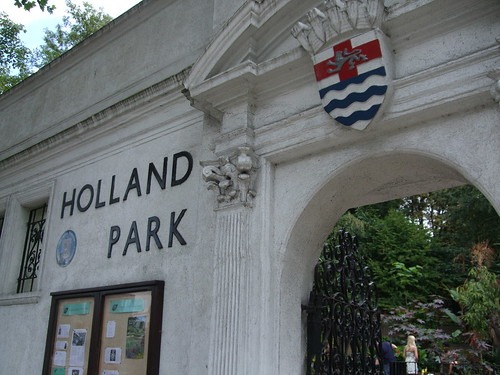
Entrance to Holland Park

On Saturday afternoon I met Yannick outside Holland Park tube station. As it turned out, I was the only one there on this particular tour so I felt very important! I was taken past some very expensive-looking houses to the park entrance, where Yannick pointed out the climbable ‘false’ terrace, leading to nowhere but providing an attractive entrance point into the garden. We then moved on to the statue of Lord Holland, after whom the park is named. This particular Lord Holland was Henry Richard Vassall-Fox, the third Baron Holland, who lived from 1773 to 1840. A lifelong Whig (his uncle was the notable Whig orator Charles James Fox), he was an interesting character with an interest in the French Revolution surprising in an English aristocrat. He caused a minor scandal by becoming involved with a married lady he met in Italy (whom he married after her divorce). The pair returned to England and lived in Holland House (built for Sir Walter Cope in the early seventeenth century and originally known as Cope Castle), entertaining a variety of celebrity guests including Benjamin Disraeli and Lord Byron (who was typically chased around the garden by inquisitive young women).

Statue of Lord Holland

The main focus of the tour was the Kyoto Garden, a Japanese garden which has long been a feature of the park. I’m no Japanophile but I found this fascinating. The garden, landscaped by Japanese gardeners and designed to represent the world in miniature, is beautiful. We entered via the main entrance – Yannick explained that you are meant to move round Japanese gardens in a clockwise direction, observing it unfolding in front of you, though most of the other visitors clearly hadn’t got the memo and kept getting in the way.
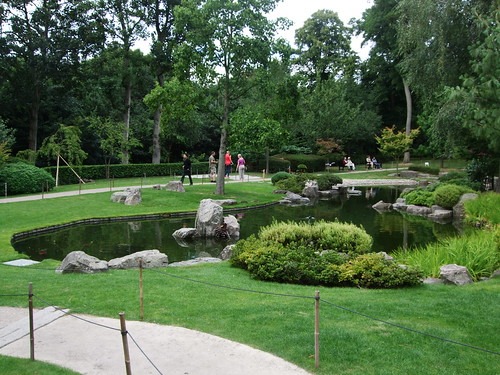
Kyoto Garden
The pond in the Kyoto Garden

I hadn’t realised just how symbolic and meaningful the elements of Japanese gardens are. The water and the rocks in the waterfall represent the contrast of yin and yang. The island in the centre of the pond symbolises a turtle. The number 3 is an important motif in Buddhist symbolism and it is apparent in several places around the garden, including the bridge which is formed of three concrete rectangles.

Kyoto Garden
Kyoto Garden

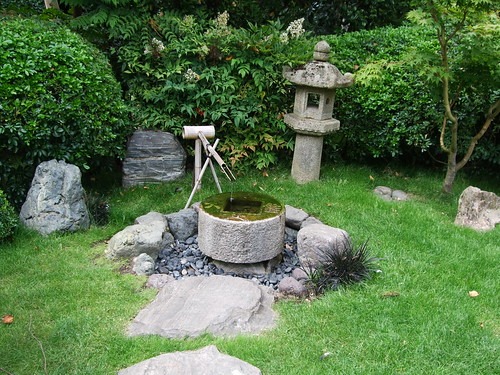
There are four different stone lanterns in the garden, as well as a fountain and a bamboo fence. A cracked paving stone, representing the Tohoku earthquake from a couple of years ago, lies next to the new Fukushima Garden, which commemorates that disaster.

Fountain
Drinking fountain (off limits to the public, sadly!)

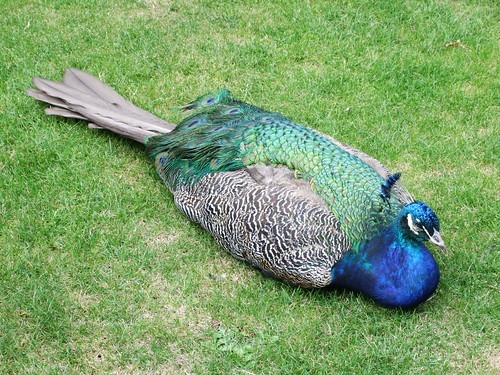
I spied one peacock inside the garden, though he was rather lazy and spent the whole time lying about, showing no inclination to display his fine feathers to us. There were also several ducks and moorhens swimming about.

Lazy peacock
Lazy peacock

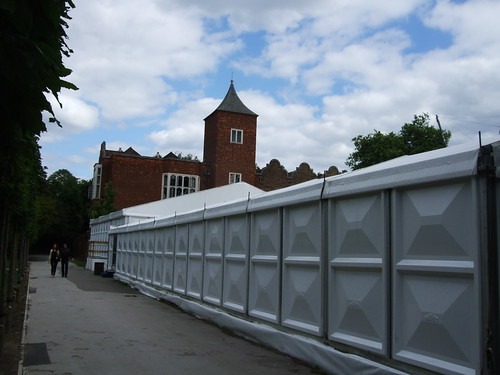
Finally we walked down to Holland House, a magnificent building that was sadly almost destroyed during the Blitz. Only the east wing and most of the library (yay!) survived. The remainder of the building is now a youth hostel. Unfortunately the façade was mostly hidden by the Opera Holland Park marquee, so I couldn’t get a proper view or a good photo.

Holland House
Holland House

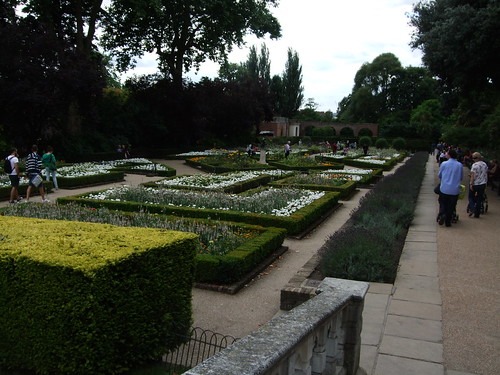
The nearby Dutch gardens (originally known as Portuguese gardens until England and Portugal fell out) were beautifully landscaped, albeit in a completely different manner to the Japanese garden. One area of the gardens is devoted to modern sculpture, while there are attractive buildings and a tea room nearby.

Dutch Gardens
Dutch Gardens

I thoroughly enjoyed my tour and learned a great deal about Holland Park and Japanese gardens. You can book a guided tour here: http://hollandparkwalk.eventbrite.co.uk/, or alternatively you can simply visit the park yourself and explore.

Ghost Bus Tour

A good friend of mine came to visit the other week and asked if we could do the Ghost Bus Tour. Of course I said yes: I’d seen the bus – an old-fashioned double decker painted black – before and thought it looked like good fun.

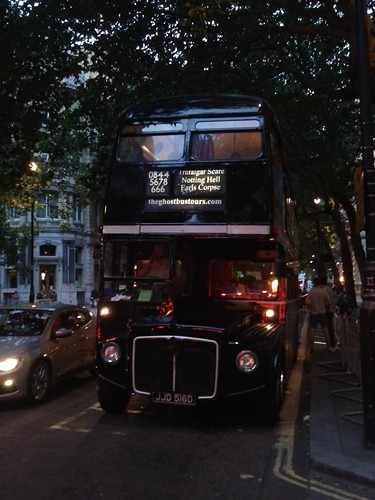
The Necrobus
The Necrobus, all ready for the tour

We got on the bus, which was located at Northumberland Avenue (near Trafalgar Square) at nine on Friday night and sat downstairs (the upper deck was far too hot). I liked the inside of the bus, which was decorated with old-fashioned lamps and had red curtains at the windows. I was moved to wish that all buses could be like that.

Inside the bus
Inside the bus

The tour was definitely entertaining. I don’t want to say too much in case I give anything away, but the actors were full of enthusiasm and energy (several times I was convinced that the conductor was going to fall off the bus). I didn’t find the tour remotely frightening, however I didn’t mind as I learned a lot over the course of our journey.  For example: the place where Charles I was beheaded is marked by a bronze bust on Whitehall, and part of Bank tube station was built in a burial ground.

We were told that the bus was the last remaining vehicle that formed part of the Necrobus Company, used for transporting coffins and mourners out of the city. I was initially sceptical about this but it seems that it might actually be true. The company was inspired by the Necropolis Railway, which was used for the same purpose from the nineteenth century after London’s graveyards became too crowded. Apparently a fire in 1967 destroyed all but one of the Routemaster buses used for the service; this one bus is now used for nearly all Ghost Bus tours (though other Routemasters have since been purchased and brought into use owing to the popularity of the tours).

It might be touristy and a bit cheesy, but I do recommend a Ghost Bus Tour. It definitely provided a good evening’s entertainment for us.