I was lucky enough to snap up a ticket to the Hidden LondonAccess All Areas Subterranean Shelter: Clapham South tour in association with the London Transport Museum. This was a unique opportunity to go underground and explore one of the shelters that was built during the Second World War as a refuge for Londoners to stay safe from the Blitz. I arrived at Clapham South station on Sunday morning and excitedly awaited my turn.
Entrance to the shelter
We were given wristbands and taken down the road to an imposing white cylindrical building, set into the side of a housing estate. I am sure the residents were bemused by all these people going in and out all day. We were taken around the space by several guides, all of whom were really knowledgeable and helpful. This is just as well as the shelter is a big place, and it would be very easy to get lost if you were separated from the group.
Inside the shelter
Clapham South subterranean shelter was one of eight shelters built between 1941 and 1942, 120 feet below ground and underneath even the tube itself. Previously, people had been sheltering in tube stations but even they were not safe in case of a direct hit: for instance, an bomb at Balham tube station in 1940 killed 66 people. The eight shelters together could hold 64,000 people, though in reality the total was never much more than 12,500.
One of the long tunnels making up the shelter
The shelter at Clapham South was dug out by hand by workers on 12-hour shifts, with no protection from the conditions. Once the death toll reached double figures they were finally provided with a shield. The resulting tunnels were made of cast iron and concrete, with two entrances: one at Balham Hill, the other at Clapham Common. The excavation caused a huge mountain of dirt to appear on the Common.
Photograph of a newly-opened deep shelter
Once construction work had finished, the worst of the Blitz was over and the shelters were initially used for other things, such as military occupancy. In 1944, however, the V1 and V2 raids began, and the shelters were hurriedly converted to their original purpose. Up to 8,000 people could be accommodated at Clapham South, though in practice the shelter never held more than 4,000 at once.
Former bathroomRemains of what was once a bathroom
Clapham South shelter was well-organised. On entering, a shelterer would be allocated a ticket to a dormitory; these dormitories were typically named after admirals. The shelter had a superintendent and a small hospital, with a doctor, nursing staff and a consulting room. For entertainment, music was played over the PA system, and sometimes dances were held. Chemical toilets were provided, with an innovative air compression system to shoot waste to the surface every few days. There were eight canteens dotted around the shelter, staffed by volunteers, with food provided by London Transport. The food was off the ration, but more expensive than it was at the surface: a cup of tea, for instance, was tuppence.
DirectionsThis area of tunnel was once a surgery
The shelter was connected to the Underground via a tunnel designed, but never used, as an emergency exit. Sometimes, shelterers were allowed to leave this way to hop on a train and get to work in the morning. Plans to convert this and some other shelters to an express Northern Line after the war never happened, owing to lack of funds. Instead, another function had to be found for the shelters once the war had ended in 1945.
Entrance to the Northern Line
After the war, Clapham South was used as a penny hotel, cheap accommodation for those visiting London on a budget. It was also used to house some of the arrivals from the Windrush once they arrived from the West Indies. During the 1951 Festival of Britain, the shelter was transformed into the Festival Hotel, costing three shillings a night. Used mostly by young students, female guests got sheets for their beds while men had to content themselves with blankets. The shelter was also used to house troops during the funeral of George VI and the coronation of Elizabeth II.
Sleeping quarters in the shelter
After a fire took place in another shelter, it was decided that the shelters were no longer safe for accommodation. What then should they be used for? TfL took over the shelters in 1998, and many were used for archive storage. Here, the last archives left in 2008, but they are still in place in some other shelters, such as Goodge Street. Another is now used for growing micro salad for an upmarket restaurant.
I loved my fascinating tour of the Clapham South shelter. Everyone was really knowledgeable and it was amazing to be in such an atmospheric place.
I’m a librarian by profession, and of the many things I like to do in London, one of the chief ones is to explore all the different libraries in the city. The Guildhall Library is a public reference library – though books cannot be borrowed, the collection is open to all – specialising in the history of London. It has a printed books collection of over 200,000 titles dating as far back as the fifteenth century, and also has items such as pamphlets, periodicals, trade directories, maps and poll books. The History and Treasures of Guildhall Library is a talk and tour that takes place every month or so. It is free and can be booked by individuals: you do not have to be part of a group. The Library is located at Aldermanbury in the City of London; the nearest tube station is St Paul’s. It is next to the Guildhall complex, but the Library itself was built in the 1970s.
We were given an introduction to the Library by one of the librarians. The first Guildhall Library was founded in 1425: this is recorded in John Stow’s Survey of London (1598). Known as the “Common Library” at Guildhall, its collections were mainly theological. Sadly, the Duke of Somerset stole borrowed the Library’s collections for his own house by the Thames during the sixteenth century. In the 1820s, the City of London Corporation decided to found another library: in 1828 there were around 1700 volumes, all concerning London, and the library was deemed very successful. By 1873, the “Old Library”, in the Guildhall complex, had 60,000 volumes. Sadly, 25,000 volumes were destroyed in only one night during the 1940 Blitz.
After the war, it was decided that another library should be built. The new building was opened on 21 October 1974. Today, the Guildhall Library focuses on the history of London, with a special collection relating to food and drink as well as three archive collections: the archives of London livery companies, the Stock Exchange archives, and the Lloyds Marine Collection. Below this library is the City Business Library, a valuable resource for anyone running a business.
We were shown some of the items from the collection, a fascinating and motley bunch. One volume, a Bible originally belonging to the Worshipful Company of Tilers and Bricklayers, was part of the original Library and ended up in the Duke of Somerset’s collection before finding its way back to the Guildhall. A third folio of Shakespeare’s works contains many plays no longer attributed to him. Nineteenth-century pictures of medieval floats from the Lord Mayor’s Pageant are fascinating, and a book with its original chain attached reminds us that books were so valuable hundreds of years ago that they had to be chained up to prevent theft.
Other items included a first example of a stocks and shares book, published in a coffee house; a collection of botanical illustrations; and, on a macabre note, a catalogue of the sale of items from Newgate. When the prison was closed in the early 1900s, the doors, fixtures and fittings were auctioned off: who knows where they have ended up?
We were then taken on a tour of the Library, observing the quiet reading room with easily-reachable reference works, freely browsable by readers. The books concern such wide-ranging subjects as gin, Jack the Ripper, and theatre. Other items can be requested from the basement, and are usually delivered within 15 minutes. We were able to tour the basement, complete with rolling stacks, and examine the riches stored within, including a collection of 21st century bound manuscripts, lavishly decorated, and editions of the Illustrated London News. The Food & Drink Collection, which is of national importance, contains some gems including Dinners for Beginners, Vegetables for the Epicurean, and Eat, Drink and be Wary.
The Guildhall Library is a fantastic resource and is well worth a visit. If I ever want to do some research about London, I know where to go.
As part of Open House London 2015, I paid a visit to the City of London Cemetery and Crematorium for a Heritage and History Tour. After having visited so many cemeteries this year, I thought I might as well go for one more. I turned up on Sunday morning in time for the tour, having travelled right across London: despite the name, the Cemetery is actually located in the east, near Epping Forest. Manor Park is the nearest station.
Cemetery gates
The Cemetery was opened in 1856, as a burial place for residents of the City of London, who prior to this had been buried within their own parishes. The overcrowding issue which led to the establishment of the “Magnificent Seven” also led to the formation of this cemetery, laid out by William Haywood on land purchased from the second Duke of Wellington. The Cemetery is nearly at capacity for burials, although former plots are re-used (sensitively, and only in particular circumstances). The remains from over 30 London parish church yards were also relocated here. Today, the City of London Cemetery and Crematorium is a Grade I listed landscape, open for burial to anyone regardless of religious belief or connection to the City. There are two crematoriums, one built at the beginning of the 20th century and one constructed in 1971. There are Grade II listed chapels and catacombs, a Garden of Rest, and memorial gardens.
Into the Cemetery
Our tour began with a look at some of the documents from the Cemetery’s 150-year history, including fascinating burial and cremation registers. We were then taken on a long, thorough and fascinating tour of the site. Several notable personalities are buried in the Cemetery, including Catherine Eddowes and Mary Ann Nichols (victims of Jack the Ripper), Dame Anna Neagle, and Edith Thompson (one of the last women to be hanged in the UK). However, what I was fascinated by the most was simply the heritage of the place, the mix of time periods and the story behind the burials here.
Hindu shrineGraves lined upVictoria Cross holderBurial site of a London parish churchDame Anna NeagleA racing driver, killed in an accident, and his familyBurial place of French HuguenotsOld CrematoriumInside the Old CrematoriumMemorial plaque for Bobby MooreRose GardenMemorial plaque for Mary Ann Nichols, buried in a paupers’ gravePlaque for John Joseph Sims, holder of a Victoria CrossBeautiful grave of a piano-loving ladyCatacombsInside the Dissenters’ ChapelInside the Dissenters’ ChapelThe Dissenters’ ChapelThe Anglican ChapelInside the Anglican ChapelBeautiful tomb carved of solid marbleThe New Crematorium
After being taken round the Cemetery, we were offered the chance to go “behind the scenes” at the Crematorium, and find out what happens when someone is cremated. While this part of the tour was entirely optional, every single person on it opted to go ahead. We were taken through the process by which bodies are cremated, the measures taken to ensure that individuals are correctly identified, how remains are turned into ashes and – most fascinatingly – the bits and pieces left over once the ashes are retrieved. These include things like metal hip and knee replacements, jewellery and anything else that is not combustible. I was hugely impressed by how hard the staff work to make sure everything runs smoothly.
My visit to the City of London Cemetery and Crematorium was one of the most fascinating and enlightening tours I have ever done. I enjoyed the tour of the Cemetery but I feel particularly privileged to have had the tour of the Crematorium, which really helped to demystify the cremation process. Death can be a taboo subject, but I honestly feel it’s important to be prepared and understand how burial and cremation work. Even without a tour, this is a lovely place to visit for a quiet walk.
FACTS
Address: Aldersbrook Road, Manor Park, London, E12 5DQ
Founded: 1856
Size: 200 acres
Still in operation?: Yes
Official website: cityoflondon.gov.uk/things-to-do/green-spaces/cemetery-and-crematorium
Owners: City of London
Tours: Tours take place at selected weekends throughout the year.
Somerset House is one of the most interesting buildings in London, with a long and rich history – in terms of the site itself, not just the existing building. It’s also been used as a film set on numerous occasions. I signed up to the Shot on Site tour to learn more about this aspect of the building’s history.
Our tour guide was enthusiastic and knowledgeable and I learned a great deal about the topic. Around 40 films have been captured here to a greater or lesser degree over the years, beginning with The Long Arm (1956) and The Day of the Jackal (1973), in which Somerset House effectively played itself, as the home of birth, marriage and death records that it then was.
Those films were unusual in that they used interior shots: this is rare as Somerset House, being designed as an office building, does not have particularly lavish interiors. For instance, the exterior stood in for the Devonshire residence in London in the film The Duchess (2008). In children’s movie Nanny McPhee and the Big Bang (2010), Flyboys (2006) – about a group of American pilots – and even Sleepy Hollow (1999), with the aid of some green screen, aspects of the Somerset House courtyard stood in for various locations, including a London street and a French hospital.
Somerset House has appeared in two Bond films, Tomorrow Never Dies and Goldeneye, standing in for a St Petersburg car park in the latter. It has “played” Buckingham Palace three times – in TV series Spooks, comedy The Worst Week of My Life and in children’s sequel Agent Cody Banks: Destination London (2004). The site has appeared in X-Men: First Class (2011) and in the 19th century-set romantic comedy Hysteria (2011) with Maggie Gyllenhaal, who apparently took several takes to cycle away wearing cumbersome Victorian skirts!
For me, the most fascinating part of the tour was the visit to the Lightwells and Deadhouse in the basement. The Lightwells, narrow passages running around and underneath the courtyard, are gloomy and atmospheric and acted as a prison in the Robert Downey Jr. Sherlock Holmes movie. In the Deadhouse, so named because it is the last remaining part of the palace that once stood on the site and still contains graves of palace staff, we were informed that it stood in for a bunker below the Ministry of Defence in the World War II thriller Glorious 39.
Finally, we were shown some glimpses of forthcoming movies which used Somerset House for filming, including the soon-to-be-released Suffragette. I really enjoyed the tour and if it comes back next year – which it may well do as part of the Film4 Summer Screen season – it’s definitely worth getting a ticket.
Sir John Soane’s Museum is a unique free museum near Holborn, the former home of the neo-classical architect responsible for the Bank of England. He established the house as a museum in 1833, and it contains numerous treasures from his collection.
I booked online for the rare chance to visit the Private Apartments at the top of the house. These were originally home to Soane and his wife, and later to curators of the museum. After refurbishment, they have been made available to visit as part of a guided tour.
I turned up with my ticket and was directed upstairs, where the group of us due to tour were gathered together and taken up a further flight of stairs, normally roped off. We were told that the house was bombed during the war and was refurbished afterwards; some lovely stained glass was pointed out to us that survived because it was removed from the house before bombing on the orders of the then live-in curator.
The first room we came to was Elizabeth (Eliza) Soane’s drawing room, where she would have taken tea, written letters and received guests. The room was decorated in her own style, with paintings of her children and family group as well as pictures that she liked. These included a beautiful representation of all the flowers in Shakespeare, and several sketches of Shakespearean characters. The next room was her bedroom, kept as it was for several years after her death by a heartbroken Soane, but eventually he turned it into a magnificent display room for his architectural models. The centrepiece was a very impressive model of a semi-excavated Pompeii, and surrounding this, on a beautiful wooden frame, were several models of notable classical buildings in both cork (for ruined buildings) and plaster of Paris (for models of buildings as-new). On the bottom of the stand were models of Soane’s own buildings, emphasising the inspiration Soane took from the classical world.
Following this we entered Soane’s bathroom, an elaborately decorated room with a grandfather clock (!) in the corner. The room contained an actual bath, and there were hot water pipes on the wall, but it is uncertain exactly how the system worked. After Soane’s death, the bath was sealed up at his request, and when it was opened after some years had passed it was found to contain a number of effects, such as pictures and documents, though none of these contained anything groundbreaking.
Next to the bathroom was Soane’s bedroom, although the bed there was not an original (that had been sold) but was one that had come from Pitzhanger Manor, his country house. Finally, we were led out of the apartments via a corridor decorated with lots of art and two mummified cats, which apparently were supposed to be lucky.
Changes have recently been announced to the Tours of the Private Apartments – the number of tours has been increased and you no longer need to book online, but can turn up on the day. The tours will continue to be free, as is entrance to the museum itself. It is definitely worth making the effort to go on a tour – it’s hugely interesting.
My attempt to visit each one of the Magnificent Seven cemeteries is coming to a close with my visit to Tower Hamlets Cemetery, the last of the seven to be founded in 1841. I visited one Sunday afternoon.
Southern Grove entrance
Getting There
Soanes Centre
The address of the cemetery is Southern Grove, London, E3 4PX. The main entrance to the park is five minutes’ walk from Mile End underground station. This is the location of the Soanes Centre, where courses and educational activities take place.
History
Inside the cemetery
The City of London and Tower Hamlets Cemetery (“Bow Cemetery” to locals) opened in 1841 after being formally consecrated by the Bishop of London. In 1966, an Act of Parliament closed the cemetery and redeclared it a park. Owned and managed by the Greater London Council until 1985, it was passed to the London Borough of Tower Hamlets. Since 1990, when the “Friends of Tower Hamlets Cemetery Park” were formed, the Borough Council and the “Friends” have worked together to promote and care for the park and run a programme of public events. It is now a designated Local Nature Reserve and a Site of Metropolitan Importance for Nature Conservation, managed by the Friends via a Service Level Agreement with LBTH Parks.
Additions have been made to the park within the last few years: the Soanes Centre, offering workshops and classes, was opened in 1993, while land including Scrapyard Meadows and Ackroyd Drive Greenlink has expanded the original area of the park. Tower Hamlets Cemetery Park is a conservation area and has several English Heritage Grade II listed monuments.
A solitary grave in amongst the parkland
My Visit
Near the entrance to the cemetery
Tours of the Cemetery Park do take place every month. However, though I turned up for a tour, it looked like I was going to be the only one there, so I didn’t bother, choosing to explore myself instead. Tours sometimes focus on the history of the cemetery and sometimes on the flora and fauna to be found within; I would certainly try and go on a tour in the future if I knew it would focus on the history.
War memorial
The war memorial can be found soon on entering the cemetery. From here, you can look around you and see how the city has grown up around the park.
Overlooking the cemetery
The graves are fairly close together and some of them are quite overgrown, but I think this adds to the atmosphere.
A row of graves
The cemetery is smaller than others I’ve visited, and I soon reached the end, where a railway bridge allows trains to rush past. This area is overgrown and wild: more meadow than graveyard.
The railway bridgeWoodland and wild flowers
A quick crossing of a footpath leads you to the chalk maze and a heap of wildflowers. I could see bees and hear crickets chirping, and for a while it felt as though I wasn’t in London at all.
Chalk mazeBench overlooking the chalk maze
Back into the cemetery, I found some interesting standalone graves, including this one in memory of a three month old baby, which I found incredibly sad.
Baby’s graveSolitary standing grave
I came across this memorial to those killed in air raids during World War II. The cemetery itself was bombed five times during the war, resulting among other things to damage to both of the chapels, which were later demolished.
WWII air raid memorial
This grave marks the resting place of a well-known local councillor.
Will Crooks’s grave
The Rev. David Roe is another notable burial.
Grave of the Rev. David Roe
This spot marks the site of the Dissenters’ Chapel.
Site of Dissenters’ Chapel
The Anglican chapel was located here.
Site of Anglican Chapel
Architecture
This cemetery doesn’t have so many notable graves, but I did like the architecture here, which in many cases was more subtle and delicate than I’ve seen before. Traditional symbols like angels, crosses and urns are common, but more unusual monuments include this little horse.
Horse lying atop a graveGrieving womanAngelImpressive monument
This carving of a ship on the sea is evocative and very impressive.
Beautifully carved ship
This sunlight-dappled tomb looks like a bath with a headless individual relaxing in it.
Slightly creepyWeeping woman
I love the detail on this carved drape.
Draped tombstone
This Art Deco-style gravestone is unusual and pretty.
Art Deco style
I enjoyed my visit to Tower Hamlets. It’s as much a park as it is a cemetery but it has a great deal of atmosphere. Plenty of people seemed to be enjoying it when I was there: dog walkers, runners, and those who were just sitting and relaxing.
Would I go back?
Possibly – it would be nice to do a history tour at some point. The cemetery doesn’t have many notable burials, but it is a lovely place.
And with that, my tour of the Magnificent Seven is over. Now I need a new project…
My latest cemetery visit involved a trip to Abney Park in east London. This cemetery, one of the least famous of the “Magnificent Seven”, recently celebrated its 175th anniversary.
South Lodge entrance to Abney Park
Getting There
The address is Stoke Newington High Street, London N16 0LH, and the tour begins by the South Lodge. The nearest station is Stoke Newington, a new addition to the London Overground, which can be reached from Liverpool Street station.
History
The cemetery is located in Stoke Newington in the London Borough of Hackney, originally on the outskirts of the city but now a busy part of east London. It is named after Sir Thomas Abney, Lord Mayor of London in 1700-01 and owner of the manor of Stoke Newington in the early eighteenth century. His town house, built in 1676, stood on the site of the present cemetery. The surrounding parkland, laid out by Lady Mary Abney and Dr. Isaac Watts (whose statue occupies pride of place in the cemetery, although he is not actually buried there), became a garden cemetery in 1840. What distinguishes Abney Park from the other garden cemeteries founded around this time is its non-denominational status, the first such garden cemetery in Europe. This means that the ground was not consecrated, and it was used as a burial place for Christians practising outside of the Church of England. The fact that Watts, a noted nonconformist thinker, was associated with the area was a bonus.
Abney Park was sold in the 1880s to a commercially-minded general cemetery company, and in 1978 it passed to the local council. Sadly, a period of neglect and decay followed, and it was included on the Heritage At Risk Register in 2009. Today, the cemetery is a designated Local Nature Reserve and Conservation Area. Following a period of care by the Abney Park Trust, management of the cemetery recently passed back to Hackney Council.
A broken statue
Tour
The tour began with an introduction to the cemetery and the concept of the Magnificent Seven, which is familiar to me after five other tours, but will be fascinating to those who haven’t previously heard the story. It was informative and interesting, and covered the flora and fauna to be found in the cemetery as well as the architecture, the chapel and some of the notable burials.
Heading into the cemetery
While the Abney Park Trust have taken really good care of the cemetery in the last few years, there are still overgrown areas. Some of these are intentional, to allow wildlife to flourish.
A selection of overgrown gravesDensely-packed burialsAn aged treeBeautiful stone angel and crossThe first burial in the cemetery
Following arson the chapel is sadly a shell, fenced off in an attempt to stop people getting inside. The basic structure is still there and some of its former beauty is still apparent. It could be restored, if only the money was forthcoming.
The chapelThe window shapes are still evident
The war memorial is located near the chapel.
War memorial
Abney Park doesn’t have as many famous burials as some of the other cemeteries I’ve visited. However, one notable individual is a policeman, William Frederick Tyler. He was killed in the “Tottenham Outrage” of 1909, shot by a robber.
Grave of William Frederick Tyler
The statue of Isaac Watts is located near the chapel.
Statue of Isaac Watts
William Thomas “Tommy” Hall was a famous cyclist who broke the world motor-paced hour record in 1903.
Grave of Tommy Hall
One of the saddest things I’ve seen in any of the cemeteries is this: a row of paupers’ graves lining the path.
Paupers’ graves
I had never heard of this author, but the title of his tome intrigued me.
Intriguing gravestone
This memorial commemorates east Londoners killed in the Blitz, including factory workers who died when a bomb destroyed their factory.
The Blitz memorial
Salvation Army founder William Booth has a large memorial in the cemetery.
William Booth’s grave
This intriguing memorial shows how widespread the Salvation Army had become.
This tomb supposedly marks the location of the door of the original Abney Park house.
The lion tomb on the right belongs to Frank Bostock, a lion tamer who was known as the “Animal King”.
A selection of graves, including the Bostock family tomb
The cemetery is also well known for being a haven for wildlife, including owls, woodpeckers and kestrels.
Architecture
The cemetery layout is a bit different to some of the others I have visited. The Egyptian Revival entrance was designed by William Hosking FSA in collaboration with Joseph Bonomi the Younger and the cemetery’s founder George Collison II. The South Lodge bears hieroglyphics which, translated, mean the “Abode of the Mortal Part of Man”.
Close-up of the Egyptian-style columns
There are no divisions in the cemetery separating one religious group from any other. The chapel, the first non-denominational cemetery chapel in Europe, designed by William Hosking, was built in a northern European brick Gothic style.
As in the other cemeteries I have visited, draped urns, crosses and angels are common.
This anchor is particularly well done.
Would I go back?
Yes – there are many interesting things to see that the tour didn’t include, such as the grave of Joanna Vassa (daughter of Olaudah Equiano) and that of James Braidwood, the first director of the London Fire Engine Establishment (forerunner to the London Fire Brigade), who died in the Tooley Street fire of 1861. There are also a number of early theatre and musical hall performers buried here, and you can do a separate tour about those, as well as a nature walk if you are interested in that side of things. Abney Park is a beautiful cemetery and deserves to be visited.
FACTS
Address: Stoke Newington High Street, London, N16 0LH
Founded: 1840
Size: 31 acres
Still in operation?: No (except for a small number of burials which take place in existing plots)
Official website: http://www.abneypark.org
Owners: Hackney Council, who have recently taken over the Cemetery’s management from the Abney Park Trust.
Friends group: Abney Park Cemetery Trust
Tours: These take place on the first Sunday of the month, beginning at 2pm and lasting for around an hour and a half. They are free, but donations are welcome. Meet at the South Lodge, on Stoke Newington High Street.
Underground at Charing Cross, waiting to go through the barriers
The tube is one of my obsessions, and I’ve already toured the closed Aldwych/Strand station, so I was thrilled to have the chance to tour the disused Jubilee Line platforms of Charing Cross station. The tours, organised by the London Transport Museum and Hidden London, sold out almost as soon as they went on sale. We were told to meet by the barriers in Charing Cross underground station – this was unusually quiet for a Sunday, perhaps because the main line station was closed.
This walled-up entrance was once the way to the Jubilee line
We were issued with wristbands and taken through the barrier and down the escalator. Once we had reached the bottom, a door in the unassuming wall directly in front of us was opened and we were ushered through to find another escalator, this time switched off, so that we had to walk down it. At the bottom were the platforms, decorated with film posters left over from the Underground Film Club‘s recent residency.
Hidden London poster
The Jubilee line was first opened in 1979, two years after the Queen’s Silver Jubilee which lent its name to the line as well as the silver/grey colour of the line on the tube map. Known prior to its construction as the Fleet line, after the tributary of the Thames that also gave its name to Fleet Street, it took over what was formerly the Bakerloo line between Stanmore and Baker Street, continuing on to Charing Cross, a station with a chequered history, having originally been two separate stations that were united only when the Jubilee line platforms opened.
Poster showing the stations along the Jubilee line when it first opened
For twenty years the Jubilee line served Charing Cross, alongside the Bakerloo and Northern lines. However, in 1999 the Jubilee line was extended: the line was rerouted from Green Park to Westminster, carrying on south of the river to the Docklands area and the O2 (then the Millennium Dome), curving back up and terminating at Stratford. The Green Park-Charing Cross section of the line has been closed to regular tube trains ever since, though it is still used as a sidings and in certain circumstances trains can be sent down here to help avoid congestion – one of my friends was once on a train that was temporarily rerouted down here, and when she told me about it I was VERY jealous.
One of the platforms
Our knowledgeable and informative volunteer guides told us all about the station, its history, and how it is used today. It is often used for testing new features.
The yellow wall signifies that there is an exit on the opposite sideFor the first time in this station, the name of the station was positioned lower on the wall so it could be read from the trainIn case of emergency, shining a light on these yellow panels makes them glow green, so that they stand out in the darkness
The station is sometimes used for storage.
You wouldn’t get this in a normal station – it is used for moving things off and on trains
The station has a distinctive look that you can recognise if you see it on screen – so long as you know what to look for.
The open ceiling signifies air vents.
We were shown a series of short film clips featuring Skyfall (2011/12), Paddington (2013) and the TV show 24 (2014), filmed on these platforms. As I had learned at Aldwych station, historical TV programmes and films tend to be filmed in that station, whereas more modern shows tend to be shot here at Charing Cross.
This is the escalator that Bond slid down in Skyfall: thankfully with the spikes at the bottom removed!
After we had explored the platforms we were divided into two groups and taken to see more hidden parts of the station.
In the film Creep (2004) a creature comes out of this very hole.
My group visited a construction tunnel first – entering via the door that Daniel Craig pops out of in Skyfall, blending in seamlessly with the hordes of commuters.
It was dark and rather disgusting in the tunnel – but still incredibly exciting
When the Jubilee line was first being built, constructors couldn’t dig directly beneath Charing Cross station, as this would have been too disruptive for traffic. Instead, they sunk a hole next to the National Gallery – where the Sainsbury Wing is located now – and tunnelled along from there.
We were walking under Trafalgar Square at this point
An older part of the tunnel is now entirely blocked up, in a location directly beneath the Fourth Plinth.
The tunnellers used the same methods as the original Underground workers did back in the nineteenth century.
Posters comparing the construction of Underground tunnels, almost a century apart
Once out of the tunnel, we changed places with the other group, causing passing tube-travellers to look somewhat bemused as we emerged from one door in the wall only to enter another one shortly afterwards.
We had to don hard hats for this part of the journey.
This is the cooling system for parts of Charing Cross station. I had no idea, waiting for a train, that there was all this space above my head.
From here we could LOOK DIRECTLY ONTO THE PLATFORM AND THE TRAINS.
Train is gone…Train has arrived
I had hoped that somebody on the platform would look up and get a shock, but sadly it was not to be. However, the guy in front of me later managed to frighten a tourist by waving to her from the passage.
We went off down the passage in the other direction to see where the cooling system begins. It’s possible to see it from outside the station, if you know where to look. It was raining outside and we could feel the rain on our faces.
That was the end of the tour. We were taken back to the top of the escalators to make our own way home.
I had an AMAZING time and would definitely recommend the tour to anyone who might be interested. It is sold out at the moment but there may be more tours announced in the future, so I’d recommend signing up to the London Transport Museum’s mailing list to be the first to find out about any future dates. The guides hinted that there would be more exciting tours to look forward to – I’m hoping for Down Street but I’ll have to wait and see!
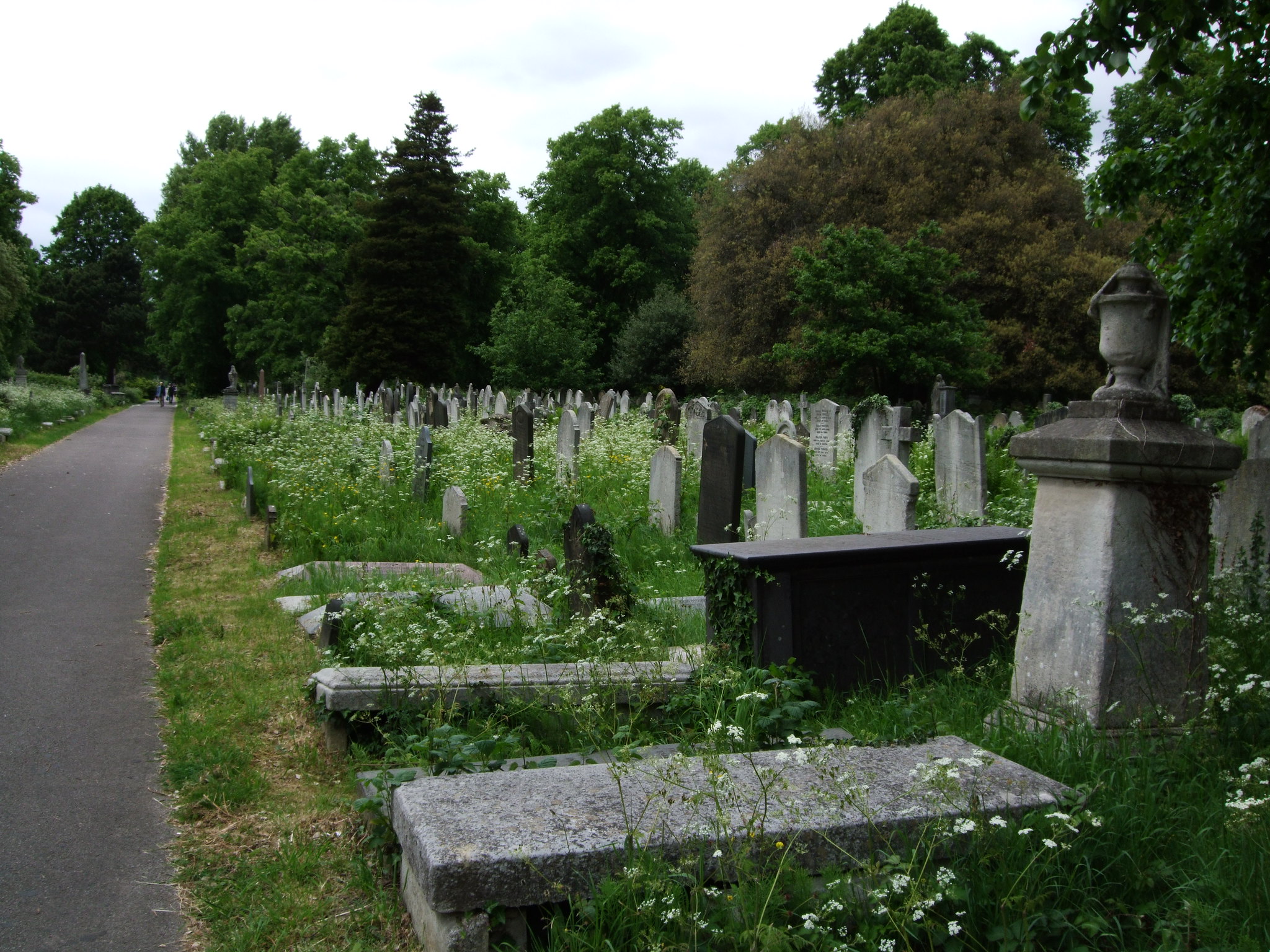
My attempt to visit each one of the Magnificent Seven cemeteries continued with a trip to Brompton Cemetery. This is the most central of the seven and the easiest one for me to reach, located in west London. However, it is also positioned right next to Stamford Bridge, and the day of my trip coincided with a football match between Chelsea and Sunderland – considering I am a Sunderland supporter I should have probably been aware of this, but I was taken by surprise to find hordes of people clad in blue getting off at Fulham Broadway station. Eventually I managed to disentangle myself from them and made my way over to the cemetery. Many supporters clad in football shirts and scarves were wandering through the cemetery, but the rush of people eventually petered out, to be replaced by cheers and roars from the football ground which punctuated the quiet during the tour.
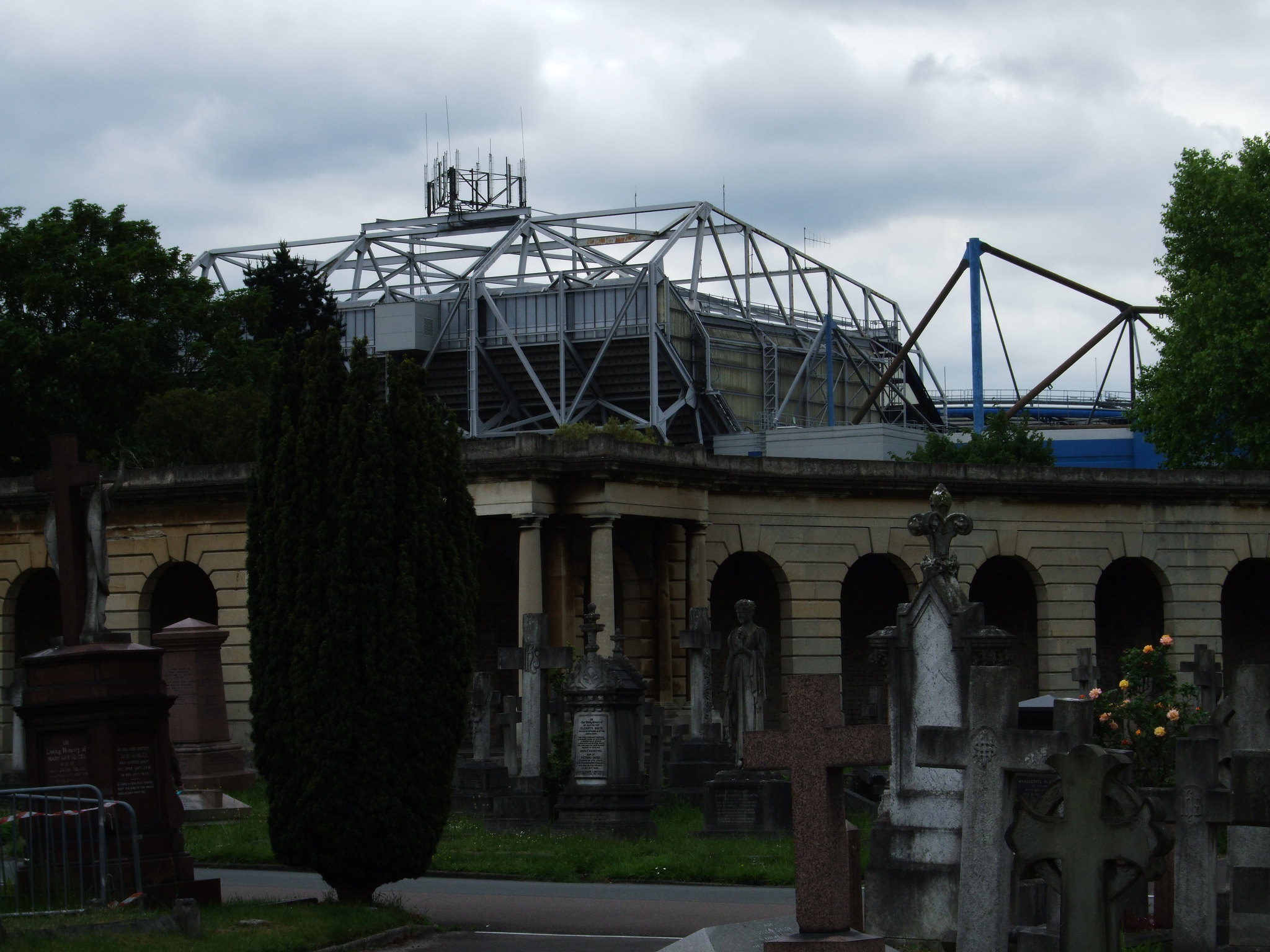
Stamford Bridge stadium, viewed from Brompton Cemetery
Getting There
The cemetery lies between Old Brompton and Fulham Roads, on the western border of the Royal Borough of Kensington and Chelsea. The postal address is Old Brompton Road, London, SW10 9UG and the nearest tube station to the main entrance (the North Gate) is West Brompton, with Earls Court a little further off. However, the tour was scheduled to begin at the South Lodge, so I got off at Fulham Broadway instead.
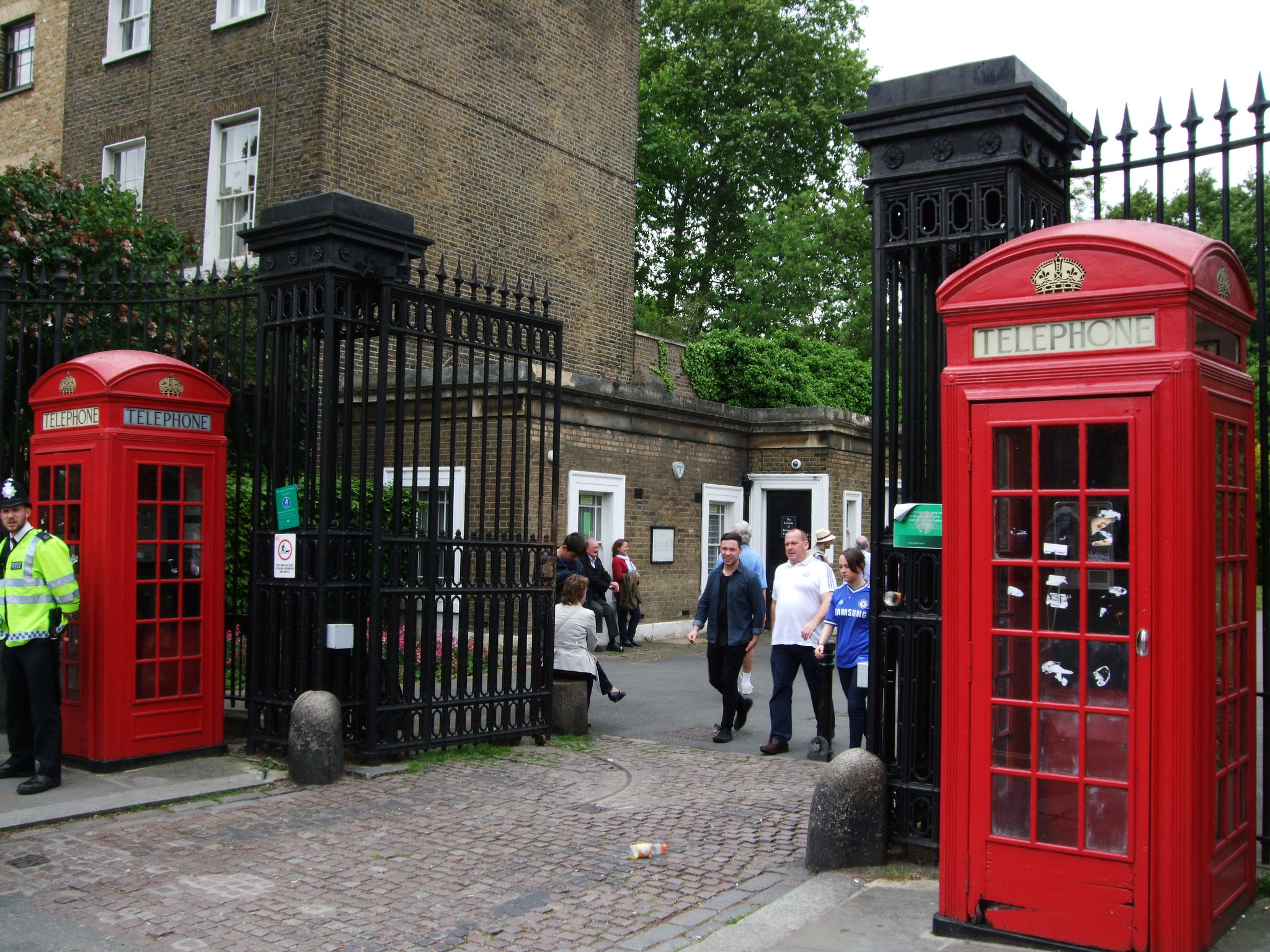
The South Gate
History
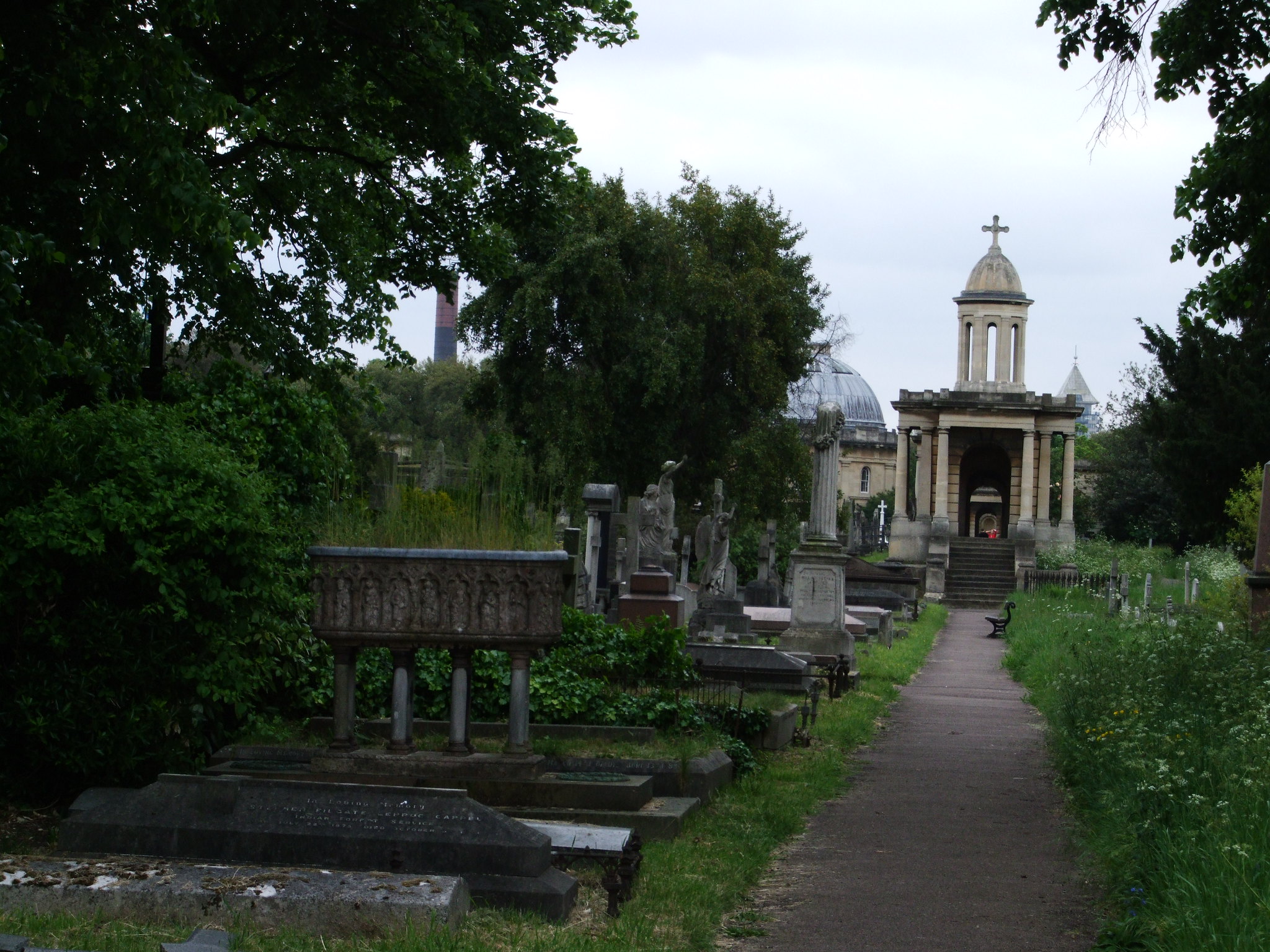
Brompton Cemetery, which is Grade I Listed on the English Heritage Register of Historic Parks and Gardens, was originally consecrated by the Bishop of London in June 1840. The cemetery occupies a rectangular site, and comprises 39-acres (16 hectares) which were purchased from Lord Kensington in 1838.
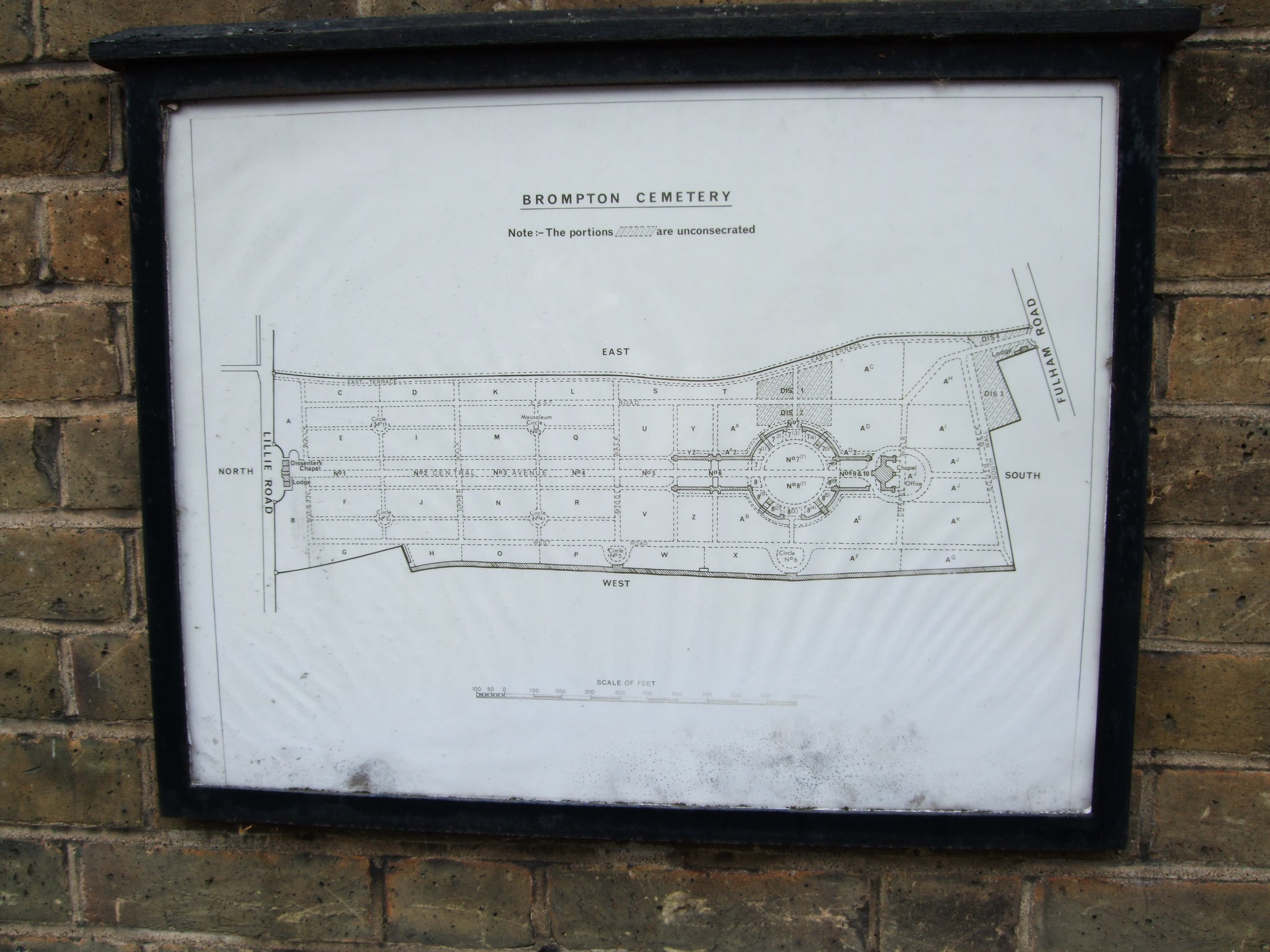
Map showing the layout of Brompton Cemetery
The cemetery was founded by the architect, inventor and entrepreneur Stephen Geary (1797-1854), who was also responsible for Highgate and Nunhead cemeteries. However, when the company directors held a competition for the cemetery’s design, the lead judge Sir Jeffry Wyatville (1766–1840), a distinguished architect, chose a design by his assistant Benjamin Baud (c.1807-1875), forcing Geary’s resignation.
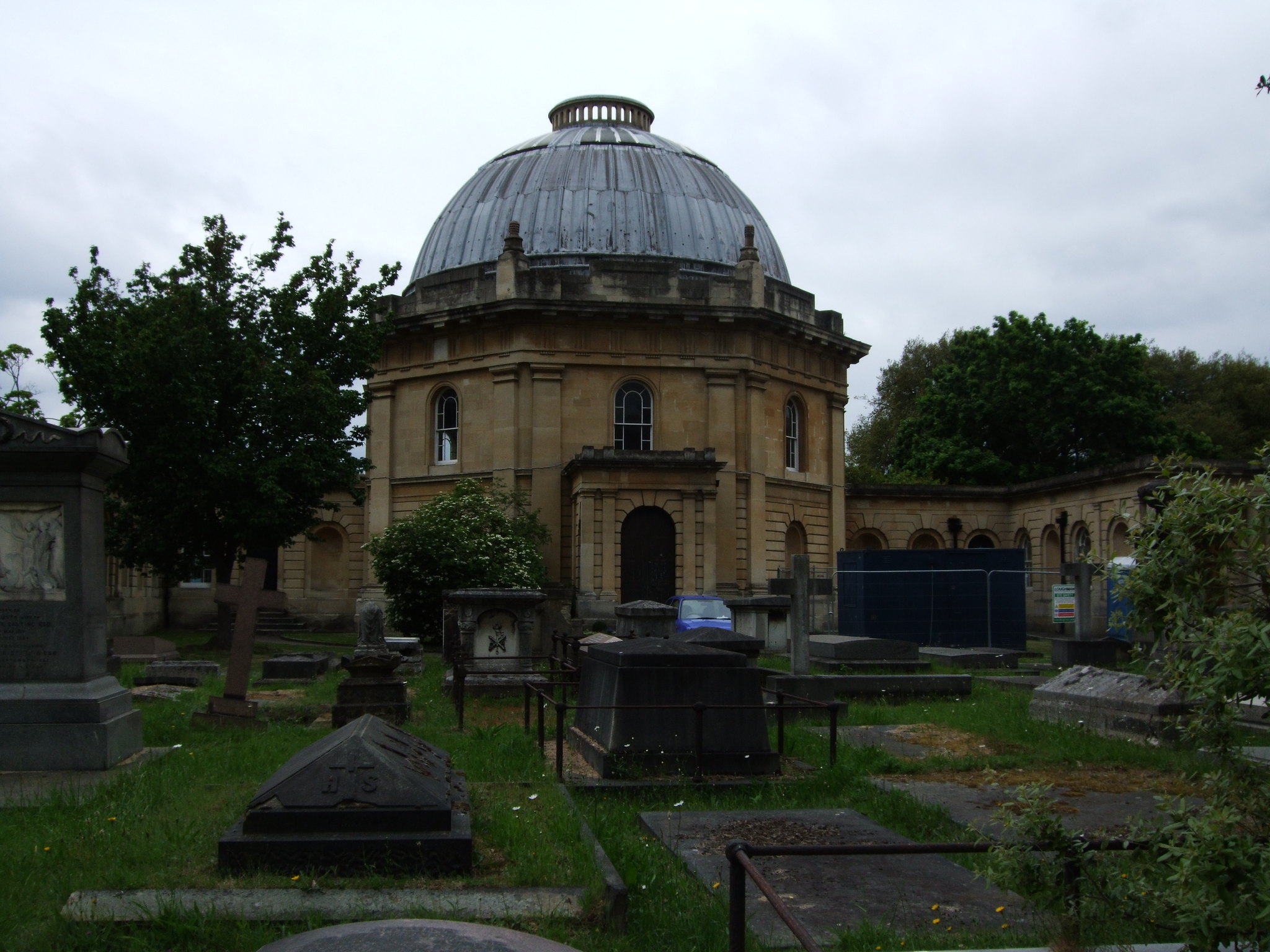
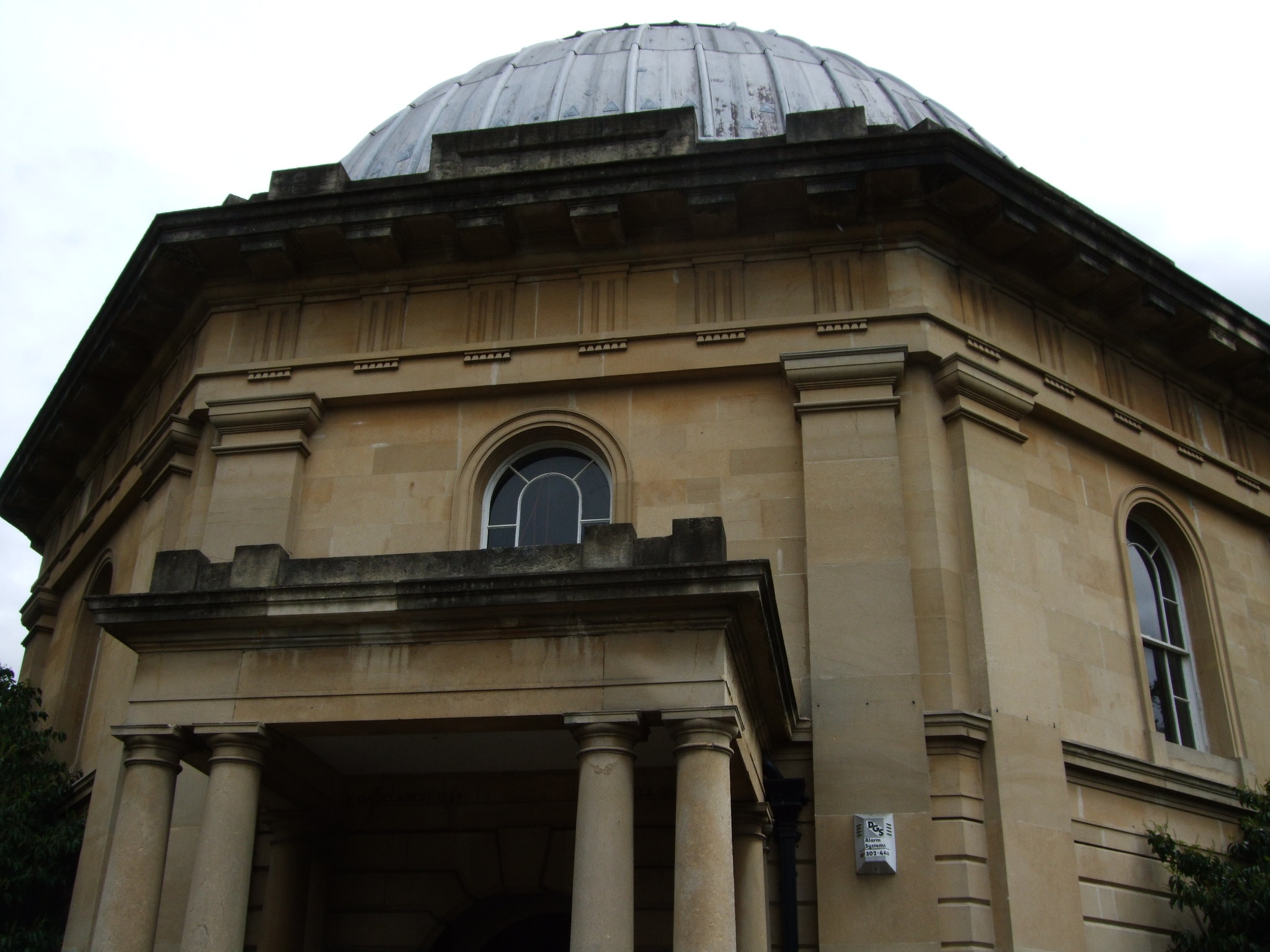
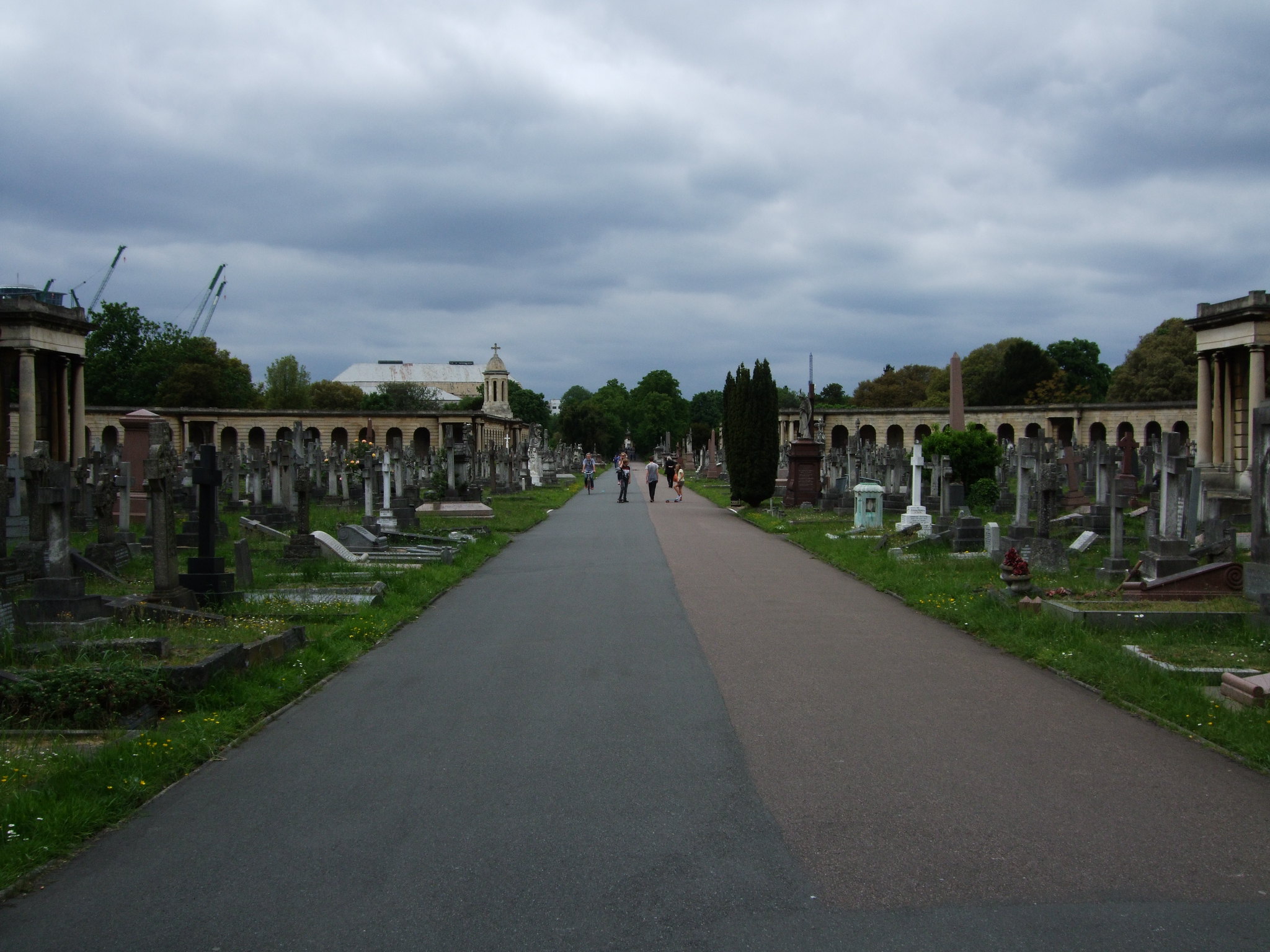
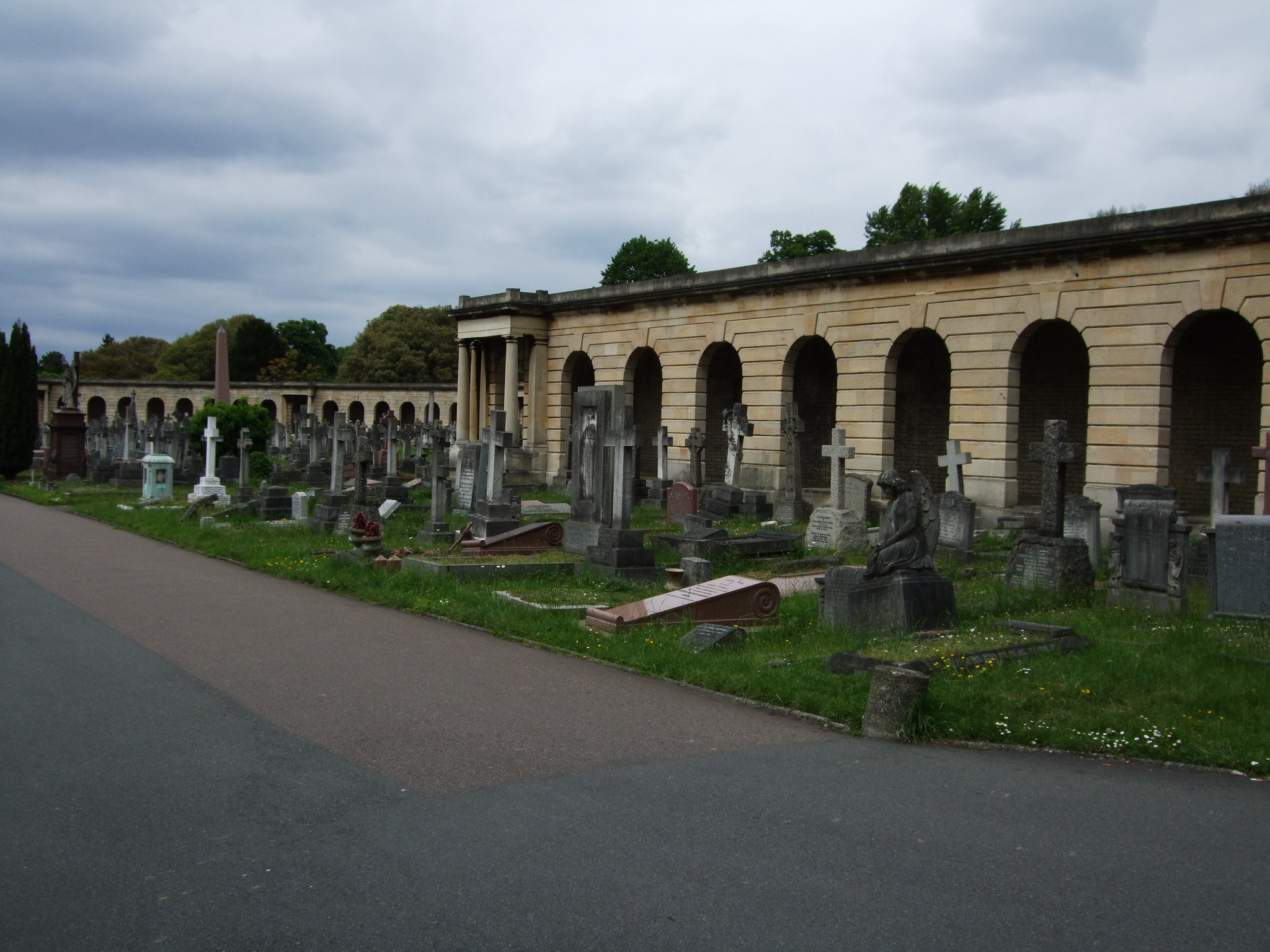
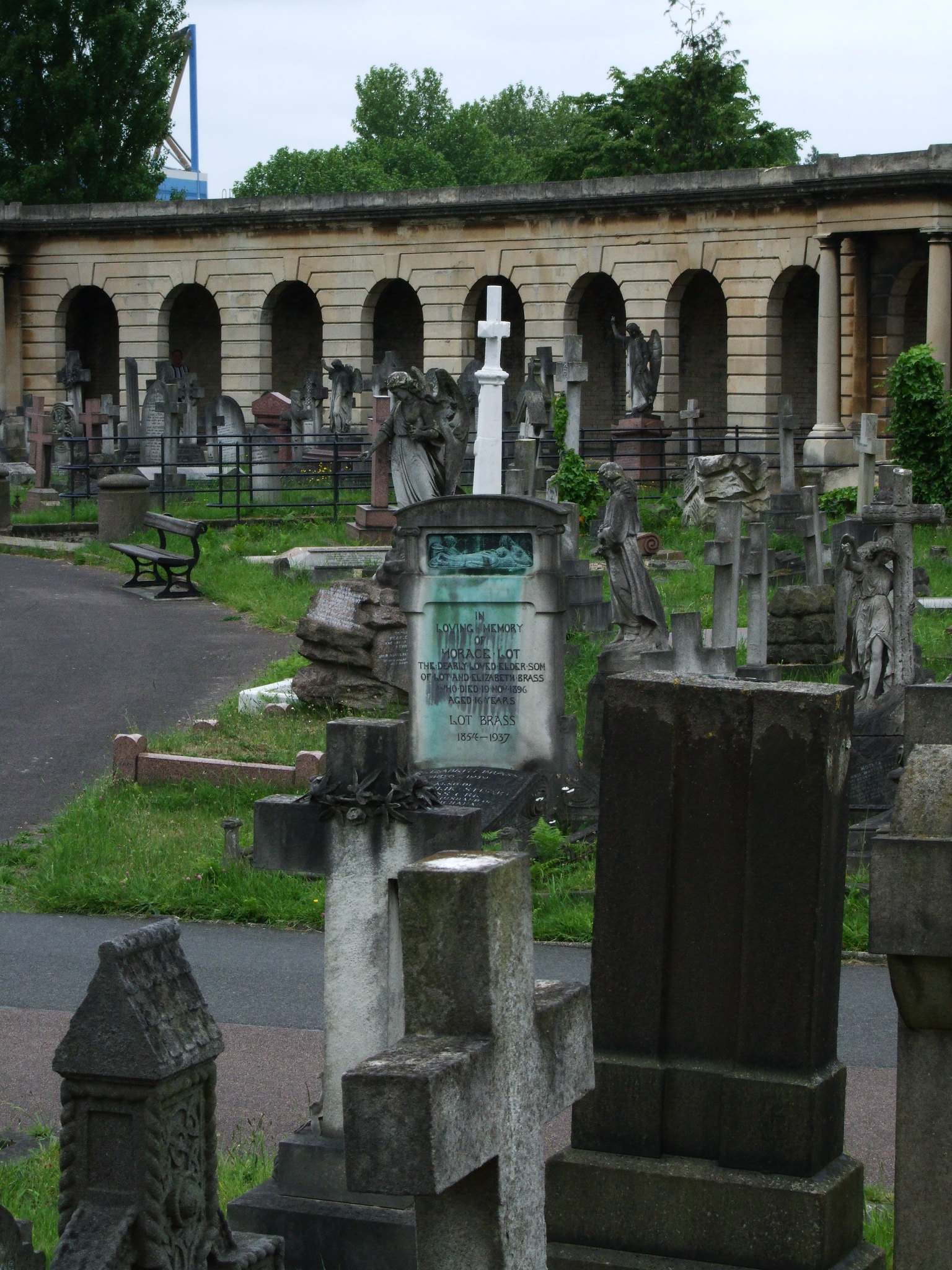
Baud’s design incorporates neoclassical elements but is chiefly notable for its resemblance to a cathedral. The central avenue, or “nave”, leads to the domed chapel, or “high altar”, while a circle of arcades with catacombs below is said to have been inspired by the piazza of St. Peter’s in Rome. The North Gatehouse was designed to represent the “great west door”; it suffered bomb damage during World War II and has since been restored.
The chapel
The cemetery was purchased under the short-lived Metropolitan Interments Act of 1850, which prohibited burial in overcrowded crypts and urban churchyards, and gave the state the power to purchase commercial cemeteries. It was the first cemetery to be nationalised, and remains Britain’s only crown cemetery, currently in the care of the Royal Parks Agency. Closed to burials between 1952 and 1996, it is now once again a working cemetery, restored, maintained and preserved by The Friends of Brompton Cemetery.
Tour
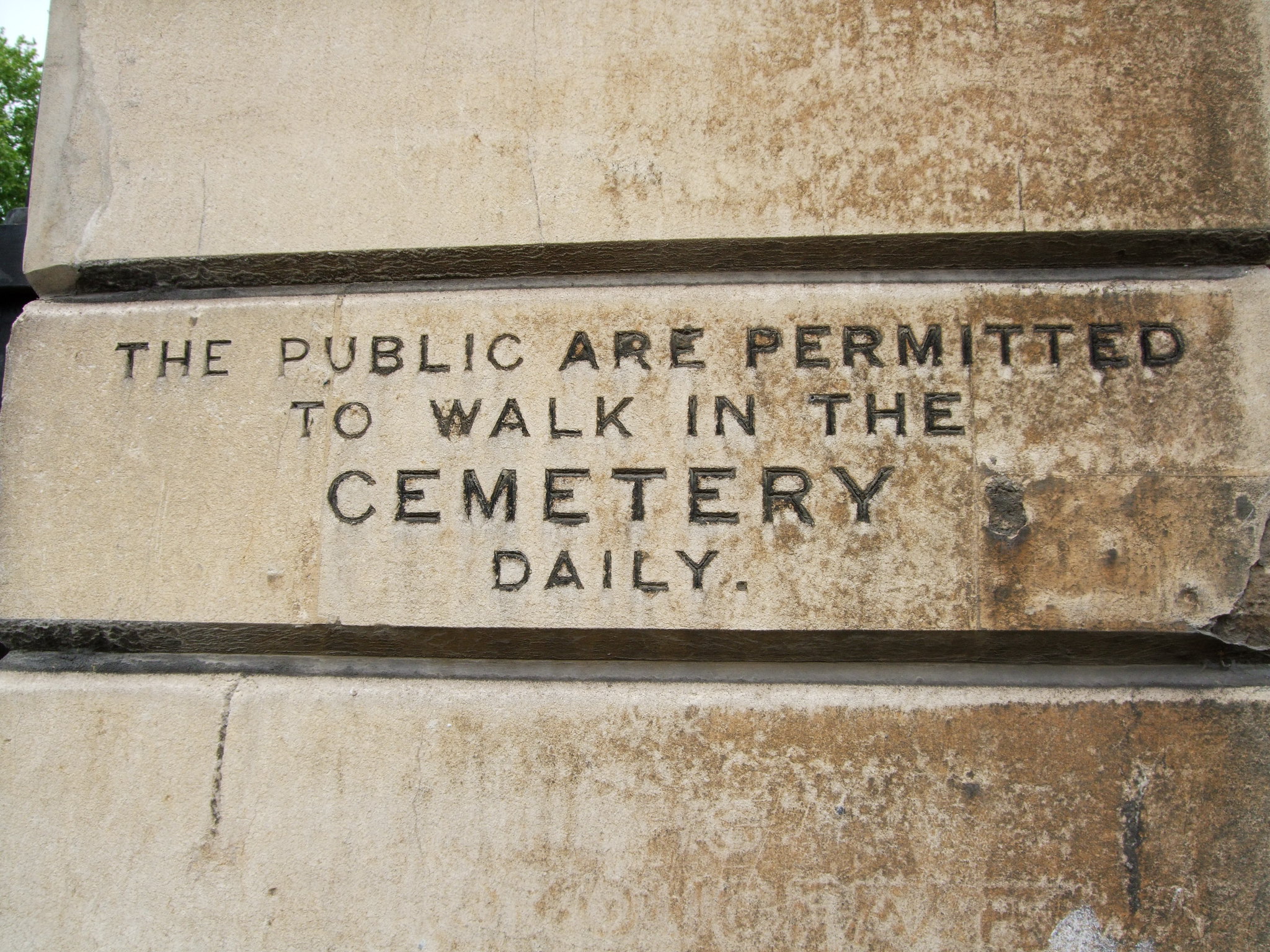
Notice at the South Gate
I attended a tour run by the Friends. These take place on Sunday afternoons and I was pleasantly surprised to find quite a crowd waiting at the gate. Our guide was incredibly knowledgeable and I am sure he could have told us much more about the cemetery than he was able to impart during the two hours of the walk.
Exploring the cemetery
Brompton doesn’t have the number of famous people that the likes of Highgate and Kensal Green possess within their walls, but there are still several notable individuals buried here. George Salting was an art collector who left considerable legacies to the British Museum, the Victoria & Albert and the National Gallery.
The grave of George Salting and his parents
Pioneer of the women’s suffrage movement Emmeline Pankhurst is also buried here, though we didn’t get to see her grave.
The chapel
We stopped off by the chapel, which was open for us to take a look around. It is possible to buy drinks and snacks here too.
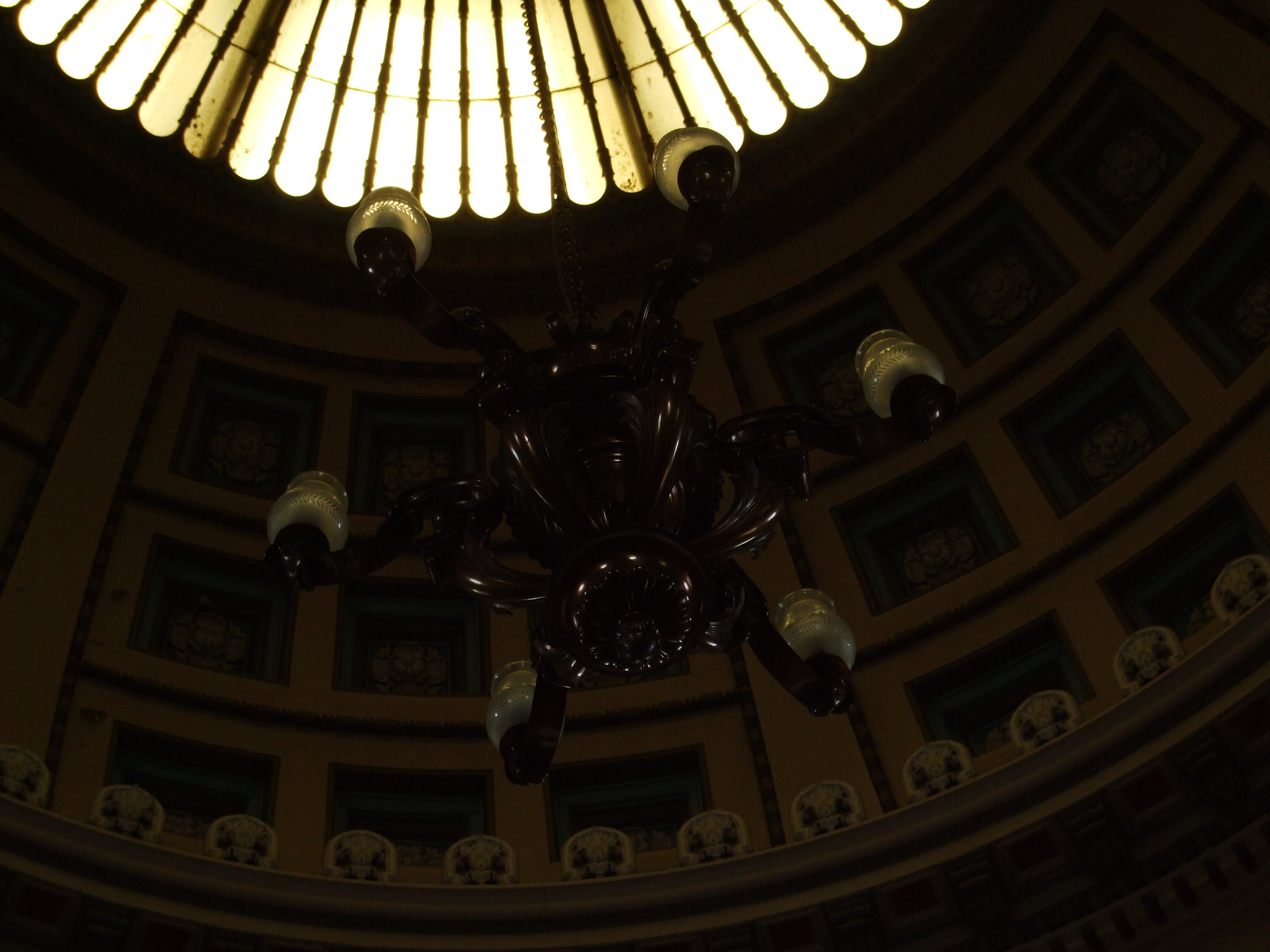
I was advised that the best way to take pictures of the chapel’s ceiling was to lie down, so that’s what I did – on a row of chairs rather than the floor.
The chapel ceiling
Looking north from the chapel
Just beyond the chapel, two arcades flank more sets of gravestones.
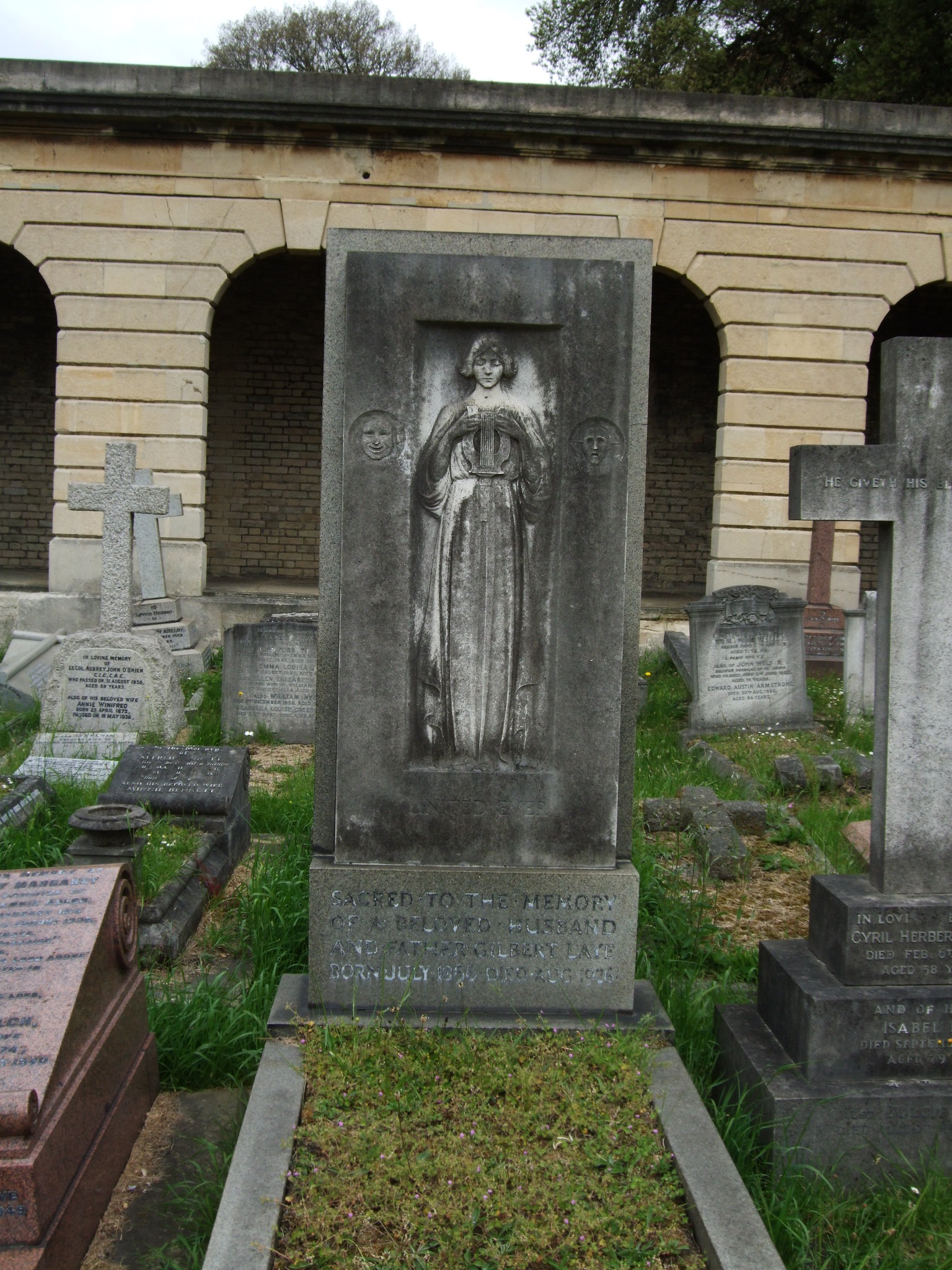
Gilbert Laye was an actor, composer and theatrical manager. I particularly liked his headstone, with the comedy and tragedy masks on either side.
Grave of Gilbert Laye
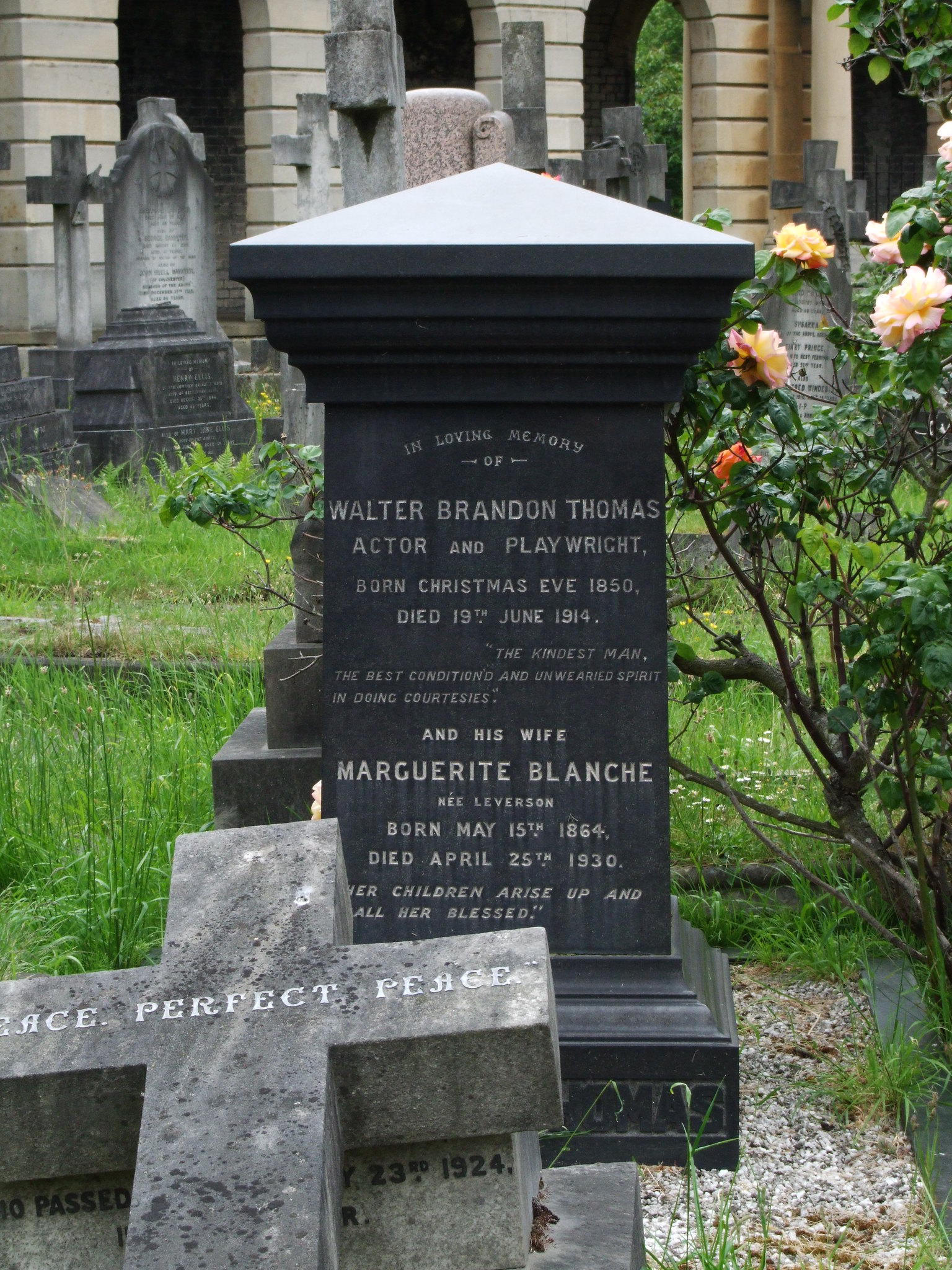
Continuing the theatrical theme, Walter Brandon Thomas was an actor and playwright best known today for his (genuinely funny) farce Charley’s Aunt.
Burial place of Walter Brandon Thomas
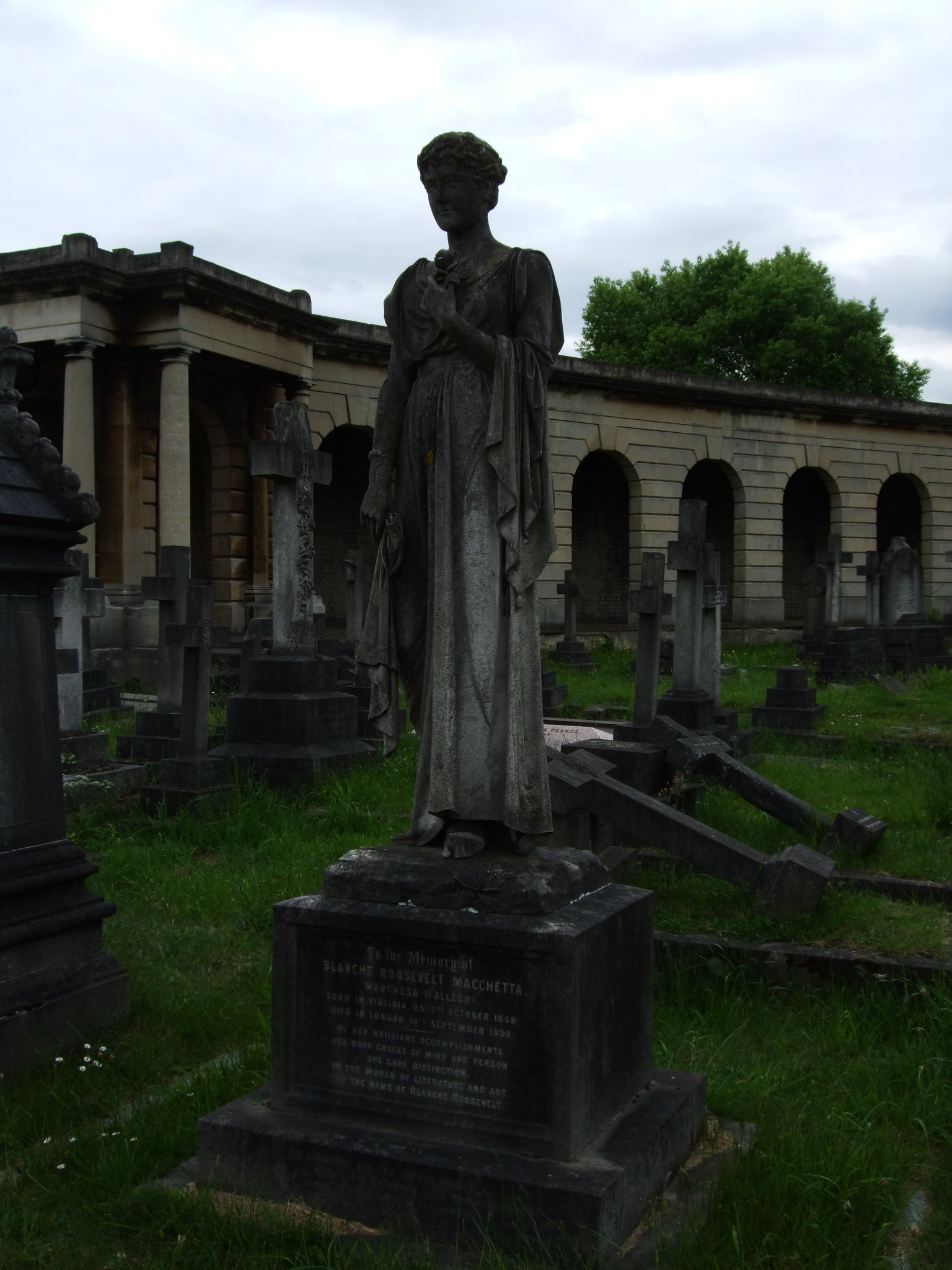
Blanche Roosevelt Macchetta was the first American woman to sing at Covent Garden’s Royal Opera House. After an accident, she died at the age of 45. The statue on her grave is of her.
Tomb of Blanche Roosevelt Macchetta
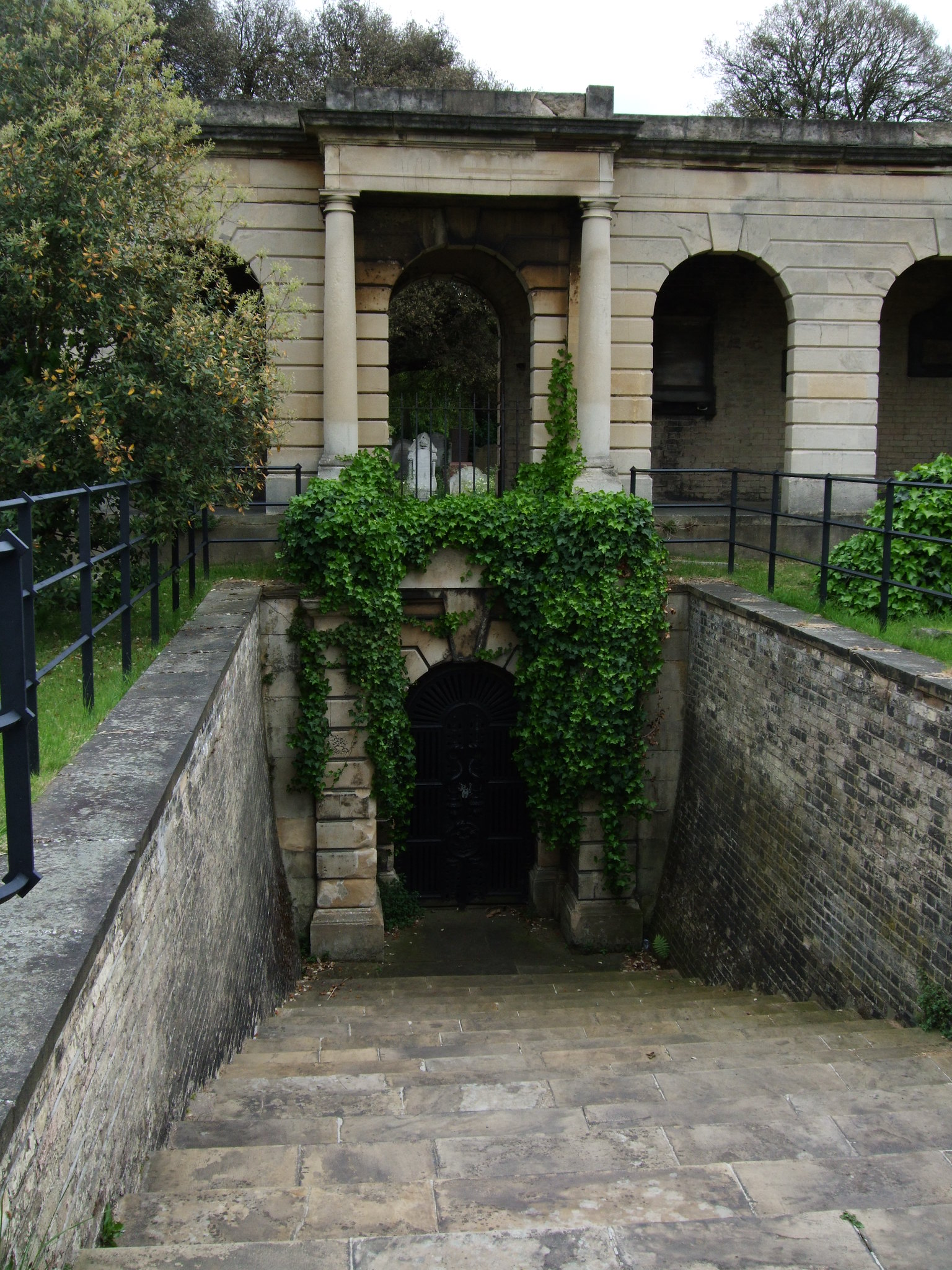
Below the arcades, catacombs are located. We weren’t able to look inside on this occasion but we were able to admire the gates, with their ornate design heavy with symbolism, including the two serpents.
Entrance to the catacombs
The interesting gravestone with the image of a wolf marks the former burial place of the Native American Sioux chief, Long Wolf, who died of pneumonia while touring with Buffalo Bill’s Wild West Show. In 1997 his remains were returned to his home in South Dakota.
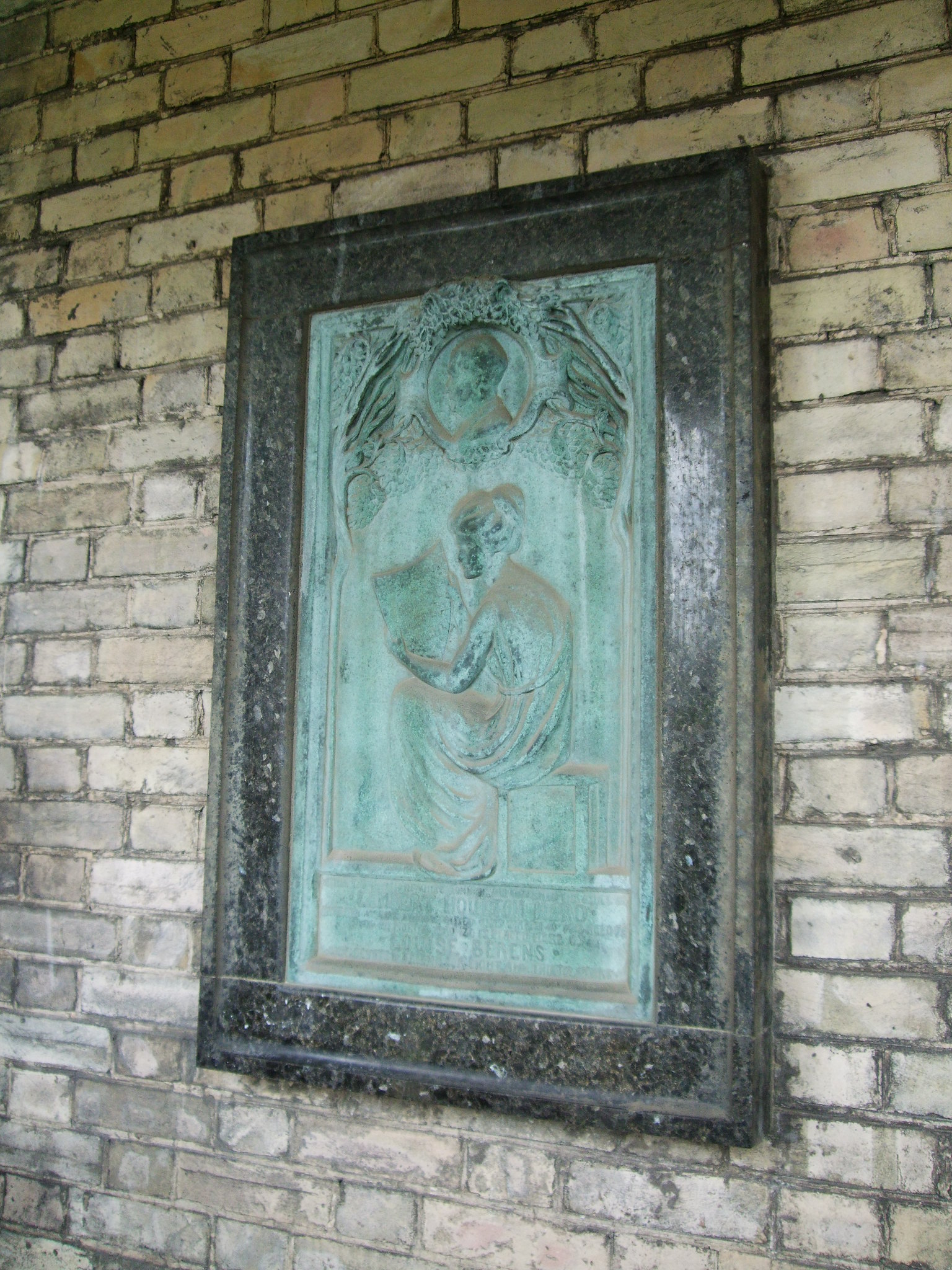
Long Wolf’s former burial placeOrnate plaque displayed on the wall of the arcade
Queen Victoria had the body of a favourite servant, her courier Joseph Julius Kanné, buried here.
Grave of Joseph Julius Kanné
Brompton Cemetery has memorials to the Brigade of Guards and the Chelsea Pensioners, as well as the graves of several Victoria Cross holders. One of these is Reginald Warneford, who was awarded the medal for downing an airship but who sadly died just over a week later during a non-combative flight.
Tomb of Reginald Warneford
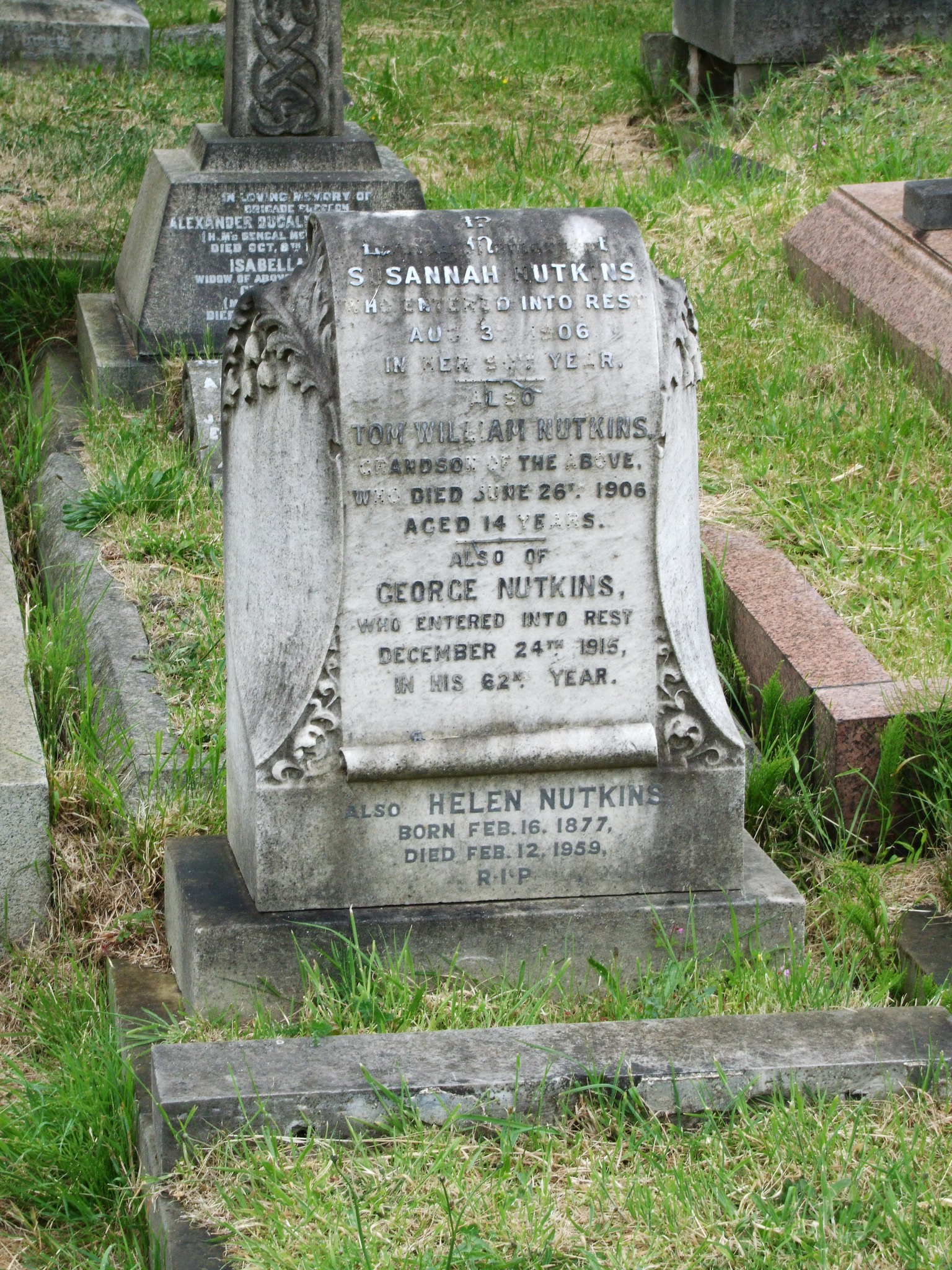
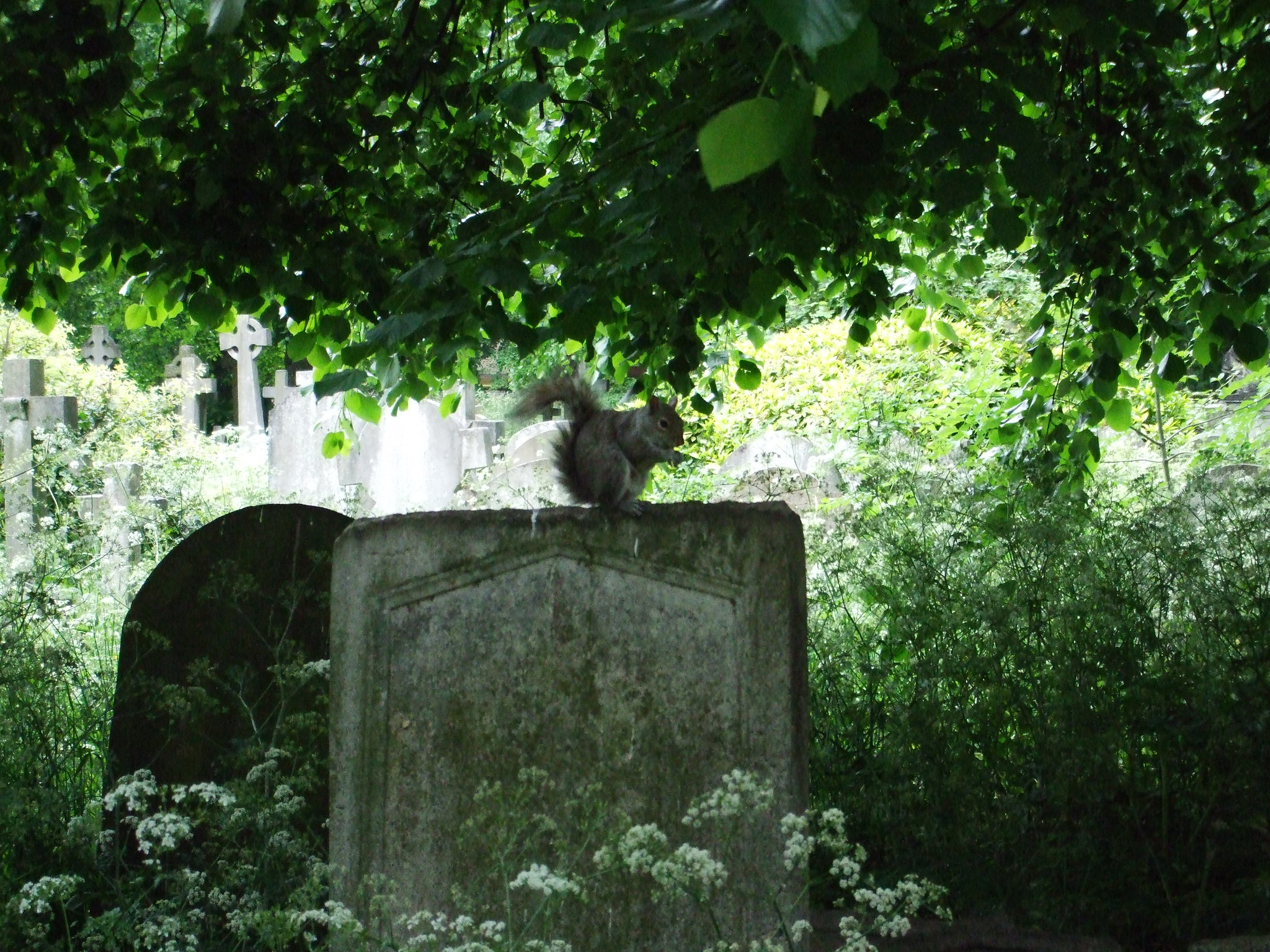
The cemetery has an interesting connection with the author Beatrix Potter, who lived nearby as a child and who is thought to have walked in the cemetery frequently. It has been suggested that the names of several individuals buried here influenced the names of some of her best-loved characters.
The Nutkins family – inspiration for Squirrel Nutkins?
An interesting-looking sarcophagus on “legs” was bought by the painter Valentine Princep as a 13th-century original. Many years after his death, however, it was found to be fake.
One of the most impressive monuments in the cemetery is the burial place of Frederick Richards Leyland, an art collector from Liverpool. His tomb was designed by the Pre-Raphaelite Edward Burne-Jones, and is Grade II-listed.
Leyland’s beautiful tomb
Richard Tauber was an acclaimed Austrian tenor who settled in Britain after the German annexation of Austria just before the Second World War.
Richard Tauber’s grave
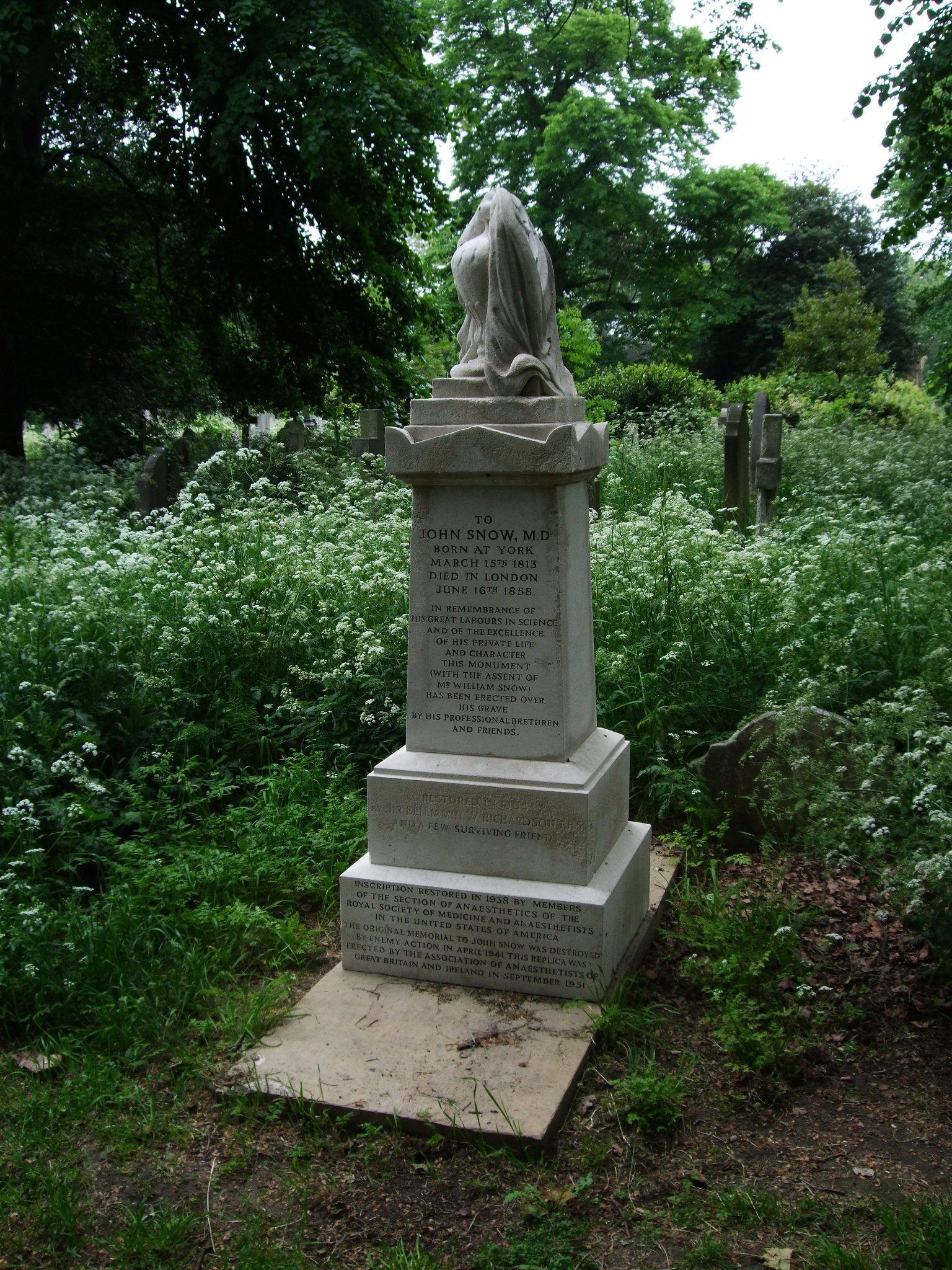
John Snow – not that John Snow, not that one either – was a physician who famously proved that cholera was not, as was commonly supposed, spread in the air but was ingested by mouth: he traced an outbreak of the disease in Soho to a particular pump on Broad Street, showing that the disease was transported via the water. I remember learning about him in history lessons at school, so I was rather excited to see his grave.
Grave of John Snow, rebuilt after being destroyed during World War II
The cemetery is something of a haven for wildlife.
Architecture
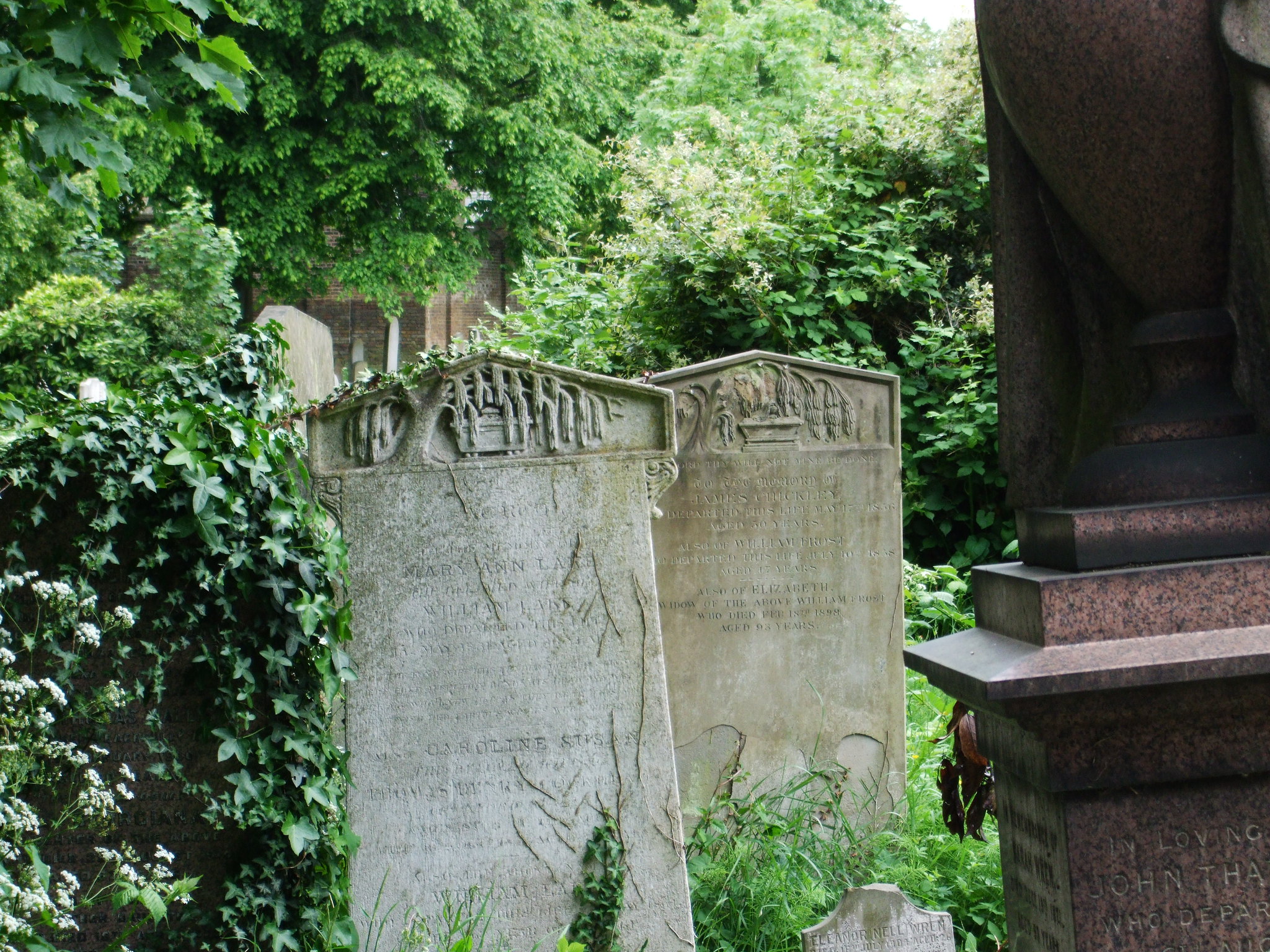
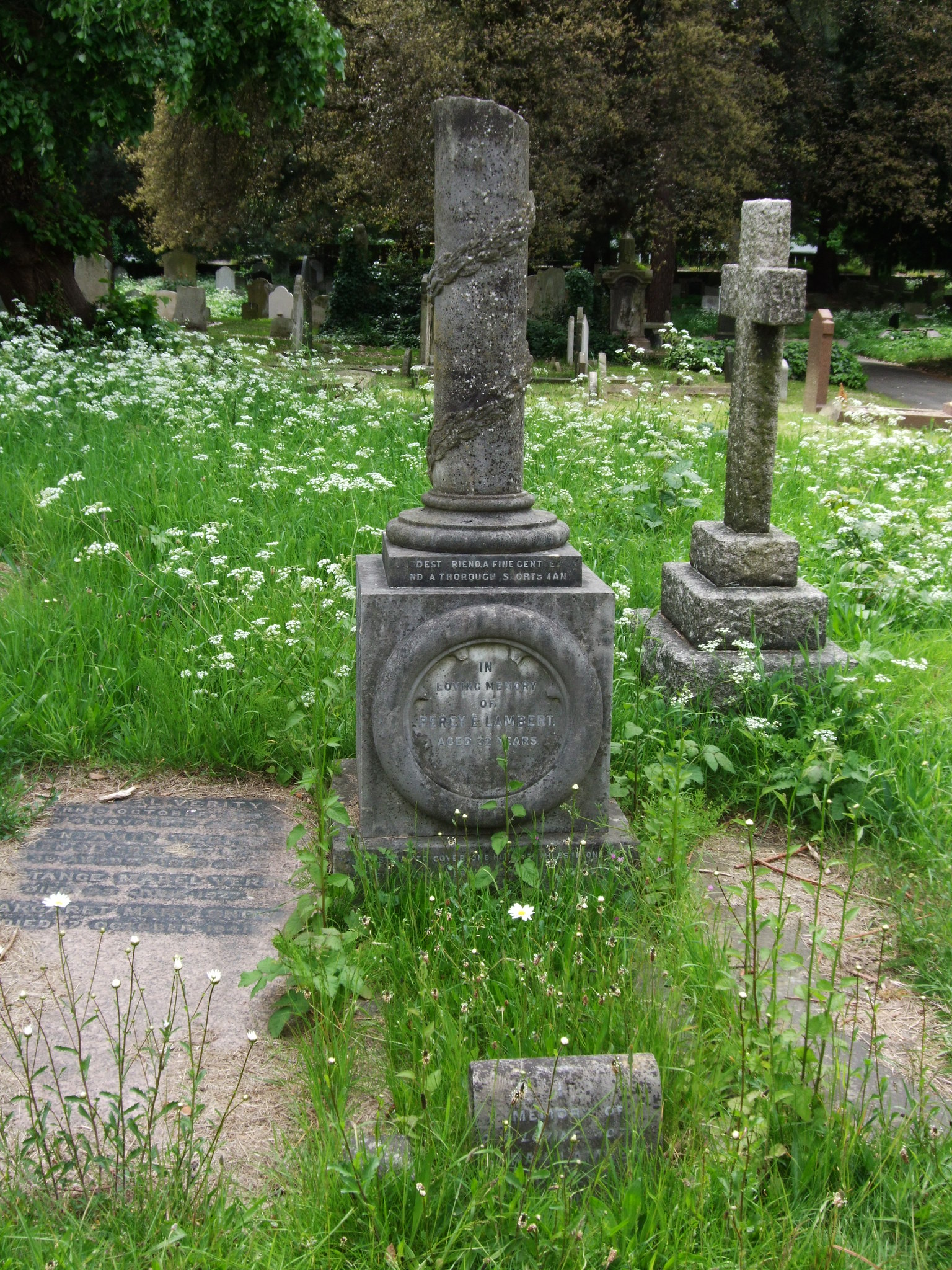
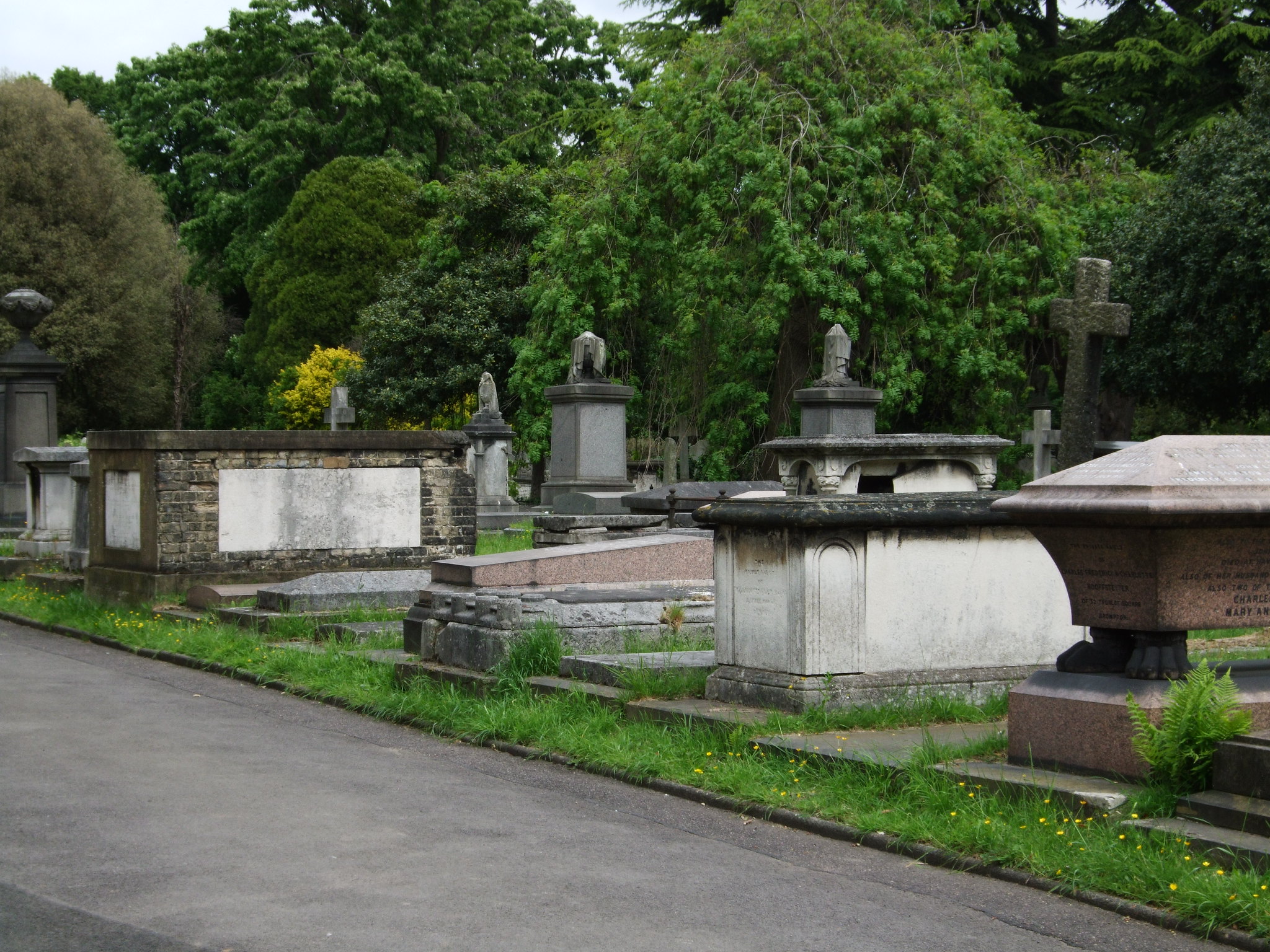
Like the other cemeteries I’ve visited, Brompton Cemetery has some beautiful architecture to admire, including some impressive gravestones as well as the cemetery design as a whole. Familiar symbols of death, such as urns and broken columns, sit alongside ornate Art Nouveau designs.
Sadly, these impressive statues have lost their headsBeautiful weeping willowsThe broken column represents a life cut short
Lovely “Art Nouveau” tomb
A draped urn, another common symbol
One of the most ornate and magnificent tombs in Brompton Cemetery
The central path ran the length of the cemetery, leading towards the North Gate.
Approaching the North GateThe North Gate, seen from outside the cemetery
Brompton’s central location makes it an ideal place for a leisurely walk. I would definitely recommend a tour, too, so that you can discover more about the cemetery.
Would I go back?
Yes – I wasn’t able to see Emmeline Pankhurst’s grave and because of the rain I wasn’t able to wander about as much as I would have liked. I’d love to have the chance to explore the cemetery at my leisure, and to visit the catacombs, too.
FACTS
Address: Old Brompton Road, London, SW10 9UG
Founded: 1840
Size: 39 acres
Still in operation?: Yes
Official website: https://www.royalparks.org.uk/parks/brompton-cemetery
Owners: Crown Estates, managed by The Royal Parks
Friends group: Friends of Brompton Cemetery (http://brompton-cemetery.org.uk/)
Tours: These cost £6 and take place at 2pm every Sunday from May to August, and on two Sundays a month from September to April. Meet at the South Lodge, at the Fulham Road entrance.
Nunhead Cemetery, looking towards the Anglican chapel
My visit to Nunhead Cemetery marked the mid-point of my “Magnificent Seven” tour. I very nearly didn’t visit on Sunday – I lost an hour of sleep to the clock change, and when I woke up all I could hear was the sound of the wind and the rain hitting my window, which didn’t exactly make me want to leap out of bed and spend time out of doors. However, I forced myself to make the effort, and luckily by the time I reached the Cemetery the wind had died down and the rain had stopped.
Getting There
Nunhead is one of only two of the seven cemeteries to be located south of the river, the other being West Norwood. Its address is Linden Grove, London SE15 3LP, and the closest railway station is Nunhead, which can be reached from Victoria or London Bridge stations. Peckham Rye station is a little further away but as more trains stop at this station than at Nunhead (including Overground trains), it is sometimes the better option.
Approaching the Cemetery along Linden Grove
The cemetery is located very close to Nunhead station, and it is easy to reach, though you do come upon it suddenly as you step out of a housing estate. The railings are reproductions, the originals having been removed during World War II, but the neoclassical gates are original, although they have been restored. The upturned torches, which symbolise life extinguished, are common symbols in Victorian cemeteries.
The restored Cemetery gates
I was due to participate in the tour, the meeting place for which is beside the Anglican chapel.
Approaching the Anglican chapel
History
The fourth of the Magnificent Seven cemeteries to be built, in response to an overcrowding problem in central London burial grounds, Nunhead was founded in 1840 by the London Cemetery Company. It was originally called All Saints Cemetery, Nunhead. The first person to be buried here was a man called Charles Abbott, a 101 year old Ipswich grocer. The cemetery was popular, becoming nearly full by the middle of the 20th century, but was never as prestigious as Kensal Green or nearby West Norwood.
Abandoned by the company, the Cemetery fell into a state of disrepair and neglect, exacerbated by vandalism. In the early 1980s, the Friends of Nunhead Cemetery were formed to renovate and protect the Cemetery. Nunhead is now owned by the London Borough of Southwark and is a Local Nature Reserve, forming a habitat for many animals and birds. It was reopened in 2001, having been restored with funds from Southwark Council and the Heritage Lottery Fund. Nunhead is listed Grade II*.
Blue plaque
The neoclassical lodges were designed by James Bunstone Bunning, who was also responsible for the entrance gates and the landscaping. One is now occupied as a private house, while the other is sadly derelict.
One of the neoclassical lodges, now derelict, with catacombs underneath
The Gothic-style Anglican chapel was designed by Thomas Little. It fell victim to arson, but has been partially restored.
Close-up of the chapelSide view of the chapel
Tour
Looking towards the Cemetery gates from the chapel
I attended a tour run by the Friends of Nunhead Cemetery. The tour began at the Anglican chapel, and we learnt about the history of the Cemetery. I was impressed with the height of the landscape, and the wonderful views that were apparent even on such a dull day.
One of the first graves we saw was that of Henry Daniel, a mason employed by the London Cemetery Company, buried surrounded by many of the memorials that he built.
Family vault of Henry and Charlotte DanielClose-up of the tomb with anchor and serpent decoration
An interesting part of the Cemetery was the Muslim section, something I had not expected to come across.
Muslim area
We noted the tomb of Bryan Donkin (d. 1855), the inventor of the tin can. His son, another Bryan, also buried here, opened a banknote factory in Russia.
Tomb of Bryan Donkin
On our way up the hill, our guide pointed out the silver granite memorial to the ship owner John Allen (d. 1865).
Heading up the hill with Allen’s tomb on the right
The tomb is a reworking of an ancient monument brought to Britain from Egypt.
Memorial of John AllenMemorial of John Allen
Some parts of the memorial are in excellent condition, but others have decayed: the two angels that formerly flanked the head of the monument are no longer in position.
A fallen weeping angel
The Stearns family mausoleum was built in 1902 by the Doulton firm. It is similar to monuments at West Norwood.
Stearns family mausoleum
Our walk eventually brought us to the top of the hill. It was considered more prestigious to be buried at the top, because you were thought to be closer to God.
Approaching the top of the hill
However, being at the top does mean that your memorial is more exposed to the weather. This one is looking a bit wonky.
An unusually carved tomb
It is possible to see St Paul’s Cathedral from this point on the hill – a stunning view.
View of London from the very top of the Cemetery
Near the top is buried John Moritz Oppenheim, a skin and fur merchant who died in 1864 and was a generous patron of the arts, despite being blind for 20 years. His stone shows an angel touching his eyes.
Grave of John Moritz Oppenheim
The Cemetery is overgrown in parts and could do with some restoration, although I did think that this unkempt look made it more atmospheric.
Many of the graves are overgrown
The Cemetery is an important nature reserve: this pond, for example, is very important for wildlife.
Pond for wildlife
We headed back down the hill towards the entrance.
The way downA winding path flanked by graves
The location of the former Dissenters’ chapel is marked by a clearing. The unconsecrated ground surrounding it contains graves of people belonging to non-Anglican denominations.
Location of the former Dissenters’ chapel
In the area you can see the Cemetery’s only gravestone with a Welsh inscription.
Welsh grave
Finally, we were shown the Scottish Martyrs obelisk, a memorial to 5 lowland Scots sentenced to transportation for advocating parliamentary reform.
Scottish Martyrs obelisk
Scouts
The Scouts memorial
The Scouts memorial commemorates a tragic accident that occurred in 1912. On the 4th of August, nine boys were drowned at Leysdown after their boat overturned. The tragedy resulted in huge public mourning, and a bronze life-size Scout was designed by Sir Giles Gilbert Scott and erected here in 1914. Sadly stolen in 1969, it was replaced by this marble stone in 1992.
Some Commonwealth war graves are located in the same area, soldiers who died in a nearby hospital after returning from the Front in World War I.
Commonwealth War Graves
Architecture
As with the other cemeteries I have visited so far, the architecture is varied and impressive. Many of the usual symbols are present, including angels, broken columns and crosses.
A stone angel decorating a graveTomb with a scroll carvingBroken column with rose design
This unusual anchor does not actually belong to the grave on which it rests. It was discovered after a period of bad weather destroyed the vegetation covering it, and bears an intriguing message.
Anchor-shaped stoneA crossA cross covered with ivy
Nunhead is one of the least-known of the Magnificent Seven cemeteries, and its lack of fame and location south of the river might put people off visiting. However, it is a little gem: a lovely site on a hill, romantically overgrown, and a haven for wildlife.
Would I go back?
Yes – Nunhead would be a lovely place for a quiet walk. I also want to do a tour of the crypt, chapel and viewing tower, run by the Friends on various dates throughout the year.
There is an Open Day each year: in 2015 this will be the 16th of May. You can view details here.
Facts
Address: Linden Grove, London SE15 3LP
Founded: 1840
Size: 53 acres
Still in operation?: Yes
Official website: http://www.southwark.gov.uk/info/461/a_to_z_of_parks/660/nunhead_cemetery
Owners: London Borough of Southwark
Friends group: Friends of Nunhead Cemetery (FONC) (http://www.fonc.org.uk/)
Tours: General tours on the last Sunday of every month, free, 2.15 pm at the Linden Grove entrance. Special interest tours on certain dates – see the FONC website for details.