My next Open House London tour was of St Pancras Chambers – the building above St Pancras Station. The station, originally constructed in 1868, was refurbished between 2001 and 2007, the threat of demolition narrowly averted thanks to the efforts of a passionate group of people including the poet John Betjeman.
Station entrance (former goods entrance)
At the time of original construction, the East Midlands Railway wanted to surpass the recently built King’s Cross Station, so commissioned George Gilbert Scott to create the beautiful, opulent Gothic Revival style building. The money ran out partway through construction, leaving no money for the planned extra storey or for the statues supposed to be dotted around the building – the empty niches are still visible.
Wyvern
On the tour we saw some fascinating details: the theme of the wyvern (a mythical creature) runs through all of the architecture, and the materials used in the building come from the various towns and cities served by the East Midlands Railway, such as Sheffield steel and stone from Nottingham.
Former station entrance (now hotel entrance)
The original entrances to the station still exist but are now more commonly used as the entrances to the apartments and hotel. The Hansom Hall is the current name for the hotel lounge, as it was originally where travellers were dropped off outside the ticket hall.
‘Spice Girls’ staircase
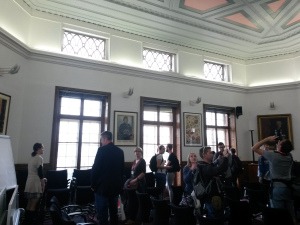
We then got to go inside the building. The most exciting part for me, I must admit, was seeing the very staircase that featured in the Spice Girls’ video for “Wannabe”.
Stairwell
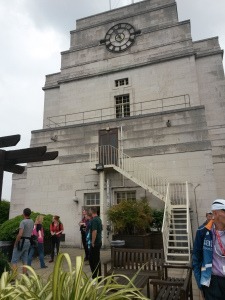
We got to go all the way up to the top floor: this part of the building has been converted into flats. You can see from the staircase that originally, the more prestigious rooms were on the lower floors: the design becomes less ornate as you go up the building. Nowadays, of course, the best flats are at the top, where it’s still possible to see the former servants’ quarters above your head (the original floor has been removed. My tour was given by the man who actually lives in one of the apartments – the one with the bell tower – so we got to look in there too – a fascinating experience.
In the corridorFormer servants’ quartersInside the bell tower
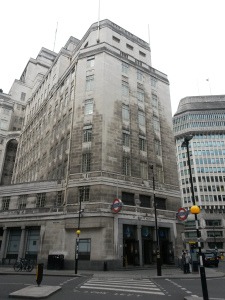
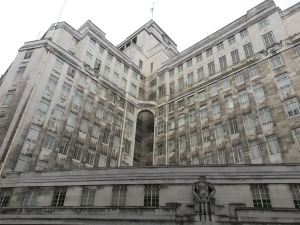
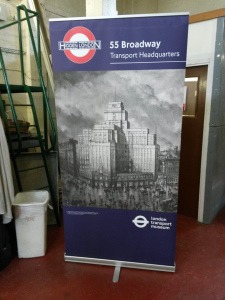
I always make a habit of visiting some interesting buildings when Open House London comes around. This year I was lucky enough to visit 55 Broadway, the former headquarters of London Underground, near St James. The Underground Group was formed from a group including the Tube railways, London General Bus company, tram operators and electrical supply companies, and in 1927 when they decided they wanted their new headquarters to reflect its bold vision of the future, they hired architects Adams, Holden and Pearson for the job.
55 Broadway
It was a challenging job from the start. With its irregular shape and depth (St James’s Park station sitting just 7.3 metres below the site) Adams, Holden and Pearson’s job was a difficult one. They managed to get around it, however, by incorporating the cruciform layout into their design.
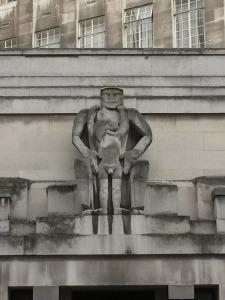
Epstein’s controversial sculpture
Charles Holden, later known for his work on the Northern and Piccadilly Line extensions, used Portland stone and added bronze features to the building. Carvings by Eric Gill, Henry Moore and Jacob Epstein (who’s “Night and Day” caused controversy) adorn the outside of the building, which is now Grade 1 listed.
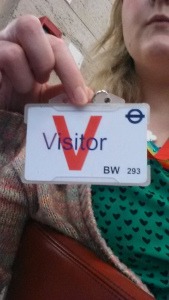
Visitor pass
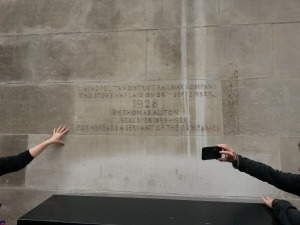
We started off outside, where we were introduced to the history of the building and got to see the original foundation stone.
Foundation stone
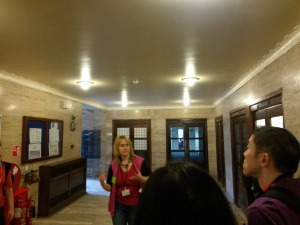
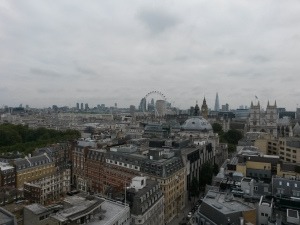
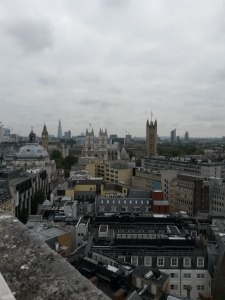
The tour took us up several floors, including the seventh floor with its original management rooms, outside to see the roof gardens, and right up to the flagpole.
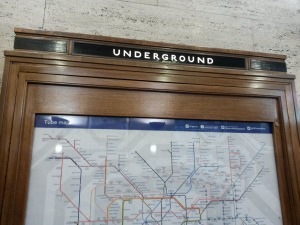
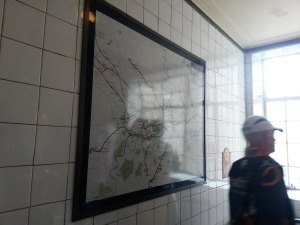
Map in the foyerLord Ashfield plaqueRoundel design in the buildingEarly tube mapInside the buildingManagement roomsManagement roomsIn the gardenView from the roofView from the roof55 Broadway
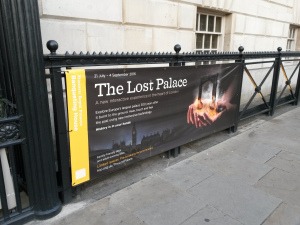
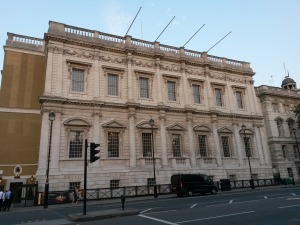
This summer, a new visitor experience launched at the Banqueting House, part of Historic Royal Palaces, in London. The Lost Palace was described as “a unique combination of immersive audio theatre, interactive technology and architectural installations”, and was an innovative way to explore the history of Whitehall Palace, of which the Banqueting House is the only remaining part.
The Lost Palace
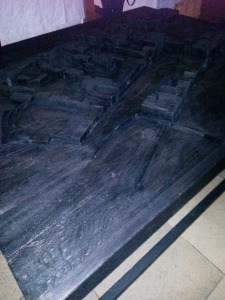
I signed up to go after work and arrived in Westminster on a warm day. I entered the basement of the House and settled down to wait until it started, trying to familiarise myself with my headphones as I did so. I didn’t have long to wait, as we were soon called to stand round a model of the old Whitehall Palace and hear a disembodied-sounding voice tell us about the fire that destroyed it. I had no idea just how big the Palace used to be – it encompassed a vast area from Northumberland Avenue to Downing Street, consisting of 1,500 rooms spread over 23 acres. The Palace was the largest royal residence for the Tudor and Stuart courts.
Model of Whitehall Palace
The audio tour-slash-digital guide took us round the neighbouring streets, pointing out places of significance and allowing us to hear stories of those who used to live here. At one gate we touched our audio guides on the archway and heard about the first performance of King Lear; at the other side of the palace, we heard stories about parties and carousing at the location of King Charles II’s sundial.
Partaking in King Lear
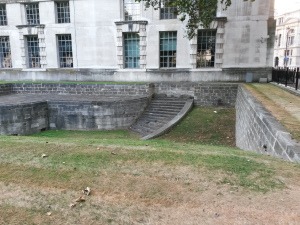
The Palace used to be closer to the Thames than it is now and Queen Mary’s Steps, designed in 1691 by Sir Christopher Wren, are still visible overlooking the river. They were designed to give access from the Royal Apartments to the State Barge.
Queen Mary’s Steps
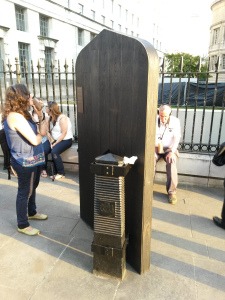
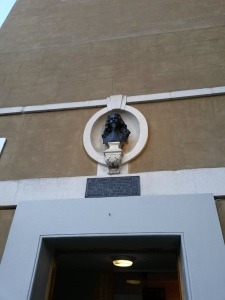
The tour took us to Horse Guards Parade to witness jousts, and allowed us to overhear Guy Fawkes before he was sent to the Tower of London. One of my favourite parts required us to pretend our audio guide was a bird in order to partake of a spot of cock fighting. After listening in on the first encounter between Henry VIII and Anne Boleyn, the last part of the tour had us listening to Charles I’s hearbeat as he walked to the gallows, the location of which is now marked by a statue above the Banqueting House doorway.
Charles I
Finally, we had a chance to sit inside the Banqueting House and take it all in. This was much needed after an intense and engrossing experience which is much recommended.
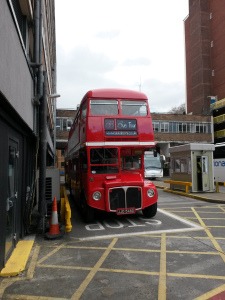
I’m rather fond of gin, and when I found out via Showfilmfirst about a special event involving gin, London, and a rather special bus I knew I had to go. The Hendrick’s Gin Ministry of Marginally Superior Transport was obviously designed as a way to promote the Hendrick’s brand, but to be honest as the tickets were only £2.50 this really didn’t bother me.
The event involved a bus journey around London in which we were served G&Ts and delicious gin cocktails with a bonus gin macaron. The bus was beautifully decorated with bizarre mock-Victorian wallpaper and we got a few freebies including a rather awesome fan, which I’m sure I’m going to make plenty of use of during the summer.
During the journey we were entertained by bearded bartenders and challenged to complete a number of tasks including writing a poem: I’m rather proud of my brief effort, considering I haven’t written a poem since school.
I had an identical twin, Who had a grand passion for gin. At the hint of a frolic, She’d pour gin and tonic, And begin her descent into sin.
This year marks the 400th anniversary of the death of William Shakespeare, and as such there are several special events going on. One such event, Shakespeare’s London, taking place at the Museum of London Archaeological Archive in Hackney, is a tour of the archive which includes a look at artefacts discovered at London’s Elizabethan theatres. I booked this pretty much as soon as I heard about it, as I love both history and Shakespeare.
Mortimer Wheeler House
The Archive is held at Mortimer Wheeler House; I looked up how to find it and I’m glad that I did, as it isn’t the easiest building to find. It’s located in east London, north of Old Street, just below the canal. We waited in the foyer for the tour to begin; there were quite a few of us, so we were taken around in two separate groups. As we explored the Archive, we were able to learn more about it, as well as the history of theatres in Shakespeare’s day.
The Museum of London Archaeological Archive is part of the museum’s Department of Archaeological Collections and Archive. Over the past century, nearly 8,500 archaeological sites have been investigated in Greater London: this archive holds information relating to all of these, with full archives for over 3,500 of them. There is also an archaeological library collection. It has been officially recognised as the largest archaeological archive in the world.
The Archive is of international significance, the primary source of evidence for early London. As archaeology itself is a destructive process – accessing one layer usually involves removing another – the only evidence of its existence is in the archive. There is an online catalogue containing information about object collections and archive records, and the Archive can also be visited for research purposes. This is free, but you need to make an appointment.
Early in the tour we got to play “archive lottery” – choosing a number and taking the relevant box off the shelf to see what it contained. Our box wasn’t particularly exciting, containing bits of pottery – however, as our tour guide (one of the Archive’s volunteers) explained, pottery is actually a really valuable tool for dating a site. We were subsequently introduced to some very special artefacts relating to the theatre.
Theatres like the Globe, the Rose and the Curtain, popular in Shakespeare’s day, were actually known as playhouses: the term “theatre” tended to refer to indoor, private theatres located in houses (similar to the Globe’s new Sam Wanamaker Playhouse). However, for the purposes of the tour they were referred to as theatres. We saw a cannonball that was found on a theatre site, once used to help create the sound of thunder (a similar item from the Rose Theatre is about to go on display at the British Library as part of their Shakespeare exhibition). Some of the smaller artefacts that we got to handle included copper pins, seals for rolls of cloth, and fragments of tobacco pipes. We also saw – but because of its fragility, understandably weren’t allowed to touch – an almost complete leather boot from the Elizabethan period: an incredible sight.
Many of the small items recovered were things which could have been dropped easily in the tightly packed, busy atmosphere of the playhouse. Gambling dice and makeup brushes were also found, as were tokens used to gain admittance into the playhouse. Money boxes were used to collect payment; when they were full, they were smashed, and the contents counted. They were kept in the money box office – what would later become the box office.
The area around Southwark where most of the theatres were situated was also known for bear-baiting, and the skull and bones of a bear and of a dog, possible rivals in the ring, are testament to this. The bear bone that we saw had tooth marks on it – possibly chewed by a dog after the poor dead or dying bear was discarded.
In a small room with a table, we were able to look at newspaper cuttings and letters related to the discovery and excavation of the Rose Theatre in 1988. When an archaeological excavation began on this site, no one had any idea just what an incredible find would be unearthed. The discovery sparked a campaign to retain and restore the site (the original developers just wanted to cover it over), and inspired a change in the law, meaning that excavations are now required when developers take over a site in London.
It was once thought that the hazelnut shells found at the Rose site indicated that theatregoers ate hazelnuts during performances, in the same way we might eat sweets or popcorn today. However, it is now thought that the thick layer of hazelnut shells would have provided cheap and effective flooring – especially as, with long performances and no toilets, groundlings would often just go where they stood – it makes me cringe to imagine walking over a spongy, urine-soaked floor of shells, but I guess they would have been used to it!
Finally, we ended up in a ceramics room, looking at some of the Shakespeare-related items held in the Archive. These included whole, and nearly whole, money boxes (which were always green, seemingly), and a figurine of Othello and Iago. We got to have a look around the room for a while before leaving, at some of the impressive collections which ranged from Roman amphorae to Victorian hot water bottles.
I absolutely loved my trip to the Archive and would recommend it for all those interested in London’s history. The Shakespeare tours are taking place again on 16 April, so it’s not too late if you want to take part.
When my mam came to London recently, she came with my auntie and several other relatives, one of whom was celebrating her birthday, so the plan was to do something exciting. We ended up booking on a bus tour of London with a difference – a tour that includes afternoon tea.
Our bus
The tours are run by BB Bakery, a traditional French bakery which is based in Covent Garden. We arrived at Victoria Coach Station on Sunday afternoon in plenty of time to board our bus, which was one of those awesome heritage Routemasters. We headed upstairs where our tables had been set out for us (we were a party of six, so we actually took up two tables).
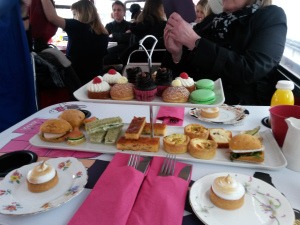
The afternoon tea consists of sandwiches, scones and cakes, as well as orange juice and, of course, tea. They do cater for different dietary requirements: as a vegetarian this is very important to me, and I’m happy to report that my veggie selection was utterly delicious (the standard sandwiches were pretty nice too, according to the rest of my family). I enjoyed my scone, and the cakes in particular were incredible. If you get too full, you are given a little box to take any uneaten cake away with you.
Yummy afternoon tea
I had been curious as to how you avoid spilling hot drinks all down yourself on a moving bus. Not to worry, you are actually given a solid takeaway-style cup with a lid which fits into a hollow on the table (you are able to take this cup home with you). The cake stand is fixed securely to the table, and the cutlery, while it looks metal, is actually plastic – all health and safety bases have been covered!
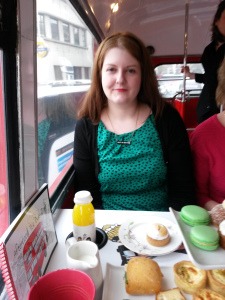
Wearing my highly appropriate, London bus-themed, Tatty Devine “Not In Service” necklace
The bus takes a roundabout route through central London, passing Buckingham Palace, Trafalgar Square and other notable landmarks. It should be noted that you don’t get actual commentary, as you would with a “normal” tour bus. However, the staff – who are very friendly, helpful and chatty – do provide random commentary which is often quite funny. As a London resident, I didn’t feel the need for a proper commentary anyway, particularly as I was enjoying my food too much to care!
The tour takes a good hour and a half, so make sure you go to the loo before it starts! Tours cost from £45 for adults and £35 for children, which sounds pricey but it really is a fantastic experience and the food is yummy. I definitely recommend this for a special occasion, and I’ll be heading to Covent Garden to check out the bakery in the near future.
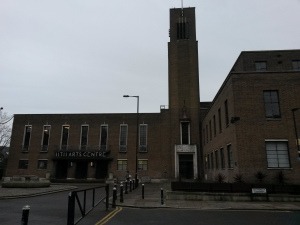
After visiting Hornsey Town Hall in Crouch End for a show last year, I became interested in this beautiful building, and was keen to explore it in more depth. I signed up for a tour, organised by Crouch End Walks, to learn more.
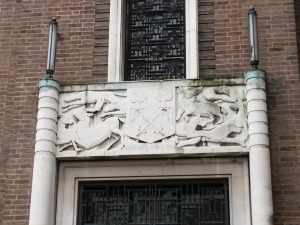
We met in the building’s foyer at 2pm and our guide began the tour by taking us outside to observe the front of the building and its beautiful façade, which harks back to the area’s rural past. Inside, we admired the modernist style of the foyer, which still has the original ticket desks and glass panels designed for function rather than form. The building was designed by R. H. Uren, a New Zealand-born architect who was only twenty-seven at the time of the design in 1933. It was influenced by European modernist architecture and radically broke away from the traditional Victorian design of previous town halls.
We were taken through the building, starting with the ground floor space currently being used as a cafe, into the large hall which has been used for concerts, dances and shows. The Kinks were one of the bands who played here in their early days. Our guide told us of her own memories attending a pantomime here as a small child. Today, the hall is very cold and clearly needs work done to it, but it’s easy to see that with a bit of TLC it could be a lovely space once again.
The open staircase and foyer spaces of the building are lovely, being ornate but spacious, well lit and stylish. The Art Deco influence is particularly strong here. We were able to see inside the former Mayor’s parlour, a very comfortable-looking room indeed.
Along the corridor, we found ourselves in a large space with a fine view over the front of the town hall. This room can be divided into three, or left as one large space. We also got to see inside the council chamber, which still has the original (very comfortable) seats.
The future of the Hall is uncertain: it is currently used by a variety of arts organisations, but whether it continues to be used for performances and events or sold off to be converted into luxury flats, only time will tell. It would be a shame if it stopped being a public building, as it is beautiful and unique, a valuable community asset for the people of Crouch End and beyond.
I signed up for a Christmas ghost walk to explore Southwark, run by poet John Constable who wrote The Southwark Mysteries. The walk began near Borough Station and ended at Cross Bones Graveyard.
There was a Dickensian element to much of the walk: it began at the St George the Martyr Church, where Little Dorrit once fell asleep in Dickens’ novel of the same name.
St George the Martyr
Nearby was the site of the Marshalsea prison, in which Little Dorrit’s father lived: Dickens’ own father was imprisoned here for debt when Dickens was a child. The wall used to be the original wall from the prison, but it has been rebuilt recently.
Wall of the Marshalsea prison
We were shown a pub nearby that is supposedly haunted by the ghost of a woman murdered by her husband. The ghost of a crying baby has also been heard there, although no one is quite sure what connection the baby has to events.
Haunted pub
On the same street that Dickens lived when he was a young boy and his father was in prison, we saw the National Trust houses established by Octavia Hill.
National Trust houses
Travelling towards London Bridge, we passed the location of the inn at which Chaucer’s pilgrims set off on their travels.
Chaucer plaque
We then popped into the George Inn, London’s only surviving galleried inn, and heard a few more ghost stories.
The George Inn
We stopped off by Southwark Cathedral after walking through Borough Market.
Southwark Cathedral
By the Golden Hind, we heard a story about the land surrounding Southwark.
The Golden Hind
We stopped to admire the remains of Winchester Palace.
I’m a librarian, and recently I went on a visit to the British Library organised by a group I’m a member of. The visit comprised a library tour, which really interested me because although I have visited the BL several times, it’s always been as a visitor to the exhibitions: I’m not a member and I’ve never been in the reading rooms or behind the scenes.
The British Library Piazza. Source: Jack1956 on Wikipedia
The British Library, which is a relatively new institution that only came into being during the second half of the twentieth century, is the national library of the UK and the largest library in the world in terms of items catalogued. The building holds around 170 million items from numerous countries and in every language in the world. Information is held in multiple formats: print books and ebooks, manuscripts, journals, newspapers, magazines, audiovisual recordings, playscripts, patents, databases, maps, prints and drawings. The collections include around 14 million books, and the Library holds ancient historical items dating back as far as 2000 BC.
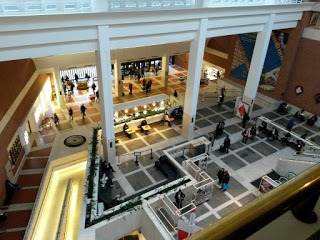
British Library Foyer
Our tour, which was delivered by a very knowledgeable and entertaining guide, began in the foyer where we learned about the library’s beginnings. The BL originally started out at the British Museum: the famous Round Reading Room is where people including Marx used to study. The British Library Act of 1972 enabled the BL to be established in 1973, although materials were dispersed around London and around the country for several years. When deciding upon a location for the eventual library site, there wasn’t much choice available: it would have to be within walking distance of the British Museum in Bloomsbury, so that the rarest and most valuable books could be carried there by hand, as they were not permitted to be transported on vehicles. Eventually the site at Euston Road was decided upon: located next to St Pancras Station, it used to be a goods yard.
The Library is a Legal Deposit Library (the others are the Bodleian at Oxford, the University Library at Cambridge, the Trinity College Library in Dublin and the National Libraries of Scotland and Wales), meaning that it receives a copy of each book produced in the United Kingdom and Ireland, including several overseas books distributed in the UK.
The Library was designed by Colin St John Wilson, and the building has met with a mixed reception (apparently Prince Charles hates it, but the Queen is a fan). Looked at from the right angle, it resembles a ship. It was made a Grade I listed building earlier this year, so it is now recognised as a landmark of design: however it is not without its problems. Wilson spent so much of the Library budget on expensive marble, containing fossils, to be laid outside on the piazza (meaning that it is extremely slippery in the rain) that there wasn’t enough left for decent shelving, resulting in some collapses as the second-hand shelves couldn’t bear the huge weight of the books.
It is impressive, however, that most of the books are stored underground: the stacks run several storeys beneath the ground, stopped only by the tube that is even further down. The Fleet River also runs nearby, so that the lowest floor does flood on occasion.
From the foyer we were taken to the Members’ Area in which you can register to become a member of the Library. Anyone can register so long as they have the appropriate ID: you don’t have to be an academic. Near here, there is a book handling system which delivers books users have ordered to the surface by means of a conveyor belt. Staff collect book requests, remove them from the shelves and send them up to the Library.
The book handling system
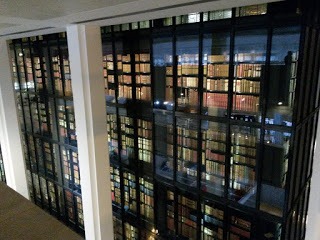
We went upstairs and were able to get a brilliant view of the King’s Library, made up of 65,000 printed volumes and numerous pamphlets, manuscripts and maps collected by George III between 1763 and 1820. The glass tower was inspired by a similar structure in the Beinecke Library in New Haven, Connecticut.
The King’s Library
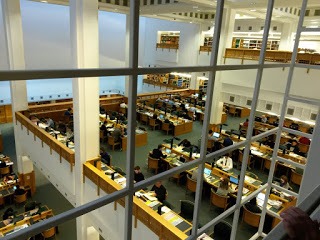
From the old to the new: our next stop was the news room where readers can view newspapers and watch a live news feed. We explored the Library considerably, taking a look at the many busy – but extremely quiet – reading rooms.
Reading Room
Before leaving, we had a quick look at a Library video in one of the quietest corners of the building – left “unfinished” to show off the brickwork.I really loved my tour: I learned a great deal about the British Library that I hadn’t known before. Public tours are available and I do recommend signing up.
Somerset House is one of the most interesting buildings in London, but the history of the site itself is just as fascinating. The current building was completed in 1780, but the site has a long history before that. It’s possible to go on an Old Palaces Tour to learn about the history of the site before the current building existed.
The site was a prime spot from the early days of London, being located on the banks of the Thames in between the financial heart, the City, and the centre of Government, Westminster. When the Duke of Somerset became Lord Protector on the accession of the boy-king Edward VI in 1547, he decided to build himself a palace on this very spot, even though it meant demolishing several churches and chapels that already existed on the land. A few years later, Somerset Palace – architect unknown – was complete, but the Duke was executed for treason in 1552 and it passed into the hands of the Crown. Elizabeth used the Palace on occasion, both as a Princess and later as Queen, but it was more heavily used after her death in 1603.
From then until its demolition nearly 200 years later, the Palace was most notable for being the home of three Catholic queens: Anne of Denmark, Henrietta Maria and Catherine of Braganza. Anne, wife of James I of England and VI of Scotland, renamed the building Denmark House, hosted numerous lavish masques, and commissioned elaborate extensions to the palace. A similar policy was followed by Henrietta Maria, wife of Charles I, and her addition of a Catholic chapel did not help improve relations between the King and his Parliament. On the outbreak of the Civil War, Henrietta Maria fled to France, Charles of course was defeated and executed, and Denmark House became the headquarters of General Fairfax, commander of the Parliamentary Army. The contents of the house were inventoried and sold – to this date only one picture remains as a record of what the interior looked like – and Inigo Jones, responsible for much of the seventeenth century redesign of the building, was fined by the Parliamentarians who viewed his work for the royal family with suspicion. He died at Somerset House, his estate confiscated. However, on Oliver Cromwell’s death – his body lying in state at Somerset House – Charles II was restored to the throne and Henrietta Maria, now Queen Dowager, returned to Somerset House.
The final Roman Catholic queen to inhabit the house was Catherine of Braganza, who moved in after the death of her husband Charles II and remained there during the reign of William and Mary, a difficult situation as the monarchs were Protestant. After Catherine left in 1693, the Palace was used by various government departments before falling gradually into disrepair. George III agreed that the building should be demolished and replaced by a new building for the purpose of government offices, on the condition that Buckingham House, further to the west, should be given to the Crown.
We were taken round the existing Somerset House during the tour and the history of the old palace was explained to us: it was fascinating considering that hardly anything of the old palace still exists and we had to rely on our imaginations. Our guide was really knowledgeable and enthusiastic and really brought the old palace to life.
Overlooking the Thames, the main transport thoroughfare at the time of the old palace
After spending some time in the courtyard, we ventured downstairs to where the nineteenth-century embankment is visible as well as the level of the Thames waterline. Originally, boats could come right inside the palace, and these days one of the royal barges is installed behind a pane of glass (one of a pair, the other barge is at the National Maritime Museum).
The embankmentThe barge
Next we visited my favourite part of Somerset House – the Deadhouse, underneath the courtyard. When the old palace was demolished, the only bits saved from it were some of the graves from the Roman Catholic chapel, which have been installed here. They include the grave of a doctor, the wife of a gardener, and a diplomat.
Finally, we visited the Strand Lane Baths, which are located next to Somerset House. During the nineteenth century, it was widely thought that these dated back to Roman times, and there is a worn Victorian sign inside the building stating this. Indeed, the National Trust sign outside calls them the Roman Baths. However, it is now generally accepted that the baths date from no earlier than the beginning of the 17th century. An intriguing theory claims that the bath was originally the feeder cistern for a magnificent fountain in the grounds of the old Somerset House, built for James I’s queen, Anne of Denmark, in 1612. The Hidden London website has a very informative piece about this.
Looking down Strand LaneThe original National Trust sign which still says Roman BathsThe buildingThe bathsThe bathsVictorian sign
By the late eighteenth century, the baths were being used as a public bathing facility. Charles Dickens reportedly bathed here, and made his character David Copperfield take the plunge here as well. Whenever they date from, they are a fascinating little feature of the embankment. Apart from these tours, access is only possible on Open House Weekend or by making an appointment with Westminster Council.
I thoroughly enjoyed my Old Palaces Tour. Tours take place each Tuesday at 12.45 and 14.15. They are free, but are popular so don’t arrive too late. I turned up at a quarter to twelve and the first tour was full up, but I was the first person to register on the second. It’s definitely worth making the effort to go on this tour.