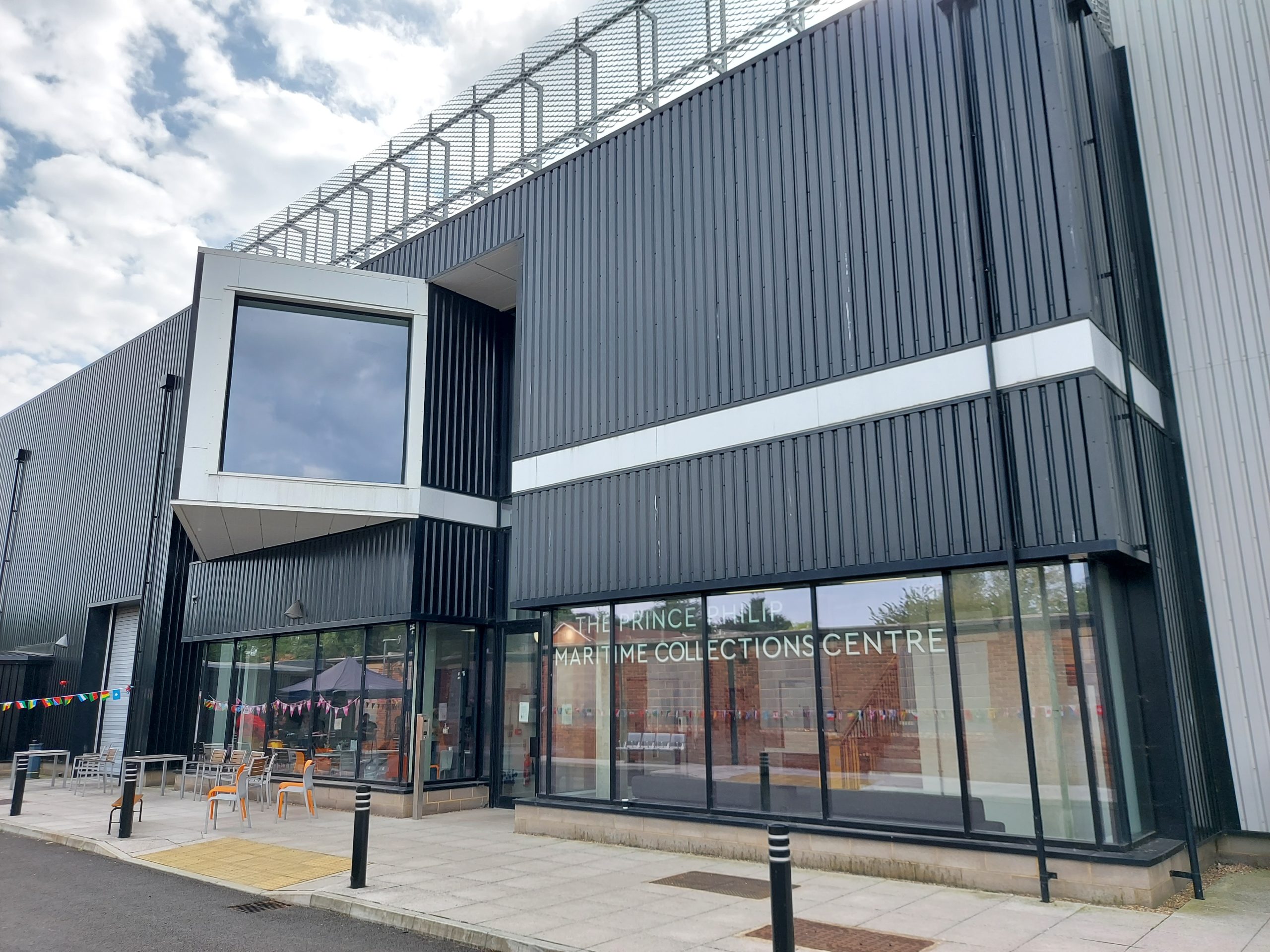
I went along during the Heritage Open Days weekend, and was interested enough to book on one of their Saturday Super Store tours (a longer Behind the Scenes tour is also available on the first Thursday of every month, and allows you to see what the conservators get up to).
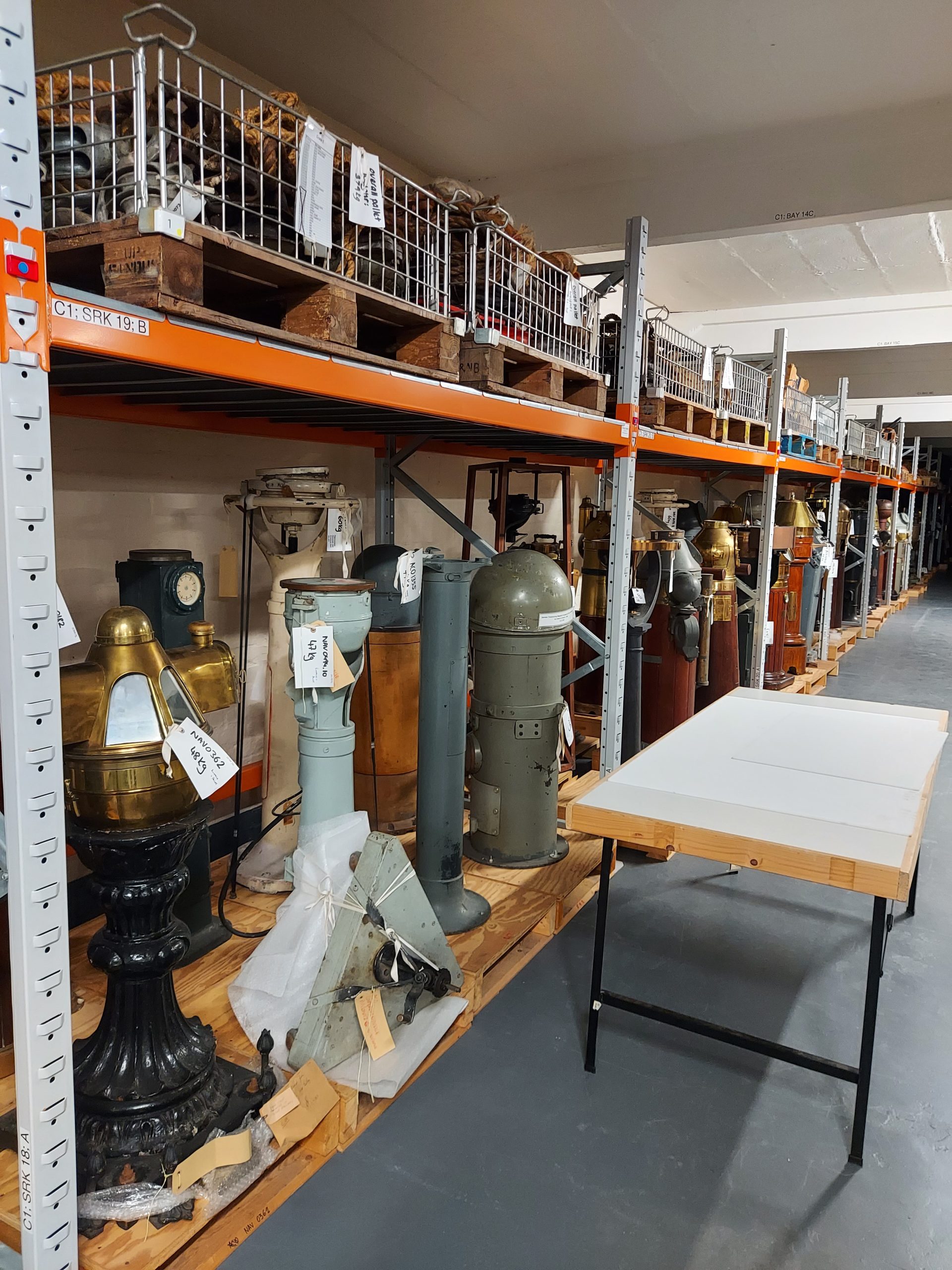
Inside the collections store
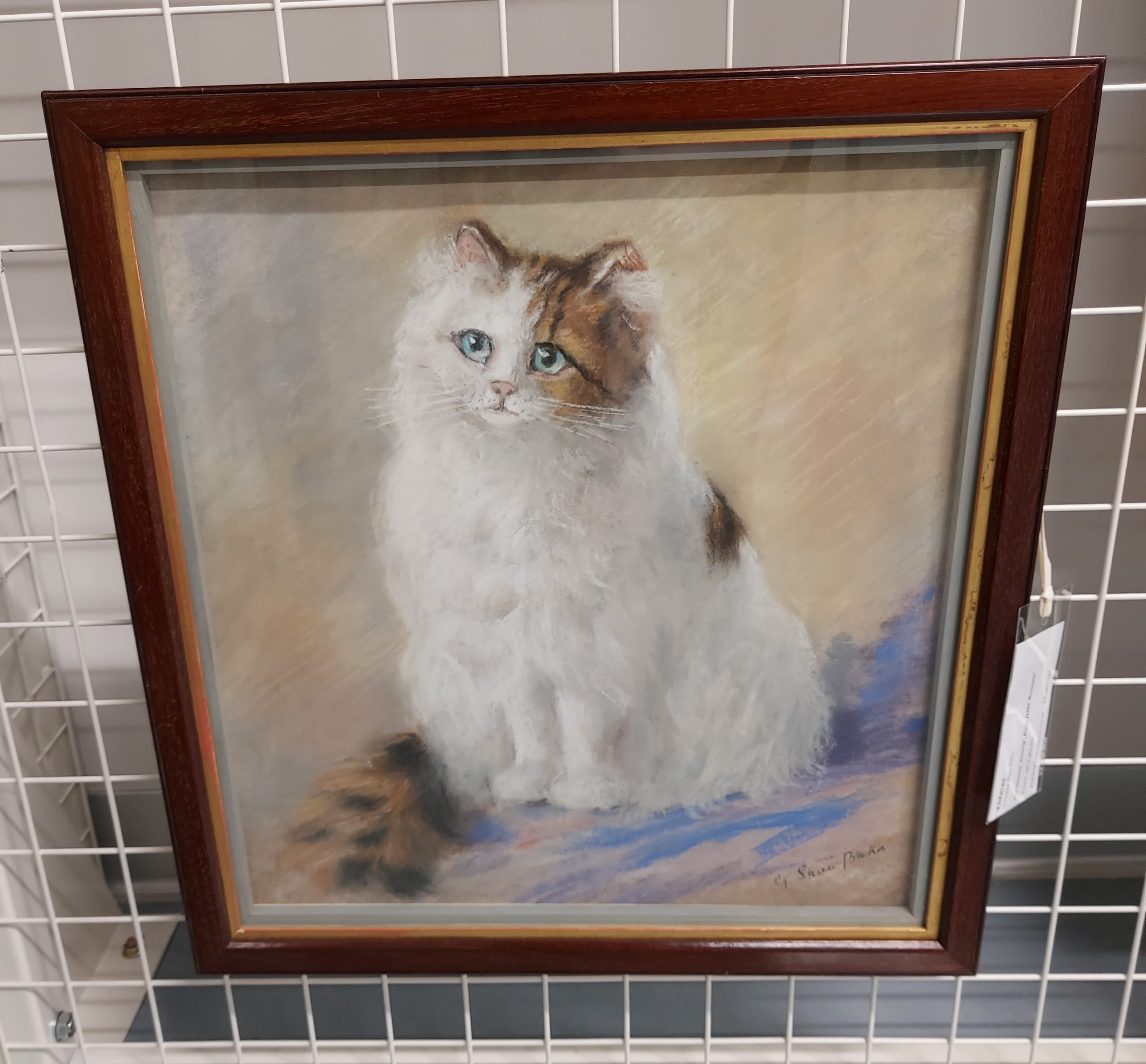
Our tour started in a room full of huge objects taken from ships, including a whale-rendering cauldron, a fireplace from a ship of Queen Victoria’s era that sank, numerous cannon, and other assorted items. We also visited a room that contained several model ships, which were often used to demonstrate to insurers that the ship in question was seaworthy. Another room contained works of art relating to maritime history, including paintings of notable sailors and other figures (including ships’ cats), as well as naval battle scenes. The Museum is actively trying to fill gaps in its collection by seeking out pictures and artefacts relating to women and minorities who have historically been underrepresented in the collection.
Cat!
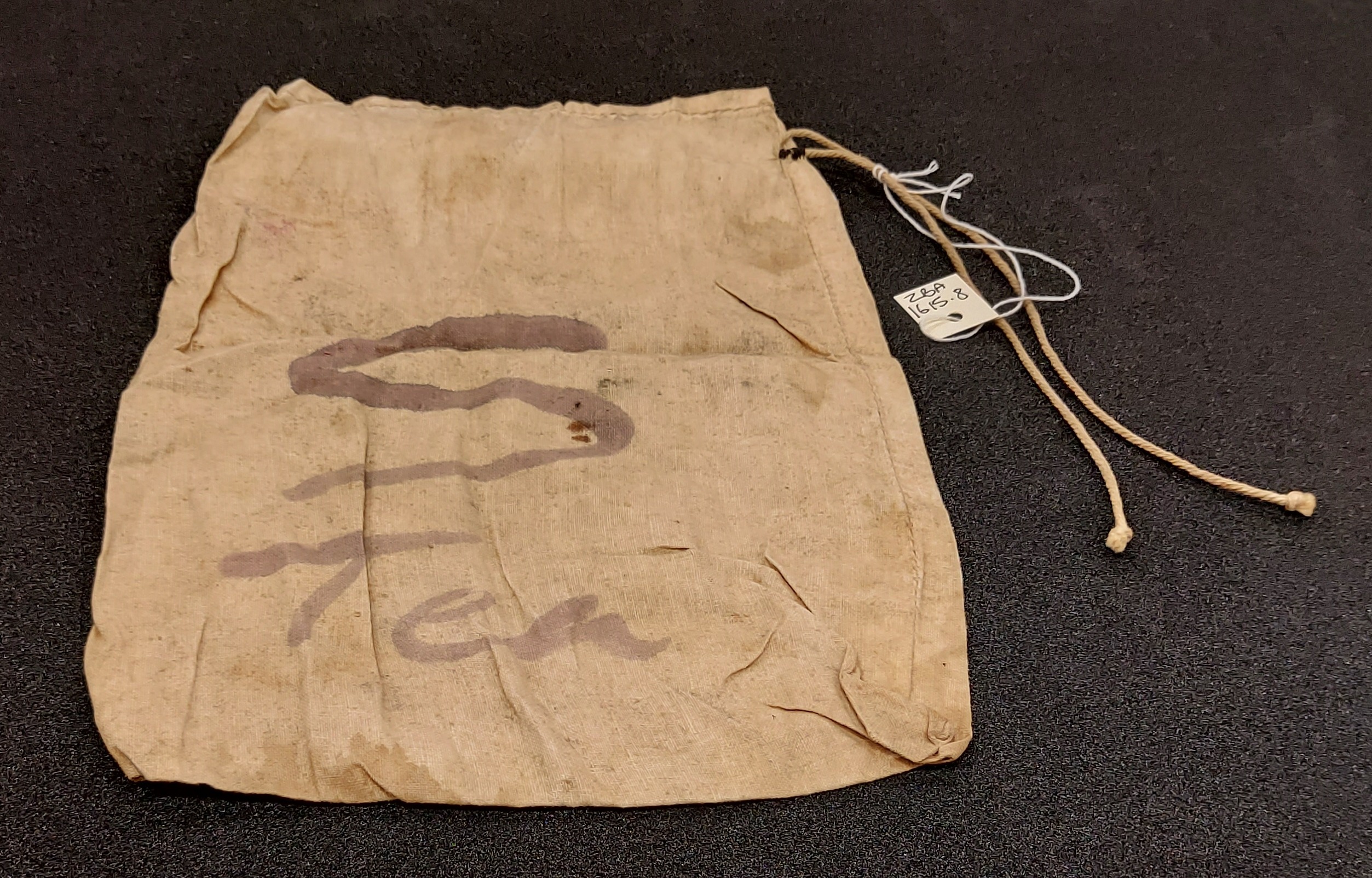
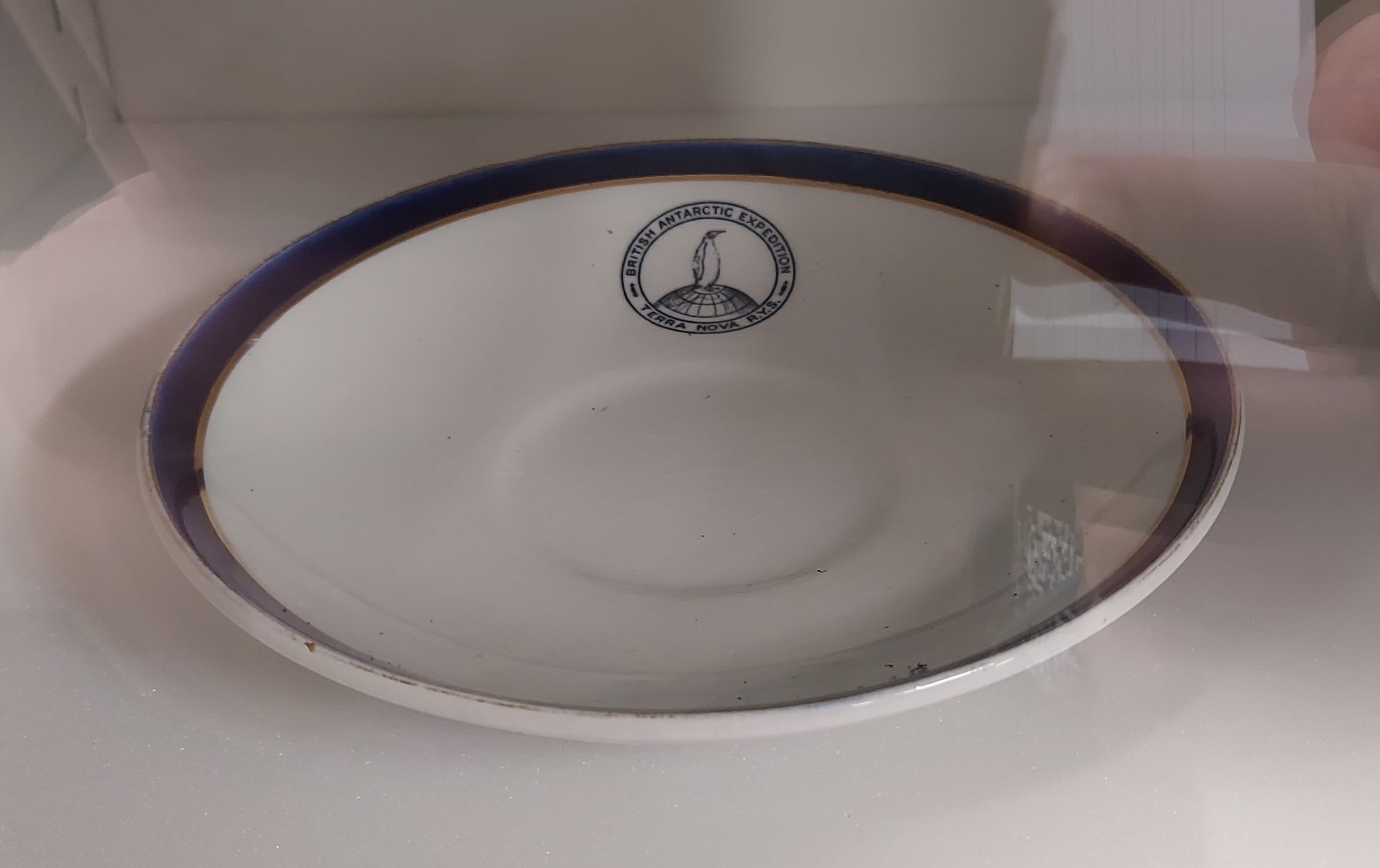
Another room was filled with china, other tableware and small artefacts – there was lots of Nelson memorabilia, but I was particularly excited to see china from Scott’s Terra Nova expedition. I’m particularly interested in polar exploration – during my Heritage Open Days visit I was excited to see ration bags from this same expedition.
Plate from the Terra Nova expedition
Finally, we got to see one of the most poignant items from the collection: the little toy pig belonged to Titanic survivor Edith Rosenbaum. It was given to her by her mother to aid her recovery after a road accident. Edith was travelling back to America on the Titanic and, of course, took her beloved pig with her. After the collision with the iceberg she was reluctant to get on the lifeboat, but when a crew member grabbed the pig from her and threw it onto the lifeboat, Edith took it as a sign and climbed aboard. While waiting to be rescued, Edith kept the other passengers on the lifeboat amused by winding up the pig – which doubled as a music box – and playing a tune. The little pig is too fragile to photograph, but you can view images here.
Every year as September approaches I look forward to Open House London, when normally closed buildings open their doors to the public for free. This year I spent my Saturday down at The National Archives at Kew, somewhere I’d never yet visited.
History
The National Archives are the official archive and publisher for the UK government and they also care for over 1,000 years of national documents. They are experts and leaders in the information and records management and archive fields, and focus on ensuring the future of physical and digital records.
The National Archives was created in 2003 by combining the Public Record Office and the Historical Manuscripts Commission. The building itself was built in 1977 as an additional home for the public records then held at Chancery Lane. The site used to be a World War I hospital, and it was later used by several government departments.
My visit
There were a number of activities and talks taking place all day. I went on a Repository Tour, which was a fascinating journey through the document shelves behind the scenes. We saw the carts zooming past the shelves, on their way to pick up books ordered by readers, and saw the lift system that sends requested books down to the reading room. Extra-valuable items can only be viewed in a specially-constructed strongroom, where you’re only allowed out by a member of staff. I also joined a Collection Care Studio tour, which was a fascinating chance to explore the ways in which the NA look after the objects in their collection. These included the protection of fragile or unusual objects with 3D printing technology, iron gall ink and the Naval Knights of Windsor, conservation as part of the digitisation process, care of highly used documents, caring for Terence Cuneo’s war paintings, packing items for loans and collections, wax seals, x-rays and the hunt for arsenic wallpaper samples, and the emergency plan.
Afterwards I attended a couple of talks: The Public Record Office, Kew: Its place in British Architecture of the 1970s and The Changing Face of Kew. I also wandered around the public areas of the building and saw a couple of screenings of films from the archives including excerpts from Blue Peter. There were a few displays of documents about the building of the PRO at Kew and the 40th anniversary of the National Archives at Kew.
Finally I popped into the Keeper’s Gallery, which has a permanent exhibition about the history of the Archives and its most popular holdings, including the Domesday Book. It proved an interesting way to round off my day.
This year marks the 400th anniversary of the death of William Shakespeare, and as such there are several special events going on. One such event, Shakespeare’s London, taking place at the Museum of London Archaeological Archive in Hackney, is a tour of the archive which includes a look at artefacts discovered at London’s Elizabethan theatres. I booked this pretty much as soon as I heard about it, as I love both history and Shakespeare.
Mortimer Wheeler House
The Archive is held at Mortimer Wheeler House; I looked up how to find it and I’m glad that I did, as it isn’t the easiest building to find. It’s located in east London, north of Old Street, just below the canal. We waited in the foyer for the tour to begin; there were quite a few of us, so we were taken around in two separate groups. As we explored the Archive, we were able to learn more about it, as well as the history of theatres in Shakespeare’s day.
The Museum of London Archaeological Archive is part of the museum’s Department of Archaeological Collections and Archive. Over the past century, nearly 8,500 archaeological sites have been investigated in Greater London: this archive holds information relating to all of these, with full archives for over 3,500 of them. There is also an archaeological library collection. It has been officially recognised as the largest archaeological archive in the world.
The Archive is of international significance, the primary source of evidence for early London. As archaeology itself is a destructive process – accessing one layer usually involves removing another – the only evidence of its existence is in the archive. There is an online catalogue containing information about object collections and archive records, and the Archive can also be visited for research purposes. This is free, but you need to make an appointment.
Early in the tour we got to play “archive lottery” – choosing a number and taking the relevant box off the shelf to see what it contained. Our box wasn’t particularly exciting, containing bits of pottery – however, as our tour guide (one of the Archive’s volunteers) explained, pottery is actually a really valuable tool for dating a site. We were subsequently introduced to some very special artefacts relating to the theatre.
Theatres like the Globe, the Rose and the Curtain, popular in Shakespeare’s day, were actually known as playhouses: the term “theatre” tended to refer to indoor, private theatres located in houses (similar to the Globe’s new Sam Wanamaker Playhouse). However, for the purposes of the tour they were referred to as theatres. We saw a cannonball that was found on a theatre site, once used to help create the sound of thunder (a similar item from the Rose Theatre is about to go on display at the British Library as part of their Shakespeare exhibition). Some of the smaller artefacts that we got to handle included copper pins, seals for rolls of cloth, and fragments of tobacco pipes. We also saw – but because of its fragility, understandably weren’t allowed to touch – an almost complete leather boot from the Elizabethan period: an incredible sight.
Many of the small items recovered were things which could have been dropped easily in the tightly packed, busy atmosphere of the playhouse. Gambling dice and makeup brushes were also found, as were tokens used to gain admittance into the playhouse. Money boxes were used to collect payment; when they were full, they were smashed, and the contents counted. They were kept in the money box office – what would later become the box office.
The area around Southwark where most of the theatres were situated was also known for bear-baiting, and the skull and bones of a bear and of a dog, possible rivals in the ring, are testament to this. The bear bone that we saw had tooth marks on it – possibly chewed by a dog after the poor dead or dying bear was discarded.
In a small room with a table, we were able to look at newspaper cuttings and letters related to the discovery and excavation of the Rose Theatre in 1988. When an archaeological excavation began on this site, no one had any idea just what an incredible find would be unearthed. The discovery sparked a campaign to retain and restore the site (the original developers just wanted to cover it over), and inspired a change in the law, meaning that excavations are now required when developers take over a site in London.
It was once thought that the hazelnut shells found at the Rose site indicated that theatregoers ate hazelnuts during performances, in the same way we might eat sweets or popcorn today. However, it is now thought that the thick layer of hazelnut shells would have provided cheap and effective flooring – especially as, with long performances and no toilets, groundlings would often just go where they stood – it makes me cringe to imagine walking over a spongy, urine-soaked floor of shells, but I guess they would have been used to it!
Finally, we ended up in a ceramics room, looking at some of the Shakespeare-related items held in the Archive. These included whole, and nearly whole, money boxes (which were always green, seemingly), and a figurine of Othello and Iago. We got to have a look around the room for a while before leaving, at some of the impressive collections which ranged from Roman amphorae to Victorian hot water bottles.
I absolutely loved my trip to the Archive and would recommend it for all those interested in London’s history. The Shakespeare tours are taking place again on 16 April, so it’s not too late if you want to take part.