I visited the British Library for a tour recently and while I was there I decided to visit the new exhibition, West Africa: Word, Symbol, Song. Running until 16 February next year, the exhibition looks at the history of the region’s 17 nations and their use of words: spoken, written and sung.
I’m afraid to say I knew very little about West African culture and history before I visited the exhibition, and I found it very enlightening. The exhibition began with an examination of the myth of the founding of ancient Mali and went on to explore the myths and legends of the various peoples of the area, the history of the various nations and the effects of colonialism. In the modern day, it looked at writers, artists and human rights activists.
The exhibition consisted of manuscripts, film and sound recordings, clothes and textiles, books and photographs. It was very different from the exhibitions I usually go and see but I really enjoyed it.
I’m a librarian, and recently I went on a visit to the British Library organised by a group I’m a member of. The visit comprised a library tour, which really interested me because although I have visited the BL several times, it’s always been as a visitor to the exhibitions: I’m not a member and I’ve never been in the reading rooms or behind the scenes.
The British Library Piazza. Source: Jack1956 on Wikipedia
The British Library, which is a relatively new institution that only came into being during the second half of the twentieth century, is the national library of the UK and the largest library in the world in terms of items catalogued. The building holds around 170 million items from numerous countries and in every language in the world. Information is held in multiple formats: print books and ebooks, manuscripts, journals, newspapers, magazines, audiovisual recordings, playscripts, patents, databases, maps, prints and drawings. The collections include around 14 million books, and the Library holds ancient historical items dating back as far as 2000 BC.
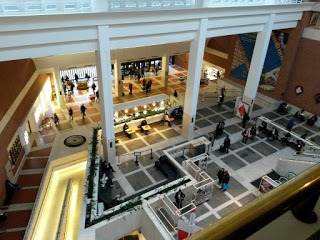
British Library Foyer
Our tour, which was delivered by a very knowledgeable and entertaining guide, began in the foyer where we learned about the library’s beginnings. The BL originally started out at the British Museum: the famous Round Reading Room is where people including Marx used to study. The British Library Act of 1972 enabled the BL to be established in 1973, although materials were dispersed around London and around the country for several years. When deciding upon a location for the eventual library site, there wasn’t much choice available: it would have to be within walking distance of the British Museum in Bloomsbury, so that the rarest and most valuable books could be carried there by hand, as they were not permitted to be transported on vehicles. Eventually the site at Euston Road was decided upon: located next to St Pancras Station, it used to be a goods yard.
The Library is a Legal Deposit Library (the others are the Bodleian at Oxford, the University Library at Cambridge, the Trinity College Library in Dublin and the National Libraries of Scotland and Wales), meaning that it receives a copy of each book produced in the United Kingdom and Ireland, including several overseas books distributed in the UK.
The Library was designed by Colin St John Wilson, and the building has met with a mixed reception (apparently Prince Charles hates it, but the Queen is a fan). Looked at from the right angle, it resembles a ship. It was made a Grade I listed building earlier this year, so it is now recognised as a landmark of design: however it is not without its problems. Wilson spent so much of the Library budget on expensive marble, containing fossils, to be laid outside on the piazza (meaning that it is extremely slippery in the rain) that there wasn’t enough left for decent shelving, resulting in some collapses as the second-hand shelves couldn’t bear the huge weight of the books.
It is impressive, however, that most of the books are stored underground: the stacks run several storeys beneath the ground, stopped only by the tube that is even further down. The Fleet River also runs nearby, so that the lowest floor does flood on occasion.
From the foyer we were taken to the Members’ Area in which you can register to become a member of the Library. Anyone can register so long as they have the appropriate ID: you don’t have to be an academic. Near here, there is a book handling system which delivers books users have ordered to the surface by means of a conveyor belt. Staff collect book requests, remove them from the shelves and send them up to the Library.
The book handling system
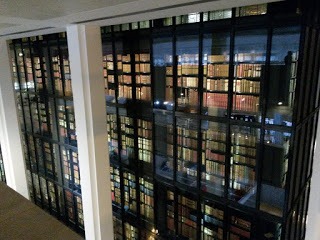
We went upstairs and were able to get a brilliant view of the King’s Library, made up of 65,000 printed volumes and numerous pamphlets, manuscripts and maps collected by George III between 1763 and 1820. The glass tower was inspired by a similar structure in the Beinecke Library in New Haven, Connecticut.
The King’s Library
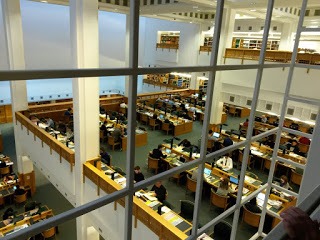
From the old to the new: our next stop was the news room where readers can view newspapers and watch a live news feed. We explored the Library considerably, taking a look at the many busy – but extremely quiet – reading rooms.
Reading Room
Before leaving, we had a quick look at a Library video in one of the quietest corners of the building – left “unfinished” to show off the brickwork.I really loved my tour: I learned a great deal about the British Library that I hadn’t known before. Public tours are available and I do recommend signing up.
Treasures of the British Library is the permanent collection of rare books and manuscripts on display in the British Library‘s Treasures Gallery. I had visited before, several years ago, but decided that the time was right for another visit.
There are more than 200 items in this Gallery, also known as the Sir John Ritblat Gallery, including hand-painted books, early printed books, maps, manuscripts and musical scores. Some of the most famous include Gutenberg’s 1455 Bible, the Magna Carta, the Lindisfarne Gospels and the Beowulf manuscript which is written in old English. These are just the early works: from later years we have a notebook of Leonardo da Vinci’s, a Shakespeare First Folio, the handwritten score of Handel’s Messiah, and even handwritten Beatles lyrics. Among the more unusual items are Jane Austen’s writing desk. There are also letters written by early kings and queens, including Elizabeth I.
My favourite items include the manuscripts of Jane Eyre and Tess of the d’Urbervilles, as well as Captain R.F. Scott’s diary detailing his ill-fated expedition to the South Pole. There is room in the Gallery for small temporary displays: the current display is Beyond Paper: 3000 Years of Chinese Writing (until 17 January 2016) and it includes some of the earliest examples of Chinese writing, inscribed on “oracle bones”, as well as writings on other materials including wood, silk and paper.
The Treasures Gallery is free to visit and it’s a must-see for anyone interested in the history of British literature. It is open seven days a week and is located near Euston and St Pancras/King’s Cross stations.
I popped into the British Library to see a small free exhibition called Animal Tales. It explored the different stories told about animals, “from Aesop’s Fables to Ted Hughes’s Crow”. It was interesting to see the variety of animals that have been presented between the pages of books, from fairy tales to childrens’ stories and even political satire (such as Animal Farm).
Even if you’re not a history lover like me, you’d be hard pressed to have missed the publicity surrounding the 800th anniversary of Magna Carta this year. The British Library, naturally enough, have installed an exhibition celebrating this document and its impact on the world, entitled Magna Carta: Law, Liberty, Legacy.
The exhibition explores how the Magna Carta came about, the context in which it was designed, and its immediate impact, as well as looking at the ways in which it has inspired campaigners throughout the centuries and impacted on political events. Linked to this, it examines how it has been exploited and perceived by the media and by people in general.
The treaty came about after King John, who had lost much territory in Northern France, imposed huge taxes on his wealthy subjects. The barons, angry, forced him into a negotiation, resulting in the “Carta de Ronemede”. Though much of it is now obsolete – one clause, for instance, covered fishing in the Thames – it still had a significant impact, as the exhibition shows. In addition, clauses 39 and 40 – guaranteeing the right to a fair and speedy trial – are still in force today.
The exhibition was very busy when I visited, but that was probably my own fault as I chose to go at the weekend. I did find that it was incredibly interesting and much more thorough than I had imagined. Partly this was because of the quality of the artefacts on display: two of the four original Magna Carta documents from 1215, plus Jefferson’s handwritten copy of the Declaration of Independence and an original copy of the US Bill of Rights, which both owe a debt to the Magna Carta. Statues, paintings and an assortment of manuscripts also added to the exhibition.
British judge Lord Bingham wrote that: “The significance of Magna Carta lay not only in what it actually said, but in what later generations claimed and believed it has said.” This exhibition brilliantly demonstrates this.
It tells the story of humanity’s interest in and travel to the Arctic from the earliest times onward, with a wealth of written and printed material relating to the subject including Inuit woodcuts, early printed books, Russian maps and, later, photographs. Interestingly, there is also information about Santa Claus and how his place of residence was “moved” from Finland to the North Pole as interest in the Pole grew.
Fiction, factual accounts, and evocative pictures combine to bring the story to life. Definitely worth popping in to see.
I finally managed to make it to the exhibition Terror and Wonder: The Gothic Imagination at the British Library before it closed. It extended its opening hours during the final week, which was handy for me because I turned up on Monday (the exhibition space is normally open until 8 pm only on Tuesdays) to find the space almost empty. This made it a very pleasant experience to go round.
The exhibition, which opened in 2014, was designed to mark the 250th anniversary of the publication of the first Gothic novel. This was Horace Walpole’s The Castle of Otranto, which made its debut in 1764. The exhibition covers the history of Gothic over the last two and a half centuries, and I found it fascinating. Many of the books on display and much of the information imparted were things I was already familiar with, but plenty of others were not.
In the eighteenth century, Gothic – which encompassed such authors as the aforementioned Walpole (who lived in a Gothic villa in Twickenham, Strawberry Hill), Matthew Lewis (author of The Monk) and Ann Radcliffe (author of The Mysteries of Udolpho) reflected the cultural concerns of the period, with ruined castles and abbeys, upstanding young noblemen, virginal heroines and mad monks. Renewed interest in sixteenth century writers such as Shakespeare and Spenser, and a growing interest in the “Gothic” or medieval past, combined with a growing interest in death and the supernatural led to many novels being set in medieval or Renaissance times, the era between the superstitious past and the dawning of the Age of Enlightenment.
I was excited to see a first edition of The Castle of Otranto, as well as copies of the “Horrid Novels” mentioned in Jane Austen’s satire of the Gothic craze, Northanger Abbey. I hadn’t realised that they really existed, so I left determined to track them down.
The French Revolution inspired more disturbing forms of Gothic literature, and the Romantic era borrowed from Gothic – most particularly in 1816 when the famous stormy night at the Villa Diodati resulted in Mary Shelley’s Frankenstein and Polidori’s The Vampyre. However, in the Victorian era Gothic was largely set in urban areas and in contemporary times – Dickens in particular used Gothic imagery to emphasise the plight of the poor. The later Victorian period saw penny dreadfuls take centre stage, and lurid stories such as The String of Pearls by James Malcolm Rymer (which introduced the character of Sweeney Todd) became popular, as well as the eternal classics Dracula and The Strange Case of Dr Jekyll and Mr Hyde. In the twentieth century, graphic novels, film and TV allowed the genre to develop further, and the exhibition ended with a display of recent photos taken at the Whitby Goth Weekend, which is now entering its third decade.
I loved the exhibition – it was a brilliant exploration of Gothic through the ages and it gave me plenty of ideas of what I would like to read next.
‘HMS Assistance and Pioneer in Winter Quarters’ [Shelfmark: 1781.a.23] – See more at: http://britishlibrary.typepad.co.uk/americas/2014/08/coming-up-lines-in-the-ice.html#sthash.vtgbSXaQ.dpuf
Recently I attended a talk at the British Library, The Search for Franklin’s Lost Ships, an event designed to coincide with the current exhibition Lines in the Ice: Seeking the Northwest Passage which runs until 29 March 2015. The talk involved Ryan Harris, a marine archaeologist, in conversation with Robin McKie from The Observer: the original subject of the talk was the search itself, but after the talk was scheduled, it emerged that one of the ships had actually been found – tremendously exciting news. Harris actually introduced his presentation by apologising for the slight change in tack – though I don’t suppose for a minute that anyone actually minded!
HMS Erebus and HMS Terror, under the command of explorer and Royal Navy officer Captain Sir John Franklin, left Greenhithe on 19 May 1845, setting sail for Canada in a bid to find the last stretch of the fabled Northwest Passage. Both ships became trapped in ice in Victoria Strait near King William Island, in the Canadian Arctic. The entire crew was lost, and their ultimate fate became one of the Victorian age’s greatest mysteries. Franklin’s wife, Jane, and others launched numerous expeditions to try and find out what had happened to them, but none were successful, though rumours of cannibalism, poisoning and scurvy abounded. Oral history and Inuit testimony was collected during the nineteenth century, suggesting that at least one ship had sunk, but their testimony was distrusted.
HMS Erebus and HMS Terror, as they appeared in Illustrated London News. Source: Getty Images via BBC News
Earlier this year, the Canadian Government initiated the biggest search yet to find the lost ships. As Canada has the largest coastline in the world, this would be no light undertaking. A previous “Project Franklin” run by the Department of National Defence ended in failure in 1967 when the divers performing the search had to be evacuated owing to hypothermia. However, modern technology has enabled new methods of searching.
Marine archeologist Ryan Harris, who took part in the search, explained how the ship – later determined to be HMS Erebus – was found. On 1 September, a piece of iron and a piece of wood were found: cross-section plans of Erebus provided by the National Maritime Museum proved that these artefacts came from that ship. Erebus itself was discovered with sonar imaging, relatively intact on the sea floor: it was possible to match up the plan of the ship with the undersea image to prove it was what they were looking for. Exciting as the discovery was, it was kept under wraps for a while so the “right” people could be informed first – the Canadian and British governments, for instance. The find was formally announced on 9 September.
The most exciting part of Harris’s talk was hearing about, and seeing pictures of, dives to the near-intact ship. Despite the covering of kelp, archaeologists were able to find cannons, anchors, decking and beams, and a table leg that, judging by a picture of Franklin’s cabin published in the Illustrated London News, came from a table belonging to Franklin himself. Particularly exciting was the discovery of the ship’s bell, still with the year ‘1845’ embossed on it. The plan is for the bell, probably made at the Whitechapel foundry, to be conserved and displayed publicly while further archaeological work continues at the site.
Further examination of the ship could lead to some important questions being answered. For instance, who were the last survivors of the crew, and when did discipline break down? How was the ship rigged – for sail, or for steam propulsion? The discovery should prompt a re-examination of the Inuit testimony which was distrusted at the time, and could shed new light on the technology of nineteenth-century British polar exploration.
A question and answer session at the end of the talk offered further insight into what might happen with the ship in the future. It seems certain that the project will go on for years, uncovering further details about the ship and the expedition as a whole. In reply to one question, Harris said that they are “optimistic” about finding some documents on board – linen-based paper can survive for centuries underwater, and it is possible that records may be found inside. The aim is to get into the middle of the ship: it is possible that it could be raised, as although it is generally preferred to leave things in situ, the significance of this one could mean that it is removed from the water at some point. Artefacts will be removed from the wreck so that they can be conserved and learned from, and in the meantime, the search for the other ship, HMS Terror, will continue.
I thoroughly enjoyed this fascinating talk and intend to keep an eye out for more news relating to the search and the Franklin expedition. I also intend to visit the exhibition at the British Library early next year.
Until 12 October 2014, a free exhibition in the Folio Society Gallery of the British Library, Enduring War: Grief, Grit and Humour, is on display to mark the centenary of the start of the First World War. The exhibition uses posters, poetry, books and pamphlets to look at how soldiers from home and overseas, and civilians back in “Blighty”, coped with the conditions of the war. It is really interesting – and sobering – to look at diaries, letters and journals from the conflict. The range of responses is fascinating and I thought it made an interesting foil to the recent exhibition of First World War portraits at the National Portrait Gallery.
I went along to the Comics Unmasked: Art and Anarchy in the UK exhibition at the British Library recently. I’m not a particular fan of comics or graphic novels, but I’m always interested in learning more about anything to do with literature.
The exhibition displays both mainstream and underground comics, demonstrating the breadth of subjects they have addressed throughout the years, including politics, gender, violence and sexuality. I enjoyed reading about the history of comics, from their roots in medieval manuscripts and the “Punch” character through to modern comics and graphic novels. I was left with several ideas about graphic novels to try, including Neil Gaiman’s Sandman, Alan Moore’s Watchmen and V for Vendetta, and Posy Simmonds’ Tamara Drewe.