Michelangelo, Leonardo, Raphael: Florence, c. 1504 – Royal Academy

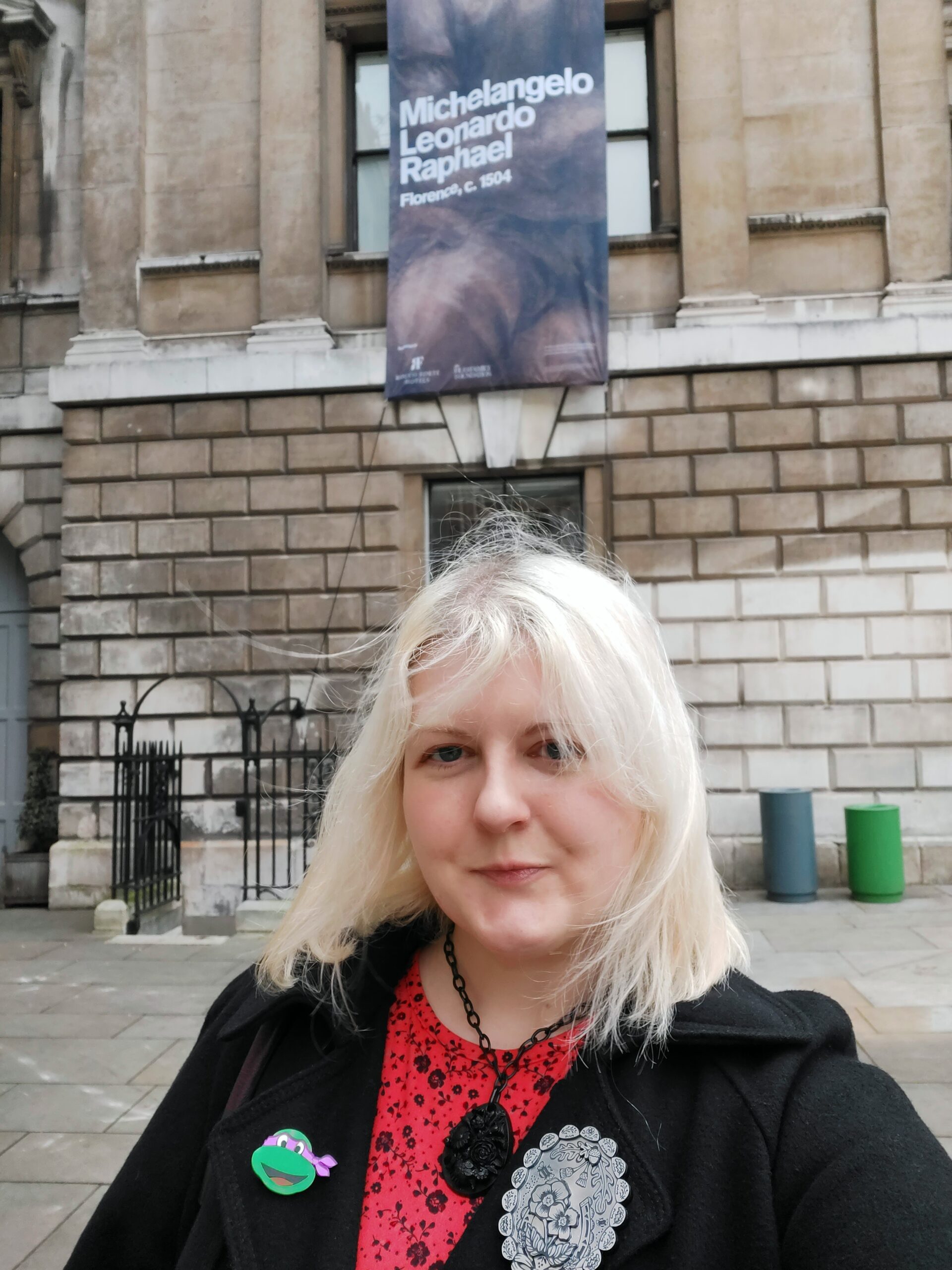
Selfie in front of the RA

I visited the exhibition Michelangelo, Leonardo, Raphael: Florence, c. 1504 at the Royal Academy. I wore my Donatello brooch to the exhibition so that he wouldn’t feel left out. This was probably the most exciting thing about the exhibition.

These three leading artists gathered in Florence on 25 January 1504 to discuss an appropriate location for Michaelangelo’s David. The exhibition uses this point in time to look at the work of these three titans of the art world and explore their similarities and differences. Sadly, I found it rather dull.

The first room brings together Michaelangelo’s Taddei Tondo, Leonardo da Vinci’s drawing The Virgin and Child with St Anne and the Infant St John the Baptist and Raphael’s oil, The Bridgewater Madonna. They are all key works of the Renaissance and worth seeing together.

One room compares battle murals by Leonardo and Michaelangelo, both commissioned to paint them in the same location. Apparently there was a tense rivalry between the two, but this doesn’t really come across here. Michaelangelo’s Battle of Cascina features nude men climbing out of a river: it tells the story of a battle in which soldiers on a break pause their swim to arm themselves and defeat the incoming Pisans. The mural was approved by Machiavelli. Leonardo’s Battle of Anghiari, in which Florence defeated Milanese mercenaries, is a more traditional depiction of war, but immense in its power.

The quality on offer in this exhibition is unquestioned, I just wish the story behind it had been more effectively conveyed.

Raphael – National Gallery

I visited the Raphael exhibition at the National Gallery, shortly before it closed. I wasn’t going to go, but realised the Gallery was open late on a Friday and I thought I would take the opportunity.

I didn’t know much about Raphael (1483-1520) – except that he was a key figure in the Italian Renaissance (and he was a turtle). In fact, most of what I knew about him was what he was not – having a longstanding interest in the Pre-Raphaelites.

This exhibition is the first outside Italy to encompass his entire career. As well as a painter, Raphael was a printmaker, draughtsman, poet, architect and archeologist – he was one of the first people to recognise the importance of Italy’s Roman heritage.

Raphael had a turbulent early life, losing his mother at 8 and his father at 11. He was brought up by his uncle, a priest, which perhaps goes some way to explain the high proportion of his works with a religious bent, although I suppose most works of art were religious at this time. He painted altarpieces and other devotional scenes, including numerous Madonnas. I was shocked to read that he died young – suddenly, of a fever, at the age of 37.

Highlights for me included his portraiture – images of friends and patrons mostly found at the end of the exhibition. These were full of life and really captured the character of the sitter – I wish more of the works had been like this rather than religious paintings. However, I did like the dragon in Raphael’s St George scene, and the near-lifesize reproduction of his fresco The School of Athens, which centres the philosophers Plato and Aristotle.