West Norwood Cemetery (The “Magnificent Seven” Tour)

2015_0307WestNorwood01
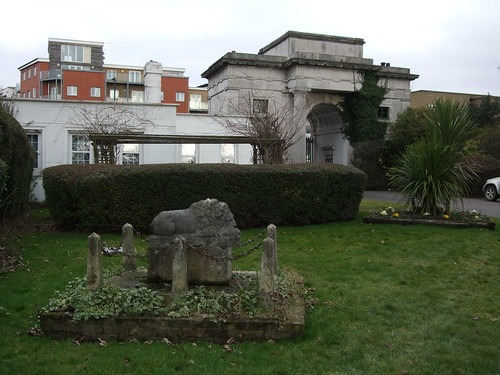
Entrance to West Norwood Cemetery with the war memorial and inner gates visible

At the weekend I made a visit to the second of the “Magnificent Seven” commercial cemeteries in London, West Norwood Cemetery. Once again I was lucky with the weather: it was a dry and sunny day, though a cold wind made me shiver on occasion.

Getting There

West Norwood Cemetery is, as the name suggests, in West Norwood, south London. The address is Norwood Road, London SE27 9JU and the closest railway station is West Norwood, which can be reached from Victoria or London Bridge stations.

History

Initially known as The South Metropolitan Cemetery, the cemetery was founded by its own Act of Parliament in 1836 and the first burial took place a year later. The South Metropolitan Cemetery Company purchased land from the estate of the late Lord Thurlow to create the cemetery, which was consecrated by the Bishop of Winchester.

2015_0307WestNorwood03
The Gothic inner gates designed by Sir William Tite
2015_0307WestNorwood06
Close-up of the arch
2015_0307WestNorwood07
Main office, which was rebuilt after the original was damaged in the war

In contrast to Kensal Green, which was built in the classical style, the South Metropolitan Cemetery was the first to be designed throughout in the Gothic style. The landscaping and some monuments, including the catacombs and the entrance gateway, were designed by architect Sir William Tite (1798-1873), who was eventually buried here himself. The cemetery later became known as the “Millionaires’ Cemetery” owing to the number of eminent Victorians buried here, including around 300 people with entries in the Dictionary of National Biography.

2015_0307WestNorwood08
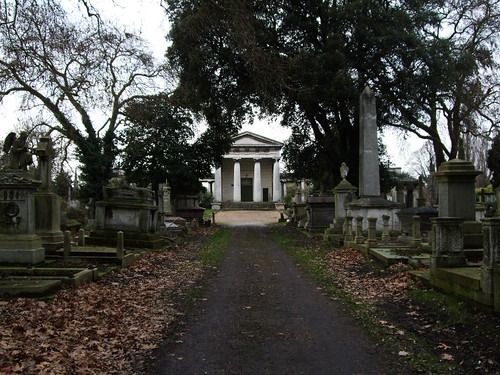
Looking into the cemetery with the entrance gates at my back

Sadly, the 40-acre cemetery suffered bomb damage during World War II and Lambeth Council, following a compulsory purchase order in 1965, proceeded to clear thousands of monuments. Luckily, the Friends group, the Archdeacon of Lambeth and others joined to prevent this. Many monuments are listed Grade II by English Heritage. The original consecrated chapel was also damaged by a bomb during the war and was later pulled down; the Dissenters’ chapel remains and has been converted into a crematorium.

Tour

Our guide told us a little about the history of the cemetery, and took us on a fascinating walk around it, pointing out some of the more notable features. One memorial that stood out is that of James Gilbart, founder of the London and Westminster Bank (now known as NatWest).

2015_0307WestNorwood23
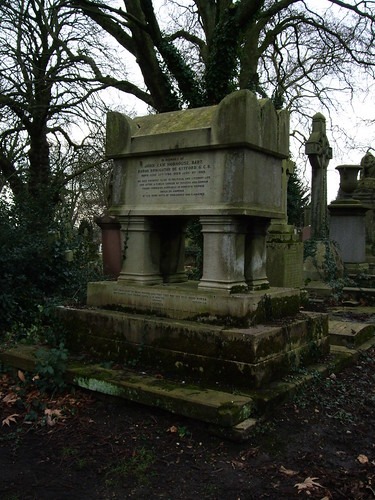
The J.W. Gilbart memorial, which is Grade II listed
2015_0307WestNorwood24
Spire view of the memorial

We also saw the grave of Sir Hiram Maxim, of Maxim Gun fame – the American inventor, who moved to England aged 41, holds the dubious honour of being the inventor of the first portable, fully automatic machine gun.

2015_0307WestNorwood09
The Maxim family grave

The grave of Joe Hunte, the anti-racism campaigner, rests here.

2015_0307WestNorwood25
Burial place of Joe Hunte

I particularly liked this gravestone with its striking image of an old-fashioned diving helmet. Augustus Siebe was an inventor and engineer whose contributions to diving technology earned him fame. His stone was replaced without the cemetery’s permission a few decades ago, but I don’t feel I can object as I really like this interesting design.

2015_0307WestNorwood64
Augustus Siebe’s grave

The most famous person to be buried in West Norwood is probably Isabella Beeton, of Mrs Beeton’s Book of Household Management fame. She died at 28 after contracting puerperal fever following the birth of her fourth child. I had always thought she was older, but then she did have 20 younger siblings, so she had plenty of time to gain ample experience in cooking and household management.

2015_0307WestNorwood47
Mrs Beeton’s unassuming burial place

The Reverend Charles Spurgeon was a Baptist preacher and he is still well-known and admired by Baptists around the world. Our guide told us about the time a coachload of American tourists came to the cemetery, surrounded Spurgeon’s tomb to take pictures and then left, without looking at anything else in the cemetery.

2015_0307WestNorwood53
Charles Spurgeon’s tomb just outside the crematorium (formerly the Dissenters’ Chapel)

Mrs Beeton might be better-known, but for me the most exciting person to be buried in West Norwood is Charles Pearson. He was a solicitor and a reforming campaigner who campaigned for an underground railway system and was instrumental in promoting and establishing the Metropolitan Railway, the forerunner to the London Underground. I’m a great admirer of Pearson, whose encouragement of the railway system stemmed from a sense of social justice and a belief that it would improve the lives of the working poor.

2015_0307WestNorwood52
Charles Pearson, buried in his son-in-law’s plot

Two lovely large red brick mausoleums stand out: the first belongs to Sir Henry Tate, the sugar magnate who also founded the Tate Gallery (now Tate Britain).

2015_0307WestNorwood55
Henry Tate’s mausoleum

The second is the burial place of Sir Henry Doulton, the pottery manufacturer who was instrumental in developing his family firm into the famous Royal Doulton brand.

2015_0307WestNorwood61
Tomb of Henry Doulton

Architecture

The cemetery is interesting because of the people buried here, but also because of the examples of cemetery architecture in evidence. This draped urn was typical of the period.

2015_0307WestNorwood21
Draped urn

Lucy Gallup’s grave is unusual because of the presence of a photograph of the deceased.

2015_0307WestNorwood18
Lucy Gallup’s photograph

The English antiquary John Britton designed his monument to be as permanent as Stonehenge. In fact, it looks just like a Stonehenge stone.

2015_0307WestNorwood22
John Britton’s unusual monument

Seaman John Wimble’s beautiful and intricate tomb, with its detailed carvings of ships, lent its name to Ship Path.

2015_0307WestNorwood37
A beautifully carved ship on Wimble’s monument

The tomb of Alexander Berens, designed by E.M. Barry, is one of the most impressive in West Norwood and sits in a prime spot on the top of the hill.

2015_0307WestNorwood43
Alexander Berens’ elaborate mausoleum

Here is an example of a heart plaque sometimes used in the sentimental Victorian period.

2015_0307WestNorwood49
Heart plaque

Greek Necropolis

2015_0307WestNorwood71
Looking towards the Greek Necropolis

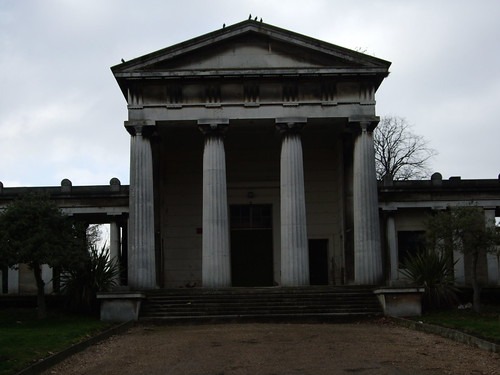
Our final stop on the tour was the Greek Necropolis, complete with an imposing Chapel of St Stephen (architect unknown but sometimes thought to have been John Oldrid Scott). This section of the cemetery was acquired by the Greek community in London in 1842, and is filled with Greek Orthodox mausoleums and monuments commemorating members of the Anglo-Hellenic community. The Necropolis is overseen by the trustees of the Cathedral of Saint Sophia.

2015_0307WestNorwood72
St Stephen’s Chapel
2015_0307WestNorwood75
Greek monuments

The end point of our tour was the elaborate mausoleum of Edmund Distin Maddick, which had been opened up to form a little shop.

2015_0307WestNorwood10
Mausoleum of Edmund Distin Maddick

It’s not as famous as Kensal Green or Highgate, and it’s a little out of the way, but West Norwood Cemetery is well worth a visit. There are some interesting monuments to see, and the cemetery’s location on a hill is an attractive one: and there are a couple of famous graves.

Would I go back?

Yes – it’s a decent-sized site with plenty to see, and I would like to be able to take a leisurely walk around it. Visiting the cemetery is free, so well worth it. In addition, if you join the Friends group for £5 per year you get a chance to take a tour of the catacombs – which is something I definitely intend to do at some point.

Facts

Address: Norwood Road, London SE27 9JU
Founded: 1836
Size: 40 acres
Still in operation?: Cremation plots are still available but the cemetery is closed to new burials, at least for now
Official website: http://www.lambeth.gov.uk/places/west-norwood-crematorium-and-cemetery
Owners: Lambeth Council
Friends group: Friends of West Norwood Cemetery (FOWNC) (http://www.fownc.org/)
Tours: The first Sunday of every month, 11 am November-March, 2.30 pm April-October. Free, but donations appreciated.

Kensal Green Cemetery (The “Magnificent Seven” Tour)

I began my tour of all seven garden cemeteries in London – the “Magnificent Seven” – with a trip to the first of them to be established, Kensal Green Cemetery. It was a lovely day: dry and warm, cloudy at first but the sun came out later.

2015_0215KensalGreen41
Inside the cemetery, with the Anglican Chapel in the distance

Getting There

The cemetery is located in North West London; the address is Harrow Road, London, W10 4RA. Nearby Kensal Green tube station is on the Bakerloo Line.

History

A rapidly increasing population in London meant that parish graveyards were becoming dangerously overcrowded, and new solutions were sought for the burial of the dead. In 1830 George Carden, a barrister, formed the General Cemetery Company (which still owns the cemetery); an Act of Parliament in 1832 enabled the company to establish a cemetery on land beside the Grand Union Canal. It was originally known as the General Cemetery of All Souls, Kensal Green.

An architectural competition was launched in 1831 to find a design for the Anglican Chapel in the centre of the cemetery. Henry Edward Kendall’s Gothic Revival design won the competition, but the owners – who preferred the classical style – overturned the decision (at least Kendall still got his prize money). The cemetery gateway and the two chapels were eventually completed to designs by John William Griffith, a company shareholder.

2015_0215KensalGreen01
Main entrance on Harrow Road

Originally there was a division between the Anglican section of the cemetery, comprising 39 acres, and the smaller Dissenters’ area of 15 acres. This distinction was very important at the time.

2015_0215KensalGreen02
Looking towards the entrance from the inside, with the Anglican burial ground on the left and the Dissenters area on the right

Exploring

2015_0215KensalGreen10
Inside the cemetery
2015_0215KensalGreen11
View of the cemetery including the former gas towers, which are due to be demolished

I had been to Kensal Green cemetery before, but only for a quick look round. The place is so huge that I had only managed to see a relatively small part of it. I decided to go back for a proper tour, getting there a bit early to have another look round by myself. Completely by accident I came across the grave of John Cam Hobhouse, close friend of my favourite poet Lord Byron.

2015_0215KensalGreen07
Approaching the Anglican chapel
2015_0215KensalGreen04
Interesting, if damaged, monument
2015_0215KensalGreen08
Weeping statue
2015_0215KensalGreen15
The way this woman has turned to look at you is quite creepy
2015_0215KensalGreen14
The Anglican Chapel from the back
2015_0215KensalGreen12
Memorial plaque commemorating the damage done in World War II
2015_0215KensalGreen03
The grave of John Cam Hobhouse

Tours, which are run by the cemetery’s Friends group, start at the steps of the Anglican Chapel.

2015_0215KensalGreen09
The Anglican Chapel

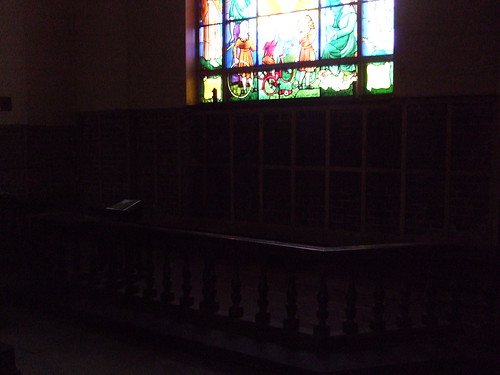
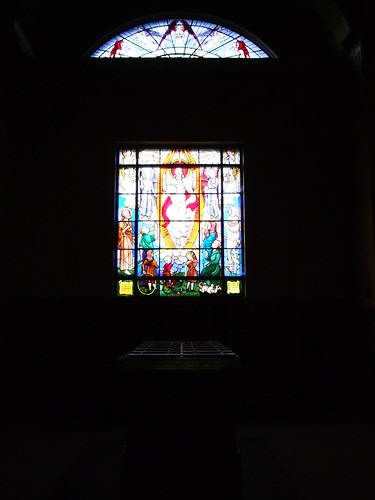
After a quick background introduction to the cemetery and London’s garden cemeteries in general, we got to go into the chapel, which is cold and in need of some repair. The ceiling is still beautiful, though.

2015_0215KensalGreen19
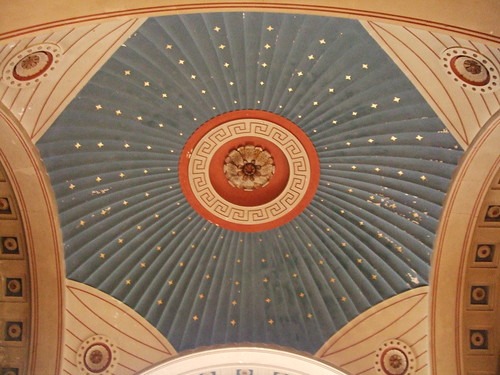
Ceiling of the Anglican Chapel
2015_0215KensalGreen20
Inside the Anglican chapel
2015_0215KensalGreen18
Inside the Anglican chapel

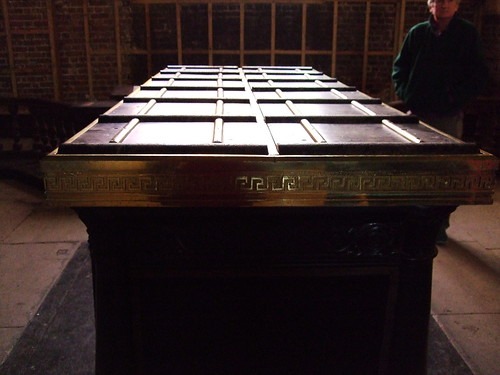
The raised platform is where the coffins are placed, and rollers help the bearers to slide it on. The platform turns around so that coffins can be taken out head first, as is custom.

2015_0215KensalGreen21
Catafalque with rollers

The raised structure also happens to be a hydraulic catafalque for lowering coffins into the catacombs. Sadly we couldn’t go into the catacombs because of Health & Safety risks (mould, apparently), but we could see the entrance from outside the chapel.

2015_0215KensalGreen22
Looking down into the catacombs

We had a comprehensive tour of the cemetery which took over two hours. The time went very quickly, however, and our guide was very knowledgeable. Even then, we didn’t see all of the notable tombs here: it is so big and there are so many significant people buried in Kensal Green.

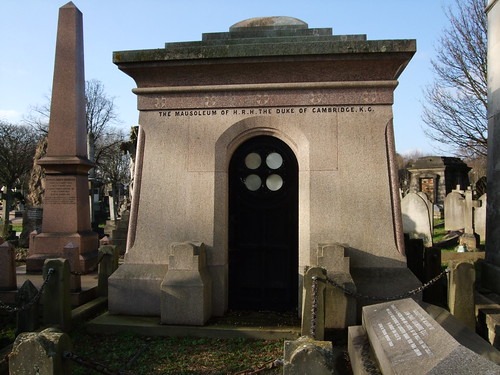
Uniquely for a public cemetery, three members of the Royal Family have been buried here: Prince Augustus Frederick and Princess Sophia, children of George III, and Prince George, Duke of Cambridge, grandson of George III and commander-in-chief of the British Army. Royal burials helped to make Kensal Green a popular and fashionable place to be buried.

2015_0215KensalGreen23
Mausoleum of Prince George, Duke of Cambridge
2015_0215KensalGreen33
Tomb of Prince Augustus Frederick
2015_0215KensalGreen34
Grave of Princess Sophia

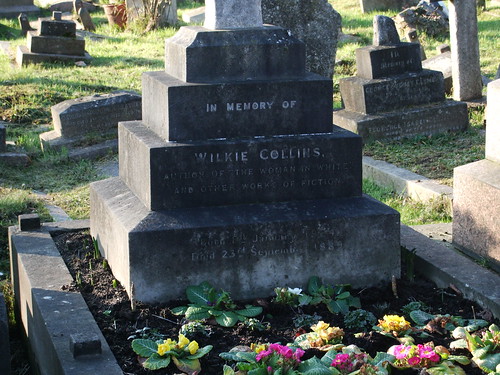
A significant number of important authors have been buried at Kensal Green, including Anthony Trollope, Wilkie Collins, Thomas Hood, Harold Pinter and William Makepeace Thackeray. As a lover of nineteenth-century literature (and twentieth-century theatre) I was thrilled to see these. My favourite was Anthony Trollope’s. I don’t know if he chose his inscription himself or if a family member selected it after his death, but either way it is astoundingly modest and deeply moving. It simply reads, “He was a loving husband, a loving father, and a true friend” – no mention of his (hugely underrated, in my opinion) forty-seven novels, written alongside his full-time job in the Post Office (he is credited with introducing the red pillar box to Great Britain).

2015_0215KensalGreen25
Grave of Anthony Trollope
2015_0215KensalGreen29
Grave of Wilkie Collins
2015_0215KensalGreen51
Burial place of Harold Pinter
2015_0215KensalGreen56
The grave with the flowers belongs to William Makepeace Thackeray

I’d already heard of many of the famous figures buried in Kensal Green, but one person new to me was Jean-François Gravelet Blondin. Blondin, who is buried with his wife, was a French tightrope walker and acrobat. His most famous and impressive feat was crossing the Niagara Falls, not once but repeatedly. On different occasions he crossed blindfolded; in a sack; and carrying a man on his back. Once, he even carried a small stove: halfway across, he stopped, lit the stove and proceeded to cook an omelette.

2015_0215KensalGreen26
Tomb of Blondin and his wife

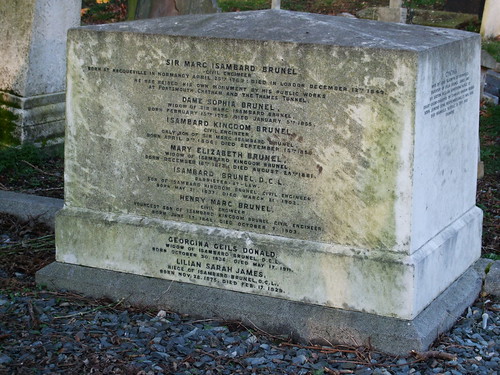
Charles Babbage, the polymath who created the concept of a programmable computer, is buried in the cemetery, as are Marc Brunel and his son Isambard, two of the most important and prolific engineers in British history. One of Marc’s great achievements was the Thames tunnel between Rotherhithe and Wapping, while Isambard’s accomplishments include the Great Western Railway and the designs for the Clifton Suspension Bridge in Bristol.

2015_0215KensalGreen40
Grave of Charles Babbage
2015_0215KensalGreen55
Burial place of Sir Marc Isambard Brunel, Isambard Kingdom Brunel, and other family members

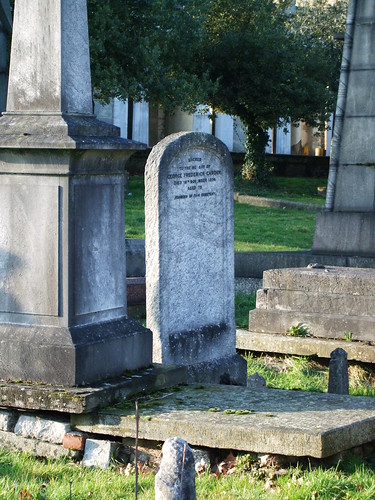
George Carden, founder of the cemetery, rests inside it.

2015_0215KensalGreen31
Grave of George Carden, founder of the cemetery

Architecture

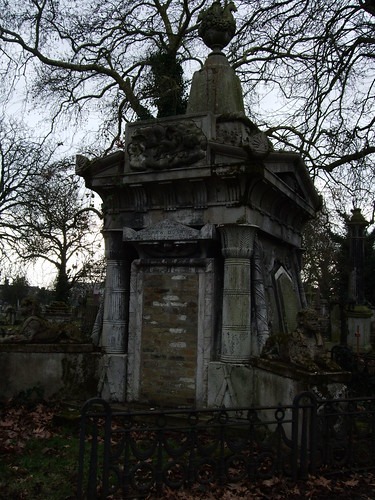
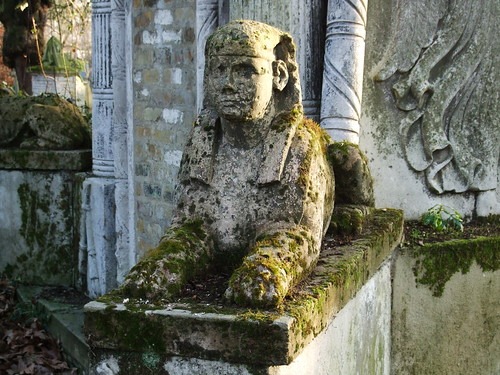
The cemetery is of interest not just because of the individuals buried here, but because of the varied and rich architecture of the different tombs and mausoleums. One of the most significant graves in this respect is that of circus performer Andrew Ducrow.

2015_0215KensalGreen46
Andrew Ducrow’s elaborate memorial
2015_0215KensalGreen47
Egyptian symbolism, like this sphinx, was popular in the nineteenth century
2015_0215KensalGreen49
Angels and broken-off columns, symbolising life cut short, were also popular
2015_0215KensalGreen50
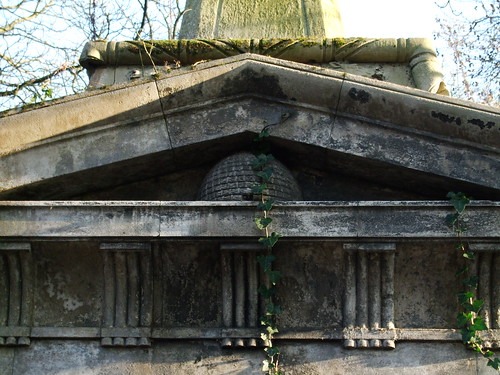
The beehive represents industriousness
2015_0215KensalGreen48
Beautifully carved hat and gloves

Dissenters’ Chapel

Our tour ended at the other end of the cemetery, with a visit to the Dissenters’ Chapel. We didn’t spend much time in this part of the graveyard, though it is interesting to me because my ancestors on my dad’s side, as Methodists, would have been classed as Dissenters, and if they had lived in London and been buried here, this is the area of the cemetery where they would have ended up. The chapel is similar in design to the larger Anglican chapel at the centre of the cemetery, but it has been restored more recently, with facilities for us to view displays and enjoy a hot cup of tea and some biscuits.

2015_0215KensalGreen58
The Dissenters’ Chapel
2015_0215KensalGreen59
Inside the chapel

Finally we were allowed to look inside the catacombs. They are smaller than those beneath the Anglican chapel, and the coffins there have been moved, but the space was still atmospheric. Plans are afoot to put on exhibitions and other events down here, which I think would be quite exciting.

We were let out of a side gate leading to Ladbroke Grove, and I made my way home.

A visit to Kensal Green cemetery is a must for anyone interested in cemeteries and the history of burials in London. It’s also a beautiful and peaceful space for a walk. Entry is free (unless you take a tour) and there is so much to see – it would be easy to go back again and again.

Would I go back?

Yes – it’s a lovely place for a relaxing walk, and I would particularly like to see Lady Byron’s grave and Terence Rattigan’s memorial stone, neither of which we had time to see on the tour. A booklet produced by the Friends, which I purchased for £2, has a map with the locations of significant graves, and this would be useful to take with me when I return.

Facts

Address: Harrow Road, London, W10 4RA
Founded: 1832
Size: 72 acres
Still in operation?: Yes
Official website: http://www.kensalgreencemetery.com
Owners: The General Cemetery Company
Friends group: Friends of Kensal Green Cemetery (http://www.kensalgreen.co.uk)
Tours: 2 pm every Sunday March to October and the first and third Sundays of the month November to February. Cost £7 (£5 for concessions/English Heritage members)

The Garden Cemeteries: London’s Magnificent Seven

Recently I’ve decided to visit the cemeteries in London known as the “Magnificent Seven”, the garden cemeteries established in the nineteenth century in order to alleviate overcrowding in parish cemeteries. The cemeteries were originally established on the edges of the city, but the expansion of London over the next two centuries ensured that they are now well and truly part of the city.

    The cemeteries are:

  • Kensal Green Cemetery (established in 1832)
  • West Norwood Cemetery (1837)
  • Highgate Cemetery (1839)
  • Abney Park Cemetery (1840)
  • Nunhead Cemetery (1840)
  • Brompton Cemetery (1840)
  • Tower Hamlets Cemetery (1841)

I hope to visit them in the order in which they were established, starting with Kensal Green.

The book I’m using as a reference and guide is Turpin, John and Knight, Derrick, The Magnificent Seven: London’s First Landscaped Cemeteries. Stroud: Amberley Publishing, 2011.

On with the adventure!

William Morris Gallery

William Morris Gallery

Located in a Georgian house in Walthamstow, which was home to Morris and his family between 1848 and 1856, is the recently redeveloped William Morris Gallery. I paid a visit as part of my tube exploration plan.

I find Morris a fascinating character – a talented poet and artist who believed that everyone should have beauty in their lives, he became a socialist later in his life and could often be found handing out pamphlets or taking part in demonstrations. He disliked the growing machine-made culture of the Victorian age, and championed small-scale production and handcrafted goods.

The museum tells us about Morris’ life, from his childhood through to old age. It also simultaneously tells the story of the house itself. Displayed in the rooms of the house are several artefacts and examples of his art, and that of his contemporaries. I particularly liked the reconstruction of the Morris and Co. store, which showed how customers could combine the different elements of the design to create a truly Arts and Crafts home. The museum is free to enter, too, which is a bonus!

FACTS

Address: Lloyd Park, Forest Road, Walthamstow, London, E17 4PP

Website: wmgallery.org.uk

Opening Hours: Wed-Sun (& Bank Holidays) 10am-5pm

Prices: Free

7 Hammersmith Terrace

2013 0413 Emery Walker House 02

The front of 7 Hammersmith Terrace

The other weekend I visited 7 Hammersmith Terrace, former home of Emery Walker and boasting an original Arts & Crafts interior. The house is only open at certain times via guided tour, so I booked my visit online and turned up at the house just before eleven. 7 Hammersmith Terrace is on the north bank of the Thames, near Stamford Brook tube station on the District line.

2013 0413 Emery Walker House 01

Emery Walker (1851-1933) was a printer and was a great friend to William Morris, who lived nearby at Kelmscott House. He also had contact with many of the other leading cultural and political figures of the period, including Philip Webb and George Bernard Shaw. His house is filled with authentic furniture and decorations from the period: William Morris wallpaper, furniture left to Walker by Webb, photographs, artefacts and personal items such as a lock of hair, as well as items he and his daughter Dorothy picked up on their travels.

2013 0413 Emery Walker House 03

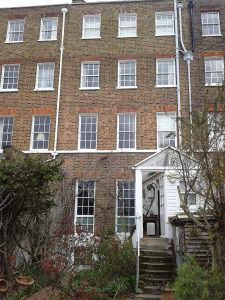
Back of the house, seen from the garden

This is a beautiful house and well worth a visit – I definitely recommend booking a tour.

FACTS

Address: 7 Hammersmith Terrace, London, W6 9TS

Website: emerywalker.org.uk

Opening Hours: Guided tour only; visit emerywalker.org.uk/booking.

Pre-Raphaelites: Victorian Avant-Garde – Tate Britain

The new exhibition recently opened at Tate Britain, and it was one I knew I absolutely had to see. The exhibition was entitled Pre-Raphaelites: Victorian Avant-Garde, and as a huge fan of this particular band of artists, has been on my must-see list for months.

I arrived at the Tate on Saturday morning about an hour after the exhibition opened, and was shocked at the sheer number  of people there. I knew it would be popular, but I hadn’t realised just how popular until I got inside the first room. Though entry to the exhibition was timed, I felt that there were far too many people there: I had trouble getting close to the things I really wanted to see, and was repeatedly annoyed by people pushing in front.

Anyway, as far as the exhibition was concerned, I thought it was excellent. I know very little about art, but the Pre-Raphaelites have always appealed to me; perhaps my fascination was inherited from my mother, who studied art at college and who also likes their work. I’m also attracted by their pivotal role in Victorian culture, and the fact that they were influenced greatly by literature: some of my favourite writers, including Shakespeare and Tennyson, inspired the movement, and several members, including Dante Gabriel Rosetti, wrote poetry (his sister, who was not part of the group but who modelled for some of their pictures, was the famous poet Christina Rosetti).

The exhibition aims to emphasise the revolutionary nature of the Pre-Raphaelite brotherhood, whose members – as well as several followers – made a conscious effort to break with tradition and seek new ways of making art. While their works remain popular to this day, it is not always apparent just how radical their approach was; in fact, the Pre-Raphaelite movement has been described as the first modern art movement.

The exhibition was displayed over several rooms, each exploring a different aspect of the movement. The first room looked at the origins of the PRB and their influences. The movement was founded in 1848, and sought to recapture beauty and spirituality in a world undergoing industrial and social upheaval. Members were inspired by early Italian painters whose works were displayed in the National Gallery (painters who worked before the time of Raphael; hence the name of the brotherhood). Other influences included William Blake, whose works combining poetry and art inspired similar creations in PRB members, and other contemporary artists of the time.

Secrecy surrounded the brotherhood at first: early works were signed with the secret initials ‘PRB’; an example of this is Isabella by John Everett Millais, on display in this room.

The second room explored how the Pre-Raphaelites explored history in their work. Their style was realist, almost photographic in its detail, thus illustrating a historical subject with a modern sensibility. One of my favourite pictures in this room was painted by Millais, and shows a Highland woman welcoming her husband, who has just been released from prison where he was kept by the English after the Battle of Culloden. Another was William Holman Hunt’s impression of the scene in The Two Gentlemen of Verona (the group was frequently inspired by Shakespearean scenes) in which Valentine rescues Sylvia from Proteus. I also liked the fact that some of Elizabeth (‘Lizzie’) Siddall’s watercolours were shown here. Most often remembered for her tempestuous and doomed relationship with Dante Gabriel Rosetti, and for being the model for Ophelia in Millais’ painting, her pictures showed that she was a talented artist in her own right.

Sir John Everett Millais,

The ‘Nature’ room contained many beautiful paintings, including Ophelia, mentioned above, which is one of my favourites; the colours are so lustrous and the water and the greenery captured so perfectly. Lizzie Siddall spent days lying in a bath of water in order to model for the doomed heroine. Other pictures were of landscape scenes, bright and summery or bleak and bare. I don’t normally associate the Pre-Raphaelites with landscapes so this section was a revelation for me. A particular highlight was Ford Madox Brown’s An English Autumn Afternoon showing the view from Hampstead towards London. I’ve seen this view myself but it looks very different nowadays: I enjoyed seeing what it was like a hundred and fifty years ago.

The photographic quality of many of the Pre-Raphaelites’ works is perhaps most evident here. Some critics accused them of working from photographs but in fact this was not the case: they would generally paint the landscapes outside during the summer (years before the Impressionists began to do the same thing) and retreat to their studios in the colder months to add figures and finish off the works. Their accurate, realist style was hugely modern and different from anything which had gone before.

The next section explored salvation, religion and social attitudes. The nineteenth century was a time of great change, with the publication of Charles Darwin’s theories, social conflict and division. The Pre-Raphaelite brotherhood sought to make Christianity accessible to all, portraying religious figures with naturalism and compassion. Millais’ Christ in the House of His Parents was a revolutionary work, showing the Holy Family as ordinary working people: he made studies for the painting in a real carpenter’s shop. Hunt, one of the more religious of the Pre-Raphaelites, made the pilgrimage to the Holy Land so that his work would be more authentic: he completed several important works based on his experiences there, including The Scapegoat, which illustrated an old Biblical legend in which a goat, bearing the sins of the population, is expelled from a village. The group’s portrayal of women was in some ways radical for the period, but in others encompassed Victorian ideals – unsurprising considering that all its members were male. In Hunt’s The Awakening Conscience, a woman comes to the realisation that her way of life – she is a kept woman – is wrong. On the one hand, Hunt does not judge her for her lifestyle; on the other, there doesn’t seem to be any issue with the morality of her lover’s chosen way of life.

Sir John Everett Millais,
Sir John Everett Millais, ‘Christ in the House of His Parents’

Another room explores the representation of beauty in Pre-Raphaelite works. In around 1860, some members of the movement began to explore the idea of ‘art for art’s sake’, presaging the Aesthetic Movement. Dante Gabriel Rosetti in particular embraced this theme, painting numerous images of beautiful women gazing out of their pictures and wearing rich robes of varying hues. This was probably my least favourite room of the lot: I like pictures to have a bit of meaning behind them, and the cynic in me believes that Rosetti’s desire to paint nothing but beautiful women stemmed from more than an artistic theory.

The Paradise section explores other art forms rather than painting: tapestries, furniture and textiles are among the pieces shown here. William Morris, inspired by the Pre-Raphaelites, set up a firm to produce items such as textiles, furniture, stained glass and tiles that were both beautiful and functional. Several members of the PRB were involved in this enterprise in the early stages. I found these items interesting to look at although I must confess that I prefer the paintings.

The final section explored mythologies and their role in inspiring Pre-Raphaelite painters. Greek and Roman myths as well as legends and stories from literature were covered here. Edward Burne-Jones’ picture King Cophetua and the Beggar Maid is a striking example of this, dramatic and detailed.

Sir Edward Coley Burne-Jones,
Sir Edward Coley Burne-Jones, ‘King Cophetua and the Beggar Maid’

I spent two hours in the exhibition, and felt slightly exhausted by the end. However, I thoroughly enjoyed myself and really appreciated the chance to learn more about a movement in which I am very interested.

Red House: the home of William Morris

Bank holidays, for me, are times to go out and visit places, experience something new. Red House, the former home of William Morris (founder of the Arts & Crafts movement, famed for his socialism and wallpaper designs), has been on my list for some time. I decided to organise an outing and got some of my librarian friends to come along this August Bank Holiday.

Red House was occupied by William Morris and his family from 1860 until 1865, when financial difficulties unfortunately compelled him to leave. He commissioned, created and lived in the house, which was built by Philip Webb and described as ‘the beautifullest place on earth’ by Edward Burne-Jones, who also contributed wall paintings and stained glass to the project.

Red House is located in Bexleyheath, easily reached in half an hour via train from London. A short walk takes you to the house, which is well signposted, even for pedestrians. In the morning the house is open only for guided tours, and I timed our visit so that we would arrive just as the self-guided visitors were being allowed in.

Red House is beautiful and rather unusual, with a large garden comprising grassy lawns, rose bushes and a vegetable patch complete with sinister scarecrow. I liked the well built in front of the house, which was rather medieval in style – I believe this was the point.
2012 0827 Redhouse 07

Inside the house, the first room you come to contains a new exhibition of the original house plans and architects’ drawings, a fascinating insight into how the building was constructed. The route through the house covers the entrance hall (where Morris often ate, in the manner of medieval halls of old), dining room, sitting room, bedroom and study. There was much to admire including beautiful wallpaper, not all of which is original to the house, but all of which was designed by Morris. Much of the furniture was designed by Morris and Webb and there were several examples of embroidery by Morris’ wife Jane and her sister. I loved the details such as the round windows and the stained glass. The house had a number of exciting hidden treasures, such as the mural painted on the back of the cupboard by Lizzie Siddall (wife of Dante Gabriel Rossetti), and the smiley face painted in blue on the corner of the ceiling of the upper landing – author unknown. Newly discovered wall decorations, hidden behind panelling for years, were also on display. The study was light and airy, and it was pleasant to imagine William Morris working on his designs. Looking out of the window, it’s hard to imagine you are in a built-up residential area and not the middle of the countryside, although of course in Morris’ time the area would have been much more rural than it is now.

Touring the house didn’t take a great deal of time, and it was a shame some areas were cordoned off as ‘Private’. Still, I’m glad I visited, if only to experience the atmosphere of somewhere my favourite Pre-Raphaelite artists visited.

FACTS

Address: Red House Lane, Bexleyheath, London, DA6 8JF

Website: nationaltrust.org.uk/red-house

Opening Hours: Open Wed-Sun in summer; guided tours only from 11am-1pm then standard admission from 1.30.

Prices: £8 adult, £4 child; free admission to National Trust members.