Wimbledon Windmill

Wimbledon Windmill

I visited Wimbledon Windmill when I came across it as part of my Capital Ring walk. It’s somewhere I’ve planned to go for a while, so I was glad to get the chance.

History

The windmill dates from a time when Wimbledon was much more rural than it is now. In the eighteenth century, many water and steam powered corn mills already existed in Wandsworth, a large number of which were owned by John Watney, who applied to the Manor Court in 1799 for permission to erect a windmill on Wimbledon Common. However, Watney died soon after, and a new application was not made until 1816. In 1817 Charles March, a Roehampton carpenter, was granted a 99-year lease at an annual rent of two shillings ‘upon this special condition that he shall erect and keep up a public Corn Mill for the advantage and convenience of the neighbourhood’.
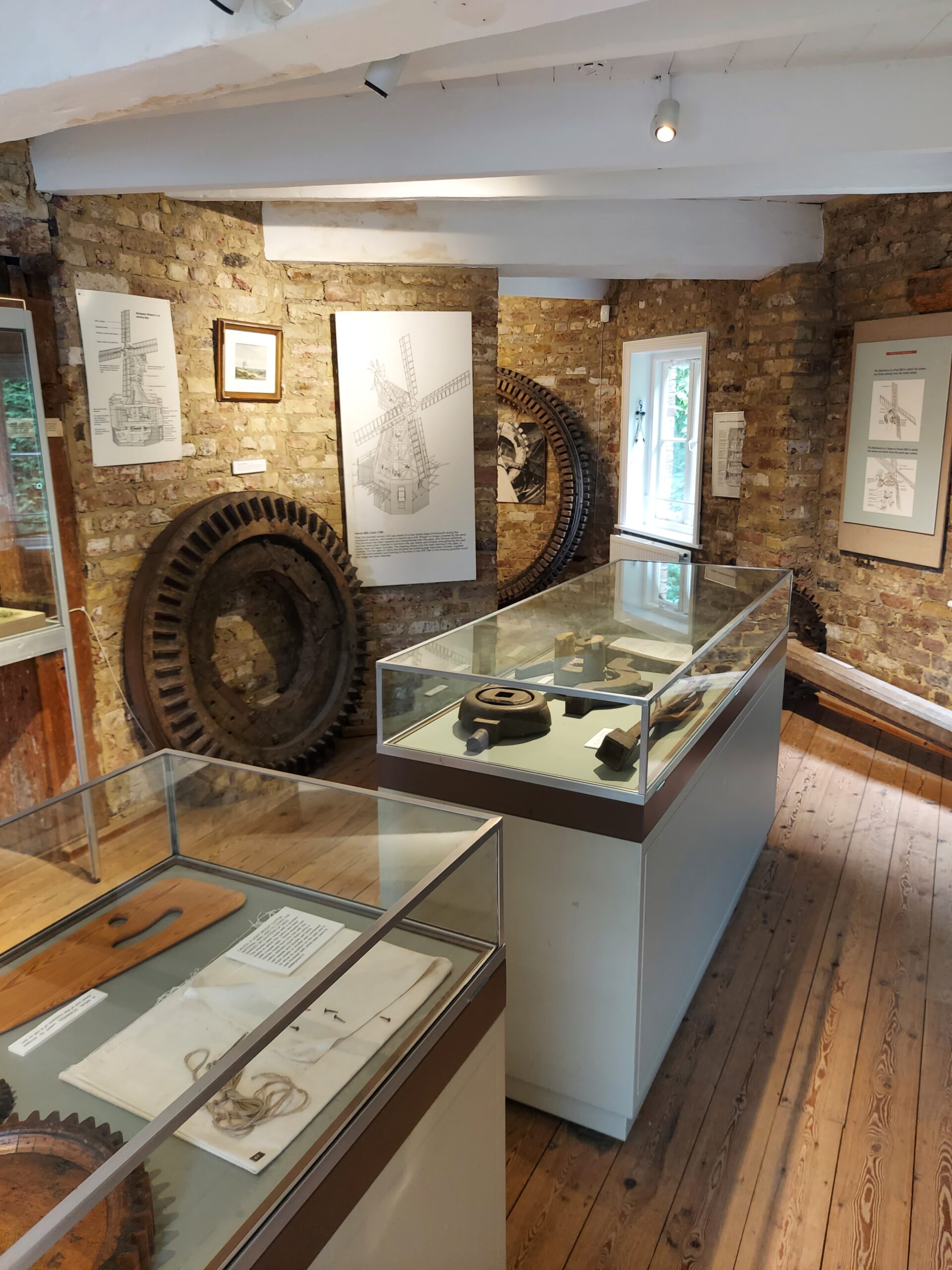
Inside the windmill

The mill was built as a hollow-post mill, a type common in Holland but unusual in Britain. One did exist in Southwark, so March may have copied this design. One storey was of brick with a second storey constructed of wood. Above, a conical tower held the post supporting the cap on which the sails were mounted. The post was hollow in order to allow an iron shaft to be taken down inside it to turn the millstones on the floor below.

In 1864, the Lord of the Manor, the 5th Earl Spencer, announced that he intended to enclose Wimbledon Common and build a new manor house on the site of the mill. Locals strongly opposed the plan, and a six-year legal battle ensued, resulting in the Wimbledon and Putney Commons Act of 1871 which handed over the commons – plus the burden of maintenance and an annuity to be paid to the Spencer family – to the local community. The Marsh family, who operated the mill, were persuaded to sell, but removed the stones and most of the machinery so that the mill could not be run in competition with their other mills, located in Kingston.
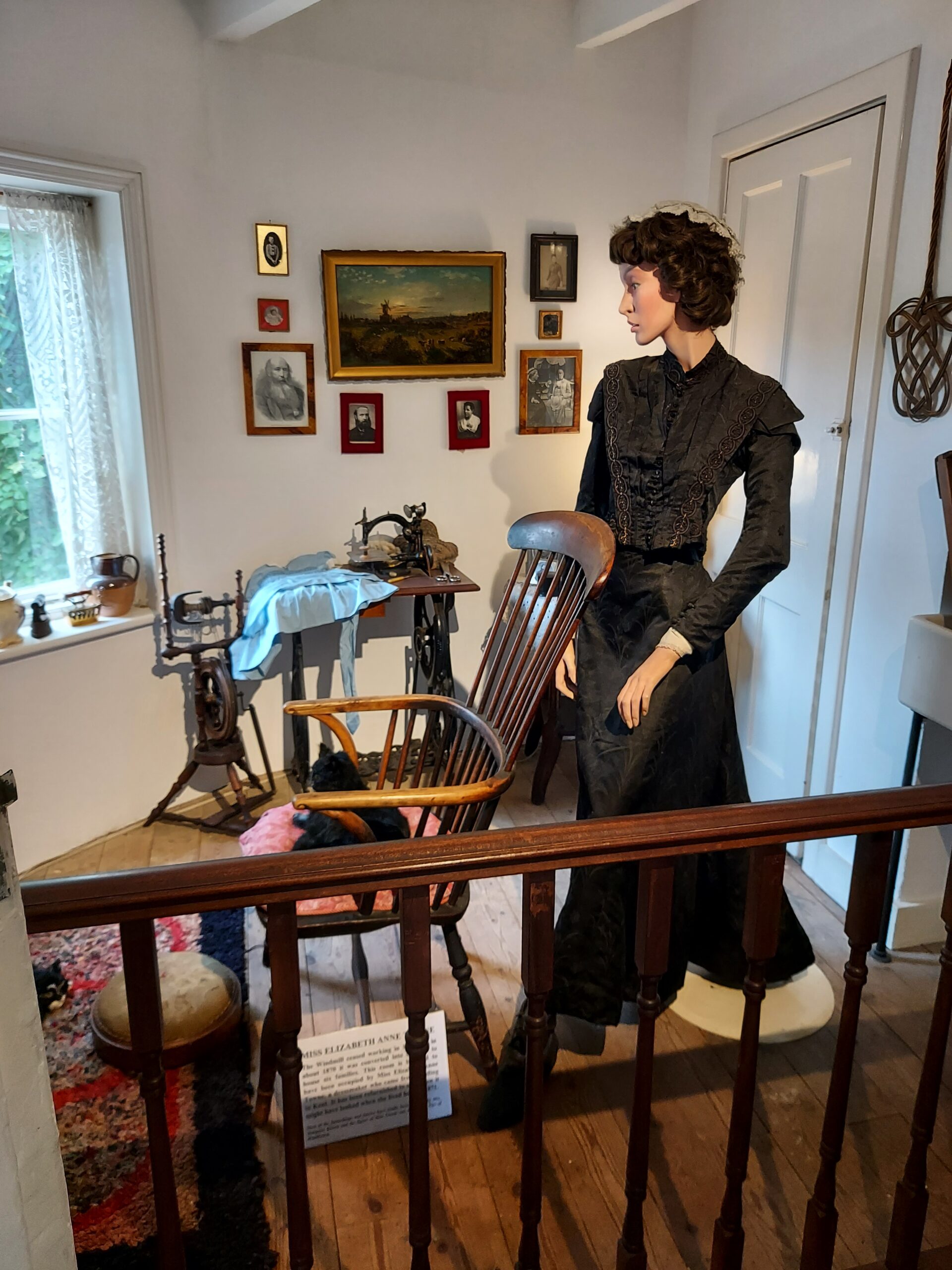
Reconstruction of a Victorian living room

​The mill was subsequently converted into accommodation for six families. The wooden first floor was rebuilt in brick, and fireplaces and chimneys were added. A major restoration took place in 1893, and the mill continued to be used as accommodation – eventually for the Commons Rangers – until the 1970s.

The museum first opened in 1976, and extended to cover both floors in 1999 thanks to a Heritage Lottery Grant. The exhibits cover windmills and milling as well as local history and the Scouting movement (Robert Baden-Powell lived, and wrote the Scouting handbook, nearby).
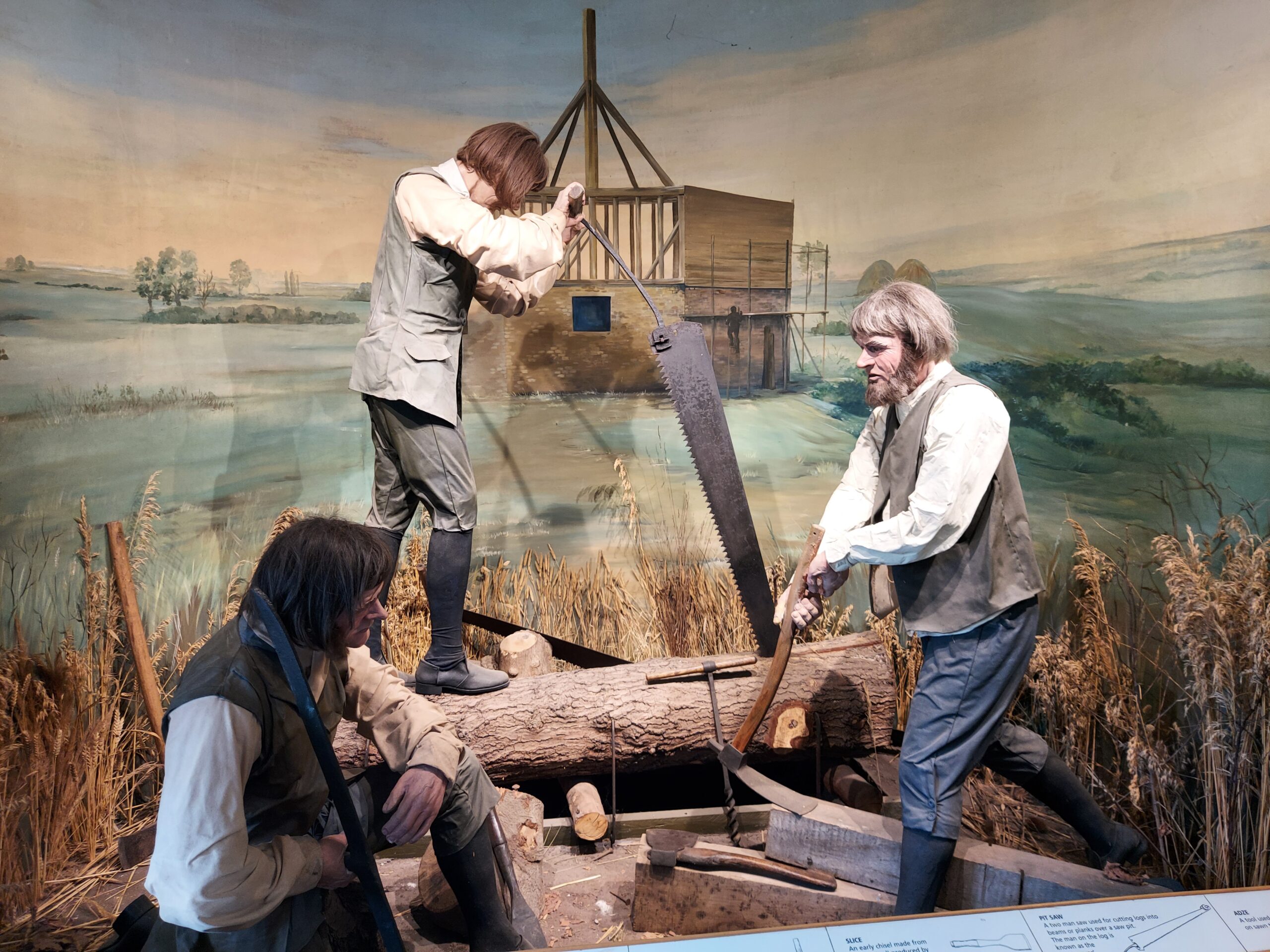
Reenactment of farm labourers working with tools

The Museum

The museum is small, but there is a lot to see. On entering, there is a scene showing the construction of the windmill using timbers hand-sawn from local trees. On the ground floor there is also an impressive collection of tools from a Norfolk millwright. A film about the development of mills in England can be seen, and there is a reproduction of the Great Spur Wheel. Finally, numerous models of windmills are on display, detailed reproductions of existing windmills that show how design has changed over time.

Miniature windmill models

Upstairs, examples of grains are provided as well as explanations of how these were turned into flour by hand in the days before mills. There are several examples of mill machinery, and one room is laid out as it would have been in the nineteenth century, when the mill was used as accommodation.

The windmill is a quaint, interesting attraction in Wimbledon that is well worth a visit. I’m glad I finally got to go.

FACTS

Address: Windmill Road, Wimbledon Common, London, SW19 5NR

Website: wimbledonwindmill.org.uk

Opening Hours: Weekends and Bank Holidays from March to October – see website for times

Price: Free

Wimbledon Lawn Tennis Museum and Tour

I’m not really a tennis fan at all, but I thought it would be really interesting to visit Wimbledon, as it has such a long history. I went there on Sunday to look round the museum and partake in a tour, and ended up being infected by some of the enthusiasm clearly felt by tennis fans.

Wimbledon Lawn Tennis Club is located in south west London, and can be reached by bus 493 which goes through Tooting and encompasses both Southfields and Wimbledon stations. I actually got off at Wimbledon Park station and walked through the park, which was a lovely experience on what turned out to be a rather pleasant day. To get to the museum you enter the site at Gate 4, and the entrance is nearby.

Wimbledon Lawn Tennis Museum
Entrance to the Museum and Shop

Entrance to the Museum and a tour of the site costs £22. This sounds expensive but I actually found it to be well worth it. I looked around the Museum first, which took about an hour. The Museum was renovated in 2006 and tells the story of lawn tennis and Wimbledon from the early days of the game and the first Championship in 1877 to more recent 21st-century developments. I found it to be interesting, well laid-out and informative, with fascinating items displayed including early tennis rackets, tennis-related memorabilia and outfits through the decades. I was appalled by the female outfits from the Victorian era, which included full corsets and long skirts. Frankly I’m amazed women were able to play the game at all in those clothes. There is also a hologram of player John McEnroe projected into a model of a dressing room, as well as videos and other interactive exhibits. Finally, the famous Wimbledon trophies are displayed in all their glory. These remain permanently on-site and winners get small copies to keep.

After looking around the Museum, it was time for the tour. This took an hour and a half and was a really good experience. Our guide was a Blue Badge guide and very knowledgeable. I was amazed at all the different nationalities of those on the tour – there were people from the USA, Australia, the Netherlands, India, Mexico and Thailand. It just goes to show how famous Wimbledon is the world over. We met at the statue of F. J. Perry, Britain’s last ever Gentlemen’s Singles Wimbledon Champion. His ashes are contained alongside.

Statue of F.J. Perry

On the tour we were shown a number of the courts, and introduced to the famous Wimbledon grass which we were ordered not to touch on pain of death (not quite!). One of the courts was the location of the nail-biting 2010 match between John Isner (USA) and Nicolas Mahut (France), which at over eleven hours turned out to be the longest ever Championship match. Our guide had been there at the match, and her recollections made me – who has never watched more than five minutes of tennis in my life – wish I had been there too.

Plaque recording the longest match in 2010

Near the beginning of the tour, we were shown the large board showing the results of all the Singles matches from Wimbledon 2012. Our guide explained that even the best players can be beaten by up-and-coming stars, and this is part of what makes tennis such an exciting game.

Boards showing the 2012 Wimbledon results

After a look around No. 1 Court (not to be confused with Centre Court), we were shown and given the chance to climb up Aorangi Park, so called because it was constructed on land previously leased to the New Zealand Sports and Social Club. It is a popular place for visitors to sit during the Championships because a giant screen is placed above the stairs by No. 1 Court showing all the matches that take place in that court. The area has been known informally as ‘Henman Hill’ and ‘Murray Mound’ as it has been commonly used by fans of these two British players.

Aorangi Park
Aorangi Park

Wimbledon logo and colours
Wimbledon logo

View of No. 1 Court
View of No. 1 Court, showing where the large television screen is placed during the Championships

Later we were shown the players’ reception, where they are required to sign in each day during Wimbledon. We also visited the press room, where players are required to give interviews to the media if requested to do so. We were offered, and a lot of my fellow tourists took the opportunity, the chance to sit in the seats ourselves and get our photos taken! I chickened out, partly because I would have been on my own, and it would have been a bit weird.

The players' reception
The players’ reception

The Press Room
The Press Room

Our guide took us past an old-fashioned roller, originally pulled by horses to ensure the grass was smooth enough for tennis. She explained that the roller played an important part in the history of Wimbledon – if it wasn’t for it breaking, the club officials would never have come up with the idea of holding a tennis tournament to raise money for another. After the success of the first tournament, a second was held the following year, and the year after that… the rest, as they say, is history.

The Pony Roller
The Pony Roller

Finally we headed to Centre Court. On the way, we passed the boards on which are engraved the names of all the Wimbledon Champions dating back to 1877.

Championship Winners' Boards
Championship Winners’ Boards

Centre Court itself looks rather similar to No. 1 Court, but there are several important differences: it is the only court to have a Royal Box, and is currently the only court to have a roof (though one is planned for No. 1 Court in the next few years). If it should start to rain, the roof can be activated; normally folded like a concertina at either end of the court, it folds out and is ready for play within 40 minutes, which is very good news given the unpredictability of British weather.

Centre Court
Centre Court

There the tour ended, leaving me, as I mentioned earlier, with a new-found appreciation of the game of tennis. Unfortunately, the ballot for tickets for the 2013 Championships closed at the end of last year, and I don’t think I am quite dedicated enough to get up early at a ridiculous hour and queue for day tickets. However, I intend to register for the 2014 ballot when it opens in August, and see what happens.

FACTS

Address: The All England Lawn Tennis Club, Church Road, Wimbledon, London, SW19 5AE

Website: wimbledon.com/en_GB/museum_and_tours

Opening Hours: Museum open 10am-5.30pm (5pm in winter); tour times vary

Prices: Museum only – Adult £13, Concession £11, Child £15; Museum and tour – Adult £24, Concession £21, Child £8