Chepik Retrospective – Mall Galleries

Sergei Chepik (1953-2011) is regarded as one of Russia’s greatest painters, which made me want to see a retrospective exhibition of his work at the Mall Galleries in central London. I was not disappointed.

When I was in St Petersburg a few years ago, I visited both the Hermitage and the Russian Museum. I found I preferred the distinctive, intense works by native painters in the Russian Museum to the European masterpieces on show in the Hermitage. I am not, and never have been, someone who is knowledgeable about art, but I just found the Russian art more… interesting.

Chepik’s work could easily belong in the Russian Museum. It is visionary, beautiful and distinctive. The artist painted religious scenes, images from his native Russia, and pictures inspired by his later home of Paris. His religious images are bleak, almost fantastical, unsettling, and moving even to an atheist (which he was himself). Many of them were based on or evoke events from Soviet Russia.

Chepik also drew on folk tales for some of his works: a painting I particularly loved showed the puppet-figure Petrushka (the Russian representation of autumn) surrounded by Russian folk figures. Other images covered sinister clowns and other circus characters, book illustrations (including for Bulgakov’s The White Guard) and portraits.

This exhibition was free and I’m so glad I went – it seems Russians still make the most awesome art!

‘The Ship of Happiness’, Sergei Chepik

Republic of the Moon – Bargehouse

Bargehouse
Entrance to the Republic of the Moon

In the Bargehouse near the Oxo Tower, The Arts Catalyst embarked on a rather odd project called the Republic of the Moon. It incorporated lunar-based works from a number of artists and was designed to explore our relationship with the Moon.

This was an odd experience to say the least, particularly the dark and silent room created by Liliane Lijn who plans to project the word SHE onto the surface of the Moon. Moon Vehicle was an interesting project based in India, where students designed their own lunar vehicles.

I really liked Leonid Tishkov’s Private Moon, which was a series of beautiful images showing him and his own small Moon in various settings. My favourite work, though, was Katie Paterson‘s Earth-Moon-Earth. Paterson sent messages in Morse Code which were reflected from the surface of the Moon and then received again on Earth. Some parts of the messages were lost, absorbed by shadows or vanished into craters. One of the messages she sent was the score of Beethoven’s Moonlight Sonata – the resulting score plays on a self-playing grand piano. Listening to the result is eerie: it is recognisable as the famous sonata, but with unsettling differences.

The top prize for weirdness has to go to Agnes Meyer-Brandis and her documentary Moon Geese Analogue: Luna Bird Migration Facility. Inspired by bishop Francis Godwin’s 1638 book Man in the Moone, in which the protagonist flies to the Moon in a chariot towed by migrating ‘Moon geese’, Meyer-Brandis has raised eleven geese from birth, given them astronauts’ names (one is called Neil!) and embarked upon a training programme designed to prepare them for travel to the Moon. This was one of the strangest things I have ever seen, and the documentary was oddly compelling.

Jake and Dinos Chapman: Come and See – Serpentine Sackler Gallery

I visited a very intriguing exhibition at the Serpentine Sackler Gallery at the weekend. Jake and Dinos Chapman are artists who work in a variety of mediums, creating models, sculptures and images that comment on consumer culture, morality and past art. Their exhibition Come and See incorporates many of these, and is absolutely fascinating.

I loved the miniature scenes of carnage and war, incorporating dinosaurs, skeletons, Hitler and Ronald McDonald. The detail of these models was incredible.

Hitler with balloons
Crucified Ronald McDonald
Creepy figures and a spaceship
Skeletons and burnt-out cars
McDonalds characters on a boat

The exhibition also had some rather frightening sculptures, like this one of a familiar figure.

Ronald McDonald
Terrifying!

The Chapmans also create paintings and other images. Some of them, painted over pages from books, reminded me of Guillermo del Toro’s films.

Painting over a page of a book

Others were inspired by the craze for portraiture among the upper classes of several hundred years ago, and comment on the futile quest for immortality these people sought.

Two children in formal clothing
Some of the other items in the exhibition included cute little figures and even dinosaurs, like these ones below.

Model of a lady in a wheelchair Models of people and dinosaurs

Sadly the exhibition has now finished, but I will certainly be looking out for more of the Chapmans’ work in the future.

The Serpentine Sackler Gallery opened in 2013. It is located in a former 1805 gunpowder store, divided from the original Serpentine Gallery by the Serpentine Bridge, with an extension by Zaha Hadid. Both galleries showcase temporary exhibitions of contemporary art.

FACTS

Address: West Carriage Drive, London, W2 2AR

Website: serpentinegalleries.org

Opening Hours: 10am-6pm Tues-Sun, plus bank holidays

Prices: Free

Pop Art Design – Barbican Art Gallery

I headed to the Barbican Art Gallery for the first time last week. I visited in order to check out the exhibition on Pop Art Design, which sounded interesting.

Pop Art flourished mainly in the mid-20th century, and grew up as a reaction to the austerity of the wartime era and the dawn of the media age. Artists like Roy Lichtenstein, Andy Warhol and others created iconic works inspired by advertising slogans and incorporating bright and bold colours and designs. I don’t know if Pop Art is really ‘me’, but I found the exhibition interesting nevertheless.

Paul Klee: Making Visible – Tate Modern

The EY exhibition at the Tate Modern is Paul Klee: Making Visible, until the 9th of March. I didn’t know a great deal about the artist, so took a chance and headed down to Bankside to check the exhibition out.

Klee is an important figure of 20th century art. His breakthrough came during the First World War, following which he taught at the Bauhaus before moving to Düsseldorf and subsequently being dismissed from his teaching position by the Nazis, who labelled his works ‘degenerate’. Though I’m not a particular fan of twentieth-century art, anything labelled negatively by the Nazis gains merit in my eyes!

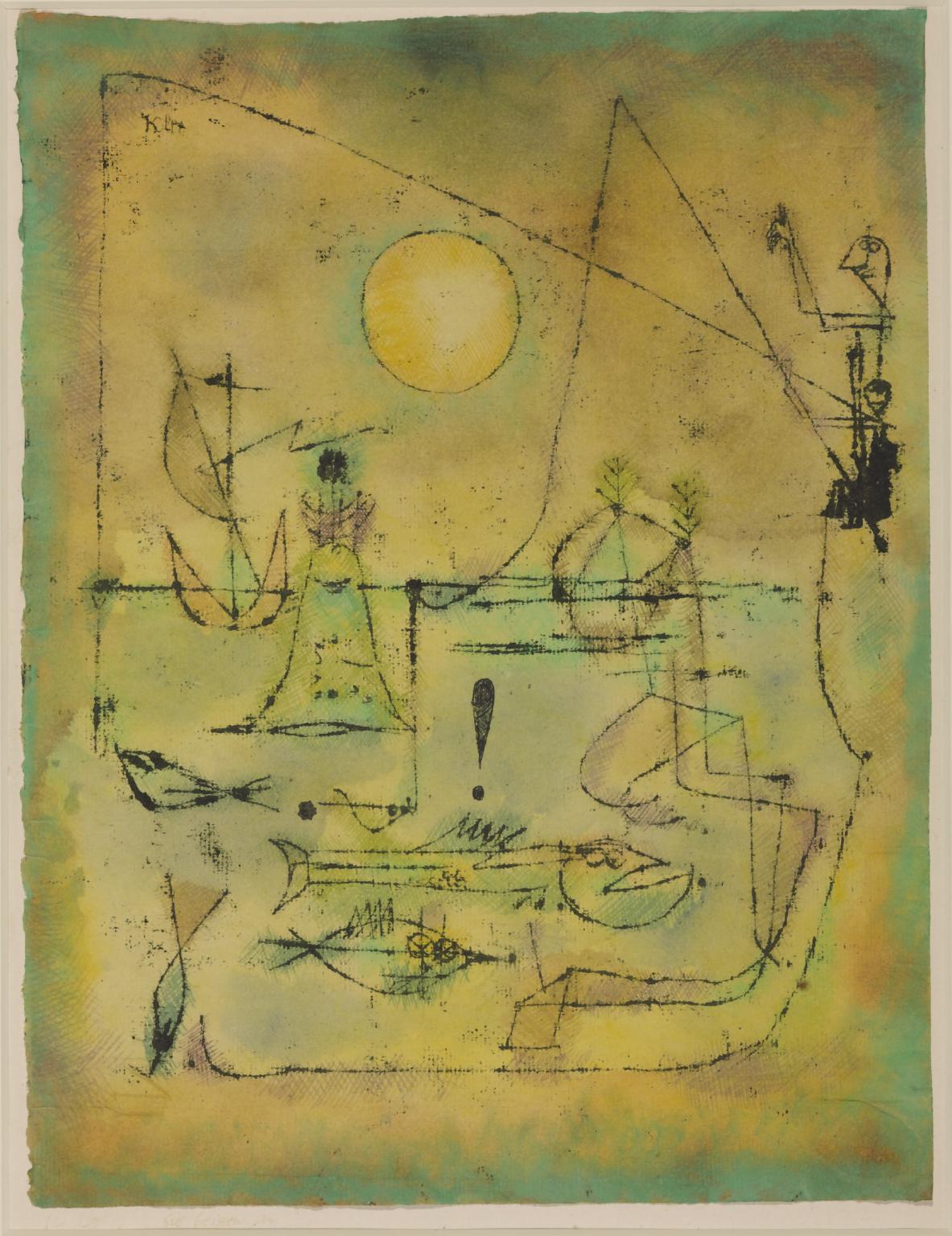
Paul Klee, They
Paul Klee, They’re Biting, 1920 (Tate Modern)

Most of Klee’s works are very small; this came as a surprise to me as for some reason I always imagine modern works of art to be huge. I saw a lot of them as ‘cute’ – this might sound like an odd thing to say about art, but many of the works were warm, attractive, with a sense of humour – something drew me into them and made me interested. I particularly liked the fish pictures, and the related ‘They’re Biting’. I loved the way his later works seemed to comment on Nazism and contemporary culture, and his late works – such as ‘Walpurgis Night’ and images of witches – had a distinctly darker tone. Despite my initial misgivings, I really enjoyed the exhibition and admired the variety in Klee’s work.

Stanley Spencer, Julian Stair and Albrecht Dürer at Somerset House

Somerset House, the magnificent 18th century building on the banks of the Thames, is home to a variety of art exhibitions and other interesting facilities. I paid a visit to check out some of the exhibitions they had going on.

I began in the Terrace Rooms in the South Wing, with Stanley Spencer: Heaven in a Hell of War. Spencer experienced the First World War and painted from his experience, both as a hospital orderly in Bristol and as a soldier on the Salonika front. This exhibition displays canvas panels on loan from the National Trust’s Sandham Memorial Chapel, as well as a projection of the altarpiece which was too fragile to remove. The Chapel was designed specifically for the panels, and was built by Spencer’s friends, John Louis and Mary Behrend. Here, they have been arranged in a way that echoes their original layout, and gives a good impression of how they look within the Chapel.

The paintings took six years to complete, and were finally finished in 1932. Unusually for images of war, they represent the domestic side of wartime life – scrubbing floors, washing clothes, making tea and inspecting kit. Spencer wanted to show how these ordinary chores became miraculous in the face of wartime danger – creating “a heaven in a hell of war”. It’s an intriguing idea, and I like it – seeking something positive in the face of such horror is a kind of defiance.

Next I ventured into the intriguingly-named Lightwells & Deadhouse, reached via the South Wing and taking me below the Somerset House courtyard, to explore Julian Stair: Quietus – The Vessel, Death and the Human Body. This unusual exhibition was made up of ceramic works in the form of coffins, jars and funerary urns. The strangest exhibit was a white urn containing the ashes of Stair’s uncle, shown alongside video and audio snippets from his life.

Finally, I went to the Courtauld Gallery to see the exhibition The Young Dürer: Drawing the Figure. This was an interesting take on the artist’s journeyman years, when he honed and developed his style.

Langdon Down Centre

The Langdon Down Centre
Entrance to the Langdon Down Centre

I visited the Normansfield Theatre in the Langdon Down Centre a couple of weeks ago to attend a performance. I reviewed the production here, but I wanted to post something on the theatre and the building itself, as it has a history much more interesting than most.

The centre was founded as a private home and hospital/care facility by Dr. John Langdon Down, who specialised in the care of people with learning disabilities. Many had the condition which now bears the Doctor’s name – Down’s syndrome. Langdon Down’s approach was radical for the time, with his emphasis on education and sympathetic care.

The theatre itself is utterly stunning. It’s rare to find such a beautiful surviving example of a private Victorian theatre; completed in 1879, it was built as an entertainment venue by Langdon Down as somewhere for his patients and students to explore drama and music. The performance I attended was a music hall-style revue telling the story of Langdon Down and one of his patients, James Henry Pullen, whose incredible creative ability is still evident in the ‘Giant of Earlswood’ which is still on display in the Centre, and the stunningly detailed ships he constructed from wood, on display in the museum.

Normansfield Theatre - proscenium arch
Normansfield Theatre – proscenium arch
Normansfield Theatre - side wall
Normansfield Theatre – side wall
Normansfield Theatre - ceiling
Normansfield Theatre – ceiling
Normansfield Theatre - back of the theatre
Normansfield Theatre – back of the theatre
The Giant of Earlswood

An American in London: Whistler and the Thames – Dulwich Picture Gallery

The other week, I headed down to Dulwich Picture Gallery to check out the exhibition An American in London: Whistler and the Thames. The exhibition, which runs until the 12th of January, looks at Whistler’s early paintings of London and the Thames, alongside other photographs and artworks of the river at this period. I loved looking at the river and how it looked in the mid-nineteenth century. I also loved Whistler’s pictures, particularly the Nocturnes.

Georgians Revealed: Life, Style, and the Making of Modern Britain – British Library

Last week I took advantage of the British Library‘s late-night Tuesday opening to visit their latest exhibition, Georgians Revealed: Life, Style, and the Making of Modern Britain. I am interested in the Georgian era – it’s the age of Byron after all – and I thought the exhibition was fascinating.

The exhibition has been designed to coincide with the 300th anniversary of the accession of King George I in 1714. It examines the Georgian age in all its chaos, innovation, prosperity and poverty. The first section looks at life in Georgian Britain, showing how the legacy of the Georgians is all around us in the architecture, culture and literature of our time. The remainder of the exhibition is divided into sections, looking at the architecture and urban culture of the period, the role of shopping and consumerism, and leisure pastimes including theatre and sport. It is a superbly informative and fascinating exhibition, and I strongly recommend paying it a visit. The exhibition runs until 11 March next year.

The Chocolate Museum, Brixton

I had a bit of time to spare last Saturday so I popped to Brixton to check out the Chocolate Museum. It’s a relatively new establishment, with a café, an exhibition on the history of chocolate (complete with artefacts) and yummy artesan chocolate to buy. Well worth a visit if you’re a chocolate fan. They also put on events for both children and adults, including chocolate tasting and cooking with chocolate – yum!