Strange Beauty: Masters of the German Renaissance – National Gallery

After a busy weekend with my friend, I saw her off at the station and then headed to the National Gallery. One of their current exhibitions, on display in the Sainsbury Wing, looks at German Renaissance paintings.

Strange Beauty: Masters of the German Renaissance explores how artists such as Hans Holbein the Younger, Albrecht Dürer and Lucas Cranach the Elder were viewed and portrayed in their time. For many decades the Italian Renaissance was held to be superior, and many German works were viewed as excessive or ugly. On a more positive note, they were often admired for their technical mastery, and their representation of a German national identity.

The exhibition has been criticised for not borrowing works of art from Germany, and instead focusing on works from the Gallery’s own collection. Reviewers have also described it as lacking excitement or anything new to say. These are all valid arguments, but as someone who is a complete amateur when it comes to art, I enjoyed this focus on the German Renaissance and it helped me to view these familiar works of art in a new way.

‘This bewitching poison’: Alcohol and the Royal College of Physicians

There’s an interesting exhibition at the Royal College of Physicians at the moment. ‘This bewitching poison’: Alcohol and the Royal College of Physicians is on display at the RCP headquarters near Regent’s Park, and is open until 27 June. I booked for a lecture evening to coincide with the exhibition, and headed there after work last night.

The RCP is the oldest medical college in England, founded by royal charter of Henry VIII in 1518. The current building was designed by Sir Denys Lasdun and opened in 1964. The on-site museum contains many interesting items, including 300 oil and sculptural portraits, the Symons collection of medical instruments in the Treasures Room, the RCP silver collection and the Victor Hoffbrand collection of apothecary jars. The College was given the personal library of William Harvey (1578-1657), who discovered the circulation of the blood, although most of his tomes were lost during the Great Fire of London. The College is also in possession of six rare anatomical tables from Padua, dating from the 1650s, as well as archives containing near-complete records of RCP over the last 500 years. The lectures were held in the Dorchester Library, which contains many volumes of note including some which suffered shrapnel damage during World War II, pointed out to me as I walked in. The College has a long history of reporting and advising on public health, including the recent alcohol minimum pricing debate, making the current exhibition highly relevant.

‘This bewitching poison’: Alcohol and the Royal College of Physicians

When I arrived at the College, I registered, collected my glass of wine and proceeded to investigate the exhibition. It was very interesting, looking at “300 years of drinking history through the work of artists, doctors and satirists”. Alcohol has long been a part of life for people in Britain, and has been seen in both positive and negative lights.

Historically, Britain was a beer-drinking nation, but the arrival of the Romans introduced wine. One result was that wine drinking was associated with high social class, which it still is to a certain extent. Most native Britons drank ale, which from around 1400 often had hops added to produce the stronger drink of beer. For many years, beer was seen as healthy, being drunk on a daily basis as an alternative to water which was not safe to drink for much of Britain’s history. Physicians such as George Cheyne advocated wine in moderation as a tonic – even now, it is uncertain whether a small glass of red wine might prevent against heart disease – and alcohol was often used as a medicine: for instance, the juniper in gin was thought to help prevent the plague.

On a more negative note, the health problems caused or exacerbated by alcohol have been recognised since ancient times. Cirrhosis of the liver was recognised by the Ancient Greeks, while gin was blamed for drunkenness, vice and poverty in the eighteenth century. Temperance campaigners during the nineteenth century encouraged people to sign the pledge and become teetotal. As we move forwards, many campaigners argue that the government needs to take some responsibility for alcohol advertising by the drinks industry, and do more to help combat the negative effects of alcohol.

‘This bewitching poison’: from gin palace to temperance hall

There were two lectures; the first, Dutch courage & mothers’ ruin: The London gin craze, was delivered by Dr Richard Barnett, lecturer at the Universities of Cambridge and London, and Wellcome Trust Engagement Fellow. He has written several books on the subject including The Dedalus Book of Gin, which I have on my bookshelf (as yet unread)!

18th-century London was awash with cheap, fiery gin. William Hogarth railed against it, politicians legislated against it, and doctors blamed it for destroying the health of the nation. Dr Richard Barnett explores the cultural and political realities behind this notorious epidemic of alcohol-fuelled social breakdown.
From the RCP website

I learned a lot in this lecture, including how the increase in gin consumption (which peaked in 1743) frightened those in authority and highlighted the problems with excessive consumption of spirits. In fact Jessica Warner has suggested that there were actually two gin crazes – one of the ‘public’, and one of the ‘pulpit’, decrying the sin of drunkenness. The phenomenon was largely confined to London, particularly the poorer parts such as Soho and Covent Garden. Gin was seen as socially subversive, and inspired Hogarth’s 1751 picture Gin Lane, a vivid and unforgettable picture of degradation and moral degeneration resulting from the consumption of gin. The authorities took action – the first Gin Act in 1729 doubled duty on spirits. It has been suggested that drunkenness “became less Falstaffian, and more Hogarthian” – less convivial and jovial, and more immoral and sinful.

One interesting aspect of the gin craze, I thought, was the case of the man in 1720 who was accused of killing his mother: there was a suggestion that gin contributed although this was probably not true. This link between alcohol and crime made me think of the absinthe craze in 1900s Paris; from what I recall, it inspired similar worries about drunkenness and morality, and I believe there was a similar case where someone was accused of murder, supposedly under the influence of alcohol.

The second lecture, An imperious impulse: medicine, morality and drink in Victorian Britain, was delivered by Dr James Nicholls, research manager at Alcohol Research UK and honorary senior lecturer at the London School of Hygiene and Tropical Medicine.

In the late 19th Century, alcohol was a fiercely contested political issue. While debates centred on crime and the threat to social progress, medical concerns became increasingly important. From defining inebriety to questions over the effect of alcohol on the unborn child, medicine became embroiled in a range of thorny questions with very real political implications. James Nicholls looks at these problems and asks how far they have been resolved today.
From the RCP website

This lecture explored the history of organised campaigns against alcohol, led in the nineteenth century by the temperance movement (c. 1829) and social reformers in general, who argued that it was the duty of the state to intervene. By the period 1880-1910 alcohol had become a big political issue, and behind it was the important question, is alcohol a beneficial substance with the potential to cause harm, or a harmful substance with some benefits?

The concept of addiction has also developed over the years, with the archaic To addict yourself to giving way to the 20th century To become addicted, which has in turn morphed into To become an addict. This illustrates the medicalisation of addiction and the shift in thinking about alcoholism: from being seen as a sin, it has become recognised as a disease.

I really enjoyed these lectures: they gave me a lot to think about, and the accompanying exhibition was really fascinating. The exhibition is free – do check it out if you get a chance.

The Photographers’ Gallery

2014_0316PhotographersGallery
The Photographers’ Gallery

The Photographers’ Gallery is not somewhere I’d ever thought of visiting, but I had some spare time one Sunday afternoon so decided to pay it a visit. The Gallery is centrally located, just off Oxford Street, and entry is only £2.50 for National Art Pass holders (£4 full price). It has a camera obscura, a studio floor, a shop and café, and has a rotating programme of exhibitions. When I visited, the Gallery was host to exhibitions by Andy Warhol, David Lynch and William S. Burroughs.

David Lynch: The Factory Photographs

I started at the top of the building, so David Lynch’s photographs were the first I saw. These were definitely my favourites: I loved the cinematic, almost noir-like quality of the images. Of course Lynch is a well-known filmmaker: although I have to admit I have never seen any of his films, there was a clear cinematic influence on these images. They were largely pictures of factories and abandoned industrial sites, and had a brooding and bleak atmosphere, almost Romantic in the impression they gave of decay and a bygone era.

Taking Shots: William S. Burroughs

Burroughs was an influential 20th century American writer, but much less well known as a photographer. This year marks the centenary of his birth, and the Gallery is therefore hosting an exhibition of his work. They were interesting images, varied and vivid, which told stories of Burroughs’ journeys.

Andy Warhol: Photographs 1976-1987

Warhol is famous as an artist, but his photographs are less well known. I recognised his distinctive artistic style in many of the images, which incorporated brands and celebrities. I particularly liked the ‘stitched’ photographs, combining the easily reproduced photograph and the unique nature of the stitching.

What all three photographers had in common was that photography was not their primary field. I thought that this made their photographs more interesting in many ways, as their other interests influenced their photographic work.

These exhibitions have now finished, but the Gallery has an interesting programme of events coming up, so do check it out.

FACTS

Address: 16-18 Ramillies Street, Soho, London, W1F 7LW

Website: thephotographersgallery.org.uk

Opening Hours: 10am-6pm Mon-Sat, 11am-6pm Sun, late opening Thursdays during exhibitions

Prices: Vary depending on exhibition(s)

Portals to the Past: A Crossrail Exhibition

The Crossrail Visitor Centre at Tottenham Court Road is soon to close, but before it does there’s a chance to see some of the archaeological finds uncovered during the ongoing construction works. Portals to the Past: A Crossrail Exhibition showcases assorted finds including Roman skulls and a cremation pot (which contained remains when it was discovered), flint, and bones from a plague burial pit. There is also an iron chain recovered from a dock, and a horse skull from a market.

It was fascinating to see these artefacts, although I find it a huge shame that historic buildings such as the Astoria have been demolished to make way for Crossrail. I was fascinated, though, by the process of construction and references to previous Crossrail finds such as skeletons from the old Bedlam burial ground near Liverpool Street.

The Crossrail website has more information about archaeological discoveries uncovered during the works and a number of lectures have been put up on the topic – they look fascinating.

The Great War in Portraits – National Portrait Gallery

2014 marks the centenary of the start of the First World War, and many museums and galleries are marking the occasion with events and exhibitions. The National Portrait Gallery has kicked things off with a display called The Great War in Portraits. I decided to visit one weekday afternoon, when I had some time off work: I thought, as the exhibition was free, it would be best to go during an off-peak time. I think I made the right decision: the exhibition was pretty crowded as it was, and there was a sign up warning of further crowding at peak times.

The exhibition shows widely different images of the people involved in the war, evoking their varied experiences and roles. It makes use of different mediums, including paintings, film, drawings and photographs. There is even a sculpture: the Prologue displays Jacob Epstein’s ‘The Rock Drill‘, a robotic-looking figure representing humanity’s fascination with mechanisation. This was originally created in 1913, the year before modern warfare would cause such devastation. However, the version shown here is the 1916 version, which Epstein created in response to the war. Gone is the celebration of automation, machines and the power of technology. Instead, the sculpture has had the drill removed and three limbs severed, reflecting the horror and destruction of war.

The exhibition is divided into a number of sections. Royalty and the Assassin contrasts formal, old-fashioned portraits of heads of state before the war with an image of Gavrilo Princip, the teenage assassin of Archduke Franz Ferdinand. Paintings of British, German, Russian and Austrian-Hungarian leaders evoke imperial grandeur and arrogance, while to a lesser extent photos of the President of the French Republic are designed to represent power. However, the picture of Princip is subdued and understated. Together, these images reflect the world before World War I and the political and social climate in which it began.

After war was declared, military leaders began to take on more power, and Leaders and Followers illustrates the hierarchical order, with traditional, formal images of commanding officers who often wore medals. Ordinary soldiers are also represented in more informal poses, often in groups and in a markedly down-to-earth manner. Both kinds of images were often shared as postcards.

By 1916, it was clear that the war would not be ‘over by Christmas’ and the horrific consequences were becoming apparent to many, even as those in power fought to maintain the illusion of jingoistic patriotism. The pictures in The Valiant and the Damned vary wildly in tone, with images of decorated soldiers, poets like Wilfred Owen, the infamous Mata Hari, killed or injured officers, and soldiers from all corners of the globe. For me, the most moving and striking images were the sketches made by Henry Tonks of facially disfigured servicemen. Reconstructive surgery made great strides during the war, and some wonderful achievements were made, but even so the experiences of these soldiers must have been dreadful: Tonks’ images help to give them back dignity and a sense of identity.

And then, something completely different – Fact and Fiction: The Battle of the Somme in film contrasts films by the British and German propaganda bureaus concerning the Battle of the Somme. These films were designed to evoke the ‘thrill of battle’, showing soldiers working and living together, and actually displaying images of dead and wounded soldiers. The first day of the Battle of the Somme, 1 July 1916, resulted in horrific losses including 19,240 British soldiers. Nevertheless, the film made by Geoffrey Malins and John McDowell, The Battle of the Somme, was a huge popular success, reaching an estimated 20 million people. It was truthful up to a point, but did not convey the full horrors of the battle. The German film, on the other hand, released in January 1917, enjoyed less success, partly because it used inaccurate footage and enacted scenes.

After the war, Britain and Germany largely headed in contrasting directions as far as art was concerned. In Britain, the trauma of the carnage led to a return to the comforting and familiar past, while in Germany there was a reaction against the old order and Expressionism gained ground. Tradition and the Avant-garde shows pictures from both of these widely different concepts, and how different artists reacted to the war.

This is a small but very well-presented exhibition that thoughtfully compares and contrasts different responses to the war in terms of portraits. It’s certainly worth a visit, particularly as entry is free. The exhibition runs until 15 June 2014.

Shoreditch Church

2014_0302ShoreditchChurch00
St Leonard’s Church

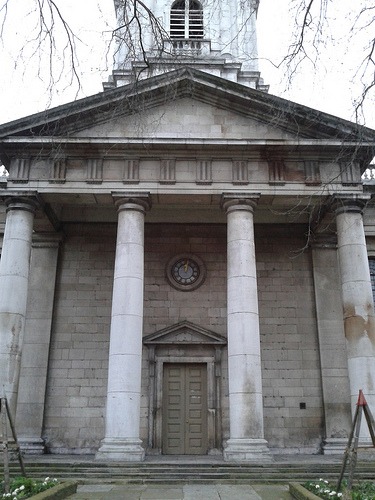
A couple of weeks ago I attended a rather unusual theatre performance called Sun. I have reviewed the theatrical experience, but I wanted to write something about the location, as it was rather an unusual one.

2014_0302ShoreditchChurch04
Sign proclaiming the performance of Sun

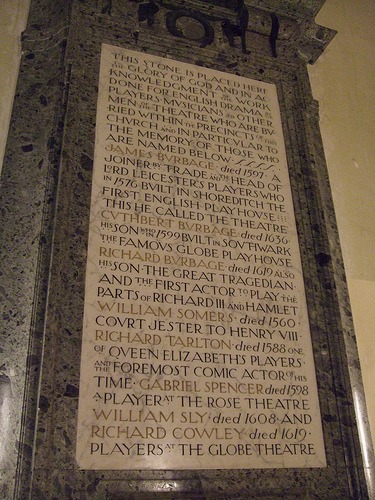
St Leonard’s Church, Shoreditch, has a long and distinguished history. There has been a church on the site for centuries, and it has been known as the actors’ church since the twelfth century, with the first English theatre located close by in New Inn Yard. Several of Shakespeare’s plays had their first performances there, and many of his associates are buried in the medieval church under the crypt: James Burbage, who built the first English theatre; his son Cuthbert, who built the Globe; and his other son Richard, the most famous actor of his time who was the first Macbeth, Hamlet, King Richard III, Othello and Romeo. A stone inside the church records this.

2014_0302ShoreditchChurch01

2014_0302ShoreditchChurch02

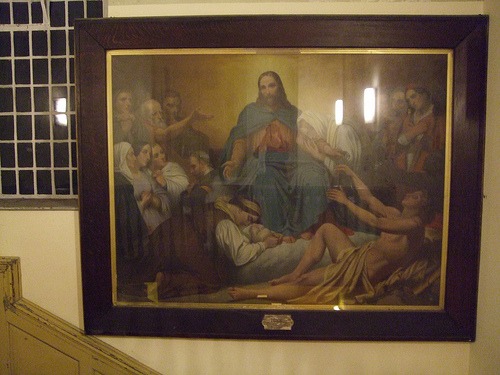
Also notable within the church is art, including this picture.

2014_0302ShoreditchChurch03

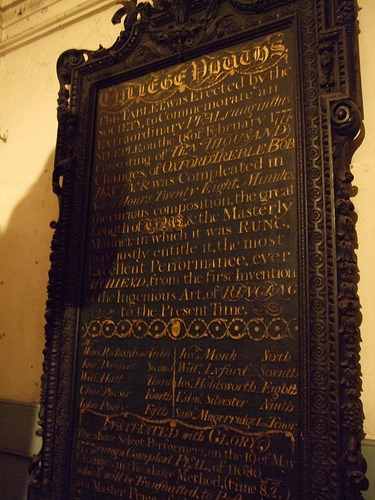
In the entrance, while waiting to go in to the performance, I had a look around and found even more interesting things, including an Alice in Wonderland-esque door and what looked like some stocks.

2014_0302ShoreditchChurch08

2014_0302ShoreditchChurch06

2014_0302ShoreditchChurch05

2014_0302ShoreditchChurch07
Looking out into Shoreditch from the church’s doorway

Court and Craft: A Masterpiece from Northern Iraq – Courtauld Gallery

The Courtauld Gallery is home to a particularly fascinating exhibition at the moment: Court and Craft: A Masterpiece from Northern Iraq. It is based around one of the most incredible objects in the Gallery’s collection, which is a bag made in Iraq around 1300.

The beautiful and ornate bag has been ranked as “one of the finest pieces of Islamic metalwork in existence”. Decorated in gold and silver, and covered with a complex design of a courtly scene, it is believed to have been made for a lady connected with the Mongol Ilkhanid dynasty.

The bag has been placed in context with an exhibition of manuscripts, artworks and other items exploring the society of that place and time. I particularly loved the beautiful illustrated manuscripts.

A Dialogue with Nature: Romantic Landscapes from Britain and Germany – Courtauld Gallery

After visiting the Isabella Blow exhibition at Somerset House, I headed to the other side of the building and the Courtauld Gallery, where a new exhibition had just opened. A Dialogue with Nature: Romantic Landscapes from Britain and Germany focused on aspects of Romantic landscape drawing in both Britain and Germany, covering the period 1760-1840. This kind of art is a favourite of mine, and I enjoyed looking at the beautiful and majestic landscapes of J.M.W. Turner, Samuel Palmer, Caspar David Friedrich and more.

Isabella Blow: Fashion Galore – Embankment Galleries, Somerset House

I spent Sunday morning checking out a few of the exhibitions at Somerset House. I was just in time to catch Isabella Blow: Fashion Galore, as this was the exhibition’s last day.

Isabella Blow at Somerset House

Isabella Delves Broughton was born into aristocracy in the 1950s. However, despite her seemingly privileged family and upbringing she had in many ways a difficult childhood. Her young brother drowned at the age of two, and the cash-strapped family lived in a cottage on the family estate as they couldn’t afford to live in the house itself. After leaving school, she worked at various jobs before moving to America; she ended up working for magazines including Vogue and Tatler. She married Detmar Blow in 1989, wearing a headdress by Philip Treacy – one of the first to recognise his talent. She also discovered Alexander McQueen, as well as the models Sophie Dahl and Stella Tennant.

Blow loved fashion and had a highly individual and unusual style. This exhibition, after an initial exploration of her early life, showcased some of her unusual outfits and accessories, including several hats by Treacy and clothes by McQueen. I particularly loved the hats and hair accessories – I’m not sure how wearable they would be, but they were so amazing to look at that I didn’t care. I especially loved the castle house, and the ship headdress made of feathers. Blow wore her own clothes frequently and with love: scratches, cigarette marks and tears reveal the person behind the amazing clothes. I’ve always seen high fashion as rather out of reach, but this exhibition made it human.

The exhibition focused on Blow’s life, career and relationship to fashion, and doesn’t say much about the fact that she sadly committed suicide in 2007, aged only 48. On the one hand, it seems to gloss over the truth of her life; on the other, I would imagine her friends and loved ones would rather focus on the happy times of her life than on her death. I’d never heard of Isabella Blow before seeing this exhibition advertised, but I wish I had – she sounds like she was an amazing lady.

Pink lobster necklace from Tatty Devine

On my way out, I purchased this little beauty from the gift shop. I had my eye on the large, crystal-studded version, but that was £180. This was only £40 and it was the last one left – clearly, it was fate! I am something of a Tatty Devine obsessive and this pink lobster is exclusive to this exhibition so I was very happy to snap it up (pun not intended).

The Cheapside Hoard – Museum of London

The Museum of London‘s exhibition on the Cheapside Hoard has been open for a few months now, and I got the chance to visit with my friend on Saturday morning. Security is tight: you aren’t allowed to take bags or coats with you into the exhibition area, which I can understand – but you have to pay for the privilege of storing your stuff in a locker, which I feel is a bit cheeky.

The Cheapside Hoard: London’s Lost Jewels is a major exhibition, and looks at the collection of jewellery from the late 16th and early 17th centuries that was discovered in 1912, buried under a Cheapside cellar. The reason why this amazing collection was left here is as yet undiscovered; the mystery surrounding the treasure is part of what makes it so fascinating.

On entering the exhibition we were able to grab magnifying glasses to help us take a closer look at the jewellery: this proved very handy, although we didn’t need them for the first part of the exhibition, which was about the history and context behind Tudor and Stuart London and the jewellery trade. We learned about the importance of jewellery in society, and how it was used to indicate status: a portrait of Elizabeth I showed her dripping in gems – perhaps, as Francis Bacon rather harshly suggested, to detract attention from her ageing person. We also took a look at the inside of a goldsmith’s shop, and viewed a number of jewellery chests and boxes, many of them almost as beautiful and ornate as the jewellery they once contained.

Afterwards it was on to the Hoard itself, displayed within glass cases, with similar items grouped together. So the first section was filled with chains, enamelled, bejewelled and worked in gold, designed to be worn around the neck or the wrist. Another case contained pearls, another displayed rings, and yet another concentrated on the different kinds of gemstones found among the treasure, ranging from rubies and emeralds to amethysts and garnets. There was even a handy guide to where the various stones came from.

Many of the items could be worn today: necklaces, bracelets and rings are all common items of jewellery. However, others would be less common in the twenty-first century. Small scented bags would have undoubtedly helped to combat the stench of sixteenth and seventeenth century London, and the examples here are beautiful and ornate, particularly the little frog. It’s also unusual nowadays to carry a watch (except for a wristwatch), but the emerald pocket watch is undoubtedly one of the highlights of this collection.

Some of the items follow similar designs and patterns, but a few stand out as individual gems among a collection of treasures. A parrot cameo, a ship hairpin and a butterfly necklace are particularly beautiful, as is the tiny salamander brooch complete with little feet. Photography is not allowed in the exhibition, but this brooch’s design has been expanded and placed on the Museum of London wall for the duration.

Museum of London
Extremely large version of the salamander brooch adorning the wall of the MoL

Visit the Cheapside Hoard exhibition. Marvel at how such a beautiful collection managed to survive underground for three hundred years, and wonder how on earth it got there. You have until the 27th of April. It’s worth it.