William Kent: Designing Georgian Britain was another exhibition at the V&A which I attended on Saturday. The Georgians are in vogue at the moment, possibly because 2014 marks the 300th anniversary of Georgian rule in Britain.
William Kent was the most prominent architect and designer in early Georgian Britain. He was responsible for, for example, Chiswick House in London and Holkham Hall in Norfolk. The exhibition was an interesting look at the range and style of his work and is well worth a visit.
One of the V&A‘s latest exhibitions is The Glamour of Italian Fashion 1945-2014. It is a look at the history of Italian fashion from the end of the Second World War to the present day. Over time Italian fashion has increased in popularity; the country already had a strong heritage of making clothes and leather goods, and individuals and organisations were able to capitalise on this, with help from postwar funds from the USA, to establish and enhance the growth of the fashion industry.
My favourite part was the stunning array of gorgeous ball dresses at the beginning, but I found it interesting to learn how fashions evolved and how dressmaking techniques were managed.
After the Jean Paul Gaultier exhibition at the Barbican I had a little time to spare and decided to pop in to Momentum. This exhibition is taking place in the Curve until 1 June and consists of “a carefully choreographed sequence of light, sound and movement, which responds to the unique space of the Curve.”
The environment was created after a lot of research and uses sophisticated technology. I can’t say that I was amazed by it, but I enjoyed the atmosphere, and the lights were rather hypnotic.
The Barbican‘s latest exhibition, The Fashion World of Jean Paul Gaultier, opened recently and I went along for a visit. I only knew of Gaultier from his famous corsets, but there is so much more to his work, which I loved. There were some amazing outfits on display, and what impressed me was that most of them were wearable – a bit dramatic and OTT, maybe, but you could wear them on a night out without worrying about whether you can actually move or see.
The exhibition started off quite gently with a display of Gallic-themed striped clothes and a selection of stunning dresses from one of Gaultier’s ranges, and moved on to look at the influence of British as well as Parisian culture and the rise of the punk movement. His corsets were looked at in detail as were several of the celebrities, including Madonna, Kylie and Lily Cole, who have worn his clothes.
I liked how Gaultier has played with traditional concepts of femininity and masculinity throughout his career, putting men in skirts and women in men’s tailored suits. His outfits do work really well; it’s hard to tell with mannequins but they seem like they would really flatter whoever was wearing them.
The mannequins rather freaked me out: their faces move and some of them talk! I found them rather creepy to be quite honest.
The exhibition runs until 25 August and if you have even the slightest interest in clothes or fashion then do go.
Entrance to the exhibitionStunning dressesMy favourite outfitMermaidBritish Punk influenceGorgeous lace dressAmazing movie reel-inspired dressCorsetJean Paul Gaultier’s ACTUAL teddy bear wearing the first ever pointy bra!Not a real leopard. I hope.
Located near Highbury and Islington Station, north London, the Estorick Collection of Modern Italian Art is home to a wide variety of 20th century Italian artworks. It opened in 1998 with a permanent collection formerly belonging to Eric Estorick (1913-93), an American sociologist and writer. There is also a rolling programme of temporary exhibitions. The space is open Wednesday to Sunday, and it costs £5 to enter (£3.50 for concessions and £2.50 for National Art Pass holders).
The building is quite small so it didn’t take me long to look around. To be honest the permanent collection didn’t grab me as much as I’d hoped, but I found a few pictures that I liked.
The temporary exhibition when I visited was Giorgio de Chirico: Myth and Mystery. The artist is best known for his paintings, but here his sculptures are on display. I must admit I’d never heard of him, but I did like his modern, occasionally creepy sculptures.
Giorgio de Chirico sculptureGiorgio de Chirico sculpture
The Estorick should appeal to those interested in modern and/or Italian art. I don’t know if I’ll be rushing back (unless there’s an exhibition I particularly want to see) but that’s just my personal taste. The place itself is very pleasant and worth a visit if you think it’s something you might enjoy.
I’ve been meaning to go on a tour of the Houses of Parliament for ages. Eventually I was able to do so as part of a Library and Information Professionals Open Day at the House of Commons Library. I wrote up the LIS part of the day, including my tour of the library, on my librarianship blog; here I will write about the tour of the Houses of Parliament itself, which was delivered by a guide, just as it would have been if I’d booked the tour myself.
House of Commons LibraryHouse of Commons Library
As part of the LIS Open Day, I completed a quiz about Parliament, which only served to emphasise my ignorance! I learned some interesting facts:
Parliament is made up of the House of Commons, the House of Lords and the Monarchy;
The oldest part of the Parliamentary Estate is Westminster Hall, which dates from 1097;
The monarch has the power to, in theory, appoint the Prime Minister, dissolve Parliament and declare war. However, in practice this would be highly unlikely – even completely unlikely – to happen;
The last time the monarch refused to give royal assent to a piece of legislation was in 1707, when Queen Anne refused to give assent to the Scottish Militia Bill. The reason for this was that writing the Bill took so long that by the time it was ready, it was no longer needed;
Currently there are 650 MPs in the House of Commons. However, shockingly, only 23% are women;
The First Lord of the Treasury and Minister for the Civil Service is the full title held by the Prime Minister;
14 PMs have served the current monarch, Elizabeth II;
The only person who is allowed an alcoholic drink in the House of Commons is the Chancellor of the Exchequer, and then only during the budget speech;
The symbol of the owl (on the cover of the quiz) is significant because the collective name for a group of owls is a parliament.
The tour began in Westminster Hall, the oldest part of the building. This is a beautiful space; it used to be a royal palace until Henry VIII took over Cardinal Wolsey’s York Place – renaming it Whitehall – and has been used for governmental purposes ever since. It has the largest surviving single span mediaeval timber roof in Northern Europe, and has been used for many different purposes throughout its history, including coronation banquets (such as Richard I’s), trials (including those of Guy Fawkes and Charles I) and the location for monarchs to lie in state after their death. Various heads of state and individuals of note have delivered speeches here, including the late Nelson Mandela. The Hall was one of the only spaces to survive the fire in 1834 and the bombing of World War II.
Westminster HallWestminster HallWestminster HallWestminster Hall
When the remainder of the Palace of Westminster was rebuilt, it was built in the Gothic style to a design by Charles Barry, with considerable input from Augustus Pugin. We were taken through the Palace to the Sovereign’s Entrance, beautifully decorated, which is where the Queen enters Parliament during the annual State Opening. We saw rooms including the Robing Room, empty except for a throne and a mirror, and the Royal Gallery.
St Stephen’s Hall was designed by Barry to stand on the site of St Stephen’s Chapel, where royal families used to worship while staying at the Palace of Westminster. In 1550, the chapel became a debating chamber for the House of Commons; the confrontational arrangement of the modern House, with opposing MPs facing each other, derives from the layout here, where pews were positioned along the walls. Nearby, in the central lobby, members of the public are able to exercise their right to lobby their Member of Parliament.
From there we walked through the House of Lords followed by the House of Commons. I was surprised at how small they were in ‘real life’, having seen them only on TV, but otherwise they both looked familiar, the House of Lords decorated in red with an ornate throne at one end, and the House of Commons in green. We weren’t allowed to sit down, but we were able to walk through the seating rows and imagine what it might be like to be involved in a Parliamentary debate.
The throne in the House of Lords marks the point beyond which the monarch cannot pass, a rule left over from Charles I’s defiance of Parliament which triggered the English Civil War. The Lords are made up of the Government, the Opposition and the Crossbenches, who do not belong to any of the main parties. In this House the Bishops, the Lord Speaker and the Woolsack can be found.
In the House of Commons, we saw the Press Gallery and the space for the Hansard Reporters that sits above the main space, with the Government on one side and the Opposition on the other. Our guide also pointed out the seats for the Speaker, the clerks and the Serjeant at Arms, as well as the spot for the mace that remains in position as long as the House is sitting.
The tour was an interesting experience, definitely recommended. You can pay to join a guided tour, or if you are a UK resident you can contact your MP to tour for free.
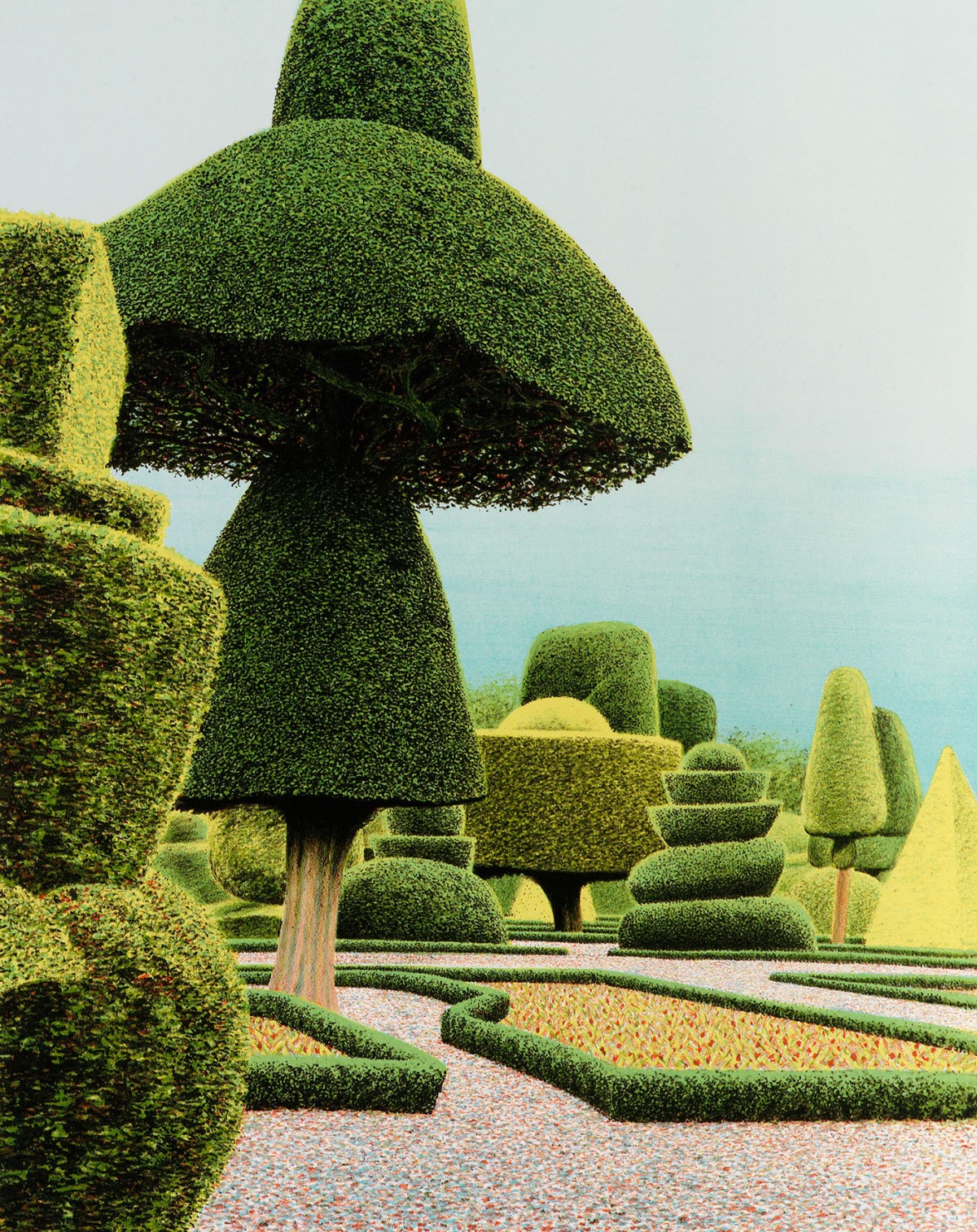
While in the Royal Academy I came across a small exhibition in the Tennant Gallery and Council Room. This was a selection of prints by Norman Stevens, and it was free with any other exhibition ticket, so I popped in. I had never heard of Stevens but I liked his prints: they were reminiscent of a dreamlike English ‘country garden’ but there was something unworldly or unnerving about many of them. I particularly liked his Levens Hall Garden, which reminded me of Alice in Wonderland.
While I was at the Royal Academy I decided to go and see Renaissance Impressions, which is running to the 8th of June in the Sackler Wing. This exhibition focuses on chiaroscuro woodcuts from the collections of Georg Baselitz and the Albertina in Vienna.
Before I visited, I had no idea what chiaroscuro woodcuts actually were, so I was happy to be enlightened. There is a helpful video at the beginning of the exhibition that shows you how they are made. They are like standard woodcuts – e.g. cut out a pattern on some wood (doh), cover with paint, and press onto paper – but you do it in layers. So you have one woodcut for the lighter tones, and you print that; then another for the highlights, and you print that; and finally, another for the outlines which is very dark. The technique results in beautiful, layered pictures full of atmosphere. Some are mainly black and white, while others involve the use of colour. There is more information, as well as a stunning selection of images, on the Royal Academy website.
The Royal Academy of Arts has been doing something a little different recently – their latest exhibition, Sensing Spaces: Architecture Reimagined, has allowed architects to take over some of their galleries with innovative designs. It marks a departure from their usual kind of show, as you are able to walk around, touch and in some cases walk through the exhibits, and there were lots of children who were clearly enjoying themselves just as much as the adults.
Featuring architects from all over the globe, the exhibition is designed to show that architecture is not just a visual medium: it affects how you perceive a space in terms of scent, touch, hearing and feeling.
On entering the exhibition space you are able to go any way you like. I chose to go straight ahead and came across this installation by Eduardo Souto de Moura, a reconstruction of the wall’s archway.
Eduardo Souto de Moura
The next work was pretty hard to miss, and I think it was my favourite out of the lot. Diébédo Francis Kéré has created a huge plastic tunnel that visitors can add to by using the coloured straws dotted about. Children in particular were having a lot of fun with this, but I couldn’t resist adding my own as I walked through the tunnel.
Diébédo Francis Kéré
The bright colours were really uplifting.
Diébédo Francis Kéré – Close-up
Pezo von Ellrichshausen’s piece dominated one of the larger rooms, consisting of four spiral staircases encased in cylinders and topped with a platform (there was also a ramp for wheelchair users). I very much enjoyed climbing about in this.
Pezo von Ellrichshausen
One of the best parts was being able to get a closer look at the roof of the Royal Academy owing to the platform at the top of the structure.
Pezo von Ellrichshausen – At the top
Japanese architect Kengo Kuma appeared to have gone to the other extreme, pioneering what he calls ‘weak architecture’ which emphasises the fragility and beauty of his structures. These are shaped canes of bamboo which give off a lovely natural smell; the whole atmosphere of the space was calming and gentle.
Kengo Kuma
Li Xiaodong’s work is a maze-like room made up of twig screens, with a pebble-covered space in the centre over which your feet crunch pleasantly.
Li Xiaodong
Lastly. Grafton Architects have created two rooms, one light, one dark, which architect Yvonne Farrell says is meant to be like going from hot to cold in a sauna. It sounds boring but I was impressed with how the clever arrangement of these supposedly plain concrete slabs helped to alter the atmosphere and feel of the two rooms.
Grafton – Light roomGrafton – Dark room
The exhibition ended with a video featuring the architects talking about their work and how they view the role of architecture. I normally don’t bother with videos in exhibitions but I was fascinated by this one. I really knew very little about architecture and I enjoyed the way the exhibition helped me to think differently about it.
I admit I had never heard of Veronese before visiting this exhibition at the National Gallery, but I was impressed with what I saw. Veronese: Magnificence in Renaissance Venice looks at the work of Paolo Caliari (1528–1588) of Verona (hence ‘Veronese’), who was one of the most acclaimed artists in late sixteenth-century Venice.
Fifty works are present in this, the first monographic exhibition on the artist ever held in the UK. The works, some of which are huge, have taken over some rooms above the Sainsbury Wing, and are shown off to wonderful effect owing to the rich natural light.
As well as the usual pictures and portraits, Veronese painted several altarpieces and frescoes. These are hugely difficult to transport from their original setting and help to explain why his work is less well known over here. I’m glad the effort was made, however, as they really are magnificent. Veronese also painted portraits, and drew inspiration from allegory and mythology. The paintings are stunning, with strong use of colour, and narratives that make an impact.