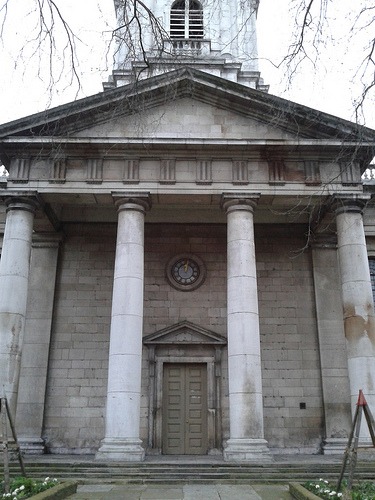
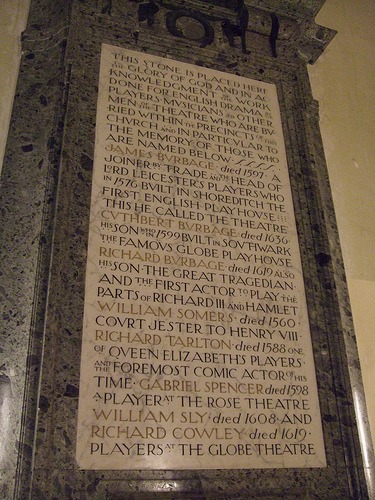
Fascinated as I am by the theatre of Shakespeare’s day, I signed up for a talk by MOLA (Museum of London Archaeology) who are responsible for excavating the Elizabethan and Jacobean theatres in Shoreditch. The talk was given by Heather Knight, who is in charge of the excavations, and was incredibly interesting. The location for the talk was St Botolph’s Hall on Bishopsgate, near Liverpool Street station: this was an appropriate location, given that the site of the Curtain Theatre is nearby; also, member of the Lord Chamberlain’s Men William Kemp was supposed to have begun his ‘Nine Days’ Wonder’ (he morris-danced from London to Norwich) from St Botolph’s Church. Ironically, the rector of the church was not impressed with the theatrical goings on of the day, and wrote a critique denouncing such activities.
Knight, whose team’s excavation of the Curtain Theatre is ongoing, spoke about what archaeology can add to our understanding of Shakespeare and the theatrical environment in which he worked. Unlike many significant cultural figures, we know relatively little about Shakespeare’s life and don’t have much in the way of items belonging to him. It was in the nineteenth century that research first began into his life and the Elizabethan theatre. We know that Shakespeare lived at different times on both Silver Street and Bishopsgate; we know that Shoreditch had a reputation as a place of fun; and we know that theatres were concentrated in two different areas surrounding the City of London: the north, Shoreditch (the Theatre and the Curtain), and the south, Southwark (the Rose and the Globe).
Archaeological research has already taken place at the Rose, part of the Globe and part of the Hope, all south of the river. However, research into theatre in the Shoreditch area began less than a decade ago, when a desk investigation was commissioned in 2007. Sample trenches dug revealed part of the Theatre, which was the headquarters of the Chamberlain’s Men managed by Richard Burbage. They discovered that the Theatre was 22m in diameter, with 14 sides and a tiled roof, not unlike the Globe, though the Theatre building also made use of the old medieval bakehouse and bathhouse that used to be part of the monastery.
Props were found on the site: bells and other costume ornaments and props, such as the end of a scabbard. At this time there was a law against people wearing clothes above their station, but this was waived in the case of actors belonging to a licensed troupe. Going to plays, therefore, was often the only way ordinary people could get to see these beautiful clothes close up. Hampshire border ware was found frequently, though one piece was particularly unusual, having the face of a bearded gentleman complete with a ruff (he looks a bit like Shakespeare). A cannonball was also found, several years after a similar one was found at the Rose – these are believed to have been used for sound effects such as thunder. The discovery implies a kind of “theatrical arms race”, as Knight put it, between Philip Henslowe, owner of the Rose, and Richard Burbage, owner of the Theatre, as they sought to introduce the most cutting edge special effects. The team also discovered something else about the site of the Theatre: after the playhouse closed it may have been taken over by an alchemist, as assorted seeds were found on site, and an upturned jug was discovered in the floor, as well as a piece of pottery in the walls symbolising good and evil in the defence of witchcraft.
The Curtain theatre, named after Curtain Place on which it stood, was nearby, owned by Henry Longman in the 1580s; he was still running it in the 1620s. A desk assessment was carried out on a portion of the supposed site as late as 2011; trenches were dug and walls discovered. Recently it has been confirmed that the theatre, 30m by 22m, was rectangular in shape, rather than the rounder shape of the Theatre, the Globe and the Rose. This is exciting news, but not as out of the ordinary as it might seem: the first Fortune Theatre in London was square, and some Spanish playhouses of the period were also rectangular or square. However, the news sheds a new light on the play Henry V. If, as is believed, that play premiered at the Curtain, then the prologue (“can this cockpit hold/The vasty fields of France? or may we cram/Within this wooden O the very casques/That did affright the air at Agincourt?) makes no sense, so perhaps it was added later, when the play was performed at the Globe. Interestingly, a 1578 French visitor to London wrote about the differences between the Curtain and the Theatre, remarking that one was particularly magnificent. Unfortunately, he didn’t actually state which one, but Knight suspects that he was referring to the Theatre, as it had what would have been a more unusual polygonal shape, with the Curtain being more of a traditional European theatre type.
At the Curtain site, fragments of a bird whistle have been found, which may have been used to emulate the lark in Romeo and Juliet. In later years the building was adapted, with a floor of animal bones in place around 1630. Excavations are still ongoing, but the absence of evidence can be as interesting as its presence. For instance, no money pots have been found, as were discovered at the Rose, suggesting that perhaps the Curtain was a building for hire rather than the home of a company.
The site of the excavation is now called The Stage, and there are plans to build a visitor centre around the remains of the theatre. It may be the last playhouse MOLA get to excavate, which in many ways is sad, but at the same time they have done some brilliant work that they can really be proud of. Work on the Curtain and Theatre has hugely added to our understanding of the theatrical world of Shakespeare’s time, and I feel very lucky to have attended this talk and heard about it first hand. I look forward to hearing more about these groundbreaking excavations.