1816: The Year Without A Summer – Study Day

year without a summer

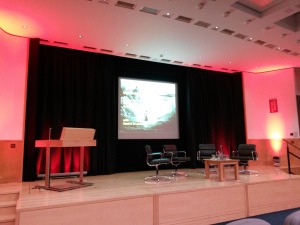
It might not be the conventional way to spend a Saturday, but I really enjoyed my experience at the 1816: The Year Without A Summer Study Day. Following on from my Friday evening talk and concert, I turned up bright and early to enjoy a day of talks around the consequences of the 1815 eruption of Mount Tambora in Indonesia.

The world’s biggest volcanic eruption caused severe climate change and led to poverty, famine, disease and migration, as well as influencing creativity. The talks were delivered by experts from the various fields of science, medicine, neurology, culture and history, and culminated in a panel discussion.


Atmospheric Effects of the Mt. Tambora Eruption
Prof Giles Harrison (Professor of Atmospheric Physics, University of Reading)

In this first talk, Professor Harrison gave us a bit of insight into the context of the eruption and what it meant for the atmosphere. Tambora, on Sumbawa Island, Indonesia, had a history of rare but major eruptions. One took place in around 3910 BC. In 1815, there was an initial eruption on 5 April before the ‘proper’ eruption on 10 April.

The immediate consequences of the eruption included whirlwinds, ashfall, a pyroclastic flow and a tsunami. Rock was expelled from the volcano, burying a nearby village. 71,000 people died in the nearby area, 12,000 directly and the rest by starvation in subsequent weeks. The Volcanic Explosivity Index lists the Mount Tambora eruption as 7 out of 8, the largest known historic eruption.

In the wider atmosphere, small particles of sulphur influenced sunlight and temperature. In recent years, ice cores taken from Greenland show that air samples from the time of the eruption contain volcanic dust and sulphur. It has been suggested that the art of the time, such as paintings by Constable and Turner, reflect the condition of the air and the presence of dust, but then again we don’t always know how the paints have aged over time.

At the time of the eruption, a sparse temperature measurement network was developing. Early measurements were usually taken by educated individuals who viewed such observations as a hobby, but their diaries enable us to make deductions about the weather of the period. The evidence suggests that the summer of 1816 was the coldest of the 1810s and the third coldest since 1659. Eastern Europe wasn’t so badly affected, but Western Europe did suffer with the cold and wet. The effects spread as far as North America, with, for instance, snow recorded in New York. Back in the UK, one diarist reported that their cucumbers froze.


Frankenstein’s Weather!
Prof Gillen D’Arcy Wood (Professor of English, University of Illinois)

Professor Wood was a particularly engaging speaker and his talk was probably my favourite of the day. He referenced the artistic works mentioned by Professor Harrison in the previous talk, mentioning Constable’s Weymouth Bay of 1816, painted on the artist’s honeymoon, which revealed the state of the sky. Most of his talk was concerned with the myths that built up around the summer at the Villa Diodati.

The summer of 1816 marked the return of British tourists to Europe after the Napoleonic wars. It was Mary Godwin’s stepsister, Claire Clairmont, who persuaded Mary and Shelley to visit Lord Byron in Geneva. Along with Byron’s physician Dr Polidori, they spent a legendary summer by the lake. Dreaming of a summer of picnics, walks and mountain climbing, they were instead faced with the coldest, wettest summer in Geneva for 450 years. Surrounded by starving refugees, the group spent the summer holed up in the Villa Diodati, telling ghost stories to pass the time: Byron’s reading of Coleridge’s Christabel had Shelley running screaming from the room.

Professor Wood drew parallels with modern-day climate change, citing a phenomenon called “climate shock”. He discussed the stages of response to climate shock: creative sympathy, political violence, and the “flight into hell”. Mary Shelley’s Frankenstein, Byron’s Darkness and other works can be read as creative sympathy, but there were other, less obvious consequences: the first bicycle prototype was invented to replace horses, many of which had died, while in a bid to deal with the problem of starvation Robert Peel established the group which would evolve to become the British Board of Health. Still, unrest was common. In Britain in 1816, there were riots and protests by starving peasants. Rural communities all over Europe experienced starvation, leaving their homes and seeking shelter and food elsewhere: hence the “descent into hell”. One wealthy figure gathered 25,000 refugees, travelling around Europe, setting up soup kitchens and preaching the imminent apocalypse. ‘Starvation medallions’ were produced as mementoes of the occasion.


‘Not yet saved’: Europe after the fall of Napoleon
Prof Robert Tombs (Professor of French History, University of Cambridge)

Professor Tombs talked about Napoleon, defeated at Waterloo in 1815. Admired by Byron, Beethoven, Shelley and Goethe, he was exiled to St Helena where he acquired much sympathy. His carriage was brought to London, where 100,000 people visited it. Byron bought it and used it to travel around Europe. Wellington, rather oddly, acquired Canova’s statue of the nude Napoleon. It can still be seen in Apsley House. He also “took over” Napoleon’s mistress.

Contemporary cartoons by the French show the English in a bad light, and many of Balzac’s novels featured English characters who were ‘bad’. Back in England, Napoleon was burned in effigy. A ‘geopolitical revolution’ was set in motion.

The fast growth of populations and cities, as well as the influx of newly unemployed soldiers, meant that famine and unrest were common problems. The ‘Bread or blood’ riots in Ely in May 1816 led to the hanging of 83 individuals – an unusually high number. Poor relief was eventually increased, but the consequences of these events lasted many years.


Lightness, Darkness and the Creative Brain
Prof Michael Trimble (Emeritus Professor of Behavioural Neurology, UCL)

This was another talk which I found especially interesting, exploring the connection between the weather (of 1816 in particular) and mental health. Professor Trimble started with a brief history, going back to Greek ideas about the four humours, a Platonic theory promoted by Hippocrates. Galen referred to a “Darkening of the mind”, and in later years a number of books on the theme of melancholy were published: Thomas Horclewe’s My Compleint (1420), Robert Burton’s The Anatomy of Melancholy (1621) and An English Malady (1733) by George Cheyne.

News reports indicated a wider spate of melancholy during 1816, but was the weather responsible? Esquirol’s French Maladies of 1845 suggested that climates and seasons can have an effect on melancholy, while Henry Morselli’s study of suicide in 1881 suggested that the dreariness of the northern climate might be more likely to influence such actions. Weather was seen as a proxy for the human condition.

The influence of the weather on mental state declined as the science of meteorology advanced. However, Seasonal Affective Disorder was first described in 1984. A recent study suggests there is no association between seasons, sunlight and latitude, but a recent review of psychiatric hospitalisations confirms a seasonal pattern, especially for bipolar patients. A literature review from 1979-2009 suggests that the highest number of suicides occurs in the spring and early summer.

Professor Trimble moved on to speak particularly about Beethoven and Schubert. Beethoven’s father and grandmother were alcoholics, his mother a melancholic. A lonely child with few friends, he hated authority and suffered greatly when his mother died. He suffered from depressive episodes in 1812-13 and 1816-17 when his productivity vastly decreased. He may well have been bipolar.

Schubert might have suffered from cyclothymia, being possessed of a bright side that coexisted with a morbid aspect. He tended to experience increased productivity during the spring and autumn, composing very little during the summer. Evidence seems to suggest that while there is no direct link between mood and weather, those already suffering from a condition such as bipolar might be more likely to be affected by it.

The day ended with a panel discussion featuring Judith Bingham, one of the composers featured in that evening’s Byron in Switzerland concert, and chaired by Ian Ritchie. The day as a whole was incredibly interesting, and if I felt like I was back at university again, this is all to the good. I enjoyed the chance to stretch my brain properly.

1816: The Year Without A Summer – Introductory Talk – King’s Place

Kings Place is an arts and conference venue just north of King’s Cross. It only opened a few years ago, but has already gained a reputation for hosting high quality music, spoken word and arts events. Recently, a weekend of events took place entitled 1816: The Year Without A Summer. It consisted of two concerts and a study day exploring the events of this momentous year, the result of the 1815 eruption of Mount Tambora in Indonesia.

Before the Friday evening concert Beethoven and Schubert in Vienna, which I reviewed on my theatre blog Loitering in the Theatre, I attended the introductory talk, delivered by curator of the programme Ian Ritchie. He summarised the exceptional climatic, cultural and historical contexts in which Beethoven and Schubert were living in 1816 and explored how their work might have been affected.

Ritchie explained that all of the music in the evening’s concert had been composed in 1816 by either Beethoven or Schubert, both of whom were living in Vienna at the time. The period was already a time of great change, with the growth of Romanticism after the Enlightenment and the recent defeat of Napoleon at Waterloo. Prometheus, inspiration for Mary Shelley’s Frankenstein, was a popular cultural figure: Beethoven wrote a piece of music on the subject, initially dedicating it to Napoleon, but after becoming disillusioned with the French leader he crossed out the dedication (Byron was another figure who wrote in praise of Napoleon – composing an Ode to Napoleon – but who later became disillusioned). Inventors, such as George Stephenson, Humphrey Davy, and Michael Faraday, were making new scientific discoveries, and Luigi Galvani was attempting to reanimate corpses using electricity (from whence we get the term “galvanise”.

The Mount Tambora eruption of April 1815 was the biggest volcanic eruption for hundreds of years. It caused a shifting ash cloud leading to crop failures from Ireland to the east coast of the USA, the coldest winter since medieval times, and the development of a new strain of cholera in India. When Byron decided to go into exile from the UK, he arrived in Switzerland to find a country suffering from crop failure and famine. Along with Percy Shelley, Mary Godwin (later Mary Shelley) and Doctor Polidori, he spent the summer in the Villa Diodati, experiencing terrible weather instead of the glorious summer he had hoped for. Byron wrote a poem about the experience, called Darkness:

I had a dream, which was not all a dream,
The bright sun was extinguish’d, and the stars
Did wander darkling in the eternal space,
Rayless, and pathless; and the icy earth
Swung blind and blackening in the moonless air
To be continued…

As meterological science was in its infancy, people didn’t know why the weather was so bad: some predicted the end of the world. In such circumstances Beethoven and Schubert wrote music in Vienna.

Schubert was only 19 at the time, compelled to write even though he had only one paid commission this year (a cantata, now lost, coincidentally also called Prometheus), composing over 100 lieder in 1816. Unable to marry his fiancée as he couldn’t support her, he was also rejected by his hero Goethe, so it is understandable that his work from this period sounded rather melancholy. His lieder from this period rarely use poems relating to summer, and his music is often sad and reflective.

Beethoven also faced disappointment at this time, partly owing to the death of his brother. Though this was a fallow period for him, he did produce the first recognised song cycle. Did the pair of composers ever meet? Possibly not – Beethoven was an established composer at this time,  and moved in higher circles, while Schubert was still a student and relatively unknown at this stage.

The short talk was really enlightening, and whetted my appetite for the evening concert and the next day’s events… on which more in the next post.

Translating Bulgakov: New Perspectives on a Russian Master – Pushkin House

Pushkin House is a Russian cultural centre in Bloomsbury which regularly hosts events related to Russian art, literature, history and so on. I attended a talk, Translating Bulgakov: New Perspectives on a Russian Master, which discussed the life of the Russian writer. It was chaired by publisher Alessandro Gallenzi and featured Hugh Aplin, translator of The Master and Margarita, and Roger Cockrell, translator of Bulgakov’s Diaries and Selected Letters.

The library at Pushkin House

I’m a huge fan of Bulgakov and The Master and Margarita is one of my favourite novels, so I was really interested to attend this discussion. If you haven’t read it, the book it is about what happens when the devil turns up in Soviet Moscow with a motley retinue including a talking cat – read it, it’s wonderful.

The talk began with Hugh Aplin exploring why The Master and Margarita was not published, or even submitted for publication. Bulgakov was well aware of the censorship issues in the Soviet Union during the mid-20th century. He was able to publish during the 1920s as that was a much more relaxed era, with satire and other forms of writing permitted. The Master and Margarita featured both a highly non-realistic storyline and the presence of Christ – neither of which were advisable in the stricter climate.

Roger Cockrell focused on the trials and tribulations Bulgakov endured. He managed to establish his reputation against all odds, gave up medicine to focus on writing, and kept going even in the face of constant rejection and censorship. He found it tough to earn a living, having a complicated relationship with the Soviet government and with the theatre, particularly Stanislavsky’s Moscow Arts Theatre. His play about Molière was never produced.

During his lifetime Bulgakov was known primarily as a playwright; his last prose works published in Soviet Russia came out in 1925, but his plays enjoyed greater success. In 1928, he had three plays running and another in production; one of the three was The Days of the Turbins, based on his novel The White Guard, inexplicably a favourite of Stalin’s (it was about a family of White Russians).

Bulgakov’s widow worked to ensure his fame, and by the 1960s some of his works had at last been published. Today, he is popular in Russia, but in Putin’s modern nation some artists are still regarded with disfavour, and Bulgakov has not escaped censure. The idea of erecting a monument to the author at Patriarch Ponds in Moscow has met with a lot of resistance.

Hugh Aplin was asked about the challenges of translating The Master and Margarita, and if there was anything still left to translate. He commented that regardless of the quality of the source material, the translator must always act as an interpreter. There are some inconsistencies in the text, which he mentions in his notes. In Russia, a number of different editions of the work have been produced based on the various versions Bulgakov worked on throughout his life, such as The Great Chancellor and The Prince of Darkness.

Roger Cockrell was asked how Bulgakov could physically manage to survive in the circumstances in which he found himself. He said that though the writer found it very difficult – he was often wracked with self-doubt, and was continually denied a visa when he begged the government to let him go abroad – he believed in the importance of writing and of literature, and this helped to sustain him. I admire Bulgakov so much – he achieved a great deal in incredibly difficult circumstances and I truly admire his commitment to literature.

Digging Shakespeare’s Shoreditch: Excavating London’s First Theatreland

St Botolph's Church Hall
St Botolph’s Church Hall

Fascinated as I am by the theatre of Shakespeare’s day, I signed up for a talk by MOLA (Museum of London Archaeology) who are responsible for excavating the Elizabethan and Jacobean theatres in Shoreditch. The talk was given by Heather Knight, who is in charge of the excavations, and was incredibly interesting. The location for the talk was St Botolph’s Hall on Bishopsgate, near Liverpool Street station: this was an appropriate location, given that the site of the Curtain Theatre is nearby; also, member of the Lord Chamberlain’s Men William Kemp was supposed to have begun his ‘Nine Days’ Wonder’ (he morris-danced from London to Norwich) from St Botolph’s Church. Ironically, the rector of the church was not impressed with the theatrical goings on of the day, and wrote a critique denouncing such activities.

Knight, whose team’s excavation of the Curtain Theatre is ongoing, spoke about what archaeology can add to our understanding of Shakespeare and the theatrical environment in which he worked. Unlike many significant cultural figures, we know relatively little about Shakespeare’s life and don’t have much in the way of items belonging to him. It was in the nineteenth century that research first began into his life and the Elizabethan theatre. We know that Shakespeare lived at different times on both Silver Street and Bishopsgate; we know that Shoreditch had a reputation as a place of fun; and we know that theatres were concentrated in two different areas surrounding the City of London: the north, Shoreditch (the Theatre and the Curtain), and the south, Southwark (the Rose and the Globe).

Archaeological research has already taken place at the Rose, part of the Globe and part of the Hope, all south of the river. However, research into theatre in the Shoreditch area began less than a decade ago, when a desk investigation was commissioned in 2007. Sample trenches dug revealed part of the Theatre, which was the headquarters of the Chamberlain’s Men managed by Richard Burbage. They discovered that the Theatre was 22m in diameter, with 14 sides and a tiled roof, not unlike the Globe, though the Theatre building also made use of the old medieval bakehouse and bathhouse that used to be part of the monastery.

Props were found on the site: bells and other costume ornaments and props, such as the end of a scabbard. At this time there was a law against people wearing clothes above their station, but this was waived in the case of actors belonging to a licensed troupe. Going to plays, therefore, was often the only way ordinary people could get to see these beautiful clothes close up. Hampshire border ware was found frequently, though one piece was particularly unusual, having the face of a bearded gentleman complete with a ruff (he looks a bit like Shakespeare). A cannonball was also found, several years after a similar one was found at the Rose – these are believed to have been used for sound effects such as thunder. The discovery implies a kind of “theatrical arms race”, as Knight put it, between Philip Henslowe, owner of the Rose, and Richard Burbage, owner of the Theatre, as they sought to introduce the most cutting edge special effects. The team also discovered something else about the site of the Theatre: after the playhouse closed it may have been taken over by an alchemist, as assorted seeds were found on site, and an upturned jug was discovered in the floor, as well as a piece of pottery in the walls symbolising good and evil in the defence of witchcraft.

The Curtain theatre, named after Curtain Place on which it stood, was nearby, owned by Henry Longman in the 1580s; he was still running it in the 1620s. A desk assessment was carried out on a portion of the supposed site as late as 2011; trenches were dug and walls discovered. Recently it has been confirmed that the theatre, 30m by 22m, was rectangular in shape, rather than the rounder shape of the Theatre, the Globe and the Rose. This is exciting news, but not as out of the ordinary as it might seem: the first Fortune Theatre in London was square, and some Spanish playhouses of the period were also rectangular or square. However, the news sheds a new light on the play Henry V. If, as is believed, that play premiered at the Curtain, then the prologue (“can this cockpit hold/The vasty fields of France? or may we cram/Within this wooden O the very casques/That did affright the air at Agincourt?) makes no sense, so perhaps it was added later, when the play was performed at the Globe. Interestingly, a 1578 French visitor to London wrote about the differences between the Curtain and the Theatre, remarking that one was particularly magnificent. Unfortunately, he didn’t actually state which one, but Knight suspects that he was referring to the Theatre, as it had what would have been a more unusual polygonal shape, with the Curtain being more of a traditional European theatre type.

At the Curtain site, fragments of a bird whistle have been found, which may have been used to emulate the lark in Romeo and Juliet. In later years the building was adapted, with a floor of animal bones in place around 1630. Excavations are still ongoing, but the absence of evidence can be as interesting as its presence. For instance, no money pots have been found, as were discovered at the Rose, suggesting that perhaps the Curtain was a building for hire rather than the home of a company.

The site of the excavation is now called The Stage, and there are plans to build a visitor centre around the remains of the theatre. It may be the last playhouse MOLA get to excavate, which in many ways is sad, but at the same time they have done some brilliant work that they can really be proud of. Work on the Curtain and Theatre has hugely added to our understanding of the theatrical world of Shakespeare’s time, and I feel very lucky to have attended this talk and heard about it first hand. I look forward to hearing more about these groundbreaking excavations.

Utopia: Then and Now – King’s Place

The other day I went to King’s Place for an interesting talk about Sir Thomas More’s Utopia. Entitled Utopia: Then and Now, the talk featured Michael Caines chairing a discussion between Matthew Beaumont and Chloë Houston, academics who have worked on the book.

I originally read Utopia as a history undergraduate and although I’ve forgotten most of the details, I do remember finding it an interesting read. The talk looked at the concept of a Utopian society, which reaches back to the classical period, and whether or not there is a universal “utopian impulse” in many societies around the world. The talk also discussed the idea of a dystopia in relation to an utopia, and how one could be related to the other. The discussion also mentioned other ideas of utopia throughout the years, including critical (such as Voltaire’s Candide) and mocking (such as Swift’s).

Ultimately, the talk made me realise that my original understanding of Utopia is actually rather simplistic, and it would definitely be worth me going back and exploring this hugely important text.

Shakespeare400: Shakespeare’s London/Beaumont’s London – Guildhall Library

The other day I went to a talk at Guildhall Library given by by Dr Lucy Munro from King’s College London. The talk was about the London of Shakespeare and Beaumont, marking the 400th anniversary of the death of both writers. William Shakespeare of course died on 23 April 1616, but Francis Beaumont also died that year (on 6 March, aged only 31): he has been rather overshadowed by Shakespeare over the past four centuries, but his life is worth celebrating too.

Munro began her talk by showing us a 1572 map of London, revealing a much smaller-scale city than the one we are familiar with today. Playhouses were growing up all over London. One of the first such houses Shakespeare wrote for was “The Theatre” – not such an unimaginative name as it sounds, as the term “theatre” was usually used for private indoor spaces. The name harks back to the classical world of Greek and Roman drama.

Shakespeare lived on Silver Street for a time; he also, in 1613, bought a gatehouse on Blackfriars (the road on which another playhouse for which he wrote was located). Beaumont was born in Leicestershire in 1584, his father a judge, his mother a recusant Catholic. His wife may have been Roman Catholic too, which would have marked out Beaumont as an outsider. He entered the Inner Temple in 1600 after studying at Oxford, and began his collaboration with the writer John Fletcher in 1605.

The pair’s first play The Woman Hater was written for the Children of St Paul’s, though the pair also wrote for the Children of the Queen’s Revels at the Blackfriars Theatre. Beaumont and Fletcher lodged together on Bankside: an anecdote from John Aubrey, found in his Brief Lives, suggests the closeness of their relationship, as they lived together and shared everything. When Beaumont died he was buried in London, in Westminster Abbey.

Whereas Shakespeare set most of his plays in fairly exotic locations (excepting the histories, which mention such landmarks as the Tower of London, Westminster, and the Boar’s Head Tavern at Eastcheap), Francis Beaumont wrote regularly about specific London locations including the Mermaid Tavern (mentioned in a poem to Ben Jonson). A painting by the nineteenth-century artist John Ford imagines what poets’ meetings at the Mermaid might have looked like, although it is not particularly accurate: it is not known that Shakespeare was involved in these meetings, but he has a central place in Ford’s painting.

Beaumont’s writing makes reference to the London streets, their smells and sights; locations reflect the social, moral and economic circumstances of the characters. The Knight of the Burning Pestle, his significant solo play, mentions London locations, transforming them from real-life places into fantastical locations for his knight’s Quixotic journey.

I really enjoyed this talk: I think Beaumont is a vastly underrated writer (The Knight of the Burning Pestle, which I saw at the Sam Wanamaker Playhouse, is a masterpiece) and I enjoyed learning about how he uses London in his work and his relationship to the city.

Happy Birthday Charlotte – British Library

Charlotte Brontë has to be my all-time favourite author. Jane Eyre was the first ‘classic’ that I ever read, and it is still my favourite book: I find something new in it every time I read it, and I adore Charlotte’s vivid prose.

Yesterday, 21 April 2016, marked the 200th anniversary of Charlotte’s birth, and to celebrate the British Library hosted an event with some guest speakers. Facilitated by Xanthe Arvanitakis, curator at the Soane Museum (where an exhibition about Charlotte’s time in London is currently taking place), it featured Charlotte Cory, Ann Dinsdale and Dame Jacqueline Wilson.

2016_0421CharlotteBronte01

Charlotte Cory is an artist whose series, Charlotte Brontë in Babylon, was recently broadcast on BBC Radio 4. She is the curator of the aforementioned Charlotte Brontë at the Soane exhibition, which sounds fascinating (Charlotte B never visited the Soane, but it was certainly around when she visited London – and hasn’t changed much since – and Charlotte C has tried to present a “what if?” scenario, giving her in a way the chance to visit after her death). Ann Dinsdale is the Collections Manager at the Brontë Parsonage Museum in Haworth: she has worked for the Brontë Society for over 25 years and has written many books on the Brontës and Haworth. Dame Jacqueline Wilson is a bestselling children’s author, and was appointed Ambassador for Charlotte by the Brontë Society recently.

It was lovely to be in a room full of people who are as enthusiastic about Jane Eyre and Charlotte Brontë as I am. In particular I had no idea that Jacqueline Wilson – whose books I read as a child – was such a big fan. Ann Dinsdale and Charlotte Cory also love the book and it was interesting to hear them compare notes about their first introduction to Jane Eyre. All seemed to agree that it was the opening chapters of the novel featuring the young Jane that initially attracted them to the book, which is something that rings true with my own experience.

Even more fascinating if possible were the anecdotes which all of the speakers regaled us with. Charlotte Cory told us a ghost story about a friend who travelled back to London with the manuscript of Jane Eyre (usually kept in the British Library), which had been lent to Haworth for an exhibition. On getting out of the taxi at the British Museum (where the Library was then housed), the taxi driver insisted that there was another passenger in the cab with them: a small woman, who had inexplicably vanished. I also liked the story of the same friend telling off Princess Margaret for turning the pages of the fragile manuscript!

We got to hear about Charlotte’s time in London, in which she spent lots of time visiting tourist sites as well as some time visiting Bedlam – about which she was, uncharacteristically, silent. We were treated to a performance of the “Hippapotamus Polka” which was a popular work at the time, inspired by a hippo which had recently been introduced to London Zoo.

Afterwards, we were treated to a G&T and a slice of birthday cake to celebrate the 200th anniversary of my favourite author.

2016_0421CharlotteBronte04 2016_0421CharlotteBronte03

Don Quixote in Words Pictures and Film – British Library

2016 not only marks 400 years since the death of England’s national poet Shakespeare, but also 400 years since the death of Spain’s national writer Miguel de Cervantes. On April Fool’s Day I attended an event at the British Library exploring the impact of Cervantes’ Don Quixote across four centuries. Don Quixote in Words Pictures and Film featured broadcaster and art historian Andrew Graham-Dixon, Oxford University academic Edwin Williamson, and University of Birmingham academic Rob Stone (it was also supposed to feature graphic novelist Rob Davis, but he was ill).

Andrew Graham-Dixon spoke about the character of Don Quixote, remarking that he is one of the greatest comic characters in literature. He also talked about the character’s influence on later writers and artists, including Picasso, Dali and possibly Jane Austen (Northanger Abbey is a novel in which the protagonist is heavily influenced by a fictional fantasy world). Don Quixote is apparently the second most illustrated book in the world, after the Bible.

Edwin Williamson explored how the novel was created and its impact on literature. It has been regarded as the first modern novel, and has had a huge influence on subsequent fiction. As a Catholic in the Spain of the Inquisition, Cervantes was taking a risk writing the novel, but the madness and delusion of the central character helped him to get away with it.

Cervantes wrote the novel as a parody and a burlesque in order to criticise books of chivalry. His target was not the original books, which gained popularity during the medieval period, but later sixteenth century versions, which were extremely popular in Cervantes’ time and which were simplistic and poorly written. While the first book, in which Don Quixote goes in search of adventure after reading dozens of books of chivalry, was a superb achievement, the second, written several years later, was even better: as Don Quixote journeys on he meets several characters who have read the original book, an interesting twist which takes the story to another level.

Rob Stone discussed the films which have been made about Don Quixote, of which there have been around fifty: the book is a compelling and retellable story, and it is impressive how many different kinds of films have been made all over the world, including a Western version, Don Quickshot of the Rio Grande, a soft porn musical version, and a recent Chinese version with incredible special effects. I was intrigued by how many Russian films have been made, reshaping the Quixote tale into different aspects of Russian culture. The Russian equivalent of Spitting Image even portrayed Boris Yeltsin as an alcoholic Quixote. Some of the most fascinating Don Quixote films are the ones that never got made: we were shown the one surviving scene from the unfinished Orson Welles version, and heard about Terry Gilliam’s more recent failed version.

I really enjoyed the evening and it’s left me with the desire to read Don Quixote again: I originally read it over a decade ago, so I’d like to give it another go and see if I feel any differently about it.

Phantom Phenomena

I recently attended a talk at the Guildhall School entitled Phantom Phenomena, about the many ways in which Gaston Leroux’s original novel has been reinterpreted and remade over the past century. Researcher Cormac Newark specialises in studying the reception of operas, and noticed that many critics who wrote about opera in the nineteenth and early twentieth centuries also wrote novels featuring scenes set at the opera. Leroux was one such individual, and his most famous novel The Phantom of the Opera was published serially in 1909-10. The novel, which employs traditional clichés about the emotional and spiritual power of opera, makes heavy reference to the opera Faust, which would have been familiar to many readers at the time as one of the most important operas of the age.

The original Phantom book has spawned musicals, ballets, spinoff novels and over fifty films. The talk focused largely on the film and TV versions, which come from all over the world: the USA, China, South America and Italy are just some of the places which have created their own versions of the Phantom story. We saw several clips from different versions: one early black and white version had the Phantom admiring a male protégé rather than a young female singer, while another had a bizarrely cheery musical number. A telenovela version from South America saw a woman being doused in acid – the implication being that the Phantom was originally disfigured in some way. Yet another version combined the characters of the Phantom and Dracula, and I was particularly intrigued by the Eighties horror version with the music being played on a computer.

20160307_182707
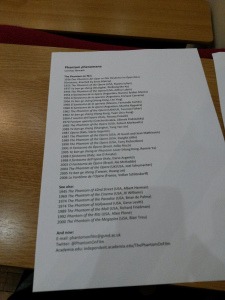
Full, very long list of films and TV shows

The continued popularity of the story in the modern age can be largely attributed to the Andrew Lloyd Webber musical, and fans continue to explore and develop the story online via websites. I enjoyed this interesting talk and it’s certainly made me want to see some different versions of the Phantom story.

The Lost World of the Georgian Chocolate House – Guildhall Library

I love history and I love chocolate, so deciding to attend The Lost World of the Georgian Chocolate House was a no-brainer. This talk, which took place at Guildhall Library, was delivered by Dr Matthew Green, whose book London: A Travel Guide Through Time was released before Christmas and whose company, Unreal City Audio, organises immersive historical tours around London.

The talk covered the beginnings of chocolate’s popularity in the Western world: Spanish explorer Hernan Cortes found hot, spicy chocolate being drunk by South Americans and the popularity of the drink extended to Baroque Spain, and later Italy. Cosimo de Medici, an Italian nobleman, was possibly the first chocoholic, and the drink retained its aristocratic connotations as it travelled first to France, then to England. Chocolate at this time contained several unfamiliar ingredients: in South America it was often mixed with blood, but luckily this practice did not survive the journey across the ocean. In Europe, it often contained musk or ambergris; sometimes even gold.

Chocolate houses in London were heavily influenced by coffee houses and tobacco houses – in fact the first chocolate was sold in coffee houses. The first chocolate house in London was established either in Vine Court, Holborn, in 1652 (as evidenced in a contemporary tract, Chocolate, or An Indian Drinke) or on Bishopsgate Street in June 1657 (as advertised in the Publick Advertiser).

The popularity of chocolate in London is largely tied up with the St James area. St James’s Square was laid out by Henry Jermyn, and several chocolate houses were located there or nearby: Cocoa Tree, Ozinda’s and White’s. Chocolate houses became associated with gambling, with aristocrats losing fortunes in games of Hazard. Hogarth’s Rake’s Progess contains a scene in a chocolate house, showing the artist’s disapproval of such dissolute practices. There is an account of a man who collapsed in the street outside of White’s chocolate house: he was taken inside, but instead of seeking medical help, the chocolate drinkers began to place bets on whether he was dead or alive. Betting on all sorts of outcomes was common in chocolate houses: this period sees the beginnings of life insurance, as people would bet on how long they – and others – had left to live. Chocolate houses were largely the preserve of men: women would send their children into the houses to seek out their husbands and tell them to come home, but this backfired on at least one occasion, when a small child ran into the chocolate house, fell into a vat of chocolate, and drowned.

Like coffee houses, chocolate houses were connected with political activity. Cocoa Tree in particular was known as a Tory stronghold and a Jacobite centre. It was often raided, and even had an underground passage to a Piccadilly tavern to allow members to escape. Ozinda’s was known for its art auctions, but White’s, the most famous chocolate house, was the most notorious. It burned down in 1733, and White’s Club is now on the site. From the middle of the eighteenth century, most chocolate houses did evolve into private members’ clubs. To date, most British prime ministers have been members.

After our talk, we were given a chance to sample some eighteenth-century style chocolate. I’m not sure exactly what ingredients were used (although I’m pretty certain blood wasn’t one of them), but the chocolate was delicious, if not quite sweet enough for my taste, being thick, rich and full of flavour.

The talk was fascinating and I definitely want to go on the Chocolate House Tour, as well as other tours organised by Unreal City Audio!