Just a quick note on an event I went to at North Finchley Library – a talk by Swedish author Arne Dahl (real name Jan Arnald). I love a bit of Nordic noir and I’ve enjoyed several of Dahl’s books as well as the TV series they are based on.
Dahl spoke a bit about his most popular series, the Intercrime books, as well as his upcoming work. At the end there was a question and answer session, which I didn’t contribute to (I never do, to be honest). It was definitely worth the trek to North London after work, though.
I went to this New Approaches to the Archive talk, part of Magnum Photos Now, a series of lectures about Magnum Photos in this year of their 70th anniversary, because I work in the field of libraries and archives and was interested to learn more about a photographic archive. I expected the talk to be more about the archives themselves, but actually the evening was fascinating even though it wasn’t really what I had expected.
The evening was made up of two talks. The first was delivered by Diane Dufour, director of Le Bal, Paris, who recounted her experiences with exploring the Magnum Photo archives and exploring the concepts behind the photos taken, as well as looking at the differences in opinions of the photographers involved. One section was particularly telling, with pictures of Jewish people settling in Israel, while another photographer’s work showing displaced Palestinians was not published anywhere.
Dr Mark Sealy, curator and cultural historian, then talked about the Eurocentric gaze of typical photography archives and made the important point that the first photographs appeared at the same time as slavery was just coming to an end in the UK – as part of a wider point that a photo shows just one aspect of the world at a particular time. He showed us photographs by and of black people during the twentieth century and emphasised the importance of having diversity among the people who are able to search the archives in the first place.
As someone who works in the field of libraries and archives, the talk was an interesting look at the varied uses which can be made of those archives, and their importance in terms of culture and history.
I’d never been to a Secret Cinema event, although I’d heard of them. It was always at the back of my mind as something I’d like to do, but I never got around to it… until they announced Moulin Rouge! as the next film, at which point I knew I would just HAVE to go. This modern classic, released in 2001, happens to be one of my favourite films of all time.
I ended up going by myself – at first I was nervous at the prospect, until I reminded myself that I’ve been to plenty of immersive theatre alone in my time, and this probably wouldn’t be that different. As the day approached, I visited the website, filled in all the forms I needed to and gathered my outfit together. You are meant to register with the website once you’ve bought your ticket and you are allocated a character, complete with a backstory and outfit guidelines. My character was Nina Boucicault, a comedian. Here I hold my hands up and frankly admit I completely ignored my character’s suggested outfit. It involved trousers, but I haven’t worn trousers for years, and I wasn’t going to start now.
I don’t know what it says about me that I didn’t actually have to make any special purchases at all in order to dress up. I wore a dress I got from ASOS (mega sale bargain) a couple of years ago, with a corset over the top. I took a fan (that I think came from Accessorize) and wore my ‘She Walks In Beauty’ earrings from Alchemy Gothic.
I got changed in the toilets at work (classy) and then I had to get the tube to Canning Town station. Now I was a bit nervous about the prospect of having to get on the tube with all those commuters, but one of the reasons I love London is that no one pays any attention to you on the Underground (unless you’ve got a dog. Everyone loves dogs), so no one looked at me twice the whole way there. At the station, I began to see other people dressed in a similar way to me, so I knew I was in the right place.
The venue was really close to the station. It was supposed to be top secret, but to be honest, any locals or anybody passing through would notice the queue of people building up at around 6pm. We didn’t have long to wait, we were soon invited to enter the world of the Moulin Rouge. No phones or photos allowed, naturally.
Wow. Inside it was incredible, like stepping into another world. There were bars and storefronts, cafes and stalls, all designed to draw you in to the fin de siècle world in which the film is set. Costumed actors added to the atmosphere, and sometimes it was hard to tell the actors from the ordinary ticket-holders. I only saw one person without costume, and I felt quite sorry for her as she really stood out!
Everyone was so friendly. I didn’t talk to many people – I didn’t need to – for most of the event, but I got chatting to people in the queue to get in and in the ladies’ loos, and I even danced with some people at one point. There’s something about immersing yourself in something like this that makes you forget yourself and act much more confident than usual – I guess that’s true for me, anyway.
I spent the time before the film started just wandering around, exploring as much as I could, and sampling the drinks on offer (which included absinthe). I also won a bet on some lesbian wrestling (don’t ask). There were performances and songs and I was almost sorry when it was time for the film to start.
Almost, that is. There was still loads going on while the film was showing, with actors performing key scenes in front of the screen. I never did see Moulin Rouge! at the cinema, as no one wanted to go with me and at sixteen I was much less inclined to do things by myself than I am now, so it was so good to actually see the movie on the big screen.
By the time it finished I didn’t want to leave. I’d had SUCH a good time and it was an unforgettable experience. I wonder what Secret Cinema will do next year?
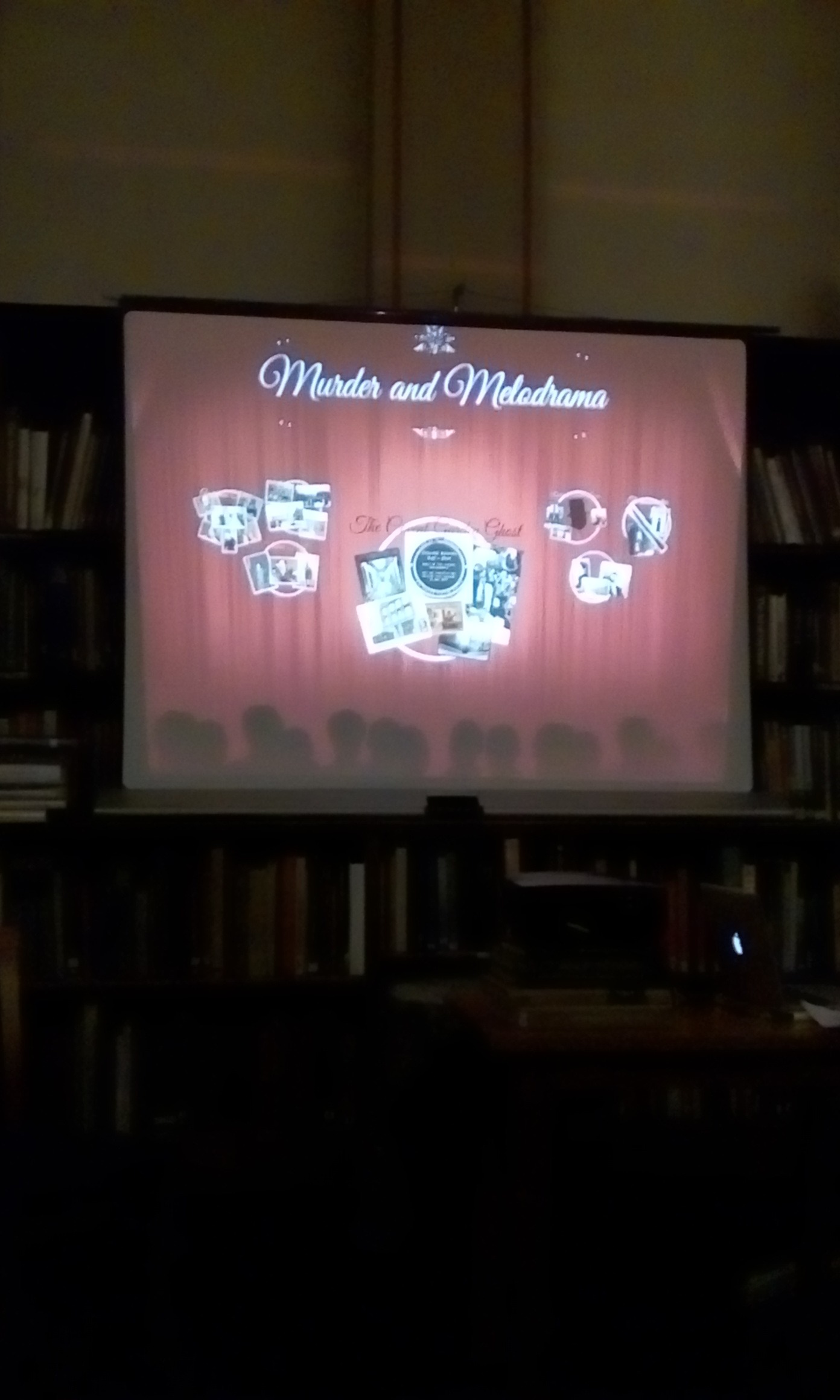
This particular talk was delivered by actor and writer Julie Balloo, and was concerned with the murder of actor William Terriss outside the stage door of the Adelphi Theatre on 16 December, 1897. It began, appropriately enough, with a scene from a Victorian melodrama, and then went on to discuss the histories of the key players in the tragedy.
Terriss was born William Charles James Lewin on 20 February 1847. His family did not want him to become an actor, so he originally pursued a variety of different careers: he joined the Navy, became a tea planter in Bengal, and tried sheep farming in the Falklands. He also tried breeding horses in Kentucky, and married Isabel Lewis (stage name Amy Fellowes) in 1870, but he still had ambitions to go upon the stage.
During the 1870s he established his acting career and performed in many popular plays of the period. His first big role was alongside Ellen Terry and he also got on well with Henry Irving, famous actor-manager of the Lyceum. In 1885 he met actress Jessie Millward and embarked on an affair with her that lasted until his death. Terriss was liked and admired by both fellow actors and the general public: he was known to be extremely generous to the former, and was hailed as a hero by the latter when he saved some people from drowning. The New York Dramatic Mirror described Terriss as one of the most popular actors in England, second only to Henry Irving. Supposedly, Terriss was told by a palm reader that he would die a violent death; his mistress Jessie Millward also had threatening dreams.
His murderer, Richard Archer Prince, was born in the slums of Dundee and grew up in abject poverty. He loved the theatre, and had ambitions to become the ‘Terriss of Scotland’. Prince moved to London and got an agent, but never managed to gain the same level of success as his hero. Terriss had assisted the struggling young actor in finding work, but over the years Prince took to alcohol abuse and grew increasingly unstable. Terriss sent several sums of money to Prince via the Actors’ Benevolent Fund, and continued trying to find him acting work, but on one occasion when Prince was refused money from the Fund, he blamed Terriss.
Prince bought a knife from a shop on Brompton Road and headed to the Adelphi Theatre. He waited in a doorway for Prince to arrive. Jessie Millward, who was in the same play, arrived first and Prince gave her a scare. When William Terriss arrived, Prince stabbed him, twice in the back and once in the front. Terriss died shortly afterwards.
Prince loved the attention he got during his trial at the Old Bailey in 1898. He was pronounced guilty, but insane. He was sent to Broadmoor and became quite involved in the dramatic scene there, putting on plays for the inmates and acting as the conductor of the prison orchestra until his death, which occurred in 1936. An interesting footnote to the story is that the ‘Covent Garden Ghost’ is supposed to be William Terriss. The ghost haunts Covent Garden station, which sounds strange until you learn that there used to be a bakery on that site, much frequented by the actors.
Thus concluded the first half of the Salon for the City event. The second involved the performance of certain scenes from Balloo’s play Gods of the Adelphi, which were entertaining and made me want to see the full play. Another dram of gin was served, and the evening drew to a satisfying conclusion.
As part of my visit to Barts Pathology Museum, I attended a talk by Professor Will Ayliffe from Gresham College on the history, purpose and present of pathology museums. He explained that the purpose of such museums has changed over time. Initially, resperentations of anatomy used to be common sights, with relics, bones and wax models widely visible in churches and beyond. These days, anatomy is often viewed with suspicion – especially after the Alder Hey scandal of a few years ago. In northern Europe particularly, we don’t habitually see the dead: there is no culture of relics, and no open caskets. Museums like this have been used for comparative anatomy, criminology and phrenology.
Dissection has been viewed with suspicion from classical times right through to medieval times. Galen dissected apes, but human dissection was usually used as a punishment; autopsies were only allowed if foul play was suspected. The papal bull of Pope Sixtus IV of 1482 allowed unclaimed corpses and executed criminals to be dissected. Da Vinci and Vesalius increased knowledge of anatomy, while William Harvey’s work discovered more about the circulation of the blood. One purpose of dissection was to desensitise the doctor, so they could be clinically detached when working on “real” patients.
By the mid-eighteenth century, criminals sentenced to death could also be sentenced to dissection. There was an insufficient supply of bodies – only 8% of those hanged were killed for murder, which meant that they could potentially be dissected – and yet there were more and more medical students who would need them. This was despite the difficult and dangerous nature of the work: Charles Darwin’s nephew died the day after cutting a finger and dissecting a child. The need for bodies led to the growth of the “Resurrection Men”, who dug up bodies from cemeteries and sold them to the surgeons. Dissection was therefore often viewed with suspicion: the dissection at Bart’s of the hanged murderer of the then Prime Minister in 1812 was accompanied by screaming crowds threatening to murder the dissectors. The skull of this man, Bellingham, is still kept in this museum.
Nowadays, the specimens in this museum are fairly old, but we can still learn from them, and the museum is still used by medical students today.
At the end of November I attended an afternoon of talks at the Barbican taking Bedwyr Williams’ exhibition in The Curve, The Gulch, as a starting point. Held in the Fountain Room, I thought the talks sounded quite interesting and I’m always up for learning new things.
The first talk, on taxidermy, was delivered by Errol Fuller, whose topic was inspired by the presence of a taxidermied goat in the exhibition. He suggested that taxidermy is one example of the smudging of boundaries between life and death. During the Victorian era, taxidermy was used to strong effect in science – for instance, Darwin’s finches which demonstrated the differences between species – but it was also fashionable to use it as decoration in the home. Creatures were often posed and arranged as though in performance: playing cricket, making music.
Taxidermy has been out of fashion for many years, but recently it has started to increase in popularity, with a growing interest in natural history and the ethical sourcing of dead animals to use. Courses are particularly popular among young women aged 15-30, while taxidermied animals have begun to appear in artworks, such as the suspended horse in the Guggenheim.
The golden age of taxidermy spanned from the nineteenth century up to the outbreak of World War One. Every town had its own taxidermist, and nowadays many are famous according to their name and town, such as Hancock of Newcastle. George Ashmead, who created a case of 300 hummingbirds, had business premises in Grosvenor Square, while Roland Ward, famed for his lion biting a bison, had premises in Piccadilly. Between the 1930s and the 1970s many good examples of taxidermy were destroyed, even by curators, as they were out of fashion and seen as valueless.
What was nineteenth-century taxidermy about? Two aspects were particularly popular. One was anthropomorphic taxidermy, primarily for amusement, such as tableaux of fencing mice. Another was the use of animals now extinct, such as the passenger pigeon, native to North America and once the commonest bird on earth. Another example is the Great Auk, of which around 65 examples remain stuffed in museums. Hooiers from New Zealand are the only birds in which the males and females have different beaks, but they became extinct in 1907. The heath hen was common when stuffed in 1880 but has since become extinct: it was stuffed to look dead, and Fuller ends his talk by suggesting that it has now become conceptual art deeper and more profound than actual conceptual art.
The second talk, on magic, was given by Jon Armstrong. He started off with a card trick involving members of the audience, and pointed out that a deck of cards has multiple meanings, with cards relating to the days of the year, the seasons, and more. He discussed the practice of magic as performance art, citing the Davenports, late nineteenth century magicians who had a black box theatre, and the magician Kirby who wrote as far back as 1972 on the relationship between magic and theatre. He discussed The Conjurer by Hieronymus Bosch, a work which portrayed magic as an ancient art, and the theatrical tricks that could be seen as magic, such as flying machinery and the ancient mystery plays that had a “hellmouth” on the stage.
At this point there was a break in proceedings, and I took the chance to go and check out the exhibition, The Gulch. This immersive exhibition in The Curve started with a moonlit beach, on which a sole shoe rested beside a camp fire. It then moved into a small gallery space with a couple of displays, including a chair with a winding road drawn on the back. Next I entered a “backstage area” of boxes, drums and beanbags, that could be before or after a performance.
A boardroom, with a long table and a large screen, followed, with a video of a self-confessed depressed hypnotist followed by a taxidermied goat in a bare room with a microphone. The exhibition ended with a curved stretch of race track on which another shoe could be seen.
I have no idea what any of it meant, but I liked it – I got the sense of someone having just left, an empty space that had been in use until a few seconds ago. I felt as though I was stepping into a story each time I moved into a new space.
The third talk was delivered by Dr. Georgina Guy, who compared aspects of the exhibition to other art exhibitions and installations, relating theatre, exhibition and curation to one another as they are displayed and performed. Unfortunately a lot of her talk went right over my head – as an academic I don’t think I was the right audience for what she was trying to say.
The final talk was possibly my favourite: Christopher Green spoke about the science and showbiz of hypnosis. He read about Victorian hypnotists in the British Library and investigated the relationship between hypnosis, theatre and healing, and how many “serious” hypnotists who want to help people end up using the tricks of “stage” hypnotists. I was particularly interested to learn about the famous female hypnotist, Anne de Montford, the daughter of a millworker, though there were plenty of other fascinating characters, including Henry Blythe the stage hypnotist, who hypnotised his daughter to pass her driving test – and she failed. Green was an incredibly engaging speaker and really sparked my interest in a topic I’d never paid any prior attention to. Overall, a fascinating afternoon.
I had lots of Art Nouveau posters on my wall in my student days, and my love of this art form has persisted for several years. Since childhood, even, as my parents had a mirror featuring the Alphonse Mucha design La Dame aux Camélias on their wall. Mucha is one of the most significant proponents of this art form, so I was interested to go along to this day-long event at the V&A discussing the relationship between Mucha and the actress Sarah Bernhardt.
‘I predict fame for you’: meetings and inventions – Dr Justine Hopkins
The first talk, delivered by Dr Justine Hopkins, explored the relationship between these two figures. Sarah Bernhardt was born Rosina Bernard, but took the name Sarah to celebrate her Jewish heritage and added letters to her surname. She was brought up in a convent, but pursued an acting career.
In the mid-1870s Bernhardt was told that she had been overdoing it and must not act for six months. With time on her hands, she decided to take up art, creating sculptures including ‘After the Tempest’ (1876), ‘The Fool & Death’ (1877) and ‘Fantastic Inkwell’, a self portrait as a sphinx (1880). She also wrote at least one novel, and penned an account of a trip over Paris in a balloon.
Mucha, who was sixteen years younger than Bernhardt, grew up in a tiny village in what is now the Czech Republic. He had a choir scholarship, so spent much time in the Cathedral of Saints Peter and Paul, Brno, built in 1738-48. Determined to become an artist, when he was turned away by art school in Prague he moved to Vienna and worked as a theatre designer. He began to paint portraits and moved to Paris in 1887, when he was 27.
The pair met when Mucha turned to illustration and designed the poster for Gismonda, in which Bernhardt was starring. This was the beginning of a long and fruitful relationship, in which Mucha designed many more posters for Bernhardt and also designed jewellery for her.
Sarah Bernhardt and Alphonse Mucha were seen as “kindred spirits”: photos and paintings exist of both working in their respective studios. Both understood that art nouveau challenged what fine art could be; both believed that art had the ability and duty to communicate; and both knew what would sell, but raised art above the merely commercial.
Posters for Posterity: Alphonse Mucha and the V&A Collections – Margaret Timmers
Mucha helped to establish the reputation of French poster artists. He initially took up posters for financial reasons, but became glad of this later on as the art form began to be appreciated. He designed for many clients after Sarah Bernhardt, and created several designs for drinks manufacturers.
The Victoria & Albert Museum has been collecting posters since the late nineteenth century, with the collection formed to represent style, method and design. An 1894 exhibition of posters was held at the Royal Aquarium, while the museum received one of the Gismonda posters in March 1895, very soon after publication.
In 1963, a Mucha poster exhibition helped to renew the popularity of the art nouveau style in the public consciousness. The style was huge in the fashion and art of the time and helped to create the pop art style.
Bernhardt in Performance
After a break for lunch, we came back to something very exciting: video and audio clips of Sarah Bernhardt. A 1900 clip of the star as Hamlet, showing the duet with Laertes, was fascinating. Bernhardt was the first major stage actress to appear in a motion picture: in Daniel, in 1921, when she was nearly eighty.
‘My two hands in yours my dear friend’: continuations and developments – Dr Justine Hopkins
The second talk by Dr Justine Hopkins focused on the later years of Bernhardt and Mucha. Bernhardt visited America in 1880 and made several visits in later years, including several “farewell tours” of America. Mucha also became involved with the US: in the New York Daily News in 1904 he was described as “the greatest decorative artist alive in the world”. He produced a poster for the St Louis World’s Fair that same year. A good teacher, he wanted to encourage US students to find their own American art.
Closer to home, he became more involved in patriotic projects from 1910, and wanted to produce an epic relating to the Moravian people. He produced a poster in 1912 for a gymnastics festival which was really a political rally where the people plotted revolution. He also produced a poster for the Lottery of National Unity, which donated fees to teach children Czech, as well as a bank note in 1923. From 1912 onwards he mostly worked on his ‘Slav Epic’.
Sarah Bernhardt died in March 1923. Alphonse Mucha died in 1939, 16 years later: called in by the Gestapo in Prague, he was released after two days but caught pneumonia.
A close up of La Dame aux Camélias at the V&A
I thoroughly enjoyed my day at the V&A, and I learned a great deal.
When I arrived at this lecture at the Royal Geographical Society it was obviously proving popular. I narrowly escaped having to sit outside the room on strategically angled chairs. It’s not surprising that this was the case given the recent media interest stemming from the discovery of Franklin’s second ship, the Terror, on the floor of the Canadian ocean. I’ve been fascinated by the Franklin expedition for a while, so was glad to get the chance to attend this talk.
Organised by the Society of Naval Research, the talk was delivered by Andrew Lambert, Laughton Professor of Naval History, King’s College London, who has published a book on Franklin (Franklin: Tragic Hero of Polar Navigation (Faber London, 2010)). He argued that the main purpose of Franklin’s expedition was not to find the North-West Passage, as searches for this elusive route over Canada had been taking place since the sixteenth century and by 1845 when the exhibition set sail, it was generally accepted that even if the passage did exist, it was impractical; in addition, the settlement of the Alaska border meant there was no obvious reason to go looking for the passage.
Crew of the HMS Terror, stuck in the ice and commanded by the British admiral George Back (1796-1878), salvaging lifeboats and provisions east of the Frozen Strait, during the Frozen Strait Expedition, 1836-1837. Yellowknife, Prince Of Wales Northern Heritage Centre. Photograph: De Agostini/Getty Images
The large-scale rescue mission to find Franklin found that the crews of both ships had marched south, leaving a pile of equipment behind. There was evidence of cannibalism, which was hastily suppressed. Both wrecks were found further south from where they were originally abandoned in 1848. No logbooks or reports or medical records were found on either ship: the only written evidence is a 263-page note. However, a non-magnetic cannon and a broken sextant were found on Erebus, further evidence of the real purpose of the expedition.
Lambert argued that the real purpose of the exhibition was to explore the new science of magnetism: looking for evidence of the earth’s magnetic field. The search for the passage was inspired by big science, but in order to get funding, going to the high Arctic needed a purpose. It was thought that magnetism could help with navigation: Sir Edward Sabine’s work gave Britain a leading role in big international scientific project and Franklin became a magnetic scientist, building a magnetic station during his time as Governor of Tasmania. He was a scientist, not an explorer: he was 59 and in poor health, he would not have been sent to the Arctic as an adventurer. Fourteen officers were all trained in magnetic science; the aim was to collect magnetic data on or near the magnetic pole, something that explorer James Clark Ross understood as his search for Franklin took him close to the magnetic north, and in fact the Erebus and Terror made it closer to the magnetic north than any ship until Amundsen’s.
The expedition did not go well. Three men died from tuberculosis during the first winter on Beechey Island; in early 1846 an opening was found into Peel Sound, formerly ignored and blocked, but the ships later became locked in the ice. In 1847 and 1848 the weather conditions grew worse: by 1848 the men had decided to try marching over 1000 miles to the nearest Hudson Bay post. Several were abandoned on the way as they grew weaker and died; the last man is believed to have perished at the appropriately-named Starvation Bay.
During the search for the lost expedition, the state and Lady Jane Franklin – who was instrumental in organising rescue missions and preserving her husband’s reputation and memory – created a narrative about the North-West Passage that has endured to this day. His statue stands at Waterloo Place, a reminder of the place he still holds in the history of Arctic exploration.
After attending the Shakespeare: Metamorphosis exhibition at Senate House Library, I waited around to go into the infamous Room 101 in order to attend a special event, Othello: The Curator’s Room. Here, I got to view Giraldi Cinthio’s Hecatommithi and other works relating particularly to Othello, as well as a Shakespeare First Folio. It was fascinating to see these texts and learn more about them.
Recently I went to a talk at the Langdon Down Museum of Learning Disability. Delivered by Ian Jones-Healey, the LDM Archivist and Curator, the talk was entitled The Life of James Henry Pullen and focused on the life of this resident of the Royal Earlswood Asylum, called an “idiot savant” by Dr John Langdon Down, the Asylum’s Superintendent.
James Henry Pullen
Langdon Down pioneered revolutionary treatment of “mongolism” (later renamed Down’s Syndrome after him) He ran the Normansfield Asylum, where the LDM is located, but prior to this worked with James Henry Pullen at the REA. The two centres differed in that the Royal Earlswood Asylum was free, whereas the Normansfield Asylum, as a private enterprise, had to charge residents. The REA building still exists, near Redhill.
Pullen’s design for a ship
Pullen (1835-1916) originally resided at the Asylum for Idiots in Essex Hall, Colchester, before moving to Earlswood. Originally supervised by Dr John Connolly and Reverend Andrew Reid, he seemed to thrive under the care of Dr Langdon Down. Pullen may have been on the autistic spectrum, although his condition is difficult to diagnose over a century on. He remained in institutions all his life, though he seemed happy enough making things: he had a reputation as a talented carpenter, and examples of his work are on display in the museum.
One of the ship models that Pullen designed and built
During the talk we were shown Pullen’s “autobiography”: complex illustrated panels telling the story of his life. These are fascinating and rich in detail. We also saw pictures of Pullen’s many creations, which we were able to view “in the flesh” later on in the museum: they were donated by the Earlswood Museum in 2011.
The Great Eastern
Pullen designed and made models of fantasy ships: one looked like a dragon, another was surrounded by angels and clouds. He also designed a rotary sailboat. However, his greatest achievement was probably the heavily detailed scale model of the SS Great Eastern which he designed and built in 1872. The ship, designed by Isambard Kingdom Brunel, had laid the first transatlantic cable between the UK and North America. When Pullen launched it in the asylum pond, it sank – he hadn’t thought about buoyancy – but he tried to fix the problem and, although he never attempted to launch it again, it is believed that the ship would have floated the second time around.
Interior of the Great Eastern
Pullen also built a model of a 40-gun Napoleonic-era man-of-war, the Princess Alexandra, inspired by a picture on a pocket handkerchief and an illustration in the Illustrated London News. He also designed another ship made of musical instruments. One of his best-known constructions is the Giant: an impressive structure, possibly inspired by soldier toys, inside which it is possible to climb.
The Princess Alexandra
Pullen’s creations have to be seen to be believed: they are quite simply stunning, incredibly detailed and perfectly put together. While talks like the one I attended only happen a couple of times a year, the Langdon Down Museum is open most Saturday mornings, and it is certainly worth a visit.