I went to this discussion with Alex von Tunzelmann, inspired by the Guardian column and the newly-released book which looks like it would be an interesting read. It was lots of fun: as someone who studied history at university I thoroughly enjoyed this look at the historical accuracy – or otherwise – of movies.
Category: Talks and Events
London Lit Weekend: Trollope at 200 – King’s Place
As part of London Lit Weekend I visited King’s Place near King’s Cross to attend a talk on Victorian novelist Anthony Trollope, entitled Trollope at 200. The talk comprised a number of academics and Trollope enthusiasts discussing the themes explored in the author’s work: writer and biographer Jonathan Keates, Oxford Professor of English Literature Helen Small, Emeritus Professor of Modern English Literature at University College London John Sutherland and Simon Grennan, scholar in the field of visual narratology and creator of a graphic adaptation of Dispossession.
I personally feel that Trollope is a very underrated author, so was pleased to attend this discussion. Members of the panel discussed their own experiences of Trollope, his role as a novelist “of the present”, his realism and naturalism, and his handling of dialogue. One panellist raised the question of Henry James’ debt to Trollope, which I had never considered although I am a fan of both authors. I left the talk with a determination to seek out those works by Trollope that I haven’t already read, and with a renewed appreciation of his work.
Time Travelling Operating Theatre – Science Museum
Described as an “immersive live theatre performance”, I was immediately attracted to an event at the Science Museum called Time Travelling Operating Theatre, which purported to offer insight into what operating theatres were like in 1884, 1984 and 2014. I do love immersive theatre, and despite my inherent squeamishness I have an interest in the history of science and medicine, so I really wanted to attend this free event.
The event was organised by Imperial College Centre for Engagement and Simulation Science. When I got there I began to wonder if it was in fact aimed at medical professionals and students – attendees had to fill in a questionnaire and from the conversation around me I gathered that many other people there had a vested interest in the subject matter. Having said that, I later discovered that there were plenty “ordinary” members of the public present, though the “immersive theatre” aspect was not what I expected. Nevertheless, I did find it incredibly interesting and worthwhile.
We watched three surgical re-enactments, each using genuine medical professionals along with authentic sets and costumes. The Victorian-era operation, set in 1884, was perhaps the most interesting to me, as it’s a time I am especially interested in. During this period, internal operations were in their infancy, owing to the relatively recent introduction of anaesthetics; administering pain relief was still a far from exact science and the anaesthetist, usually an assistant rather than a specialist, would have to keep careful watch on the patient to establish how much to give. Anaesthetics were given via a cloth placed over the patient’s mouth. Operations would usually take place in the patient’s house; the set was an ornate room lined with bookcases, and to modern eyes looked both oddly homely and appallingly unhygienic. After visiting the Old Operating Theatre Museum near London Bridge a few weeks ago, this fitted in nicely, exploring the post-anaesthetic stage of surgical history.
By 1984 things had moved on considerably, and operations took place in hospital, with surgeons gowned and equipment sterilised. The kind of operation we were watching – the removal of a gall bladder – was still performed via open surgery, which involved one large incision. However, conditions were much more hygienic and this sort of operation was relatively straightforward with a high success rate.
Interestingly, the professionals performing this re-enactment were those responsible for advances in keyhole surgery, the technique demonstrated in the 2014 scenario. Keyhole surgery is much less invasive and means a much faster recovery time. Here, computer screens helped the surgeon complete the operation via much smaller incisions, using long instruments which did not require first-hand viewing of the area to be operated on. Masks were no longer worn, most instruments were single-use, and robes were blue instead of green (they don’t look so bad when covered in blood, apparently). The patient’s vital signs were monitored via a computer, and the job of the anaesthetist was much more specialised, measuring the correct dose of drug for each patient. I was surprised by how noisy this particular room was, with chatter from the professionals present, music, and mobile phones all in evidence.
One of the interesting aspects which came out of watching all three re-enactments was the roles of the various medical personnel involved. In the Victorian era, the roles were distinctly hierarchical with the nurse and assistant following the orders of the head surgeon. There were still elements of this by 1984, but by 2014 the structure was much more democratic, and the atmosphere of the operating room much more relaxed. Music was allowed, talking was more common, and staff kept in touch with the outer world via modern technology such as mobile phones.
Surprisingly, although, as I have mentioned, I am incredibly squeamish, I didn’t have any problems observing any of the surgeries, even though they were very realistic. Perhaps I was just interested, or perhaps the scenarios were so clean and “ordered” that I found it hard to relate them to the things that normally make me feel queasy.
After observing all three scenarios, there was a discussion with clinicians, historians, medical ethicists and policy-makers that included attendees at the event. It examined surgical ethics – such as the element of patient choice – and I found it really enlightening. To date, I’ve been lucky enough not to need surgery in my life (unless having several teeth taken out of my tiny mouth via general anaesthetic as a pre-teen counts…) but after attending this event I feel much better-informed, and if I were to need surgery in the future I think I would be much less apprehensive about it.
This event wasn’t really what I was expecting, but I still felt that I got a great deal from it. I would recommend it to anyone with any interest in the history and future of surgery, whether you have professional medical knowledge or are a lay person with no relevant experience at all.
Alice’s Adventures Underground

I love immersive theatre and recently I visited Alice’s Adventures Underground, a show held at The Vaults in Waterloo, performed by Les Enfants Terribles to celebrate the 150th anniversary of the publication of Alice’s Adventures in Wonderland. I’ve written a review here, but I thought I would go into my experience in more detail, as I want to be sure of remembering it all. Please note, the following may contain spoilers!
I arrived at the venue and, after a short wait in the bar, we were taken to the first room of the experience, a gorgeous Victorian study full of books, papers and developing photographs – perhaps in homage to Lewis Carroll’s interest in photography? Even here, it was obvious that nothing was quite as it seems – the bookcases were curved as if to fit a rabbit hole, with nothing but magic to keep the books from falling out.
There was a mirror in the corner of the room, and we could see Alice, trapped and unable to get out. The clock chimed and a hidden door in the wall flew open, revealing a passageway lined with the pages of books. We made our way tentatively through the tunnel, to find ourselves “falling” down the rabbit hole, as Carroll’s words were read out by a hidden voice somewhere above us.
Once again the doors flew open and we found the White Rabbit waiting for us; he introduced us to Wonderland and invited us to eat or drink to determine the route we would take. The set here was incredibly clever, using visual tricks to make it look as if you really were growing smaller or larger depending whether you chose the “Eat Me” or “Drink Me” route. I chose “Drink Me” and followed the White Rabbit, who smuggled us into Wonderland away from the eyes of the Queen’s border guards. I was hoping to keep my little “Drink Me” bottle as a souvenir, but sadly it was taken away.
I did get to keep my playing card: we were each given one of these which determined the group we would belong to for the rest of the evening. In a small woodland area we all met the Cheshire Cat, an incredible puppet who was chilling and magical.
We then split into our groups: I was a Club, and we first of all visited the Duchess in her kitchen, complete with pig baby. We helped to make some “soup” and were hustled into the office of the Knave of Hearts, in which we ended up having to eat the evidence – a plate of jam tarts. Again, the detail in each room was astounding, and all the characters were incredibly well drawn.
A visit to Tweedledum and Tweedledee saw us huddle down in an attempt to avoid the brothers swinging about over us, and squirting us with water pistols. Fortunately our next visit was much more relaxing: a trip upstairs to lounge with the Caterpillar (another amazing puppet) in his lair.
Throughout all of this, we were aware that we were part of the rebel forces fighting against the Queen – who was trying to stamp out all the “nonsense” in Wonderland – and we had to learn a special Raven hand signal. We were introduced to “Bill” the Lizard, the leader of this gang, before we made our way into the garden – full of white roses being painted red – and then a spooky vault containing a long table: the Mad Hatter’s Tea Party.
Following some party antics, we were taken through to the courtroom for the grand finale. It was at this point that I really began to appreciate the amount of thought and care that had gone into the production. It became apparent that the Clubs (of which I was one) and the Spades belonged to the rebels, while the Hearts and the Diamonds were on the side of the Queen. Each group had their own role to play in the ensuing conflict – would the Queen be defeated and Alice be released?
I thought this experience was truly amazing, one of the most detailed and best thought out immersive theatre experiences I’ve ever enjoyed. I wouldn’t have missed it for anything, and I wonder if I could manage to get back before it closes at the end of August to take the “Eat Me” route…
Science in Wonderland: The Scientific Fairy Tales of Victorian Britain – Conway Hall

Yesterday I attended a talk organised by the Conway Hall Ethical Society and the London Fortean Society, held at Conway Hall. The talk, entitled Science in Wonderland – The Scientific Fairy Tales of Victorian Britain, was delivered by Melanie Keene, a historian of science for children.
Keene spoke about how and why fairy tales were seen as appropriate mediums to instruct children in science. Fairy stories were very popular in Victorian Britain, and science was also growing in popularity. In 1859 The Fairy Tales of Science was released, a compilation of non-fiction lectures. We were shown some impressive pictures, including witches flying through the skies on telescopes and an evocative image of “monster soup”, a display of life as seen through a microscope. One unusual love story saw a microscopist falling in love with a creature living in his petri dish, who sadly subsequently died. Fairies were drawn as chemical elements, holding hands to combine into molecules, while L. Frank Baum’s The Master Key was subtitled An Electrical Fairy Tale. Finally, referencing the title of the lecture, an edition of Alice’s Adventures in Wonderland was displayed, showing Alice’s encounters with creatures beneath the microscope, even more unusual than the ones she encounters in the Lewis Carroll original.
The Terror of London: Spring-heeled Jack and the Victorian Metropolitan Press – Conway Hall

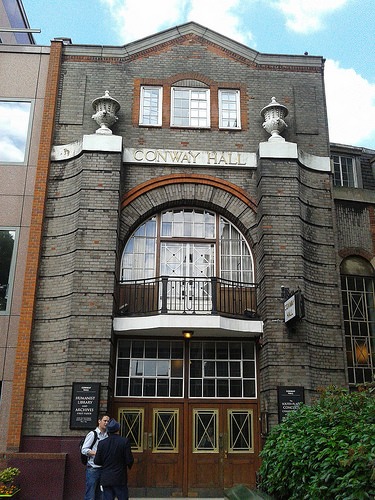
The other night I attended a talk organised by the Conway Hall Ethical Society and the London Fortean Society, on the theme of Spring-heeled Jack, the legendary Victorian figure made famous by late nineteenth century penny dreadfuls. The event was held at Conway Hall, a building near Holborn which hosts many talks, events and courses.
I know of Spring-heeled Jack, a mysterious figure of urban folklore, mainly through his incarnations in Victorian fiction and later, including Philip Pullman’s novel. This talk, delivered by Dr Karl Bell, a Senior Lecturer in History at the University of Portsmouth, focused on his origins at the beginning of the Victorian era.
The legend of Jack supposedly grew out of the reported sightings of “local” ghosts throughout London, including the “Hammersmith ghost” that terrorised Londoners in the south west at the beginning of the nineteenth century. In the autumn of 1837 a sighting of a white bull was reported in Barnes, swiftly followed by a bear in East Sheen. In the next few weeks the creature appeared to transform, being seen as a man and a devil, heading out as far as Hampton Court and attacking a carpenter in Isleworth, who reported that the creature wore polished steel armour. The creature continued to traverse west London, causing some individuals to comment that he appeared to be making use of the Great Western Railway: he was sighted in Uxbridge, Ealing and Acton before eventually surfacing in Lewisham and Blackheath. A mention in the London Metropolitan News in early 1838, and a letter to The Times, brought the affair to the attention of the general public.
When the Mayor requested descriptions of the mysterious figure so that attempts could be made to catch him, he was inundated with widely conflicting accounts. The thing was a devil, a person, a ghost; he was covered with a white sheet or metal armour; he breathed fire, which was sometimes blue. An odd creature, whose raison d’être was apparently to frighten, rather than harm, people: he would terrify them out of their wits then casually wander away. At this stage there was no mention of the springs attached to his shoes that would help him leap ten feet into the air and vanish along the housetops. It was rare to find a first-hand account; most stories came from someone who’d heard that their second cousin’s neighbour’s daughter (or some such connection) had encountered Spring-heeled Jack.
Dr Karl suggests that there were three reasons in particular that helped this character to become so well-known. Firstly, his appearance and character evolved, becoming distinctive and memorable, and it helped that satirist magazines printed vivid images. Secondly, his name, “Spring-heeled Jack”, was particularly memorable, even though he didn’t receive a name until he had been around for about four months.
Finally, the combination of oral gossip and press interest overlapped and fuelled growing interest, ensuring that Spring-heeled Jack entered the public consciousness. It wasn’t until the 1860s that he received his “terror of London” epithet, but it seemed particularly apt for a creature that had been terrorising the city for, by then, over twenty years.
Dylan Thomas in Fitzrovia
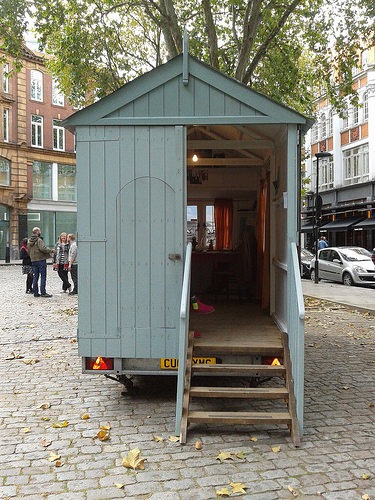
This week has seen the Dylan Thomas in Fitzrovia festival happening in central London, based around the part of Bloomsbury where the writer used to hang out in the middle of the century. Talks, readings and performances have all been taking place, and I have booked to see Clown in the Moon, a performance about Dylan, tomorrow. Yesterday I took advantage of the fact that I work incredibly close to the area where the festival is taking place, and popped out to see Dylan’s writing shed, which is on tour around the country.
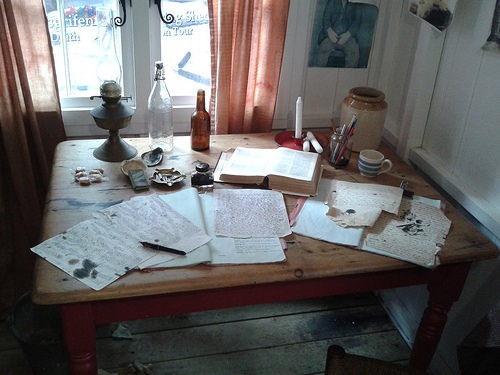
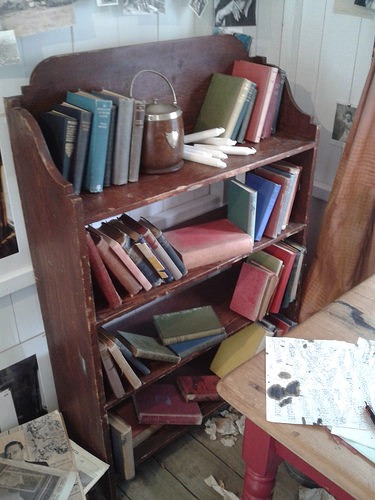
The shed is a near-exact replica (it has been scaled down slightly to allow it to be transported around the country on a trailer) of Thomas’ real writing shed in Laugharne. It is full of bookshelves, papers and other odds and ends, with Dylan’s coat draped over the back of the chair – just as if the poet himself could come inside at any moment.

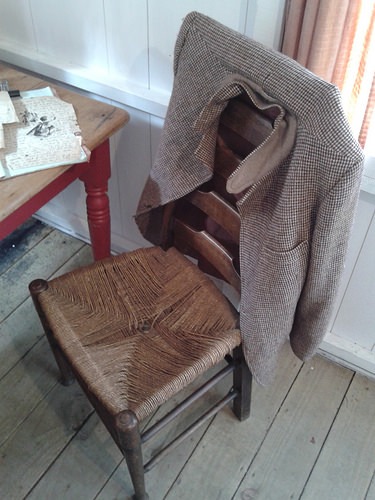
Behind the Screen: Hollywood Glamour – Somerset House
On Sunday night I went to Somerset House to attend a talk called Behind the Screen – Hollywood Glamour: Classic Hollywood icons and how they created their signature looks. The talk was held in the Screening Room and was delivered by Jane Richardson, International Lead Stylist at NARS.
Richardson, who obviously has a great understanding of modern makeup, proved an engaging speaker who is clearly interested in the history of Hollywood glamour. She discussed how modern attempts to recreate classic styling often involve tweaking various elements of a look to make them a bit more modern, as well as using innovative phone apps such as Instagram to make a picture look older and more “vintage” than it really is. In the mid-20th century, however, cinemagoers who wanted to emulate their favourite stars usually tried to recreate the whole look: when they went to see films they wanted to be transported into a different world, and wanted to “be” that person on screen. Demos of hair and makeup would often take place at cinema screenings. On a similar note, actresses themselves would usually pick a look and stick to it throughout their career, rather than changing their image frequently like many modern-day actresses do. They were “owned” by the studio that hired them and were often taught how to do their own makeup – although these items were still called “cosmetics” as the term “makeup” was seen as vulgar, associated with women of a certain profession.
I was interested to learn how filming procedures and equipment affected the look of makeup on-screen. Nowadays we associate the Twenties with dark burgundy lipstick, but in fact actresses wore red, and it was the black and white film that made the colour appear darker (on a similar note, anything blue came out white). The advent of Technicolor changed makeup, and two firms in particular, Elizabeth Arden and Max Factor, pioneered new products. Elizabeth Arden was famous for “nuchromatic” makeup, while Max Factor launched the first “cosmetic” product in 1914, followed by “panchromatic” cosmetics in 1929 and the “pan-cake” in 1937. Actress Norma Shearer, a genius in manipulating how she appeared on-screen, would wear the lightest shade of pan-cake herself and demand that every other actress wore a darker shade, ensuring her complexion appeared brighter and fresher than everybody else’s.
During the talk we learned about the lengths several Hollywood actresses would go to in order to enhance their beauty. Margaret Sullavan was signed to Universal Studios in 1933: the studio made her endure some rather drastic procedures including the removal of a mole on her face and the removal of her entire top row of teeth, which were supposedly crooked. Greta Garbo was particularly influential: we saw some “before” and “after” shots which showed how she removed most of her eyebrows in order to fit accepted standards of beauty, as well as using makeup to change the shape of her mouth and appearance of her eyes. Marlene Dietrich, who compared her relationship with her makeup artist to that between accomplices in crime, had her back teeth removed to make her cheekbones look more lifted, and aged 43 gave herself a “temporary facelift” by twisting her hair and pulling it back so hard that it bled. Perhaps the most drastic – and horrific – procedure was undergone by the actress Carole Lombard. She had plastic surgery to reduce scarring after an accident, in itself not particularly drastic – until you find out that she had this surgery without pain relief, as it was believed that anaesthetic would reduce the success of the procedure.
It wasn’t just makeup, but hair that was an important part of an actress’s style. Rita Hayworth underwent electrolysis to raise her hairline when the studio claimed that her forehead was too low. Carole Lombard and Marilyn Monroe famously dyed their hair blonde, but the original “platinum blonde” was Jean Harlow, who used a harsh dye containing peroxide and ammonia. So influential was her hairdo that producers changed the name of her movie to Platinum Blonde.
Some actresses used rather less drastic methods to enhance their beauty. Joan Crawford became such an expert in studio lighting – knowing how it could affect her entire look – that she could supposedly tell when one of the bulbs had blown before the technicians, claiming that she could feel the cold spot on her face (studio lights were notoriously hot). Crawford would also splash her face with ice-cold water 25 times after every wash, believed to freshen the complexion but not advisable now! Vivien Leigh, believing that her hands were too big, wore gloves as often as she could get away with.
What interested me, in the face of all these rather dramatic methods of achieving “beauty”, was how several acclaimed actresses actually did their own makeup. Elizabeth Taylor actually did her own makeup for Cleopatra. Jane Russell also did her own makeup, as did Marilyn Monroe, who supposedly invented lip gloss by choosing to add shine to her lipstick. An interesting way to end a fascinating talk.
RIFT Macbeth

I’m going to write a proper review of RIFT’s Macbeth, but in the meantime I want to write something about the experience itself, as it was one of the craziest, most intense things I’ve ever done. I booked it for myself for a birthday treat, and I tried to get some friends to come along, but none of them were particularly keen on the idea. Despite initial apprehensiveness about going on my own, I needn’t have worried. I talked to loads of really interesting people, about the show and about our shared interest in immersive theatre (practically everyone there had already been to Punchdrunk’s The Drowned Man). In any case, most of our time was spent taking in the show, and we didn’t have to worry too much about chatting.
Webcowgirl and Playhouse Pickings have already written really helpful guides to the experience, so all I will do is emphasise the importance of following their tips – they came in very handy for me. Having said that, there were no super-hot peppers at our banquet – only perfectly innocuous, not at all spicy ones. I felt rather smug that I’d heeded the warnings about eating beforehand and going to the loo (I spent a couple of hours at Westfield Stratford before heading to Langdon Park DLR) as many of my fellow audience members were dying for the toilet almost immediately and when we were finally allowed to go there was a huge queue.
I stayed overnight and slept very well in my bunk bed – a bit TOO well, to my disappointment, as I slept right through the whopping thunderstorm that occurred on Thursday night, and missed out on the chance of watching the action from my flat’s 18th floor balcony. The flat itself – the hall and bathroom, at least – was still covered in blood from the performance, which was somewhat disconcerting. I was able to wash my face and brush my teeth, but after much-appreciated coffee and croissants in the morning I was very happy to get home and finally have a shower.
Still, this performance will go down as one of my favourite London experiences, and it was definitely one of the best birthdays ever!


Boring IV Conference – Conway Hall

On Saturday I attended the Boring Conference, held at Conway Hall near Holborn. This was the fourth such conference, although the previous ones had been numbered 1 to 3 while this one has been given the appellation IV – a move to Roman numerals (as was explained to us at the beginning of the conference by founder James Ward). The conference aims to celebrate the mundane and the everyday, finding fascination in supposedly dull and boring things.
James Ward (@iamjamesward) gave the first presentation of the day, looking at highlights from the 1990s Saturday night ITV show You Bet!. I had never heard of this show, but I have clearly been missing out. Participants attempted bizarre challenges which included identifying cast members of The Bill by only their ears or noses, and balancing an egg between an engine and a carriage. One particularly bizarre stunt showed a couple of boys identifying their friends by looking at their belly buttons.
Continuing the media theme, Martin White (@martylog) spoke about film titles translated into German. These hilariously literal interpretations of English language humour included such gems as “A Magical Nanny in a Further Adventure” (Nanny McPhee and the Big Bang), “Unbelievable adventures in a crazy aeroplane” (Airplane!), “The City Neurotic” (Annie Hall) and, perhaps best of all, “The Annoying Man” (The Cable Guy).
Valerie Jamieson (@valeriejamieson), former particle physicist and current features editor at New Scientist, talked about ‘boringology’, or the “science of boring”. She spoke about the science of watching grass grow and seeing paint dry, as well as the accuracy of the phrase “as dull as ditchwater”. Her talk proved very interesting: we learned that grass grows from the root up, that ditchwater is actually full of life, and that most of the action in drying paint happens during the first twenty minutes.
Next up was the Wolverhampton-based dentist Toby Dignum (@dignut), speaking on the subject of calendars. He talked about how the ancients measured the calendar, how Caesar introduced leap years, and how Pope Gregory rejigged the calendar again in 1582, ‘resetting’ it after centuries in which the few minutes left over each year gradually added up moving the calendar out of its original place. I’ve always been slightly confused about the Julian and Gregorian calendars, so it was good to finally have this cleared up. Another fascinating fact I learned was that the Best Before date on a packet of crisps is always a Saturday.
Another of my favourite talks came from Ali Coote (@alisouthsea), based in Southsea, who shared her memories of working in an ice cream van. The trials and tribulations of the job proved very interesting, and I enjoyed her clear enthusiasm about ice cream, including the right way to make a 99!
Martin Zaltz Austwick (@martinaustwick), a lecturer at UCL, spoke on the unusual topic of eggs. Eggs are very versatile and the science behind them is really quite exciting. Martin mentioned the #eggchat topic he started on Twitter, to encompass facts about eggs and recipes involving them, and the resulting Twitterstorm involving angry vegans!
Before lunch, there was time for one more presentation, this time from George Egg (@georgeegg) – an interesting egg-theme seemed to be developing – who gave a talk on the meals you can make using the equipment provided in hotel bedrooms. From toasting pitta bread in the trouser press, to boiling pasta in the kettle and frying eggs on irons, there is little limit to what you can make. I am not sure how thrilled hotel staff would be, though, to go into a room and find an eggy iron!
After lunch (super-cheap salads from Waitrose… score) it was time for the afternoon presentations. The PM session kicked off in fine style with Rhodri Marsden (@rhodri) demonstrating the similarities between 198 of the world’s national anthems. The crucial fact I took away is that many, many of them have the same three chords at the end.
Next, Francesco Tacchini (@RuffNuff), Julinka Ebhardt and William Yates-Johnson from the Royal College of Art showed us their Space Relay project: “a hovering object that explores and manipulates transitional public spaces with particular acoustic properties”. To be honest I wasn’t all that excited about this at first, but I actually really enjoyed the presentation: it was interesting to see the public’s reaction to the sphere, and the different references it suggested, including The Prisoner.
As a librarian, I was looking forward to Andrew Male’s (@AndrewMaleMojo) session on Eric Clapton’s bookshelf; the actual talk was very different to what I had expected, yet very entertaining in its own way. Male developed a bizarre obsession with Clapton’s bookshelf after seeing it in a number of documentaries. He identified the books that Clapton had and tried to work out what they said about Clapton himself, in a very funny talk.
Ben Target (@bentarget), with French accent and a packet of cream crackers, delivered a presentation supposedly about his family while continually stuffing crackers into his mouth. To be honest I didn’t really ‘get’ this one. It wasn’t particularly funny or interesting – I know this is the ‘boring’ conference but I don’t think this kind of ‘boring’ is the kind that was meant!
Emerald Paston (@emeraldpaston), an assistant producer, talked about a list she made as a child, ambitiously consisting of “every boy’s and every girl’s name ever”. In total her list encompassed 523 girls’ names and 572 boys’ names – an impressive count! What I liked about this list was what it revealed about the psyche of a child/young teenager: the names ranged from Noddy and names taken from Harry Potter to the names of Greek gods.
Another of my favourite presentations came from John Grindrod (@Grindrod), author of Concretopia: A Journey Around the Rebuilding of Postwar Britain, who revealed “the secret modernist agenda hidden in Ladybird books”. This was very funny and some of the images shown were brilliant: “a cross between Swallows and Amazons and North By Northwest”, as he said. Ladybird books included pictures of high-rise flats and prefab schools, as well as airports, roads, and a disturbing number of nuclear power stations.
Marc Isaacs could not make it to the conference so his award-winning documentary was shown instead. Lift, made in 2001, was filmed in the elevator of a tower block in the East End of London. It captured the lives of those who live in the tower block, and was by turns funny, touching and illuminating.
A discussion of inkjet printers from the 1990s followed, facilitated by Mark Dean Quinn (@markdeanquinn). He had a seriously impressive knowledge of these printers and got into conversation with another printer enthusiast in the front row.
Nathaniel Metcalfe (@natmetcalfe) talked about being a fan of the actor Deep Roy. His was a touching talk describing how he maintained a fan site for the actor for years, until his popularity shot up after he starred in Charlie and the Chocolate Factory.
The penultimate presentation was delivered by Helen Zaltzman (@helenzaltzman), who gave a very funny talk on the sociological lessons which can be learned from cookbooks of the 1950s and 60s. This was hilarious and I couldn’t help thinking that it was no wonder everyone was thin in the 50s – the food was too disgusting to eat!
Finally, and perhaps most impressively, Vincent Connare (@VincentConnare), an American typographer, spoke to us about his most famous creation, Comic Sans. Comic Sans is the font we all love to hate, but Connare’s talk on how it came about was very interesting, and I was intrigued to learn that it was inspired by the Watchmen comic.
I really enjoyed the day: despite the name, it was a really interesting conference. I learned a lot and if I can, I would like to go back next year, to Boring 5, or V…