Strange Beauty: Masters of the German Renaissance – National Gallery

After a busy weekend with my friend, I saw her off at the station and then headed to the National Gallery. One of their current exhibitions, on display in the Sainsbury Wing, looks at German Renaissance paintings.

Strange Beauty: Masters of the German Renaissance explores how artists such as Hans Holbein the Younger, Albrecht Dürer and Lucas Cranach the Elder were viewed and portrayed in their time. For many decades the Italian Renaissance was held to be superior, and many German works were viewed as excessive or ugly. On a more positive note, they were often admired for their technical mastery, and their representation of a German national identity.

The exhibition has been criticised for not borrowing works of art from Germany, and instead focusing on works from the Gallery’s own collection. Reviewers have also described it as lacking excitement or anything new to say. These are all valid arguments, but as someone who is a complete amateur when it comes to art, I enjoyed this focus on the German Renaissance and it helped me to view these familiar works of art in a new way.

The Great War in Portraits – National Portrait Gallery

2014 marks the centenary of the start of the First World War, and many museums and galleries are marking the occasion with events and exhibitions. The National Portrait Gallery has kicked things off with a display called The Great War in Portraits. I decided to visit one weekday afternoon, when I had some time off work: I thought, as the exhibition was free, it would be best to go during an off-peak time. I think I made the right decision: the exhibition was pretty crowded as it was, and there was a sign up warning of further crowding at peak times.

The exhibition shows widely different images of the people involved in the war, evoking their varied experiences and roles. It makes use of different mediums, including paintings, film, drawings and photographs. There is even a sculpture: the Prologue displays Jacob Epstein’s ‘The Rock Drill‘, a robotic-looking figure representing humanity’s fascination with mechanisation. This was originally created in 1913, the year before modern warfare would cause such devastation. However, the version shown here is the 1916 version, which Epstein created in response to the war. Gone is the celebration of automation, machines and the power of technology. Instead, the sculpture has had the drill removed and three limbs severed, reflecting the horror and destruction of war.

The exhibition is divided into a number of sections. Royalty and the Assassin contrasts formal, old-fashioned portraits of heads of state before the war with an image of Gavrilo Princip, the teenage assassin of Archduke Franz Ferdinand. Paintings of British, German, Russian and Austrian-Hungarian leaders evoke imperial grandeur and arrogance, while to a lesser extent photos of the President of the French Republic are designed to represent power. However, the picture of Princip is subdued and understated. Together, these images reflect the world before World War I and the political and social climate in which it began.

After war was declared, military leaders began to take on more power, and Leaders and Followers illustrates the hierarchical order, with traditional, formal images of commanding officers who often wore medals. Ordinary soldiers are also represented in more informal poses, often in groups and in a markedly down-to-earth manner. Both kinds of images were often shared as postcards.

By 1916, it was clear that the war would not be ‘over by Christmas’ and the horrific consequences were becoming apparent to many, even as those in power fought to maintain the illusion of jingoistic patriotism. The pictures in The Valiant and the Damned vary wildly in tone, with images of decorated soldiers, poets like Wilfred Owen, the infamous Mata Hari, killed or injured officers, and soldiers from all corners of the globe. For me, the most moving and striking images were the sketches made by Henry Tonks of facially disfigured servicemen. Reconstructive surgery made great strides during the war, and some wonderful achievements were made, but even so the experiences of these soldiers must have been dreadful: Tonks’ images help to give them back dignity and a sense of identity.

And then, something completely different – Fact and Fiction: The Battle of the Somme in film contrasts films by the British and German propaganda bureaus concerning the Battle of the Somme. These films were designed to evoke the ‘thrill of battle’, showing soldiers working and living together, and actually displaying images of dead and wounded soldiers. The first day of the Battle of the Somme, 1 July 1916, resulted in horrific losses including 19,240 British soldiers. Nevertheless, the film made by Geoffrey Malins and John McDowell, The Battle of the Somme, was a huge popular success, reaching an estimated 20 million people. It was truthful up to a point, but did not convey the full horrors of the battle. The German film, on the other hand, released in January 1917, enjoyed less success, partly because it used inaccurate footage and enacted scenes.

After the war, Britain and Germany largely headed in contrasting directions as far as art was concerned. In Britain, the trauma of the carnage led to a return to the comforting and familiar past, while in Germany there was a reaction against the old order and Expressionism gained ground. Tradition and the Avant-garde shows pictures from both of these widely different concepts, and how different artists reacted to the war.

This is a small but very well-presented exhibition that thoughtfully compares and contrasts different responses to the war in terms of portraits. It’s certainly worth a visit, particularly as entry is free. The exhibition runs until 15 June 2014.

A Dialogue with Nature: Romantic Landscapes from Britain and Germany – Courtauld Gallery

After visiting the Isabella Blow exhibition at Somerset House, I headed to the other side of the building and the Courtauld Gallery, where a new exhibition had just opened. A Dialogue with Nature: Romantic Landscapes from Britain and Germany focused on aspects of Romantic landscape drawing in both Britain and Germany, covering the period 1760-1840. This kind of art is a favourite of mine, and I enjoyed looking at the beautiful and majestic landscapes of J.M.W. Turner, Samuel Palmer, Caspar David Friedrich and more.

Isabella Blow: Fashion Galore – Embankment Galleries, Somerset House

I spent Sunday morning checking out a few of the exhibitions at Somerset House. I was just in time to catch Isabella Blow: Fashion Galore, as this was the exhibition’s last day.

Isabella Blow at Somerset House

Isabella Delves Broughton was born into aristocracy in the 1950s. However, despite her seemingly privileged family and upbringing she had in many ways a difficult childhood. Her young brother drowned at the age of two, and the cash-strapped family lived in a cottage on the family estate as they couldn’t afford to live in the house itself. After leaving school, she worked at various jobs before moving to America; she ended up working for magazines including Vogue and Tatler. She married Detmar Blow in 1989, wearing a headdress by Philip Treacy – one of the first to recognise his talent. She also discovered Alexander McQueen, as well as the models Sophie Dahl and Stella Tennant.

Blow loved fashion and had a highly individual and unusual style. This exhibition, after an initial exploration of her early life, showcased some of her unusual outfits and accessories, including several hats by Treacy and clothes by McQueen. I particularly loved the hats and hair accessories – I’m not sure how wearable they would be, but they were so amazing to look at that I didn’t care. I especially loved the castle house, and the ship headdress made of feathers. Blow wore her own clothes frequently and with love: scratches, cigarette marks and tears reveal the person behind the amazing clothes. I’ve always seen high fashion as rather out of reach, but this exhibition made it human.

The exhibition focused on Blow’s life, career and relationship to fashion, and doesn’t say much about the fact that she sadly committed suicide in 2007, aged only 48. On the one hand, it seems to gloss over the truth of her life; on the other, I would imagine her friends and loved ones would rather focus on the happy times of her life than on her death. I’d never heard of Isabella Blow before seeing this exhibition advertised, but I wish I had – she sounds like she was an amazing lady.

Pink lobster necklace from Tatty Devine

On my way out, I purchased this little beauty from the gift shop. I had my eye on the large, crystal-studded version, but that was £180. This was only £40 and it was the last one left – clearly, it was fate! I am something of a Tatty Devine obsessive and this pink lobster is exclusive to this exhibition so I was very happy to snap it up (pun not intended).

Chepik Retrospective – Mall Galleries

Sergei Chepik (1953-2011) is regarded as one of Russia’s greatest painters, which made me want to see a retrospective exhibition of his work at the Mall Galleries in central London. I was not disappointed.

When I was in St Petersburg a few years ago, I visited both the Hermitage and the Russian Museum. I found I preferred the distinctive, intense works by native painters in the Russian Museum to the European masterpieces on show in the Hermitage. I am not, and never have been, someone who is knowledgeable about art, but I just found the Russian art more… interesting.

Chepik’s work could easily belong in the Russian Museum. It is visionary, beautiful and distinctive. The artist painted religious scenes, images from his native Russia, and pictures inspired by his later home of Paris. His religious images are bleak, almost fantastical, unsettling, and moving even to an atheist (which he was himself). Many of them were based on or evoke events from Soviet Russia.

Chepik also drew on folk tales for some of his works: a painting I particularly loved showed the puppet-figure Petrushka (the Russian representation of autumn) surrounded by Russian folk figures. Other images covered sinister clowns and other circus characters, book illustrations (including for Bulgakov’s The White Guard) and portraits.

This exhibition was free and I’m so glad I went – it seems Russians still make the most awesome art!

‘The Ship of Happiness’, Sergei Chepik

Republic of the Moon – Bargehouse

Bargehouse
Entrance to the Republic of the Moon

In the Bargehouse near the Oxo Tower, The Arts Catalyst embarked on a rather odd project called the Republic of the Moon. It incorporated lunar-based works from a number of artists and was designed to explore our relationship with the Moon.

This was an odd experience to say the least, particularly the dark and silent room created by Liliane Lijn who plans to project the word SHE onto the surface of the Moon. Moon Vehicle was an interesting project based in India, where students designed their own lunar vehicles.

I really liked Leonid Tishkov’s Private Moon, which was a series of beautiful images showing him and his own small Moon in various settings. My favourite work, though, was Katie Paterson‘s Earth-Moon-Earth. Paterson sent messages in Morse Code which were reflected from the surface of the Moon and then received again on Earth. Some parts of the messages were lost, absorbed by shadows or vanished into craters. One of the messages she sent was the score of Beethoven’s Moonlight Sonata – the resulting score plays on a self-playing grand piano. Listening to the result is eerie: it is recognisable as the famous sonata, but with unsettling differences.

The top prize for weirdness has to go to Agnes Meyer-Brandis and her documentary Moon Geese Analogue: Luna Bird Migration Facility. Inspired by bishop Francis Godwin’s 1638 book Man in the Moone, in which the protagonist flies to the Moon in a chariot towed by migrating ‘Moon geese’, Meyer-Brandis has raised eleven geese from birth, given them astronauts’ names (one is called Neil!) and embarked upon a training programme designed to prepare them for travel to the Moon. This was one of the strangest things I have ever seen, and the documentary was oddly compelling.

Jake and Dinos Chapman: Come and See – Serpentine Sackler Gallery

I visited a very intriguing exhibition at the Serpentine Sackler Gallery at the weekend. Jake and Dinos Chapman are artists who work in a variety of mediums, creating models, sculptures and images that comment on consumer culture, morality and past art. Their exhibition Come and See incorporates many of these, and is absolutely fascinating.

I loved the miniature scenes of carnage and war, incorporating dinosaurs, skeletons, Hitler and Ronald McDonald. The detail of these models was incredible.

Hitler with balloons
Crucified Ronald McDonald
Creepy figures and a spaceship
Skeletons and burnt-out cars
McDonalds characters on a boat

The exhibition also had some rather frightening sculptures, like this one of a familiar figure.

Ronald McDonald
Terrifying!

The Chapmans also create paintings and other images. Some of them, painted over pages from books, reminded me of Guillermo del Toro’s films.

Painting over a page of a book

Others were inspired by the craze for portraiture among the upper classes of several hundred years ago, and comment on the futile quest for immortality these people sought.

Two children in formal clothing
Some of the other items in the exhibition included cute little figures and even dinosaurs, like these ones below.

Model of a lady in a wheelchair Models of people and dinosaurs

Sadly the exhibition has now finished, but I will certainly be looking out for more of the Chapmans’ work in the future.

The Serpentine Sackler Gallery opened in 2013. It is located in a former 1805 gunpowder store, divided from the original Serpentine Gallery by the Serpentine Bridge, with an extension by Zaha Hadid. Both galleries showcase temporary exhibitions of contemporary art.

FACTS

Address: West Carriage Drive, London, W2 2AR

Website: serpentinegalleries.org

Opening Hours: 10am-6pm Tues-Sun, plus bank holidays

Prices: Free

Pop Art Design – Barbican Art Gallery

I headed to the Barbican Art Gallery for the first time last week. I visited in order to check out the exhibition on Pop Art Design, which sounded interesting.

Pop Art flourished mainly in the mid-20th century, and grew up as a reaction to the austerity of the wartime era and the dawn of the media age. Artists like Roy Lichtenstein, Andy Warhol and others created iconic works inspired by advertising slogans and incorporating bright and bold colours and designs. I don’t know if Pop Art is really ‘me’, but I found the exhibition interesting nevertheless.

Paul Klee: Making Visible – Tate Modern

The EY exhibition at the Tate Modern is Paul Klee: Making Visible, until the 9th of March. I didn’t know a great deal about the artist, so took a chance and headed down to Bankside to check the exhibition out.

Klee is an important figure of 20th century art. His breakthrough came during the First World War, following which he taught at the Bauhaus before moving to Düsseldorf and subsequently being dismissed from his teaching position by the Nazis, who labelled his works ‘degenerate’. Though I’m not a particular fan of twentieth-century art, anything labelled negatively by the Nazis gains merit in my eyes!

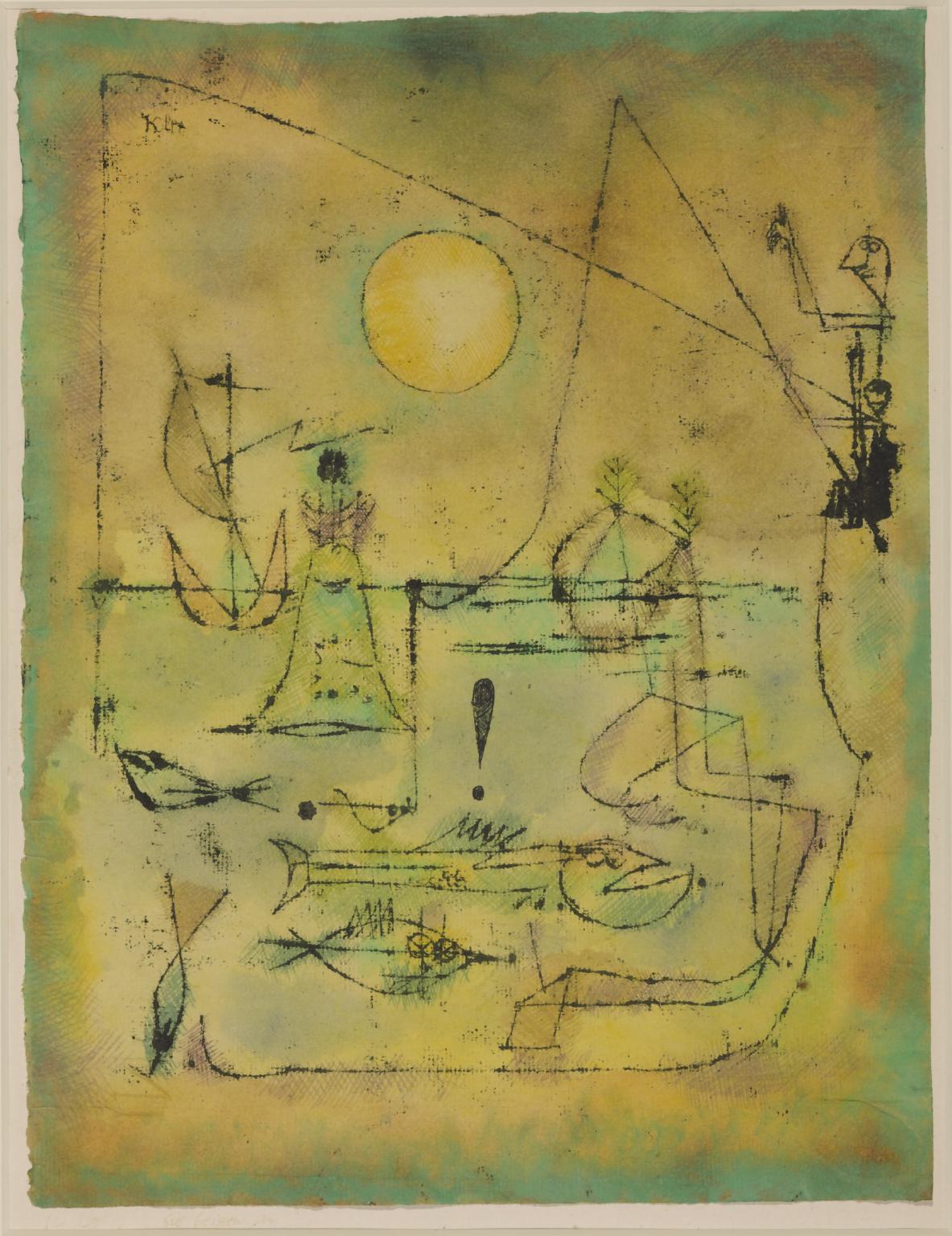
Paul Klee, They
Paul Klee, They’re Biting, 1920 (Tate Modern)

Most of Klee’s works are very small; this came as a surprise to me as for some reason I always imagine modern works of art to be huge. I saw a lot of them as ‘cute’ – this might sound like an odd thing to say about art, but many of the works were warm, attractive, with a sense of humour – something drew me into them and made me interested. I particularly liked the fish pictures, and the related ‘They’re Biting’. I loved the way his later works seemed to comment on Nazism and contemporary culture, and his late works – such as ‘Walpurgis Night’ and images of witches – had a distinctly darker tone. Despite my initial misgivings, I really enjoyed the exhibition and admired the variety in Klee’s work.

Stanley Spencer, Julian Stair and Albrecht Dürer at Somerset House

Somerset House, the magnificent 18th century building on the banks of the Thames, is home to a variety of art exhibitions and other interesting facilities. I paid a visit to check out some of the exhibitions they had going on.

I began in the Terrace Rooms in the South Wing, with Stanley Spencer: Heaven in a Hell of War. Spencer experienced the First World War and painted from his experience, both as a hospital orderly in Bristol and as a soldier on the Salonika front. This exhibition displays canvas panels on loan from the National Trust’s Sandham Memorial Chapel, as well as a projection of the altarpiece which was too fragile to remove. The Chapel was designed specifically for the panels, and was built by Spencer’s friends, John Louis and Mary Behrend. Here, they have been arranged in a way that echoes their original layout, and gives a good impression of how they look within the Chapel.

The paintings took six years to complete, and were finally finished in 1932. Unusually for images of war, they represent the domestic side of wartime life – scrubbing floors, washing clothes, making tea and inspecting kit. Spencer wanted to show how these ordinary chores became miraculous in the face of wartime danger – creating “a heaven in a hell of war”. It’s an intriguing idea, and I like it – seeking something positive in the face of such horror is a kind of defiance.

Next I ventured into the intriguingly-named Lightwells & Deadhouse, reached via the South Wing and taking me below the Somerset House courtyard, to explore Julian Stair: Quietus – The Vessel, Death and the Human Body. This unusual exhibition was made up of ceramic works in the form of coffins, jars and funerary urns. The strangest exhibit was a white urn containing the ashes of Stair’s uncle, shown alongside video and audio snippets from his life.

Finally, I went to the Courtauld Gallery to see the exhibition The Young Dürer: Drawing the Figure. This was an interesting take on the artist’s journeyman years, when he honed and developed his style.