Southwark Cathedral

I’ve wanted to visit Southwark Cathedral for quite a while, and finally got my chance the other week. I was hanging around the London Bridge area one Sunday waiting until the right time to take the train to New Cross (I was going to the theatre) and decided to pop in.

2012 0916 Southwarkcathedral 43

Southwark Cathedral

Southwark Cathedral has a long and distinguished history. There has been a church on this site since (probably) the first millennium, and it is recorded that it was refounded as a priory in 1106. Parts of the current building date from this time, although the church was restored in the 19th century and new extensions were added in 2000. The church became a cathedral in 1905 on the creation of the area’s diocese.

2012 0916 Southwarkcathedral 40

Plaque at Southwark Cathedral

While the building itself is worthy of a visit, there are other aspects of the cathedral which mark it out. It was probably Shakespeare’s place of worship, as he lived and worked nearby, and is in fact the burial place of one of his brothers. It also contains the tomb of Bishop Lancelot Andrewes, one of the translators of the King James Bible, and the founder of Harvard University was baptised here in 1607. Of particular interest to me was the tomb of John Gower, Poet Laureate to King Richard II and King Henry IV, and author of the Confessio Amantis, of which a manuscript exists in my old workplace in Cambridge (hence my interest). You can see the title of the book engraved on the volume carved in his tomb effigy.

2012 0916 Southwarkcathedral 27

Tomb of John Gower

It is requested that £4 is donated to the cathedral to contribute towards its upkeep, which I was happy to pay. Even without the noteworthy individuals associated with the place, the cathedral is still a stunning building that is well worth a visit.

2012 0916 Southwarkcathedral 34

Ceiling of the cathedral

Diamonds: A Jubilee Celebration – Buckingham Palace

As the summer opening of Buckingham Palace is drawing to an end, I decided to pay a visit and make the most of my ticket from last year (I visited in 2011 as I wanted to see Kate’s wedding dress, and your ticket is valid for a year after purchase). To celebrate the Diamond Jubilee, there is an exhibition of diamonds at the Palace and I wanted to see this. After all, diamonds are a girl’s best friend.

Diamonds are a girl's best friend

There was some beautiful jewellery on display, some of it from the time of Queen Victoria, and I liked seeing paintings and photographs of kings and queens wearing the items displayed. Sword hilts, crowns and tiaras were among the pieces shown, and sparkled beautifully in the low-lit room.  I liked the Coronation Earrings and Necklace from 1858, so called because Queen Elizabeth II wore them on her coronation day. The exhibition also displayed seven of the nine major stones cut from the Cullinan Diamond (the other two are part of the Crown Jewels). This famous diamond – the largest ever found – was discovered in South Africa in 1905 and named after the chairman of the mining company which owned the mine in which it was found. It was formally presented to King Edward VII in 1907. Too big to be much use, it was cut up into a number of stones. I also loved the diamond crown made for Queen Victoria in 1870: it was so small and delicate.

Queen Victoria's Small Diamond Crown

I walked through the grounds afterwards; it was a beautiful autumn day, sunny but with a refreshing nip in the air. It was so early that the streets weren’t particularly busy. It was almost worth setting my alarm for seven thirty.

2012 0915 Buckinghampalace

Bethlem Royal Hospital Museum and Archives

We all know the modern meaning of the word Bedlam, used to denote a place of chaos. This modern meaning has its origins in the Bethlem Royal Hospital of London, which was founded in 1247 and exists to this day. In the eighteenth and nineteenth centuries it was notorious as a place where visitors could go to stare and jeer at the inmates, but it has a rich and varied past that extends way before and long after this dubious period in its history.

I studied History at university, and one of the topics I studied was the history of medicine in the eighteenth and nineteenth centuries. One week we looked at insanity, and the different ways this has been interpreted and treated over the centuries. The role of Bethlem Hospital was significant in helping us to understand how madness was viewed and treated, and when I found out that there was a museum about the hospital, I knew I wanted to go.

Bethlem Royal Hospital Museum and Archives is located on the modern hospital site, at Beckenham, south London. It is open Monday to Friday, but only one Saturday a month. Visiting the museum is free, but you need to get the train to Eden Park from London Bridge, Waterloo East or Charing Cross. I like trains so enjoyed my journey; I always find it incredible that a short journey can take you into a suburban or even a rural area, away from the busy centre of the city.

The museum itself is tiny, but considering the lack of space a surprisingly large number of items are on show. The museum has too many objects and archival documents to be able to display them all, so if you want to see something in particular you will need to phone ahead; I, however, was just happy to browse. At the entrance to the museum room, a number of boards relate the history of the hospital; I found this particularly interesting, as beyond the little I found out during my studies, I didn’t know a great deal.

Bethlem Royal Hospital began life as the priory of St Mary of Bethlehem (the site of which is now covered by Liverpool Street Station), which was treating insanity by the fourteenth century.  Bethlem and Bedlam were interchangeable terms for Bethlehem, and were both used to describe the hospital. Refounded after the Reformation as one of five ‘Royal’ hospitals, Bethlem came under the control, and later the possession, of the City of London.

The hospital was in need of new premises by the seventeenth century: numbers had increased, and the old building was showing signs of wear and tear. The new building, designed by Robert Hooke, was opened at Moorfields in 1676. Galleries, which ran the length of the building, were where sightseers were able to view the inmates until such visits were stopped in 1770. At the time, Bethlem was the only public institution of its kind, though private madhouses did exist. It was largely designed for short stay patients, though an incurable wing did exist from the 1730s until 1919.

The third Bethlem site opened in 1815 – what remains of the building is now the Imperial War Museum.  Throughout the nineteenth century, restraint of patients was abandoned and patients were encouraged to work and enjoy recreation and entertainments. I found this interesting as the changing treatment of mentally ill people was something I had studied during my degree.

Bethlem has occupied its present site since 1930. Designed on a different system to the previous hospitals, it is made up of individual buildings containing its own ward, kitchen, dining room and garden. The hospital was joined with the Maudsley Hospital in Denmark Hill after the founding of the NHS in 1948.

Inside the museum itself, there were artworks created by former patients; often dark in tone, these were striking and unusual. Among the most interesting for me were pictures drawn by Jonathan Martin, the man responsible for setting fire to York Minster in 1829 and later incarcerated in Bethlem. He was the brother of John Martin, the famous popular painter of dramatic Biblical scenes whose work was recently exhibited at Tate Britain. Despite studying in York for three years I hadn’t realised that this had occurred!

2012 0901 Bethlem 05

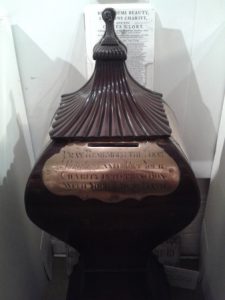
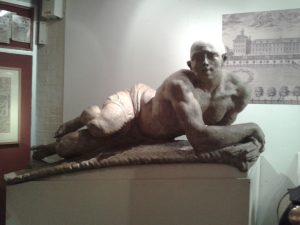
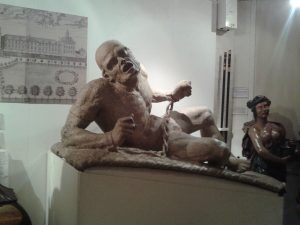
There were some fascinating objects on display, including fearsome-looking restraint devices and a number of alms-boxes, one bearing the pleading message, “Pity the poor Lunaticks”. Dominating the small room were the two stone figures, carved by Caius Gabriel Cibber, from the gates of the seventeenth century hospital. These are known as “Raving” and “Melancholy” madness, meant to represent the two ways in which insanity was chiefly classified at this time.

2012 0901 Bethlem 03

“Melancholy” madness
2012 0901 Bethlem 04

“Raving” madness

I also enjoyed looking at the archives on display, such as a book of instructions for those working at the Hospital in the eighteenth century. I think it would be really rewarding to study these archives properly and find out what life was like for mentally ill patients and those who cared for them in the past.

Red House: the home of William Morris

Bank holidays, for me, are times to go out and visit places, experience something new. Red House, the former home of William Morris (founder of the Arts & Crafts movement, famed for his socialism and wallpaper designs), has been on my list for some time. I decided to organise an outing and got some of my librarian friends to come along this August Bank Holiday.

Red House was occupied by William Morris and his family from 1860 until 1865, when financial difficulties unfortunately compelled him to leave. He commissioned, created and lived in the house, which was built by Philip Webb and described as ‘the beautifullest place on earth’ by Edward Burne-Jones, who also contributed wall paintings and stained glass to the project.

Red House is located in Bexleyheath, easily reached in half an hour via train from London. A short walk takes you to the house, which is well signposted, even for pedestrians. In the morning the house is open only for guided tours, and I timed our visit so that we would arrive just as the self-guided visitors were being allowed in.

Red House is beautiful and rather unusual, with a large garden comprising grassy lawns, rose bushes and a vegetable patch complete with sinister scarecrow. I liked the well built in front of the house, which was rather medieval in style – I believe this was the point.
2012 0827 Redhouse 07

Inside the house, the first room you come to contains a new exhibition of the original house plans and architects’ drawings, a fascinating insight into how the building was constructed. The route through the house covers the entrance hall (where Morris often ate, in the manner of medieval halls of old), dining room, sitting room, bedroom and study. There was much to admire including beautiful wallpaper, not all of which is original to the house, but all of which was designed by Morris. Much of the furniture was designed by Morris and Webb and there were several examples of embroidery by Morris’ wife Jane and her sister. I loved the details such as the round windows and the stained glass. The house had a number of exciting hidden treasures, such as the mural painted on the back of the cupboard by Lizzie Siddall (wife of Dante Gabriel Rossetti), and the smiley face painted in blue on the corner of the ceiling of the upper landing – author unknown. Newly discovered wall decorations, hidden behind panelling for years, were also on display. The study was light and airy, and it was pleasant to imagine William Morris working on his designs. Looking out of the window, it’s hard to imagine you are in a built-up residential area and not the middle of the countryside, although of course in Morris’ time the area would have been much more rural than it is now.

Touring the house didn’t take a great deal of time, and it was a shame some areas were cordoned off as ‘Private’. Still, I’m glad I visited, if only to experience the atmosphere of somewhere my favourite Pre-Raphaelite artists visited.

FACTS

Address: Red House Lane, Bexleyheath, London, DA6 8JF

Website: nationaltrust.org.uk/red-house

Opening Hours: Open Wed-Sun in summer; guided tours only from 11am-1pm then standard admission from 1.30.

Prices: £8 adult, £4 child; free admission to National Trust members.

Shakespeare: Staging the World – British Museum

Alongside the Olympics this year, the World Shakespeare Festival is taking place, with many events occurring in London that I’ve been able to take advantage of. The British Museum has got in on the act, with an exhibition called Shakespeare: Staging the World. I knew I wanted to go as soon as I found out about it. Luckily I work fairly close to the British Museum so was able to pop there on Friday night after work – they are open late so it is the ideal time to go if you work all week but want to avoid the weekend crowds.

While I think it’s a huge shame that the famous Round Reading Room has been hijacked as an exhibition space, I do think that the staff and curators have done a good job in assembling an absorbing and well laid out exhibition. The first thing I saw as I went up the stairs was a copy of the First Folio under glass – I’ve seen this on display before but it’s always exciting to see it again. The exhibition began on a comparatively small scale, examining late sixteenth century London with a famous panoramic view of the city on display and an assortment of objects recovered from theatres of the Tudor era, including toothpicks, coins and pipes. I picked up an interesting snippet of information about the origins of the word ‘groundling’ (used to refer to spectators standing in the pit, both in Tudor times and at the modern Globe on Bankside) – it was, apparently, a fish with the habit of “lying on the bottom of the river, gazing at the surface with its mouth open”.

When I originally heard about this exhibition, I was surprised that it was being held in the British Museum. Surely the British Library would be a more appropriate showcase for an exhibition on the most famed English-speaking writer in history? However, I soon began to realise that I was wrong. The exhibition is much more concerned with objects, and what they convey about the world in Shakespeare’s time, than books and literature per se. Many of these items come from the extensive collections held by the British Museum, and others have been borrowed from other museums and galleries. Among the items on display were an assortment of portraits and maps, objects from far-off lands (including a lamp from Calabar, now Nigeria, and a picture of the ambassador from Barbary, now Morocco), and the helmet and sword believed to have been worn by Henry V during the Battle of Agincourt (on display in Westminster Abbey until the 1970s).

After setting the scene in London, the exhibition moves to consider the wider world. In Shakespeare’s day, explorers and privateers such as Sir Francis Drake were discovering more than ever before about the world beyond Europe, and Shakespeare was able to make use of this knowledge in several of his plays, including The Tempest and Twelfth Night. As well as discoveries about Asia and the Americas, Shakespeare also used inspiration from closer to home, such as the Forest of Arden near Stratford-upon-Avon, which he used to memorable effect in As You Like It.

The exhibition explores how and why Shakespeare set his own plays in alternative worlds in order to comment more freely on his own society. I found this section particularly enlightening. For example, the history plays were written with Elizabeth I in mind: there’s a reason why Richard III was portrayed as an angry hunchback and Henry Tudor as the noble, rightful ruler. Henry V portrays a warlike nationalism that might have encouraged contemporary society to feel similar pride in their Englishness, particularly given the ongoing war with Spain. Other plays, such as Julius Caesar, deal with controversial topics such as the assassination of a ruler: by setting them in the classical world Shakespeare could explore these topics without exposing himself to royal wrath (at least not to the same extent). I already knew some of this, but I had no idea, in spite of studying it for A Level, that the relationship between Antony and Cleopatra in the eponymous play was to some extent inspired by Elizabeth I’s relationship with her favourite, the Earl of Essex. ‘The Virgin Queen’ couldn’t seem more remote from the sensual Egyptian leader, but one thing the two did have in common was their role as a leader in a man’s world.

I enjoyed the section on Venice: Shakespeare set a number of plays here (it is rumoured that he travelled to the city during his ‘lost years’), and often treats it as a kind of parallel to London, a modern city with all the problems and complexities that urban areas encounter. I found the section on foreigners – ‘strangers’ – particularly interesting. Shylock, the Jew from The Merchant of Venice, and Othello, the ‘Moor’ of the city, both belong in this category, and the ideas and feelings explored in these plays are profound, highly relevant and in many ways ahead of their time.

I often think of Shakespeare as an Elizabethan playwright, but he wrote many of his major works under the reign of James I, drawing inspiration from issues brought up by the new dynasty and the unification of England and Scotland. The exhibition explores the Gunpowder Plot and James’ hatred of witchcraft, both of which helped to inspire Macbeth, and examines the attempted unification of Britain which Shakespeare drew on when writing Cymbeline, the play about the Roman conquest of the ancient Britons. The roughly chronological exploration ends with the Bard’s last solo-authored play, The Tempest, and the ‘brave new world’ it heralds, as well as suggesting that sixteenth-century ‘magician’ John Dee was the inspiration for Prospero.

I loved the exhibition: it was very well laid out and presented, and though I have read and seen several of Shakespeare’s plays, have visited Stratford-upon-Avon and read a few books about him, I still learned things that I hadn’t known before.

Shakespeare: Staging the World is on until 25 November.

I’m sure I’m not the only one who enjoys looking at museum gift shops, and the British Museum’s is particularly special. I really wanted the exhibition catalogue (which is more substantial than it sounds, it is a proper book), but it was a bit expensive so I decided to put it on my Christmas list instead. I DID splash out on a mini volume containing summaries of all Shakespeare’s plays and a ruler listing the plays and their (approximate) dates of composition, which I genuinely think will come in handy. I also got a collapsible water bottle with the museum logo, because, really, who wouldn’t want one of those? Finally I impulse-bought a British Museum canvas bag. You can never have too many canvas bags, and if I’m going to promote something with the bag I’m using, it might as well be something I love.

British Museum Gift Shop Goodies

RAF Museum

2012_0607RAFMuseum05

In June, my mam came down to London to stay with me for a few days. I decided to take her to the RAF Museum at Hendon, north London, as she is very interested in World War II, in particular Bomber Command, and I had found out that the museum held a Lancaster in the collection, which I knew she would love to see.

I had never seen the museum advertised and only heard of its existence because I am trying to visit every London Underground station. I was attempting to tick off some stations on the Northern Line and saw a couple of posters around the Brent Cross area. I looked the museum up online, and what I learned convinced me that a trip would be a good idea.

***About the museum***
The RAF Museum actually occupies two sites: there is another at Cosford near Birmingham. The Hendon site was opened in 1972 by the Queen on the site of the London Aerodrome. It is home to over 100 aircraft from around the world, from the earliest flying machines to modern state-of-the-art jets. With films and interactive activities as well as standard displays, the museum aims to offer an exciting day out for all the family.

Oh, and entry is free – another reason to visit! A few activities cost money, and you have to pay to use the car park if you’ve chosen to drive rather than use public transport, but the museum does offer a very cheap day out.

***Opening Times***
The museum is open 10-6 every day with some closures and shortened opening hours during the Christmas period. Some exhibitions have slightly different opening hours: check the website for more details.

***Getting There***
Colindale is the nearest London Underground station (about a 10 minute walk away). It is on the Edgware branch of the Northern Line, about 30 minutes north from Central London. When you come out of the station, you need to go left: the museum is clearly signposted and it is difficult to get lost (and trust me, coming from me, this means something!).

2012_0607RAFMuseum01
Helpful directions at the Tube

***First Impressions***
As my mam and I walked up Grahame Park Way we saw the museum on our right, clearly visible with the name emblazoned on a grey building. We entered the grounds and saw a series of buildings, or hangars, behind a car park. The entrance was across the car park, and it had started to rain quite heavily by this time so we hurried inside!

2012_0607RAFMuseum03
At the museum

The entrance was large and airy with toilets next to the door and an enquiry desk, where my mam purchased a guidebook. This was also the place where you could purchase tickets for things like the 4D show. A free leaflet containing a map was provided. The museum has different themed sections which you walk around in order.

***Milestones of Flight**
This was the first section and comprised a large hangar inside which were hung numerous aircraft covering a period of around a hundred years. Now I am not particularly interested in aircraft, but I AM interested in history and I found this section fascinating. Among the exhibits was a lookout balloon used in World War One – I imagine this would have been very dangerous! There was also a Blériot XI, an early plane that was used by Louis Blériot in 1909 when he became the first person to fly across the English Channel. At the other end of the scale the Eurofighter Typhoon is displayed: this is the most modern aircraft the RAF possesses and can fly at twice the speed of sound.

2012_0607RAFMuseum08
Milestones of Flight

Stairs up to the next level allowed you to see the aircraft that were hung further up. This area had walls with pictures of fighter pilots in the First World War that shot down a certain number of planes. Many of them died. Along the walkway were interactive screens offering more information on the exhibits. As you walk down the stairs you can see a huge timeline covering an entire wall of the hangar. This timeline is labelled with key events in the history of flying alongside important events in general history to put them in context. This is far too detailed to memorise and a bit overwhelming but it was fascinating to read.

2012_0607RAFMuseum12
Historical timeline

***Bomber Hall***
This section was the reason I brought my mam to the museum, as it is home to the Lancaster, used during World War II in bombing raids over Germany. My mam knows a great deal about this aircraft, to the extent that when one flew over our house at the time of the Sunderland Airshow she recognised it from the sound of the engine! The Lancaster is certainly impressive and imposing, huge (it had a crew of seven), and I found it quite chilling to look at.

2012_0607RAFMuseum19
Lancaster bomber
2012_0607RAFMuseum20
Lancaster bomber

Also on display was a Halifax bomber recovered from a Norwegian lake, rusted and broken but still recognisable. Other bombers on display include a German Messerschmitt, and a Valiant from the Cold War era.

2012_0607RAFMuseum23
Halifax bomber

Bomber Hall is a kind of memorial to the casualties of Bomber Command. While I was there the wreath which would later be placed on the new Bomber Command memorial in London was on display. Because of the raids on Germany, many of which involved loss of civilian life, those who flew the bombers were essentially ignored after the end of World War II, even though they suffered the highest casualty rate of any of the services, and it is only now that they are getting the recognition they deserve.

***Battle of Britain Hall***
This section holds and commemorates aircraft that flew in the Battle of Britain in 1940. Spitfires and Hurricanes are among the aircraft on display, and there is also a sound and light show about the battle although we didn’t watch this. These planes are much smaller and lighter than the bombers, designed for in-air combat when speed and dexterity were of paramount importance.

2012_0607RAFMuseum26
Battle of Britain Hall

There were also other hangars: Grahame-White Factory, which contains the museum’s oldest aircraft; Historic Hangars which were part of the original aerodrome and contain various exhibitions about the RAF; an Aeronauts Interactive Centre for children; and a Marine Craft exhibition. However, we didn’t have time to visit these as we had to get back to central London to go to the theatre.

***Food and Drink***
The museum has a restaurant and a café, as well as a picnic area to eat your own sandwiches: this came in handy for us as I had made us lunch to save money and we couldn’t have eaten it outside as it was pouring down! We didn’t visit the restaurant, but did have a cup of tea and a muffin in the café. It wasn’t the nicest café as it was actually inside the Bomber Hall surrounded by all the planes as well as screaming children, and there was a long queue: I felt sorry for the man serving, as he was there by himself and clearly rushed off his feet. I should point out that we were there during half term and perhaps the museum is quieter at other times.

***Accessibility***
Designated parking is available for disabled visitors, and manual wheelchairs are available for hire free of charge, though you need to pre-book. Aisles are wide for ease of wheelchair access – I witnessed this first-hand myself – and disabled toilets are available. Seating is available at regular intervals throughout the museum.

***Conclusion***
I was impressed with the museum: it was interesting, well laid-out and there was a great deal to see – too much, in fact, for us to see over the course of several hours! There are activities and interactive exhibits for children, and the children I saw during my visit seemed to be enjoying themselves.

Something to be aware of is that the museum is obviously owned and run by the RAF, and naturally enough emphasises the RAF’s contribution to the history and development of flight. Sometimes I felt that the technological advances were emphasised to the extent that they glossed over the harm and injury that military planes can cause. I felt this particularly in Bomber Hall: while I have immense respect and admiration for those who risked, and still risk, their lives to man them, they are essentially killing machines and I found it sobering to look at them. Some planes, such as the modern fighters, are used today around the world in military attacks and who knows how many deaths they have caused.

Having said that, I’m sure people can draw these conclusions for themselves and the museum is primarily a celebration of the technological development of flight. The history of flight is just over a century old, after all, and it is incredible how far we have come in such a short space of time. The museum does an excellent job of demonstrating this.

 FACTS

Address: Grahame Park Way, London, Greater London NW9 5LL

Website: rafmuseum.org.uk

Opening Hours: 10am-6pm (shortened hours over the Christmas period)

Prices: Free

Hampton Court Palace

When my mam came down to London to stay with me for a few days, I asked her to choose some places she’d like to visit. Top of her list was Hampton Court Palace. Years ago, my dad, who used to be a teacher, visited several times with parties of schoolchildren, but my mam had never had the chance to go – until now. I had visited before – back in 2009 – but was happy to go again.

Hampton Court is perhaps best known for its connection with Henry VIII. The Palace was the main country residence of Cardinal Wolsey, and on his fall it was taken over by the King. However, it also has strong associations with the age of William and Mary, and in fact it has a rich and varied history going back around 800 years. If you live in or have visited London recently you may have noticed the adverts for Hampton Court: some display the Palace’s striking Tudor front and some, its exuberant Baroque-inspired back view. I feel that these adverts are excellent at getting across what Hampton Court is all about – royal connections and contrasting design.

***Location and Travel***
Hampton Court Palace is south west of London, beside the River Thames. If you are coming by car, the Palace is within the M25 near the M3 and M4 and is apparently well signposted with brown heritage signs (though I can’t verify this, having never visited by car). My mam and I arrived via train: there is a regular South West Trains service to Hampton Court Station from London Waterloo, which takes only 35 minutes. For Travelcard and Oyster card purposes, the station is in Zone 6 so if you have a Travelcard valid for that zone – or Oyster Pay as You Go – there’s no need to buy a separate train ticket. The Palace is close by, signposted and easily reached by crossing the bridge to the right. Several bus routes also pass by the Palace: visit the website for more details.

***History***
Hampton Court Palace has a long and eventful history. Records indicate that the Knights Hospitallers of St John Jerusalem used the site as a centre for their agricultural estates as early as 1236. They began to rent out the site around the fifteenth century. One tenant, the socially climbing courtier Giles Daubeney, received visits from the royal family – Henry VII and his wife Elizabeth – at the beginning of the Tudor period, and after he died in 1508 the estate was taken over by Thomas Wolsey.

Wolsey was Henry VIII’s right-hand man for a number of years, rising to become a Cardinal and Lord Chancellor of England. He transformed Hampton Court into a vast Bishop’s palace, installing private rooms for himself and suites for the royal family. Base Court, the vast outer courtyard, was built by Wolsey. During his tenure, the Palace played host to state occasions, entertaining important European visitors and serving as a backdrop for political machinations.

After Wolsey’s fall in 1528 (he had failed to get Henry a divorce from Katherine of Aragon so that he could marry Anne Boleyn), the King took over Hampton Court and it acquired a pre-eminence never subsequently matched. His building works were extravagant and included tennis courts, kitchens, a chapel, a Great Hall and a hunting park. All of his wives spent time here and they, along with the King’s children, had lodgings in the Palace. Again, the place was used to host international delegations, such as the French ambassador and his 200-strong entourage in 1546.

After Henry’s death, each of his three children – all of whom ruled England at one point or another – spent time at Hampton Court. The Palace was used but not greatly added to until the reign of James VI of Scotland – in 1603, James I of England – who was a keen huntsman and made the most of the superb hunting to be found in the nearby park. It was used for entertainments, masques and theatrical productions – among the guests was William Shakespeare himself, whose plays were produced at the Palace. James’s son Charles I spent time at the palace as both a king and a prisoner. He is noted for purchasing Mantegna’s Triumphs of Caesar and displaying them at the Palace in 1630, where they have remained ever since.

After his execution the victorious Parliamentarians removed several of the Palace’s treasures for sale, but when Oliver Cromwell became Lord Protector he took Hampton Court for his own use. On the Restoration in 1660, Charles II made occasional use of the Palace, installing his mistress Barbara Villiers in lodgings here. The accession of William III and Mary II heralded dramatic changes to Hampton Court Palace. They commissioned Sir Christopher Wren – famous architect of St Paul’s Cathedral – to completely demolish and rebuild the Palace. Luckily for posterity, neither the time nor the money was sufficient to allow this to happen. Instead, the king’s and queen’s apartments on the south and east sites of the Palace were rebuilt. Wren’s architecture, Grinling Gibbons’ carvings and Antonio Verrio’s painted ceilings ensure that there is a striking contrast between this part of the Palace and the remaining Tudor buildings. The gardens were also transformed during this time.

Neither Queen Anne nor George I left much impact on the palace, but George II and his wife Caroline – as both Prince and Princess and King and Queen – spent a great deal of time at Hampton Court. They oversaw the completion of the long-neglected Queen’s Apartments, and had lodgings built for their second son the Duke of Cumberland. The royal family and royal court spent considerable time at the Palace.

From the 1760s, Hampton Court Palace was used for a very different purpose. It was divided into lodgings, granted rent-free to tenants who had served the Crown or country. This went on until 1838, when the young Queen Victoria declared that the Palace should be opened to the public. For the next few years, Hampton Court was restored, a development which was fuelled by the interest of antiquarians and architects. Another wave of restoration followed towards the end of the century.

The history of the Palace remained largely uneventful until a fire in 1986 – which some older readers may recall – severely damaged the King’s Apartments. Repairs, and subsequent restorations, were largely completed in 1995. The King’s Apartments had been restored and recreated, as far as possible, to their original form, while a similar process had been undertaken in the Queen’s Apartments. Defined ‘routes’ through the Palace were implemented to improve visitor accessibility, and the Privy Garden was replanted to its 17th-century design. Conservation, restoration, and even – on occasion – new building work continue to this day. Staff at Hampton Court continue to explore ways to make a visit here more accessible, enjoyable and educational.

***Visiting Hampton Court Palace***
Hampton Court Palace can be seen as you cross the bridge after exiting the railway station. You go in through the driveway and purchase tickets from the building on your left. After that you are free to explore the Palace. Approaching the front of the building, you get your first taste of the grandeur you are about to experience. The Palace is certainly well situated. You are given a map when you buy your ticket, which is incredibly helpful considering the size and scale of the place.

As with Kensington Palace, Hampton is divided into different areas or routes, which is handy for getting your bearings and planning your visit. My mam and I decided we would like to get audio guides (included in the price of your ticket) and these can be obtained from the centre of the Palace. This area also contains rails of velvet Tudor-style robes which can be borrowed: as we went round the Palace, we saw many people – both children and adults – with these on. I wanted to put some on, but my mam flatly refused, much to my disappointment!

Before heading off on our adventure, we had a look at the small but detailed exhibition on the history of Hampton Court, which tells the story of the area from earliest known times to the present day. This exhibition contained a great deal of information, but was presented logically and in an easy to read format. This done, we headed off on our travels.

*Henry VIII’s Kitchens*
We decided to begin at the kitchens, since we had passed the entrance to this section on our way to retrieve the audio guides. The kitchens were heavily used during Henry VIII’s time to feed the huge number of guests he entertained at Hampton Court. They comprise a number of rooms, enormous roaring fires (one of which was lit on our visit, giving off a considerable amount of heat) and various utensils. Mam and I were amazed at the sheer size of everything, and as a non-meat eater I was somewhat freaked out by the giant roasting spits and the huge tub in which pie filling was cooked. I must say that, apart from the fact that they contained meat, the pies on display looked rather appetising – although as our audio guides told us, people at the time wouldn’t actually have eaten the pastry, which simply acted as a cooking pot. The top would be removed, the contents eaten and the rest of the crust thrown away. What a waste!

Our wanderings took us through the kitchens and out the other side, where liveried servants would be waiting to carry the piping hot food the short distance to the guests in the Great Hall. We passed a room in which accounts were kept – as you can imagine, feeding such a huge number of people required an incredible amount of organisation, and it was essential to keep track of what was available and what was needed.

Finally, we ended up at the wine cellar. I liked this part! Beer was drunk by pretty much everyone during the Tudor period – the water was unsafe – but wine was reserved only for the wealthiest. Whereas the majority of Hampton Court Palace is concerned with the grand surroundings of royalty, the kitchens explored what it was like for the servants below stairs. They clearly had an extremely difficult job!

*Young Henry VIII’s Story*
Continuing the Henry VIII theme, we headed for this section of the Palace, which concerned Henry’s life as a young prince right up to his divorce from Katherine of Aragon. These rooms had comparatively modern surroundings, although they were basic enough not to look odd framed by the ancient stone walls. In each room, three wooden ‘thrones’ represented Henry, Katherine and Sir Thomas Wolsey, the three most powerful people in the land, and carried information about each individual and their role in state affairs. As you follow the story from room to room, you witness the fall from favour of both Katherine and Wolsey: the one demoted from her role as Queen and separated from her daughter, and the other forced to give up his titles and royal palaces (he died shortly afterwards). Henry was never meant to be king – that role was to have been taken by his elder brother Arthur, but Arthur died relatively young, leaving Henry as the next heir. This section of the exhibition did well in exploring the youthful Henry’s exuberance, enthusiasm and successes, before he became the ungainly tyrant-King of later years.

*Henry VIII’s Apartments*
We finished off our exploration of the Henrician age with a visit to Hampton Court’s main draw – Henry VIII’s Apartments. Our audio guides proved invaluable here, as they had done in the kitchens, in telling us about the rooms. They were magnificent, as befits a King’s apartments – particularly the Great Hall (which I had seen from below earlier, on my tour of the kitchens). The tapestries – which were originals – were especially impressive and the pictures were fascinating to inspect. The chapel, too, was beautiful and ornate (you can go onto the top balcony from these apartments; the chapel itself can be entered from the corridor below, near Fountain Court).

One of my favourite things about this part of the Palace was ‘Henry VIII’ himself! The King resided at Hampton Court later in his reign, after the fall of Wolsey, and actors portray an event from this period – the preparations for his marriage to Catherine Parr. This was his final marriage and Catherine actually survived him – a lucky escape considering Henry had divorced his first and fourth wives (the latter was ‘too ugly’ for Henry!), and had two others beheaded, not to mention Jane Seymour who died in childbirth. ‘Henry’ strides about the Palace at frequent intervals, heralded by courtiers crying “Make way for the King”, and occasionally stopping to make a speech declaring how happy he is at the prospect of his forthcoming marriage. My mam found this a bit silly, but I thought it was highly entertaining!

*William III’s Apartments*
The brightly-coloured apartments are in great contrast to the dark wood Tudor parts of the Palace. To get to them, you need to climb up a staircase – this is shallower than most, as it was designed for the asthmatic William. The rooms are in more or less a straight line, the majority containing thrones, though the last few contain beds. The rooms get grander and grander as you go along – they were designed so that less-important subjects could speak to the King in the first room, while only a select few had access to the more intimate bedchamber and adjacent throne room. These rooms reminded me of Buckingham Palace in their formal layout, although the finishings and furniture were less ostentatious. It was interesting to see another side to William’s character, after seeing the King’s Apartments in Kensington Palace, where he also spent time.

*Mary II’s Apartments*
Though these apartments were begun during the reign of Mary, her sudden death called a halt to building work and they were not finally completed until the reign of George II and his wife Caroline. When my mam and I visited, there was a temporary exhibition on display entitled “The Beautiful and the Damned”. This consisted of paintings of court beauties in the reign of Charles II, and featured several scantily-clad ladies draped over armchairs, usually mistresses of the King or other men of note. My mam and I did notice that ideas of beauty have changed considerably over the centuries: with a few exceptions, neither of us would have called these women ‘beautiful’, but I guess that’s a good thing – there’s hope for us all! The exhibition was interesting and provided something a bit different to look at.

*Georgian Private Apartments*
These apartments were built by George II for his second son, the Duke of Cumberland. They have a strong Georgian feel to them, and seem much more private and homely than the other parts of the Palace. They provided an interesting contrast to the grandeur on display elsewhere.

*Mantegna’s Triumphs of Caesar*
We didn’t have enough time to see these, but they are paintings, held in the Palace since the reign of Charles I.

*Palace Gardens*
Again, we didn’t have enough time to wander around the gardens. However, I spent some time in the gardens on my previous visit, and they were beautifully landscaped and very pleasant to spend time in. I must say though that I much prefer houses to gardens when visiting places like this, so I wasn’t overly disappointed at not being able to have more of a wander around.

One of the cafes at Hampton Court is beside the gardens, and they also offer the best view of the Baroque side of the Palace, so it’s worth popping out for a few minutes.

*Maze*
Much to my disappointment, we hadn’t time to visit the maze either. However, last time I visited – with a group of friends – we DID go in the maze and it was great fun. It isn’t huge like the maze at Longleat, but it’s big enough to get lost in once or twice, although we did eventually manage to reach the centre. I do recommend leaving enough time to have a go, as it is really enjoyable – particularly if you have children.

***Gift Shop***
The Palace has a number of gift shops, including a general shop near the entrance and a smaller shop near Henry VIII’s Kitchens which stocks several items of a historic culinary nature. The main shop has the usual range of souvenirs and tat as well as some genuinely nice items. Some of the items are part of the general Historic Royal Palaces range, but many are tailored to the individual site: for example, medieval-themed souvenirs were available here but not at Kensington Palace, which I had visited previously, while reproduction Victorian jewellery was found at Kensington but not at Hampton.

***Food and Drink***
There are three eateries open for visitors: the Tiltyard Café, the Snug and the Privy Kitchen. My mam and I had a well-earned cup of tea and slice of cake in the Privy Kitchen, which used to be the kitchens used by Elizabeth I and strongly resembled Henry’s kitchens that we visited earlier in the day. An interesting assortment of refreshments was available, and I was half sorry that we had brought our own sandwiches, as the hot meals looked delicious. In any case, our cake was lovely. Prices were average – not cheap (I have never encountered any café within a heritage site in which they were), but not excessively expensive.

***Accessibility***
Hampton Court is massive – as the website states, if you see all the interiors and a bit of the gardens you will travel over 2 miles. Disabled car parking spaces are available on a first-come, first-served basis and parking is free for Blue Badge holders. There are several accessible toilet facilities across the site and while visitors with disabilities pay the standard admission charge, an accompanying carer or assistant will receive free entry. Service dogs are also welcome.

A limited number of manual wheelchairs and single-person scooters (for use in the gardens only) are available on a first-come, first-served basis. British Sign Language tours take place within the Palace, and a number of downloadable resources are available from the Hampton Court Palace website, including a guide for parents of children on the autistic spectrum.

***Conclusions***
My mam and I both had an amazing day at Hampton Court Palace. Whereas my mam was disappointed with Kensington Palace, she thoroughly enjoyed Hampton Court. I certainly feel that the entrance fee is better value for money: while it costs a few pounds more to get into Hampton Court, not to mention the cost of travelling from central London by train, you get a great deal more for your money. If you make the most of everything the Palace has to offer, you could easily spend an entire day here, or even more if you want to spend a lot of time in the gardens. If you live in London and think you might visit again I would strongly recommend the Historical Royal Palaces membership, which gives you free entry to Hampton Court plus the other four palaces for a year – you could easily get a lot out of this. Alternatively, if you have a Tesco Clubcard, the Days Out tokens are worth exchanging Clubcard points for.

If you are thinking about visiting, or can’t visit for whatever reason but still want to find out more about the Palace, I highly recommend the website (address given below) which is rich in detailed information about the history of the Palace, what you can see there, current and forthcoming exhibitions, concerts which take place in the grounds, and more.

FACTS

Address: East Molesey, Surrey, KT8 9AU

Website: hrp.org.uk/HamptonCourtPalace

Opening Hours: 10am-6pm daily

Prices: £16.95 adults, £8.50 children; membership of Historic Royal Palaces allows free entry to all five included palaces – Kensington Palace, Hampton Court Palace, Kew Palace, the Tower of London and the Banqueting House