From 1867, Vienna was the imperial capital of Austria-Hungary until the end of the First World War in 1918. Portraits depicted the growing, confident middle class, newly wealthy in times of economic renewal, and also the insecurities and anxiety inherent at times of growing nationalism and antisemitism.
In some ways I actually preferred the earlier paintings, more conservative in style but beautifully done and hugely detailed. However, I appreciated the innovation of the later works. Gustav Klimt’s work in particular surprised and impressed me – I am reasonably familiar with ‘The Kiss’ but I had no idea that he also painted extensively detailed portraits, almost photographic in quality. In his ‘Portrait of a Lady in Black’ (c1894), the woman’s black dress is portrayed in all its shades and shadows.
Gustav Klimt, ‘Portrait of a Lady in Black’
Oskar Kokoschka’s colourful works were less immediately appealing, but were certainly highly unique and reflected the burgeoning modern society.
Another element of the exhibition was the presence of death masks: masks of Klimt, Beethoven, Egon Schiele and Gustav Mahler were all present. I find death masks fascinating as they offer a real glimpse into the faces of these famous figures.
Geoffrey Farmer: The Surgeon and the Photographer is currently showing at the Barbican, a strange and unnerving modern work of art. It is displayed in the Curve, a long winding gallery that reflects its name, and consists of 365 puppets made up of faces, masks, limbs and accessories applied like a collage onto fabric bodies. Popular culture, the ancient world, history and fiction are all referenced. The title of the exhibition comes from an essay by Walter Benjamin, ‘The Work of Art in the Age of Mechanical Reproduction’, in which he compared the work of a magician to that of a painter and the role of a surgeon to that of a photographer. Both, Benjamin says, deal with fragments.
Creepy yet fascinating, these varied figures are rich in detail and personality. I was reminded of the song by the Doors, ‘People Are Strange’, as I wandered among them. Accompanying the exhibition was a montage of sounds, while at the end a series of pictures was presented as a film. I sat and watched these compelling images for a good few minutes.
I have ambivalent feelings towards modern art, but this is something that is worthwhile and rich in meaning. It closes on Sunday – visit beforehand if you can.
Light Show, the current exhibition at the Hayward Gallery on the South Bank, has been enjoying enormous popularity since it opened on 30 January. Tickets are selling out well in advance, so I decided to buy my ticket a couple of weeks ago in order to visit the exhibition yesterday. Setting my alarm for 8 am on a Sunday morning was torturous, but certainly worth it.
The exhibition explores the use of light to shape space and experiment with different forms. Installations encompassed clear and coloured lights, fluorescent strip lighting, bulbs (including one designed to represent moonlight), mini LED lights, sparkling effects and continuous illumination. Some of the installations were enclosed in different rooms. I was amazed, impressed and enlightened (excuse the pun) by the exhibition.
I had a number of favourite exhibits. One was the very first one I saw – Cylinder II (2012) by Leo Villareal. This consists of strips of LED lights (19,600 in total) arranged in a cylinder, which move in hypnotic and evocative ways. The lights are actually controlled by a computer programme, but they are stunning. Another was Anthony McCall’s You and I, Horizontal (2005). This is in a room of its own and a projector throws out a beam of light – essentially a light sculpture that you can walk through.
Another favourite was Ivan Navarro’s Reality Show (Silver) (2010). This is a small room with four doors, around the size of a telephone box. When you are inside you can look up or down and see mirrors reflecting rows of light endlessly, as if you are in a long column or pipe. You can see yourself in the doors, but outside the sculpture, others can see you inside – a claustrophobic and unsettling experience. Navarro grew up in Chile during Pinochet’s dictatorship and the installation echoes the surveillance and control inherent in the system.
One thing that both surprised and impressed me was the extent to which children seemed to be enjoying themselves. Personally it wouldn’t occur to me to take a small child to a modern art exhibition, but there were loads there on this Sunday morning and they were fascinated by the exhibits – from the small baby amazed by the twinkling lights to the little boys excited by the rooms of coloured light.
Light Show is on until 28th April. You will almost certainly have to book in advance, and I also recommend booking the first slot available and turning up as soon as possible – in theory you can arrive at any time during the hour stated on your ticket, but even with visitor limits the space can get very crowded and early arrival gives you the best chance of beating the crowds. I’m so glad I came here – I wasn’t sure if I was going to enjoy it, but I really did.
This despite the fact that modern art is certainly not my forte. Still, I enjoyed my previous visit to the Gallery – rather to my surprise – and resolved to keep an open mind. Some of the exhibitions were lost on me, such as odd sculptures; some weren’t to my taste, but I could appreciate the thought that went into them and the humanity that lay behind them, such as Sergei Vasiliev’s photographs of tattooed prisoners and Boris Mikhailov’s pictures of the homeless in Ukraine, illustrating the disintegration of society in a post-Soviet world.
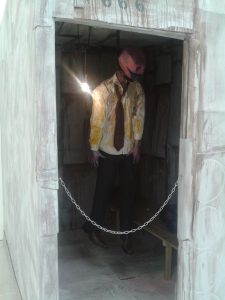
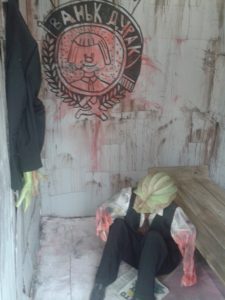
One of my favourite displays was this piece by Daria Krotova, bringing to mind the works of Dostoyevsky and Gogol and seemingly concerned with the recession and the culpability of those in positions of power.
I also loved these pictures by Valery Koshlyakov – made from cardboard and roughly-applied paint, they are striking and beautiful.
Grand Opera, Paris Notre Dame, Paris and High-rise on Raushskaya Embankment
The exhibition is running until the 9th of June.
Breaking the Ice: Moscow Art, 1960-80s
While I was at the Gallery I also dropped in on the exhibition upstairs, which continued the Russian theme by displaying Moscow art from an earlier period. I found this harder to get into, but I did like this image which juxtaposed Lenin’s face with an easily recognisable advertising logo.
I had a bit of time left on Saturday morning and decided to pay a visit to the Saatchi Gallery, which is fairly close to Buckingham Palace. I’m not the greatest fan of modern art, and I must confess that one of the main reasons I went was so that I would have an excuse to tick Sloane Square station off my list.
Founded in 1985 by advertising behemoth Charles Saatchi in order to display his collection of contemporary art, the Gallery occupied several premises before finally settling in the Duke of York HQ building on King’s Road, Chelsea with an exhibition dedicated to new art from China. It has been there since 2008, and Saatchi gifted the Gallery and more than 200 works to the state in 2010. The Gallery aims “to provide an innovative forum for contemporary art”.
Entrance to the Saatchi Gallery
The Saatchi Gallery is pretty famous for holding regularly changing exhibitions of modern art, and the current exhibition is called Korean Eye 2012. Having been to Korea before, I was interested in seeing what Korean art was all about and this curiosity partially overcame my aversion to modern art, which I don’t understand and rarely like.
Many pieces displayed as part of the exhibition were odd to say the least. The first exhibits I came across were the apparent result of smashing up a pile of crockery and sticking it back together to produce something resembling a termite nest. A giant ball of wood dominated one room. I came across some pictures which appeared fairly normal until I walked past them and realised they were hologram pictures: the stylishly clad ladies viewing works of art miraculously appeared to shed their clothes when viewed from a different angle. This technique is undoubtedly clever, but also a bit voyeuristic.
Still, the display exceeded my expectations and I was genuinely impressed by some of the work. In one room I came across a round side table on which rested a cup of tea. Initially scornful, I peered at it more closely and observed a little whirlpool disturbing the surface of the tea. The exhibit was accurately titled ‘Storm in a Teacup’ and I really liked it, partly because I genuinely don’t know how the whirlpool got in there.
Another artist had produced models from cardboard, which were well designed and carefully put together, except for the fact that they were unfinished. A cardboard dog with perfectly constructed and finished hind legs and an abstract box-shaped head was particularly eerie. In another room, photographs of women posing in white dresses took on a life of their own with the addition of white fabric attached to the bottom of the frames, extending the dresses beyond the boundaries of the photographs and adding an extra dimension to the work.
In addition to the Korean art on show, there was an exhibition of chess sets, each the work of a different artist. There were some pretty unusual sets on display: I especially liked the ‘picnic’ set with slices of pizza as pawns. There was also a great set with one team made up of characters like Superman, WonderWoman and Jesus and the other consisting of such figures as Voldemort, Dracula and Saruman.
The Saatchi Gallery itself is well laid out with a clean white design and logically labelled exhibition rooms. It is free to enter and doesn’t have the pretentious atmosphere I had expected: there were all kinds of people there, including Korean (I presumed) holidaymakers and families with small children. I never thought I’d say this about a modern art gallery, but I actually quite enjoyed my visit, and I’d consider going back.
FACTS
Address: Duke of York’s HQ, King’s Road, London, SW3 4RY
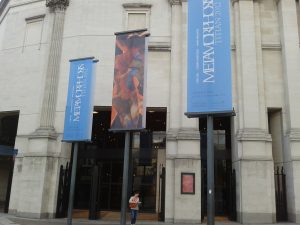
A sunny autumn afternoon; the perfect time to take advantage of the National Gallery’s late night Friday opening and check out the small exhibition Metamorphosis: Titian 2012 in the Sainsbury Wing. Basically, three Titian paintings – Diana and Actaeon, The Death of Actaeon and the recently acquired Diana and Callisto – have been displayed alongside modern ‘responses’ to them. Chris Ofili, Conrad Shawcross and Mark Wallinger have created pieces of art inspired by the paintings, with varied results. I wasn’t sure what to make of the metal crane, and the costumes were rather odd, but I liked the sets (works inspired by the paintings were performed at the Royal Ballet). I’m not the biggest fan of modern art, but I enjoyed the original Titian paintings.