On Sunday I visited an exhibition at the Museum of London, entitled Doctors, Dissection and Resurrection Men. It explores the relationship between the trade in dead bodies and the study of anatomy in the early 19th century, and was inspired by the 2006 excavation of a burial ground at the Royal London Hospital, in which evidence of dissection, amputation and anatomical examination was found. I am rather squeamish and was worried that the exhibition would be a bit gruesome for me, but despite a few icky bits I was fine. The exhibition was sensitively arranged and the bones and anatomical models on display were generally presented from a scientific point of view.
Surgery during this period was difficult and dangerous, made even more risky by the lack of anaesthetic. Surgeons needed to develop their knowledge of anatomy and disease, and the best way to do this was by examining and dissecting real bodies. However, demand far outstripped supply. Religious beliefs, superstitions and personal feelings meant that the vast majority of people were terrified at the prospect of their bodies being cut up after death. In addition, they did not want to be equated with murderers, whose corpses were habitually donated after being hanged.
The ‘resurrection men’, or ‘body snatchers’, stepped in, raiding churchyards to provide the surgeons with the corpses they required. They were feared by the population at large: the exhibition displayed an iron coffin used to protect its inhabitant from being removed, and other artefacts designed to prevent grave robbery. This fear is understandable, especially given the publicity surrounding those body snatchers who did not stop short at robbing graves, but actually resorted to murder. Still, the bodies were necessary to the surgeons in order to broaden their knowledge of anatomy, and thus enable them to save lives.
I was interested and surprised to learn, at the end of the exhibition, that there is still a shortage of bodies for dissection at the beginning of the 21st century. Maybe there needs to be some sort of campaign?
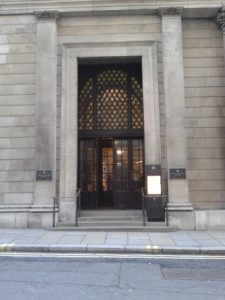
After my trip up the Monument I walked up to the Bank of England. Here I visited the Bank of England Museum.
Bank of England Museum
This is a small, free museum at the back of the Bank. It is free to enter and is open Monday to Friday. When you go in you have to go through airport-style security – understandable I guess, given the proximity to the Bank.
For a free museum, there is quite a lot to see. Exhibitions explore the history of the Bank of England, which was founded in 1694. The inside of the museum has been designed to resemble Sir John Soane’s original design for the vestibule area. Sadly his building was demolished in the mid-20th century to enable a new, multi-storey building to be constructed. I liked looking at the different images of the Bank throughout the years, as well as examples of the different bank notes and coins produced over time.
The most surprising section of the museum was a small display devoted to Kenneth Grahame, author of The Wind In the Willows. He worked at the Bank for many years and wrote his famous novel during this time. A first edition of the book is on display.
The Bank of England Museum is well worth a visit if you are in the area. It is informative and interesting and best of all free.
FACTS
Address: Bank of England, Threadneedle Street, London, EC2R 8AH
I was intrigued by the poster for Death: A Self-Portrait, the current exhibition at the Wellcome Collection, as well as the title of the exhibition itself. I visited the exhibition on Saturday with two of my friends, after having lunch at the African Kitchen Gallery next to Euston Station (which I highly recommend).
I had to laugh at the sign outside the exhibition door. It read:
No photography is allowed in Death
Well, I can’t imagine it’s easy to transport cameras to the other side.
The exhibition is based on the collection of Richard Harris, a former antique print dealer based in Chicago. He has amassed a diverse and fascinating collection of objects and artworks exploring attitudes towards and the iconography of death. The collection prompts questions about the role of art in exploring attitudes to and ideas about death, and the existence of a collection at all suggests a desire to somehow escape or transcend death.
For a free exhibition, Death: A Self-Portrait is extremely comprehensive, containing about three hundred artefacts spread over five rooms.
Contemplating Death
The first room looked at how death and mortality might be contemplated. It displayed several memento mori (Latin for “remember you must die”) artefacts, including Adriaen van Utrecht’s 1643 painting, comprising a skull set in the midst of assorted items including flowers and a pocket watch. The desire for personal possessions seems to contradict the knowledge that we are all going to die: it is commonly said that “you can’t take it with you”, whether the ‘it’ is money or valued possessions. Perhaps our love for things is a way of fighting against the idea of mortality?
The Dance of Death
I found this section bizarre, but brilliant. The Dance of Death, or Danse Macabre as it is more commonly known, appeared first in the medieval period when death was at the forefront of peoples’ minds: plague, famine and war conspired to kill off individuals in their hundreds. Death was the ultimate leveller: it came to peasants and nobles alike. I have come across images of the dance of death before, in the course of my historical studies. Pictures of grinning skeletons dancing with humans are both amusing and morbid. My favourite item on display was a giant skull made largely out of plasticine during the last few years in South America. Looking more closely, you can see the shanty towns of South American cities, crushed by capitalism and Western culture: tiny books with recognisable covers – Alice’s Adventures in Wonderland, Great Expectations, Catch 22 – lie in layers at the skull’s eye level.
Violent Death
This section was, I thought, the most disturbing. Here, images showing violent death, often in war, were displayed. I studied the First World War for A Level English Literature and one of the ideas that came out of my studies was that World War I was the first in which the horror and violence of war were truly condemned: before that, the honour and glory of soldiering was emphasised. Francisco Goya’s ‘Disasters of War’ series, produced in the wake of the Napoleonic invasion of Spain in 1810-20, seem to disprove this theory. They are disturbing, vivid and brutal images; at the beginning, only the invaders are violent, but towards the end brutality is evident from both sides. Jacques Callot’s ‘The Miseries and Misfortunes of War’ of 1683 also contributes to the debate, while Otto Dix’s ‘The War’ of 1924 is equally violent, but in a way less immediately disturbing, given that the horror of World War I is well documented.
Eros and Thanatos
Eros and Thanatos are the contrasting instincts towards life and towards destruction, according to Sigmund Freud. In this room, our fascination with death, pain and disturbing phenomena is examined. Anatomical studies reflect the knowledge gained from the dissection of the dead, while postcards of lovers, or of friends playing cards, have been made to look like skulls. I found this room intriguing too, and especially loved the postcards, which were very clever.
Commemoration
The final room examined the ways in which we commemorate the dead, suggesting that the varied ways different cultures achieve this have one thing in common: to connect with the dead and our ancestors. From the Day of the Dead celebrations in Mexico, to the American families posing with skeletons, they are all about exploring our relationship with the dead. Other interesting artefacts in this room included Tibetan ceremonial cups and Aztec vessels, as well as a rather frightening grave guardian from a Pacific island.
Conclusion
I thought this exhibition was excellent: well put together, thought-provoking and varied. At the end, there is a video which shows Richard Harris discussing the exhibition and there is also a chart which provides much food for thought, showing the ways in which people died during the 20th century. The larger the circle, the greater the number of deaths, and related methods of death are linked together. Some of the results were to be expected – the high proportion of deaths from cancer, for example – but others I found surprising, such as the huge numbers dead from diarrhoea. A few I actually found reassuring: the number of deaths caused by air travel accidents is tiny by comparison to most other causes.
This free exhibition is on at the Wellcome Collection, near Euston, north London, until 24 February 2013, and comes highly recommended.
I know very little about India; in fact most of my literary, historical and cultural interests are very Western-based so I hoped this exhibition would give me the chance to broaden my horizons. The Mughals ruled India for over three hundred years, from 1526 when Henry VIII was on the throne in England until 1858, the time of the early Victorian era. I am roughly familiar with the progress of British, and to a lesser extent European, history during this period, but my knowledge of Asian history of this (or any) period is slim.
I found it interesting that the Mughals were an Islamic dynasty, but those over whom they ruled were mostly Hindus. By and large, according to the exhibition, rulers exercised religious tolerance. This helped to keep the peace throughout the empire and fostered debates on different aspects of religion. Geographically, the empire at its height spanned a large and diverse area, including most of what is now India, Pakistan, Bangladesh and Afghanistan.
The first Mughal emperor was Babur (1483-1530), who came from Samarquand (modern Uzbekistan) to conquer Kabul, Lahore and Delhi. Descended from Genghis Khan and Timur, the emperors adopted Persian as their cultural and administrative language.
There were fifteen major emperors over the years: traditionally the early six emperors are known as the ‘Great’ Mughals, famed for their expansion of the empire and their commissioning of great buildings such as the Taj Mahal and the Delhi Red Fort. I found it difficult to get my head around all the different emperors, but a central part of the exhibition displays pictures and artefacts relating to each emperor in chronological order. I found this very handy to help me work out who was who and give me some insight into the achievements and character of each emperor.
The exhibition was divided into sections, looking at life in Mughal India, painting, religion, literature, science and medicine. Images and artefacts were displayed clearly, and there were numerous books and other examples of writing, as you might expect from an exhibition at the British Library. I thought the art was incredibly beautiful, very different to the Western style of painting, colourful and vivid. I found it particularly interesting to see paintings of British and other European visitors in this style, which were in great contrast to the paintings you see in places like the National Gallery. One of the most unusual pictures was of one of the emperors engaged in some bedroom fun with a mistress: I found it very bizarre that an emperor would agree to being painted in such a compromising position!
Of course I couldn’t read works in Persian or other languages of the empire, but I found the descriptive cards next to them to be good sources of information. Many rulers were patrons of literature and several wrote poetry or kept diaries themselves. I found the works on science extremely fascinating: great advances were made through the study of the sciences, in medicine for example. Geography and astronomy were especially important and the Mughals were also influenced by astrology.
The empire began to reduce in size over time and towards its end covered only the area of the Delhi Red Fort. The dynasty came to an end in 1858 after the failed Uprising against the British East India Company.
I really enjoyed this exhibition. It was very different to what I am used to but I found it fascinating, and once again I feel I learned something.
After popping into the Greenwich Heritage Centre, I went to visit Firepower: the Royal Artillery Museum. The museum covers the history of the Royal Artillery, which was first formed in 1716. This particular building was opened in 2001, but before that the collections were housed in the Rotunda on Greenwich Common from 1820, and prior to that the Royal Artillery Museum was known as the Royal Military Repository, established in 1778 by a Royal Warrant issued to Captain William Congreve RA by King George III.
The Royal Arsenal has a military history dating back to Roman times, but the RA itself dates to the sixteenth century. The museum covers the history of the Artillery and the RA, with a special mention for the role the Artillery and the Arsenal played during the war years.
The museum holds collections of artillery of all kinds, including an early 15th century bombard, an early mortar and a 14th century Chinese t’ung, as well as cast-iron and bronze guns. Modern ammunition and medals are also featured. A timeline of artillery places the museum’s collections in context. I’d be lying if I said I was fascinated by armaments, but I thought the displays were well thought-out and engaging. The children I saw in the museum seemed particularly fascinated.
Perhaps of greatest interest to those with an interest in military matters, the museum is worth a visit especially if you have children. The entrance price is very reasonable and there’s a great deal to see.
FACTS
Address: Royal Arsenal, Woolwich, London, SE18 6ST
I visited Greenwich Heritage Centre on my tube jaunt down to Greenwich. The Centre, which is free to visit, is located in Artillery Square in the Royal Arsenal, a short walk from Woolwich Arsenal station.
The small museum is about the development of Greenwich from the earliest times to the present day. It contains a wealth of artefacts including tools that were used in the Royal Arsenal, an Egyptian mummified cat, nineteenth and twentieth-century artworks and material from the Roman temple in Greenwich Park.
The museum takes its unusual logo from an artefact called the Bellarmine Jug. This was excavated in the 1970s from the old Woolwich Dockyard and was made in a large kiln there in the 17th century.
The Main Gallery houses the exhibition Inside the Arsenal, which examines the story of the Royal Arsenal and the Royal Woolwich Dockyard from the time of Henry VIII to the present. The role of the Arsenal during the war years is examined, and there is a piece on the Arsenal football team, who later moved to north London, where they are still.
Alongside the main part of the museum is an exhibition called The Millennium Embroideries, showcasing the incredible talents of local women who have created embroidered panels covering the borough’s history over the past thousand years. When I visited, there was also an exhibition in the Temporary Gallery concerning Asian culture in Greenwich, which was very interesting.
The Greenwich Heritage Centre is a small but free interesting museum, and if you’re passing through the borough on your way to the more famous heritage attractions, it’s worth popping in here to get a sense of the borough’s history.
FACTS
Address: Artillery Square, Royal Arsenal, Woolwich SE18 4DX
Another Friday night, another exhibition after work. This time I went to see the Hollywood Costume exhibition at the Victoria & Albert Museum in South Kensington. I’d booked my ticket in advance, which was just as well as my chosen date was sold out well before the day itself.
Hollywood Costume brings together iconic, special and unusual costumes from the history of cinema, exploring the important role costume plays in storytelling. The exhibition was divided into three sections. The first explored the role of costume in film, using examples to demonstrate the importance of what the actors wear. I found this really interesting, giving a context to the exhibition rather than just displaying lots of pretty costumes. Among those costumes exhibited was the iconic outfit of Indiana Jones, with a detailed exploration of each item. The ‘curtain dress’ worn by Vivien Leigh as Scarlett O’Hara in Gone With the Wind was also on show. Outfits from The Adams Family were also displayed, and there was a whole section on costume drama, highlights of which were dresses worn by a number of actresses, including Judi Dench, playing Elizabeth I.
In this section I learned that it is actually more difficult to clothe actors in modern films, as audiences are much more familiar with modern styles of dress. The idea is that you don’t really notice the clothes, yet each item is chosen with thought and care. Though I’m not a particular fan of the film Ocean’s Eleven, I enjoyed the display of mannequins around a table each dressed in a different character’s outfit. The display showed how each outfit reflected the individual’s personality. On a similar note, the outfits worn by Jake Gyllenhal and Heath Ledger in Brokeback Mountain appeared fairly similar on the surface, but contained subtle differences which reflected the history of each character.
The exhibition showed how Matt Damon’s outfit as the spy Matthew Bourne was designed to blend into the background. I was less impressed with the displays relating to Fight Club, a film I haven’t seen, as the plot was basically given away. I don’t really think this was necessary: they could at least have given a spoiler warning!
Something I liked about this section was the clips of ordinary people talking about their clothes and accessories. This was interesting and made the point that even the simplest outfits have a history of their own, and this needs to be reflected in film, with characters needing a believable existence outside the movie.
The second section also divided the costumes up into themes. The first part examined collaborations between directors and designers. Edith Head, possibly the most famous costume designer of all time, designed for many of Alfred Hitchcock’s films including The Birds; one of Tippi Hedren’s outfits – a green skirt suit – is displayed here. The designer on Sweeney Todd worked closely with director Tim Burton, and the suit worn by Johnny Depp as the ‘Demon Barber of Fleet Street’ is displayed.
Another section compared outfits worn by the same character in different films, such as two costumes for Cleopatra worn by Elizabeth Taylor and another actress whose name I can’t remember. The difference between clothes designed for black and white films and for colour was also explored: in black and white films colour didn’t show so it was necessary to make outfits stand out in other ways. This part also looked at clothes designed for animated characters such as Jessica Rabbit and Shrek, and displayed a motion capture suit such as the one worn by Andy Serkis who played Gollum in the Lord of the Rings trilogy and the forthcoming Hobbit films. The original Darth Vader costume was here too, looking particularly imposing as it loomed over the spectators.
This part ended with a look at some particular actors and their relationship with their character’s clothes. Acclaimed actress Meryl Streep has portrayed a number of different characters, such as the title character in The French Lieutenant’s Woman and former British Prime Minister Maggie Thatcher, and her outfits have helped her to get into and stay in character. The Victorian-style grey cloak and smart blue suit are very different! Robert De Niro is another actor who has portrayed wildly varying characters, and a number of his costumes are here, such as his outfit from Taxi Driver, which he reportedly wore before filming to get into character.
The final part of the exhibition dispensed with theories and themes and simply displayed iconic costumes from the history of cinema. There was a veritable wealth of costumes, many of which I recognised instantly. Among my favourites were the corseted, feathered outfit in which Nicole Kidman makes her entrance in Moulin Rouge, Audrey Hepburn’s black Givenchy dress from Breakfast at Tiffany’s, the outfits in which we are introduced to Jack and Rose’s characters in Titanic, and two dresses worn by Keira Knightley: the flowing green dress she wore in Atonement and the stunning nineteenth-century style deep red gown she had on in Anna Karenina. Superheroes were not forgotten: Batman and Spiderman were both represented, not to mention schoolboy wizard Harry Potter, and anti-heroes were present too: I was delighted to see Johnny Depp’s Jack Sparrow costume from Pirates of the Caribbean.
Right at the end of the exhibition there were two iconic dresses: one the white frock famously worn by Marilyn Monroe, the other the gingham pinafore worn by Judy Garland in The Wizard of Oz. The pinafore – which naturally enough looks rather faded now – is distinctly recognisable and is displayed with a pair of reproduction ruby slippers made to the original pattern, sparkling as brightly as the originals would have done when they were first made.
This brings me to the final exhibit: the highlight of the whole thing as far as I am concerned. In a glass case, on loan from the Museum of American History in the USA for the first time, until the 19th of November only, are the original ruby slippers. One of the pairs at least: five pairs have survived of the several made, though one of them was stolen in 2005. They have faded over the years, but the sequins are still in place and the shoes are still in one piece. They look to be about size 5 or 6. Possibly the most iconic piece of cinema merchandise in history, they came about because red was thought to offer the strongest contrast against the yellow of the brick road. In L Frank Baum’s original story, the shoes were silver. I admit I got quite emotional when I saw these slippers – The Wizard of Oz is my favourite film of all time and I felt so privileged to be able to see first-hand this piece of history.
This is a fantastic exhibition that contains a veritable wealth of costumes and artefacts. It has been thoughtfully put together and I feel as though I learned something about the nature of costume in cinema. I strongly recommend this exhibition, and would urge everyone to see it in the next couple of weeks before the ruby slippers are sent back to America!
In June, my mam came down to London to stay with me for a few days. I decided to take her to the RAF Museum at Hendon, north London, as she is very interested in World War II, in particular Bomber Command, and I had found out that the museum held a Lancaster in the collection, which I knew she would love to see.
I had never seen the museum advertised and only heard of its existence because I am trying to visit every London Underground station. I was attempting to tick off some stations on the Northern Line and saw a couple of posters around the Brent Cross area. I looked the museum up online, and what I learned convinced me that a trip would be a good idea.
***About the museum***
The RAF Museum actually occupies two sites: there is another at Cosford near Birmingham. The Hendon site was opened in 1972 by the Queen on the site of the London Aerodrome. It is home to over 100 aircraft from around the world, from the earliest flying machines to modern state-of-the-art jets. With films and interactive activities as well as standard displays, the museum aims to offer an exciting day out for all the family.
Oh, and entry is free – another reason to visit! A few activities cost money, and you have to pay to use the car park if you’ve chosen to drive rather than use public transport, but the museum does offer a very cheap day out.
***Opening Times***
The museum is open 10-6 every day with some closures and shortened opening hours during the Christmas period. Some exhibitions have slightly different opening hours: check the website for more details.
***Getting There***
Colindale is the nearest London Underground station (about a 10 minute walk away). It is on the Edgware branch of the Northern Line, about 30 minutes north from Central London. When you come out of the station, you need to go left: the museum is clearly signposted and it is difficult to get lost (and trust me, coming from me, this means something!).
Helpful directions at the Tube
***First Impressions***
As my mam and I walked up Grahame Park Way we saw the museum on our right, clearly visible with the name emblazoned on a grey building. We entered the grounds and saw a series of buildings, or hangars, behind a car park. The entrance was across the car park, and it had started to rain quite heavily by this time so we hurried inside!
At the museum
The entrance was large and airy with toilets next to the door and an enquiry desk, where my mam purchased a guidebook. This was also the place where you could purchase tickets for things like the 4D show. A free leaflet containing a map was provided. The museum has different themed sections which you walk around in order.
***Milestones of Flight**
This was the first section and comprised a large hangar inside which were hung numerous aircraft covering a period of around a hundred years. Now I am not particularly interested in aircraft, but I AM interested in history and I found this section fascinating. Among the exhibits was a lookout balloon used in World War One – I imagine this would have been very dangerous! There was also a Blériot XI, an early plane that was used by Louis Blériot in 1909 when he became the first person to fly across the English Channel. At the other end of the scale the Eurofighter Typhoon is displayed: this is the most modern aircraft the RAF possesses and can fly at twice the speed of sound.
Milestones of Flight
Stairs up to the next level allowed you to see the aircraft that were hung further up. This area had walls with pictures of fighter pilots in the First World War that shot down a certain number of planes. Many of them died. Along the walkway were interactive screens offering more information on the exhibits. As you walk down the stairs you can see a huge timeline covering an entire wall of the hangar. This timeline is labelled with key events in the history of flying alongside important events in general history to put them in context. This is far too detailed to memorise and a bit overwhelming but it was fascinating to read.
Historical timeline
***Bomber Hall***
This section was the reason I brought my mam to the museum, as it is home to the Lancaster, used during World War II in bombing raids over Germany. My mam knows a great deal about this aircraft, to the extent that when one flew over our house at the time of the Sunderland Airshow she recognised it from the sound of the engine! The Lancaster is certainly impressive and imposing, huge (it had a crew of seven), and I found it quite chilling to look at.
Lancaster bomberLancaster bomber
Also on display was a Halifax bomber recovered from a Norwegian lake, rusted and broken but still recognisable. Other bombers on display include a German Messerschmitt, and a Valiant from the Cold War era.
Halifax bomber
Bomber Hall is a kind of memorial to the casualties of Bomber Command. While I was there the wreath which would later be placed on the new Bomber Command memorial in London was on display. Because of the raids on Germany, many of which involved loss of civilian life, those who flew the bombers were essentially ignored after the end of World War II, even though they suffered the highest casualty rate of any of the services, and it is only now that they are getting the recognition they deserve.
***Battle of Britain Hall***
This section holds and commemorates aircraft that flew in the Battle of Britain in 1940. Spitfires and Hurricanes are among the aircraft on display, and there is also a sound and light show about the battle although we didn’t watch this. These planes are much smaller and lighter than the bombers, designed for in-air combat when speed and dexterity were of paramount importance.
Battle of Britain Hall
There were also other hangars: Grahame-White Factory, which contains the museum’s oldest aircraft; Historic Hangars which were part of the original aerodrome and contain various exhibitions about the RAF; an Aeronauts Interactive Centre for children; and a Marine Craft exhibition. However, we didn’t have time to visit these as we had to get back to central London to go to the theatre.
***Food and Drink***
The museum has a restaurant and a café, as well as a picnic area to eat your own sandwiches: this came in handy for us as I had made us lunch to save money and we couldn’t have eaten it outside as it was pouring down! We didn’t visit the restaurant, but did have a cup of tea and a muffin in the café. It wasn’t the nicest café as it was actually inside the Bomber Hall surrounded by all the planes as well as screaming children, and there was a long queue: I felt sorry for the man serving, as he was there by himself and clearly rushed off his feet. I should point out that we were there during half term and perhaps the museum is quieter at other times.
***Accessibility***
Designated parking is available for disabled visitors, and manual wheelchairs are available for hire free of charge, though you need to pre-book. Aisles are wide for ease of wheelchair access – I witnessed this first-hand myself – and disabled toilets are available. Seating is available at regular intervals throughout the museum.
***Conclusion***
I was impressed with the museum: it was interesting, well laid-out and there was a great deal to see – too much, in fact, for us to see over the course of several hours! There are activities and interactive exhibits for children, and the children I saw during my visit seemed to be enjoying themselves.
Something to be aware of is that the museum is obviously owned and run by the RAF, and naturally enough emphasises the RAF’s contribution to the history and development of flight. Sometimes I felt that the technological advances were emphasised to the extent that they glossed over the harm and injury that military planes can cause. I felt this particularly in Bomber Hall: while I have immense respect and admiration for those who risked, and still risk, their lives to man them, they are essentially killing machines and I found it sobering to look at them. Some planes, such as the modern fighters, are used today around the world in military attacks and who knows how many deaths they have caused.
Having said that, I’m sure people can draw these conclusions for themselves and the museum is primarily a celebration of the technological development of flight. The history of flight is just over a century old, after all, and it is incredible how far we have come in such a short space of time. The museum does an excellent job of demonstrating this.
FACTS
Address: Grahame Park Way, London, Greater London NW9 5LL