City of London Cemetery & Crematorium Heritage and History Tour

20150920LondonCemetery01

As part of Open House London 2015, I paid a visit to the City of London Cemetery and Crematorium for a Heritage and History Tour. After having visited so many cemeteries this year, I thought I might as well go for one more. I turned up on Sunday morning in time for the tour, having travelled right across London: despite the name, the Cemetery is actually located in the east, near Epping Forest. Manor Park is the nearest station.

20150920LondonCemetery03
Cemetery gates

The Cemetery was opened in 1856, as a burial place for residents of the City of London, who prior to this had been buried within their own parishes. The overcrowding issue which led to the establishment of the “Magnificent Seven” also led to the formation of this cemetery, laid out by William Haywood on land purchased from the second Duke of Wellington. The Cemetery is nearly at capacity for burials, although former plots are re-used (sensitively, and only in particular circumstances). The remains from over 30 London parish church yards were also relocated here. Today, the City of London Cemetery and Crematorium is a Grade I listed landscape, open for burial to anyone regardless of religious belief or connection to the City. There are two crematoriums, one built at the beginning of the 20th century and one constructed in 1971. There are Grade II listed chapels and catacombs, a Garden of Rest, and memorial gardens.

20150920LondonCemetery32
Into the Cemetery

Our tour began with a look at some of the documents from the Cemetery’s 150-year history, including fascinating burial and cremation registers. We were then taken on a long, thorough and fascinating tour of the site. Several notable personalities are buried in the Cemetery, including Catherine Eddowes and Mary Ann Nichols (victims of Jack the Ripper), Dame Anna Neagle, and Edith Thompson (one of the last women to be hanged in the UK). However, what I was fascinated by the most was simply the heritage of the place, the mix of time periods and the story behind the burials here.

20150920LondonCemetery07
Hindu shrine
20150920LondonCemetery10
Graves lined up
20150920LondonCemetery11
Victoria Cross holder
20150920LondonCemetery12
Burial site of a London parish church
20150920LondonCemetery16
Dame Anna Neagle
20150920LondonCemetery18
A racing driver, killed in an accident, and his family
20150920LondonCemetery19
Burial place of French Huguenots
20150920LondonCemetery20
Old Crematorium
20150920LondonCemetery21
Inside the Old Crematorium
20150920LondonCemetery22
Memorial plaque for Bobby Moore
20150920LondonCemetery23
Rose Garden
20150920LondonCemetery24
Memorial plaque for Mary Ann Nichols, buried in a paupers’ grave
20150920LondonCemetery25
Plaque for John Joseph Sims, holder of a Victoria Cross
20150920LondonCemetery26
Beautiful grave of a piano-loving lady
20150920LondonCemetery27
Catacombs
20150920LondonCemetery28
Inside the Dissenters’ Chapel
20150920LondonCemetery29
Inside the Dissenters’ Chapel
20150920LondonCemetery31
The Dissenters’ Chapel
20150920LondonCemetery36
The Anglican Chapel
20150920LondonCemetery37
Inside the Anglican Chapel
20150920LondonCemetery38
Beautiful tomb carved of solid marble
20150920LondonCemetery39
The New Crematorium

After being taken round the Cemetery, we were offered the chance to go “behind the scenes” at the Crematorium, and find out what happens when someone is cremated. While this part of the tour was entirely optional, every single person on it opted to go ahead. We were taken through the process by which bodies are cremated, the measures taken to ensure that individuals are correctly identified, how remains are turned into ashes and – most fascinatingly – the bits and pieces left over once the ashes are retrieved. These include things like metal hip and knee replacements, jewellery and anything else that is not combustible. I was hugely impressed by how hard the staff work to make sure everything runs smoothly.

My visit to the City of London Cemetery and Crematorium was one of the most fascinating and enlightening tours I have ever done. I enjoyed the tour of the Cemetery but I feel particularly privileged to have had the tour of the Crematorium, which really helped to demystify the cremation process. Death can be a taboo subject, but I honestly feel it’s important to be prepared and understand how burial and cremation work. Even without a tour, this is a lovely place to visit for a quiet walk.

FACTS

Address: Aldersbrook Road, Manor Park, London, E12 5DQ
Founded: 1856
Size: 200 acres
Still in operation?: Yes
Official website: cityoflondon.gov.uk/things-to-do/green-spaces/cemetery-and-crematorium
Owners: City of London
Tours: Tours take place at selected weekends throughout the year.

Shot on Site: The Somerset House Film Tour

Somerset House is one of the most interesting buildings in London, with a long and rich history – in terms of the site itself, not just the existing building. It’s also been used as a film set on numerous occasions. I signed up to the Shot on Site tour to learn more about this aspect of the building’s history.

Our tour guide was enthusiastic and knowledgeable and I learned a great deal about the topic. Around 40 films have been captured here to a greater or lesser degree over the years, beginning with The Long Arm (1956) and The Day of the Jackal (1973), in which Somerset House effectively played itself, as the home of birth, marriage and death records that it then was.

Those films were unusual in that they used interior shots: this is rare as Somerset House, being designed as an office building, does not have particularly lavish interiors. For instance, the exterior stood in for the Devonshire residence in London in the film The Duchess (2008). In children’s movie Nanny McPhee and the Big Bang (2010), Flyboys (2006) – about a group of American pilots – and even Sleepy Hollow (1999), with the aid of some green screen, aspects of the Somerset House courtyard stood in for various locations, including a London street and a French hospital.

Somerset House has appeared in two Bond films, Tomorrow Never Dies and Goldeneye, standing in for a St Petersburg car park in the latter. It has “played” Buckingham Palace three times – in TV series Spooks, comedy The Worst Week of My Life and in children’s sequel Agent Cody Banks: Destination London (2004). The site has appeared in X-Men: First Class (2011) and in the 19th century-set romantic comedy Hysteria (2011) with Maggie Gyllenhaal, who apparently took several takes to cycle away wearing cumbersome Victorian skirts!

For me, the most fascinating part of the tour was the visit to the Lightwells and Deadhouse in the basement. The Lightwells, narrow passages running around and underneath the courtyard, are gloomy and atmospheric and acted as a prison in the Robert Downey Jr. Sherlock Holmes movie. In the Deadhouse, so named because it is the last remaining part of the palace that once stood on the site and still contains graves of palace staff, we were informed that it stood in for a bunker below the Ministry of Defence in the World War II thriller Glorious 39.

Finally, we were shown some glimpses of forthcoming movies which used Somerset House for filming, including the soon-to-be-released Suffragette. I really enjoyed the tour and if it comes back next year – which it may well do as part of the Film4 Summer Screen season – it’s definitely worth getting a ticket.

Soane’s Private Apartments Tour – Sir John Soane’s Museum

Sir John Soane’s Museum is a unique free museum near Holborn, the former home of the neo-classical architect responsible for the Bank of England. He established the house as a museum in 1833, and it contains numerous treasures from his collection.

I booked online for the rare chance to visit the Private Apartments at the top of the house. These were originally home to Soane and his wife, and later to curators of the museum. After refurbishment, they have been made available to visit as part of a guided tour.

I turned up with my ticket and was directed upstairs, where the group of us due to tour were gathered together and taken up a further flight of stairs, normally roped off. We were told that the house was bombed during the war and was refurbished afterwards; some lovely stained glass was pointed out to us that survived because it was removed from the house before bombing on the orders of the then live-in curator.

The first room we came to was Elizabeth (Eliza) Soane’s drawing room, where she would have taken tea, written letters and received guests. The room was decorated in her own style, with paintings of her children and family group as well as pictures that she liked. These included a beautiful representation of all the flowers in Shakespeare, and several sketches of Shakespearean characters. The next room was her bedroom, kept as it was for several years after her death by a heartbroken Soane, but eventually he turned it into a magnificent display room for his architectural models. The centrepiece was a very impressive model of a semi-excavated Pompeii, and surrounding this, on a beautiful wooden frame, were several models of notable classical buildings in both cork (for ruined buildings) and plaster of Paris (for models of buildings as-new). On the bottom of the stand were models of Soane’s own buildings, emphasising the inspiration Soane took from the classical world.

Following this we entered Soane’s bathroom, an elaborately decorated room with a grandfather clock (!) in the corner. The room contained an actual bath, and there were hot water pipes on the wall, but it is uncertain exactly how the system worked. After Soane’s death, the bath was sealed up at his request, and when it was opened after some years had passed it was found to contain a number of effects, such as pictures and documents, though none of these contained anything groundbreaking.

Next to the bathroom was Soane’s bedroom, although the bed there was not an original (that had been sold) but was one that had come from Pitzhanger Manor, his country house. Finally, we were led out of the apartments via a corridor decorated with lots of art and two mummified cats, which apparently were supposed to be lucky.

Changes have recently been announced to the Tours of the Private Apartments – the number of tours has been increased and you no longer need to book online, but can turn up on the day. The tours will continue to be free, as is entrance to the museum itself. It is definitely worth making the effort to go on a tour – it’s hugely interesting.

Warner Bros. Studio Tour London – The Making of Harry Potter

One of my birthday presents was a ticket to the Warner Bros. Studio Tour, which is all about the making of Harry Potter. I’d been wanting to go for ages, but I’m glad I waited, as it was only recently that the Hogwarts Express was installed at the attraction.

2015_0725WarnerBros001
Shuttle bus at Watford Junction

The tour site is about 20 miles north of London, near Watford, and there is a shuttle bus from Watford Junction. My friend and I travelled from west London, catching the train at Euston, and were impressed to see references to the studio tour all over the place – it’s a popular attraction! Once there, it was VERY exciting to see the bus. It’s not free, but it’s very handy – taking you straight there and back – and there’s even a little Harry Potter video to watch while you’re travelling.

2015_0725WarnerBros007
Entrance
2015_0725WarnerBros003
Chess pieces

The entrance to the building is exciting in itself, with a number of props dotted around, including a number of the chessmen from the first film. Elisa and I took the opportunity to get a selfie in front of the attraction!

2015_0725WarnerBros009
Harry Potter selfie!

The main lobby is huge, with a cafe, a gift shop and cloakroom (and toilets of course) – there are even some attractions here, like Ron’s car that was used in Chamber of Secrets. We had loads of time to kill before our tour, so we went for something to eat in the cafe.

2015_0725WarnerBros016
Main lobby

Afterwards we checked out the gift shop, as you do. Everything was incredibly expensive. I did buy a little something later on, but I might have bought more if it hadn’t been so pricey.

2015_0725WarnerBros012 2015_0725WarnerBros013

When it was time for our tour, we got in the queue and were thrilled to notice Harry’s cupboard under the stairs as we were passing.

2015_0725WarnerBros018
Harry’s cupboard

We were taken into a room and shown a video, with the main actors from the films – Daniel Radcliffe, Emma Watson and Rupert Grint – introducing the experience. Then it was into the Great Hall!

2015_0725WarnerBros019
Entrance to the Great Hall
2015_0725WarnerBros020
Inside the Hall
2015_0725WarnerBros022
The fireplace
2015_0725WarnerBros026
Laden tables
2015_0725WarnerBros028
Hourglasses showing House points
2015_0725WarnerBros030
Teachers’ costumes
2015_0725WarnerBros032
The Hall

I loved the Great Hall. It was an amazing feeling to be in the space where so many things happened over the course of the eight films. There were tables laid out with food, and costumes from some of the characters, including the school uniform and the teachers’ robes. The Great Hall doesn’t have a ceiling, because it is meant to reflect the night sky, and CGI stars were added after filming.

2015_0725WarnerBros040
The Gates of Hogwarts

Once out of the Great Hall, the rest of the building is full of amazing props from the Harry Potter series, complete with information boards explaining how particular tricks were done and how things worked on screen. There were so many things to see, from the Gryffindor common room to the Potions classroom, Dumbledore’s office and game props from Quidditch and the TriWizard Tournament.

2015_0725WarnerBros034
TriWizard Ball costumes
2015_0725WarnerBros046
The Mirror of Erised
2015_0725WarnerBros048
Gryffindor Common Room
2015_0725WarnerBros057
Dumbledore’s office
2015_0725WarnerBros060
TriWizard Cup
2015_0725WarnerBros061
Quidditch balls
2015_0725WarnerBros063
The Golden Snitch
2015_0725WarnerBros070
Potions classroom
2015_0725WarnerBros071
Hogwarts paintings
2015_0725WarnerBros075
Entrance to the Chamber of Secrets

I really liked the “green screen” section which explained how broomsticks, Hagrid’s bike and other objects were made to fly.

2015_0725WarnerBros081
Quidditch outfits
2015_0725WarnerBros079
Motorbike and sidecar
2015_0725WarnerBros080
Broomstick

Later in the exhibition, the displays focused on sets outside of Hogwarts.

2015_0725WarnerBros086
Borgin and Burke’s
2015_0725WarnerBros089
The Malfoy mansion
2015_0725WarnerBros094
Umbridge’s office

The next part was one that I was really excited about – the Hogwarts Express! You can see the train in all its glory, and even climb inside the carriages.

2015_0725WarnerBros100
The Hogwarts Express
2015_0725WarnerBros104
Logo on the side of the train
2015_0725WarnerBros106
The station
2015_0725WarnerBros107
Costumes from the final scene from the last movie (sob!)

Following this we arrived at a cafe, which was perfectly timed – we were pretty tired by this time, having spent a good couple of hours wandering around, and wanted a sit down. You can bring your own food for a picnic if you like, or you can purchase food here. We weren’t hungry, but we did fancy trying the Butterbeer. It was very sweet: Elisa hated it, but I quite liked it!

2015_0725WarnerBros112
Sampling the Butterbeer

Luckily it was a fine day, as the next bit was outside. We got to see the Knight Bus (made from two genuine double decker buses), Privet Drive, the moving corridor at Hogwarts, the cottage at Godric’s Hollow, and Ron’s car.

2015_0725WarnerBros114
The Knight Bus
2015_0725WarnerBros119
Bus sign
2015_0725WarnerBros120
Inside the bus
2015_0725WarnerBros123
No. 4 Privet Drive
2015_0725WarnerBros124
Sign
2015_0725WarnerBros126
Corridor
2015_0725WarnerBros127
Cottage
2015_0725WarnerBros128
Inside the car

Back inside, there was a fascinating section on animatronics and how they were made and manipulated for the Harry Potter films. I was particularly interested in Dobby and in Hagrid’s huge head, not to mention Fawkes the phoenix.

2015_0725WarnerBros130
Fawkes
2015_0725WarnerBros132
A mandrake

Next we made our way into Diagon Alley, which was full of shops from the movies. I loved this section – I only wish it was really possible to go into the shops and buy wands and delicious sweets for real!

2015_0725WarnerBros138
Diagon Alley
2015_0725WarnerBros141
Florian Fortescue’s ice cream parlour
2015_0725WarnerBros142
Flourish & Blott’s
2015_0725WarnerBros146
Madam Malkin’s robe shop
2015_0725WarnerBros148
Diagon Alley

The next section was all about concept art and models for the sets, which was fascinating. Finally, we got to see the incredible model of Hogwarts which was used for overhead shots. The detail on this model is incredible and my picture really doesn’t do it justice.

2015_0725WarnerBros155
Hogwarts

I had an incredible time at the studio tour and it is a must-see for any Harry Potter fan, or even anyone who is interested in how films are made. It’s pricey, but worth it in my opinion as there is so much to see.

Timed tours are in operation and you do need to book in advance. My friend and I didn’t book far enough in advance for a Saturday in July so we ended up having to choose a later timeslot. The attraction doesn’t close until late so this wasn’t a big problem for us, but I think the earlier in the day you can go the better, as there are likely to be fewer people.

The tour was definitely a highlight for me, as a huge Harry Potter fan, and I’m so glad I went.

FACTS

Address: Studio Tour Drive, Leavesden, WD25 7LR

Website: wbstudiotour.co.uk

Opening Hours: Times vary, but it is open 7 days a week, usually from 9 or 10am until 6-10pm with the last tours scheduled three hours before closing. You MUST book (well) in advance.

Prices: Adult £35, child £27; family tickets and studio tour packages are available

Tour of Ealing Studios

2015_0213EalingStudios01
The original entrance to Ealing Studios, with blue plaque dedicated to Michael Balcon

On Friday I was lucky enough to be able to go on a tour of Ealing Studios as part of the Ealing Music & Film Festival. The studios are the oldest continuously working film studios in the world, and have played a huge part in the British film industry for over a century, encompassing silent film, the onset of the “talkies”, the upheaval of two world wars and technological developments such as motion capture.

The site was originally occupied by Will Barker Studios from 1902, later becoming Associated Talking Pictures Ltd. Ealing Studios was built in 1931 and in 1938 Michael Balcon (who gave his name to the local branch of Wetherspoon’s) from MGM took over, issuing films under the Ealing Studios name. Many memorable films were produced in the 1930s and 40s, including documentary war films, but the studio’s heyday was during the post-war 1940s and the 1950s when celebrated Ealing comedies, including Kind Hearts and Coronets and The Ladykillers, were produced.

The studios were purchased by the BBC in 1955, leading to nearly half a century of location filming for television dramas and serials. After a transitional period late in the century, the studios entered new ownership in 2001. The five original sound stages are present, and are now listed. As well as offices and bases for modern production and related companies, the studios produce films and television shows: recent films include The Importance of Being Earnest (2002) and St. Trinian’s (2007), as well as the hugely popular Downton Abbey. In addition, the Imaginarium, a performance capture studio set up by Andy Serkis and Jonathan Cavendish, is based in one of the sound stages: famously it was used to create Gollum in The Lord of the Rings and The Hobbit.

2015_0213EalingStudios05
Inside the complex, looking towards reception

To reach the tour meeting point, which was the reception area, I had to go through the security point. There were several of us on the tour and we were taken to see the white building which was the original studio entrance in the 1950s. Famous figures including Michael Balcon and Alfred Hitchcock had offices here. It is looking slightly shabby these days but they are hoping to get the funds to restore it shortly. We were taken around the large complex and saw some of the modern companies, including a casting company and a hair and makeup studio, present on-site. One of the buildings, which includes the original sound stages, is listed but the newer building in front of it is due to be demolished and replaced with up-to-the-minute production facilities.

2015_0213EalingStudios06
The original entrance, seen from the back

The most exciting part of the tour was being able to go on to the sound stages. On one, we saw a set being built, consisting of a theatre foyer and a staircase. This set is for a remake of the 1983 film The Dresser, and will star Anthony Hopkins and Ian McKellen. The top of the staircase leads to nowhere: a real theatre is being used for the auditorium (Hackney Empire). Thanks to a question from another person on the tour, I found out that this was the sound stage on which Scott of the Antarctic was shot. It was huge and still had some of the old safety notices on the walls.

2015_0213EalingStudios07
Listed building containing sound stages

The second sound stage was even more exciting: crew members and carpenters were preparing for the filming of Downton Abbey. Much of this popular show is filmed at Highclere Castle, but a significant proportion is filmed at Ealing Studios. As they were busy creating the set, we couldn’t see much but I could see into Lady Mary’s bedroom – which was in the process of having wooden “fireplaces” fitted – and had a peek into the servants’ corridor. We also saw the large backdrops used behind the windows, to give the illusion that it is a real room in a real house with a view. I also had a very brief glance into the Dower House sitting room.

2015_0213EalingStudios08
Plaque commemorating famous films made here

The tour was fairly short – it is a working studio after all – but very interesting. I was thrilled to have had the opportunity to visit.

Houses of Parliament

I’ve been meaning to go on a tour of the Houses of Parliament for ages. Eventually I was able to do so as part of a Library and Information Professionals Open Day at the House of Commons Library. I wrote up the LIS part of the day, including my tour of the library, on my librarianship blog; here I will write about the tour of the Houses of Parliament itself, which was delivered by a guide, just as it would have been if I’d booked the tour myself.

2014_0219HousesofParliamentCommonsLib01
House of Commons Library
2014_0219HousesofParliamentCommonsLib05
House of Commons Library

As part of the LIS Open Day, I completed a quiz about Parliament, which only served to emphasise my ignorance! I learned some interesting facts:

  • Parliament is made up of the House of Commons, the House of Lords and the Monarchy;
  • The oldest part of the Parliamentary Estate is Westminster Hall, which dates from 1097;
  • The monarch has the power to, in theory, appoint the Prime Minister, dissolve Parliament and declare war. However, in practice this would be highly unlikely – even completely unlikely – to happen;
  • The last time the monarch refused to give royal assent to a piece of legislation was in 1707, when Queen Anne refused to give assent to the Scottish Militia Bill. The reason for this was that writing the Bill took so long that by the time it was ready, it was no longer needed;
  • Currently there are 650 MPs in the House of Commons. However, shockingly, only 23% are women;
  • The First Lord of the Treasury and Minister for the Civil Service is the full title held by the Prime Minister;
  • 14 PMs have served the current monarch, Elizabeth II;
  • The only person who is allowed an alcoholic drink in the House of Commons is the Chancellor of the Exchequer, and then only during the budget speech;
  • The symbol of the owl (on the cover of the quiz) is significant because the collective name for a group of owls is a parliament.

The tour began in Westminster Hall, the oldest part of the building. This is a beautiful space; it used to be a royal palace until Henry VIII took over Cardinal Wolsey’s York Place – renaming it Whitehall – and has been used for governmental purposes ever since. It has the largest surviving single span mediaeval timber roof in Northern Europe, and has been used for many different purposes throughout its history, including coronation banquets (such as Richard I’s), trials (including those of Guy Fawkes and Charles I) and the location for monarchs to lie in state after their death. Various heads of state and individuals of note have delivered speeches here, including the late Nelson Mandela. The Hall was one of the only spaces to survive the fire in 1834 and the bombing of World War II.

2014_0219Parliament16
Westminster Hall
2014_0219Parliament14
Westminster Hall
2014_0219Parliament04
Westminster Hall
2014_0219Parliament05
Westminster Hall

When the remainder of the Palace of Westminster was rebuilt, it was built in the Gothic style to a design by Charles Barry, with considerable input from Augustus Pugin. We were taken through the Palace to the Sovereign’s Entrance, beautifully decorated, which is where the Queen enters Parliament during the annual State Opening. We saw rooms including the Robing Room, empty except for a throne and a mirror, and the Royal Gallery.

St Stephen’s Hall was designed by Barry to stand on the site of St Stephen’s Chapel, where royal families used to worship while staying at the Palace of Westminster. In 1550, the chapel became a debating chamber for the House of Commons; the confrontational arrangement of the modern House, with opposing MPs facing each other, derives from the layout here, where pews were positioned along the walls. Nearby, in the central lobby, members of the public are able to exercise their right to lobby their Member of Parliament.

From there we walked through the House of Lords followed by the House of Commons. I was surprised at how small they were in ‘real life’, having seen them only on TV, but otherwise they both looked familiar, the House of Lords decorated in red with an ornate throne at one end, and the House of Commons in green. We weren’t allowed to sit down, but we were able to walk through the seating rows and imagine what it might be like to be involved in a Parliamentary debate.

The throne in the House of Lords marks the point beyond which the monarch cannot pass, a rule left over from Charles I’s defiance of Parliament which triggered the English Civil War. The Lords are made up of the Government, the Opposition and the Crossbenches, who do not belong to any of the main parties. In this House the Bishops, the Lord Speaker and the Woolsack can be found.

In the House of Commons, we saw the Press Gallery and the space for the Hansard Reporters that sits above the main space, with the Government on one side and the Opposition on the other. Our guide also pointed out the seats for the Speaker, the clerks and the Serjeant at Arms, as well as the spot for the mace that remains in position as long as the House is sitting.

The tour was an interesting experience, definitely recommended. You can pay to join a guided tour, or if you are a UK resident you can contact your MP to tour for free.

Jack the Ripper Tour

It’s great when my friend Elisa comes to stay, as we get to do loads of fun touristy things that I wouldn’t normally think of doing. This time, one of them was a Jack the Ripper tour. If there’s anyone out there who hasn’t heard of Jack the Ripper, he’s a killer who murdered several prostitutes in Victorian London, and despite many theories and conjectures about who he was, his identity has never been confirmed.

We met outside Aldgate East station (apologies for the terrible quality of these photos: my camera’s never been great at taking pictures at night).

2014_0321JacktheRipper02
Our guide outside Aldgate East

Our costumed guide led us down alleys, up little hidden paths and beside old history-ridden buildings overshadowed by the shiny new modern office blocks that have popped up in the last few years. We stopped beside several workhouses, factories and landmarks made significant because they were the places where the bodies were found, or where the women had been last seen before their bodies were discovered.

2014_0321JacktheRipper03
Start of the tour

Our guide made pretty good use of projections to show us images of the victims, as well as pictures of the areas we were at as they would have looked back in the nineteenth century. This was really interesting and helped us compare and contrast. Seeing the faces of the murdered women helped to bring home the fact that they were actually real people. This tour is for entertainment but it also has a serious side.

2014_0321JacktheRipper09
One of JR’s victims

One of the places we passed was the Ten Bells pub, rumoured to be the place where one of the victims drank. We were also treated to a bit of theatre, as an actor playing the drunk partner of one of the women wandered past!

2014_0321JacktheRipper06
The Ten Bells

On a lighter note, one of the alleys we walked through was pointed out as being Knockturn Alley from the Harry Potter films.

2014_0321JacktheRipper08
Knockturn Alley

I probably wouldn’t have thought of going on something like this, so I’m glad my friend got me along. Definitely something a bit different for a Friday night!

Sipsmith Distillery Tour

The other week I finally got around to doing the tour of the Sipsmith Distillery that I booked back in June. The tours sell out so far in advance that I had to do this in order to get a place. I was supposed to be going with a few friends, but because of work and illness only one actually came with me on the night.

Inside the distillery

The distillery is in the middle of a residential street in Shepherd’s Bush and it is tiny – no wonder the tours sell out quickly, as there is very little space inside. It’s cosy and appealing though, and despite the clutter has a number of interesting things going on. I suppose ‘tour’ is a bit of a misnomer, since there’s nowhere else to go once you’re inside the building. ‘Talk’ and ‘tasting’ would be better terms, and our host was hugely entertaining – I thought he should have a career on the stage.

Bottles lined up on the shelves

During our talk we heard about the history of gin and the hoops the group had to jump through in order to establish Sipsmith’s. I found it interesting to learn about the name of the brand – ‘smith’ comes from the concept of making something by hand, the artisan practice of crafting with care. ‘Sip’ is obviously what you do to the finished product! This is great quality alcohol – something to be savoured and enjoyed.

The tasting crowd
The tasting crowd

In pride of place stands Prudence, the first copper still in London for nearly 200 years. She helps to make the different spirits Sipsmith are known for, four of which we got to taste this evening: barley vodka, London dry gin, damson vodka, and sloe gin.

Prudence, the copper still

Sipsmith, with its beautiful bottles decorated with ornate swans, is best known for its gin, and we were greeted with a gin and tonic on arrival. We got to taste some of the gin straight, without a mixer, and though this isn’t the way I would choose to consume it, it was clear that the gin is high quality, crisp and refreshing.

Enjoying a G&T
Enjoying a G&T

A surprise was the barley vodka. Normally, straight vodka has me making faces, and it’s usually reserved for those nights when getting drunk as quickly and efficiently as possible is the aim (and I experience fewer and fewer of those nights as I get older). However, this vodka was surprisingly drinkable, and I could detect the different flavours with no nasty aftertaste.

The damson gin was very pleasant, rather sweet, and I think it would taste lovely with tonic or lemonade. However, by far my favourite drink of the evening was the sloe gin. I’ve had sloe gin before – I’ve a bottle of the Gordon’s variety at home – but this Sipsmith version is the nicest I’ve ever tasted. It was flavoursome, not too sweet, and would be perfect with ice for a Christmassy drink.

Holland Park Walking Tour: From the ‘House of all Europe’ to the tranquility of the Kyoto Garden

Holland Park is relatively easy for me to reach, being just fifteen minutes away on the tube from where I live, but I still hadn’t managed to get there to check it out. I decided, therefore, to sign up for a guided tour organised by Yannick Pucci, having read about it in a blog post by Sequins and Cherry Blossom.

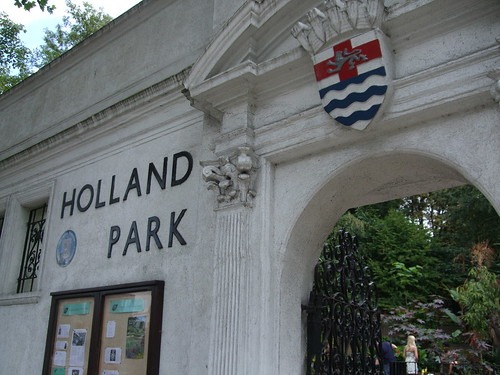
Holland Park entrance
Entrance to Holland Park

On Saturday afternoon I met Yannick outside Holland Park tube station. As it turned out, I was the only one there on this particular tour so I felt very important! I was taken past some very expensive-looking houses to the park entrance, where Yannick pointed out the climbable ‘false’ terrace, leading to nowhere but providing an attractive entrance point into the garden. We then moved on to the statue of Lord Holland, after whom the park is named. This particular Lord Holland was Henry Richard Vassall-Fox, the third Baron Holland, who lived from 1773 to 1840. A lifelong Whig (his uncle was the notable Whig orator Charles James Fox), he was an interesting character with an interest in the French Revolution surprising in an English aristocrat. He caused a minor scandal by becoming involved with a married lady he met in Italy (whom he married after her divorce). The pair returned to England and lived in Holland House (built for Sir Walter Cope in the early seventeenth century and originally known as Cope Castle), entertaining a variety of celebrity guests including Benjamin Disraeli and Lord Byron (who was typically chased around the garden by inquisitive young women).

Statue of Lord Holland

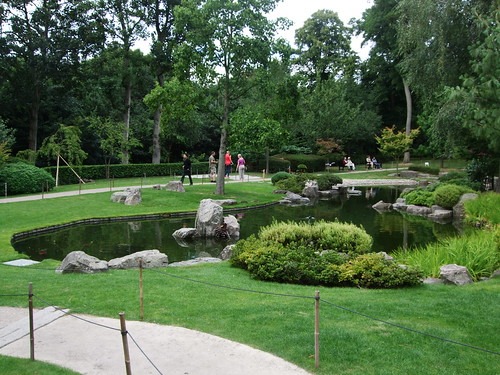
The main focus of the tour was the Kyoto Garden, a Japanese garden which has long been a feature of the park. I’m no Japanophile but I found this fascinating. The garden, landscaped by Japanese gardeners and designed to represent the world in miniature, is beautiful. We entered via the main entrance – Yannick explained that you are meant to move round Japanese gardens in a clockwise direction, observing it unfolding in front of you, though most of the other visitors clearly hadn’t got the memo and kept getting in the way.

Kyoto Garden
The pond in the Kyoto Garden

I hadn’t realised just how symbolic and meaningful the elements of Japanese gardens are. The water and the rocks in the waterfall represent the contrast of yin and yang. The island in the centre of the pond symbolises a turtle. The number 3 is an important motif in Buddhist symbolism and it is apparent in several places around the garden, including the bridge which is formed of three concrete rectangles.

Kyoto Garden
Kyoto Garden

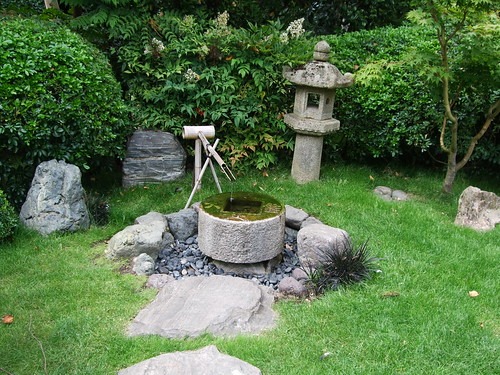
There are four different stone lanterns in the garden, as well as a fountain and a bamboo fence. A cracked paving stone, representing the Tohoku earthquake from a couple of years ago, lies next to the new Fukushima Garden, which commemorates that disaster.

Fountain
Drinking fountain (off limits to the public, sadly!)

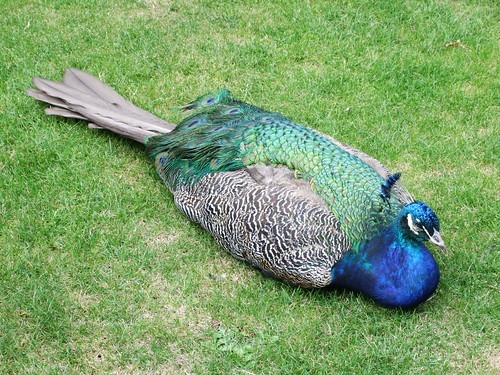
I spied one peacock inside the garden, though he was rather lazy and spent the whole time lying about, showing no inclination to display his fine feathers to us. There were also several ducks and moorhens swimming about.

Lazy peacock
Lazy peacock

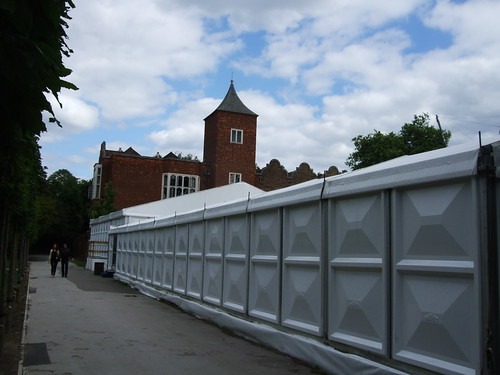
Finally we walked down to Holland House, a magnificent building that was sadly almost destroyed during the Blitz. Only the east wing and most of the library (yay!) survived. The remainder of the building is now a youth hostel. Unfortunately the façade was mostly hidden by the Opera Holland Park marquee, so I couldn’t get a proper view or a good photo.

Holland House
Holland House

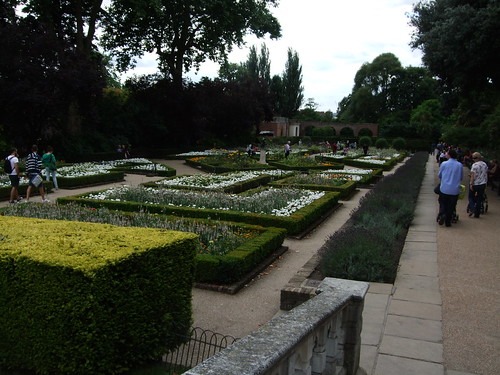
The nearby Dutch gardens (originally known as Portuguese gardens until England and Portugal fell out) were beautifully landscaped, albeit in a completely different manner to the Japanese garden. One area of the gardens is devoted to modern sculpture, while there are attractive buildings and a tea room nearby.

Dutch Gardens
Dutch Gardens

I thoroughly enjoyed my tour and learned a great deal about Holland Park and Japanese gardens. You can book a guided tour here: http://hollandparkwalk.eventbrite.co.uk/, or alternatively you can simply visit the park yourself and explore.

Wimbledon Lawn Tennis Museum and Tour

I’m not really a tennis fan at all, but I thought it would be really interesting to visit Wimbledon, as it has such a long history. I went there on Sunday to look round the museum and partake in a tour, and ended up being infected by some of the enthusiasm clearly felt by tennis fans.

Wimbledon Lawn Tennis Club is located in south west London, and can be reached by bus 493 which goes through Tooting and encompasses both Southfields and Wimbledon stations. I actually got off at Wimbledon Park station and walked through the park, which was a lovely experience on what turned out to be a rather pleasant day. To get to the museum you enter the site at Gate 4, and the entrance is nearby.

Wimbledon Lawn Tennis Museum
Entrance to the Museum and Shop

Entrance to the Museum and a tour of the site costs £22. This sounds expensive but I actually found it to be well worth it. I looked around the Museum first, which took about an hour. The Museum was renovated in 2006 and tells the story of lawn tennis and Wimbledon from the early days of the game and the first Championship in 1877 to more recent 21st-century developments. I found it to be interesting, well laid-out and informative, with fascinating items displayed including early tennis rackets, tennis-related memorabilia and outfits through the decades. I was appalled by the female outfits from the Victorian era, which included full corsets and long skirts. Frankly I’m amazed women were able to play the game at all in those clothes. There is also a hologram of player John McEnroe projected into a model of a dressing room, as well as videos and other interactive exhibits. Finally, the famous Wimbledon trophies are displayed in all their glory. These remain permanently on-site and winners get small copies to keep.

After looking around the Museum, it was time for the tour. This took an hour and a half and was a really good experience. Our guide was a Blue Badge guide and very knowledgeable. I was amazed at all the different nationalities of those on the tour – there were people from the USA, Australia, the Netherlands, India, Mexico and Thailand. It just goes to show how famous Wimbledon is the world over. We met at the statue of F. J. Perry, Britain’s last ever Gentlemen’s Singles Wimbledon Champion. His ashes are contained alongside.

Statue of F.J. Perry

On the tour we were shown a number of the courts, and introduced to the famous Wimbledon grass which we were ordered not to touch on pain of death (not quite!). One of the courts was the location of the nail-biting 2010 match between John Isner (USA) and Nicolas Mahut (France), which at over eleven hours turned out to be the longest ever Championship match. Our guide had been there at the match, and her recollections made me – who has never watched more than five minutes of tennis in my life – wish I had been there too.

Plaque recording the longest match in 2010

Near the beginning of the tour, we were shown the large board showing the results of all the Singles matches from Wimbledon 2012. Our guide explained that even the best players can be beaten by up-and-coming stars, and this is part of what makes tennis such an exciting game.

Boards showing the 2012 Wimbledon results

After a look around No. 1 Court (not to be confused with Centre Court), we were shown and given the chance to climb up Aorangi Park, so called because it was constructed on land previously leased to the New Zealand Sports and Social Club. It is a popular place for visitors to sit during the Championships because a giant screen is placed above the stairs by No. 1 Court showing all the matches that take place in that court. The area has been known informally as ‘Henman Hill’ and ‘Murray Mound’ as it has been commonly used by fans of these two British players.

Aorangi Park
Aorangi Park
Wimbledon logo and colours
Wimbledon logo
View of No. 1 Court
View of No. 1 Court, showing where the large television screen is placed during the Championships

Later we were shown the players’ reception, where they are required to sign in each day during Wimbledon. We also visited the press room, where players are required to give interviews to the media if requested to do so. We were offered, and a lot of my fellow tourists took the opportunity, the chance to sit in the seats ourselves and get our photos taken! I chickened out, partly because I would have been on my own, and it would have been a bit weird.

The players' reception
The players’ reception
The Press Room
The Press Room

Our guide took us past an old-fashioned roller, originally pulled by horses to ensure the grass was smooth enough for tennis. She explained that the roller played an important part in the history of Wimbledon – if it wasn’t for it breaking, the club officials would never have come up with the idea of holding a tennis tournament to raise money for another. After the success of the first tournament, a second was held the following year, and the year after that… the rest, as they say, is history.

The Pony Roller
The Pony Roller

Finally we headed to Centre Court. On the way, we passed the boards on which are engraved the names of all the Wimbledon Champions dating back to 1877.

Championship Winners' Boards
Championship Winners’ Boards

Centre Court itself looks rather similar to No. 1 Court, but there are several important differences: it is the only court to have a Royal Box, and is currently the only court to have a roof (though one is planned for No. 1 Court in the next few years). If it should start to rain, the roof can be activated; normally folded like a concertina at either end of the court, it folds out and is ready for play within 40 minutes, which is very good news given the unpredictability of British weather.

Centre Court
Centre Court

There the tour ended, leaving me, as I mentioned earlier, with a new-found appreciation of the game of tennis. Unfortunately, the ballot for tickets for the 2013 Championships closed at the end of last year, and I don’t think I am quite dedicated enough to get up early at a ridiculous hour and queue for day tickets. However, I intend to register for the 2014 ballot when it opens in August, and see what happens.

FACTS

Address: The All England Lawn Tennis Club, Church Road, Wimbledon, London, SW19 5AE

Website: wimbledon.com/en_GB/museum_and_tours

Opening Hours: Museum open 10am-5.30pm (5pm in winter); tour times vary

Prices: Museum only – Adult £13, Concession £11, Child £15; Museum and tour – Adult £24, Concession £21, Child £8