2015 Reading Challenge – A funny book

As soon as I finished this book I knew I had to count it as the “funny” book in my challenge. I doubt I’ll read a funnier all year.

Hyperbole and a Half by Allie Brosh is an illustrated account of various events in the author’s life, from her adventures with her two dogs to her experience of depression. Her unique drawings are full of character: I don’t normally go for cartoons but I love these.

2015-02-08 21.39.01

The book is based on the successful and marvellous blog Hyperbole and a Half. If you haven’t checked it out, please do.

2015 Reading Challenge – A graphic novel

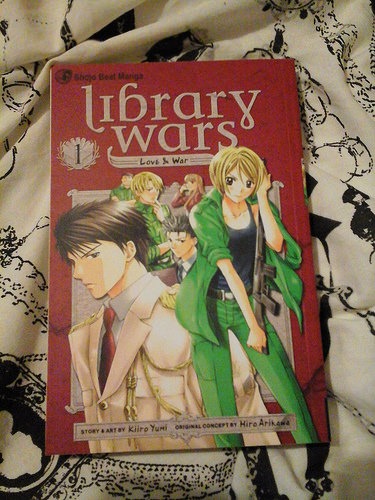
I hardly ever read graphic novels, but I quite fancied this manga book because of the title. Library Wars: Love & War Volume I is the first in a series about Iku Kusahara, an officer-in-training to be part of the Library Defense Force. This group fights against censorship and the banning of books in an alternative future where a government Act allows officials to remove “inappropriate” material from bookshops. Though the public can access such material via the library, tension between the two groups means that the Defense Force is a very important presence.  I quite enjoyed the story, though it was quite light, and I will probably seek out further volumes of Library Wars in the future.

2015-02-08 21.39.33

The Garden Cemeteries: London’s Magnificent Seven

Recently I’ve decided to visit the cemeteries in London known as the “Magnificent Seven”, the garden cemeteries established in the nineteenth century in order to alleviate overcrowding in parish cemeteries. The cemeteries were originally established on the edges of the city, but the expansion of London over the next two centuries ensured that they are now well and truly part of the city.

    The cemeteries are:

  • Kensal Green Cemetery (established in 1832)
  • West Norwood Cemetery (1837)
  • Highgate Cemetery (1839)
  • Abney Park Cemetery (1840)
  • Nunhead Cemetery (1840)
  • Brompton Cemetery (1840)
  • Tower Hamlets Cemetery (1841)

I hope to visit them in the order in which they were established, starting with Kensal Green.

The book I’m using as a reference and guide is Turpin, John and Knight, Derrick, The Magnificent Seven: London’s First Landscaped Cemeteries. Stroud: Amberley Publishing, 2011.

On with the adventure!

BOLT: Exhibition at GRAD London

I popped into GRAD (Gallery for Russian Art and Design), located near Oxford Street, last night. The current exhibition, BOLT, is about Dmitri Shostakovich’s 1931 ballet The Bolt, and includes rarely seen designs, photographs and costumes. The exhibition is organised in collaboration with the St Petersburg State Museum of Theatre and Music.

The ballet is described as the last Constructivist ballet, and judging by the costumes and photographs on display it is unique among ballets I have seen. The story, written by Victor Smirnov, is one of industrial sabotage and the innovative choreography by Fedor Lopukhov includes such pieces as the “Dance of the Cyclists” – a bit different from Sleeping Beauty!

The Bolt was pulled after its first performance at the Leningrad Academic Theatre of Opera and Ballet, after a backlash from critics and a perception that it was a threat to the Soviet authorities. It was not seen again until the Bolshoi Ballet performed it 74 years later. After seeing this exhibition, I am curious to see the ballet for myself.

A Victorian Obsession: The Perez Simon Collection at Leighton House

Last Thursday I went to the Leighton House Museum near Holland Park in order to visit the latest exhibition, A Victorian Obsession. Leighton House is the former home and studio of Frederic, Lord Leighton (1830-1896), a leading exponent of nineteenth-century classical art and one-time President of the Royal Academy. I’ve visited the house, designed and built to Leighton’s requirements by George Aitchison RA, before, and it’s beautiful: a Moroccan-style fountain court and a blue-tiled hallway are just two of the marvellous rooms inside.

Currently the house is home to part of the collection of Juan Antonio Pérez Simón, a Mexican businessman and art collector who holds the largest collection of Victorian and Edwardian art outside Britain. The pictures cover the period from around 1860 until the start of World War I, and the unifying theme is “representations of female beauty”. It’s easy to be somewhat cynical about this theme, but in fairness all of the artists represented were superb painters and their work encompasses a huge diversity in such representation, from the inspiration of the Greco-Roman period to Arthurian legend. The paintings are displayed throughout the main rooms of the house, which is a perfect setting considering that many of their artists knew this house and its owner well.

The paintings encompass late Victorian art in many forms, including historical painting and Pre-Raphaelite imagery. This kind of art is very much to my taste, so I greatly enjoyed the exhibition. There were paintings by artists with whom I am familiar, including Dante Gabriel Rossetti and Edward Burne-Jones. I particularly like the work of John Everett Millais: his The Crown of Love (1875) was on display here, and I also loved The Crystal Ball (1902), a magical work by another of my favourites, John William Waterhouse. Some of house owner Frederic Leighton’s work made an appearance, several paintings returning to the house for the first time since they were created. Leighton’s Antigone (1882) is impressive, as is Crenaia, The Nymph of the Dargle (1880), modelled by Leighton’s favourite muse Dorothy Dene.

Throughout the exhibition I was introduced to other artists I hadn’t previously been aware of, including Henry Arthur Payne, Arthur Hughes and John Melhuish Strudwick, whose Passing Days (1878) is an allegorical representation of the passage of time. His Elaine (c.1891) is a gorgeously detailed representation of the woman of Arthurian legend who pined away for love of Lancelot.

One artist seemed to dominate the exhibition – Lawrence Alma-Tadema. Famous for painting historical scenes, particularly those inspired by Ancient Rome, he painted several of the works on display, including An Earthly Paradise (1891), a rather sweet picture of a Roman woman with her young child. Alma-Tadema’s couch – the only object in the exhibition which is not a picture – sits underneath this painting. The artist designed the couch himself to use as a prop in his historical scenes, and it even has differently-designed legs – one side of the couch represents Egyptian style, the other, Roman. It’s rather fun to play “spot the couch” with Alma-Tadema’s pictures – it appears in several.

Alma-Tadema’s famous work The Roses of Heliogabalus (1888) is the highlight of the exhibition, presented in a room of its own which has been scented with roses courtesy of Jo Malone. The picture shows the young, wicked Emperor Heliogabalus suffocating his guests under a shower of rose petals, and it is beautifully detailed, although I can’t help but concur with the contemporary critics who felt that the victims hardly seemed frightened enough.

This superb exhibition is a must-see for any fans of late Victorian art. It runs until the 29th of March and normally costs £10, or £5 with a National Art Pass. Special late evening openings allow free entry for Art Pass holders between 5.30 and 8.30 on 19 February and 26 March.

Disobedient Objects – V&A

I popped into the Victoria & Albert Museum today to visit the Disobedient Objects exhibition, which is on until next weekend. This free exhibition looks at the role of objects used as tools for social change, beginning with the Suffragette teapots designed to promote the movement and ending with graffiti robots and protest banners.

The exhibition is inspiring, showing how people have come together over the years to protest against government decisions and instigate change. Quite different from the usual displays at the V&A, but well worth it.

Rembrandt: The Late Works – National Gallery

After a tense few days during which I feared I’d missed my chance – only a phone call to inquire about tickets saved me – I managed to get a ticket to the National Gallery‘s exhibition Rembrandt: The Late Works on its last day. My efforts proved to be well worth it: the exhibition was very well laid-out and organised, and I really appreciated the fact that information about the pictures was set out in a booklet rather than presented on labels beside the paintings – this meant that though the exhibition was very busy, it was still manageable because you weren’t faced with hordes of people crowded round the pictures trying to read the captions.

Of course, it goes without saying that the actual content – Rembrandt’s work – was stunning. I particularly liked the five self-portraits on display at the beginning: full of variety, they captured the painter in different moods and at different stages. The most affecting was the portrait painted in the year of his death (1669), which shows him as visibly frail, but I also liked the 1659 portrait in which he wears a quizzical expression.

The exhibition focuses on the later years of Rembrandt van Rijn (1606-1669), and like the Late Turner exhibition at Tate Britain that I visited last year, it shows that the artist did not become complacent or enter into a decline during his last years, but continued to experiment and develop as an artist. In particular, The Conspiracy of the Batavians under Claudius Civilis (c.1661) shows a profound mastery of the creation of darkness and light in painting, while his two versions of the Roman heroine Lucretia (1664 and 1666) are extremely powerful.

Less outwardly grand, but equally masterful, is his picture of his son Titus at his desk (1655), an affectionate and intimate portrait. Fully finished paintings sit alongside sketches and drawings in the exhibition, showing the developments of Rembrandt’s ideas and style, and several of these are exquisite, although their role in the development of the artist’s work will likely appeal more to other artists or art students.

This exhibition was well worth the visit and I am glad I managed to make it before the end.

2015 Reading Challenge – A classic romance

2015-01-22 23.14.41

I’m not sure if the compilers of the 2015 Reading Challenge intended for the category “classic romance” to be interpreted in this way, but that’s what I’ve chosen to go for. After all, medieval tales of knights, damsels and dragons were the original romances.

Sir Thomas Malory’s Le Morte D’Arthur isn’t an easy read, but it is a worthwhile one. The legend of King Arthur had been around before and would continue to pervade European culture for years afterwards – Arthurian tales are still being created and adapted today – but Malory’s version is one of the most famous and influential. I have found myself wanting to reintroduce words like “smite” and “churl” into the language, however.

Terror and Wonder: The Gothic Imagination – British Library

I finally managed to make it to the exhibition Terror and Wonder: The Gothic Imagination at the British Library before it closed. It extended its opening hours during the final week, which was handy for me because I turned up on Monday (the exhibition space is normally open until 8 pm only on Tuesdays) to find the space almost empty. This made it a very pleasant experience to go round.

The exhibition, which opened in 2014, was designed to mark the 250th anniversary of the publication of the first Gothic novel. This was Horace Walpole’s The Castle of Otranto, which made its debut in 1764. The exhibition covers the history of Gothic over the last two and a half centuries, and I found it fascinating. Many of the books on display and much of the information imparted were things I was already familiar with, but plenty of others were not.

In the eighteenth century, Gothic – which encompassed such authors as the aforementioned Walpole (who lived in a Gothic villa in Twickenham, Strawberry Hill), Matthew Lewis (author of The Monk) and Ann Radcliffe (author of The Mysteries of Udolpho) reflected the cultural concerns of the period, with ruined castles and abbeys, upstanding young noblemen, virginal heroines and mad monks. Renewed interest in sixteenth century writers such as Shakespeare and Spenser, and a growing interest in the “Gothic” or medieval past, combined with a growing interest in death and the supernatural led to many novels being set in medieval or Renaissance times, the era between the superstitious past and the dawning of the Age of Enlightenment.

I was excited to see a first edition of The Castle of Otranto, as well as copies of the “Horrid Novels” mentioned in Jane Austen’s satire of the Gothic craze, Northanger Abbey. I hadn’t realised that they really existed, so I left determined to track them down.

The French Revolution inspired more disturbing forms of Gothic literature, and the Romantic era borrowed from Gothic – most particularly in 1816 when the famous stormy night at the Villa Diodati resulted in Mary Shelley’s Frankenstein and Polidori’s The Vampyre. However, in the Victorian era Gothic was largely set in urban areas and in contemporary times – Dickens in particular used Gothic imagery to emphasise the plight of the poor. The later Victorian period saw penny dreadfuls take centre stage, and lurid stories such as The String of Pearls by James Malcolm Rymer (which introduced the character of Sweeney Todd) became popular, as well as the eternal classics Dracula and The Strange Case of Dr Jekyll and Mr Hyde. In the twentieth century, graphic novels, film and TV allowed the genre to develop further, and the exhibition ended with a display of recent photos taken at the Whitby Goth Weekend, which is now entering its third decade.

I loved the exhibition – it was a brilliant exploration of Gothic through the ages and it gave me plenty of ideas of what I would like to read next.

Shoreditch Underground Station (Pillow Cinema)

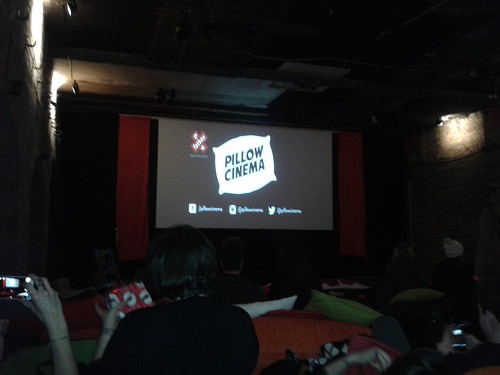
This post should probably be about Pillow Cinema, the east London phenomenon dreamed up by the same people who founded Hot Tub Cinema. The idea of sitting in a hot tub surrounded by strangers has never particularly appealed to me, but the Pillow Cinema idea is much better-sounding – sprawl out on a giant bean bag, pillow behind your head, and relax while watching a classic movie. I saw Billy Elliot on Saturday, and the experience was a great one – but that’s not why I wanted to write this post, and it isn’t why I wanted to go in the first place. After all, I could probably have recreated the experience much more cheaply in my front room with a couple of duvets and a pile of cushions.

No, it was the location of Pillow Cinema that appealed to me, much more than the concept itself. Screenings are held in the former Shoreditch Underground station, and being the Tube obsessive that I am – particularly when it comes to disused or “ghost” stations – I was certain that I wanted to get inside.

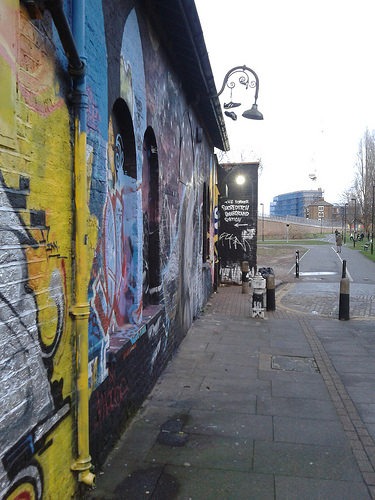
Shoreditch Underground Station is located near Brick Lane, at the end of Code Street. It’s covered in graffiti so it’s not hard to spot. The station used to be the northern terminus of the East London Line, and it closed in 2006 in preparation for the development of the Overground network, which now runs through Shoreditch High Street station.

2015_0110ShoreditchUnderground01
Approaching the station from Brick Lane
2015_0110ShoreditchUnderground02
Sideways view
2015_0110ShoreditchUnderground03
View from Code Street
2015_0110ShoreditchUnderground05
The original entrance
2015_0110ShoreditchUnderground07
Inside the building
2015_0110ShoreditchUnderground09
Looking west
2015_0110ShoreditchUnderground08
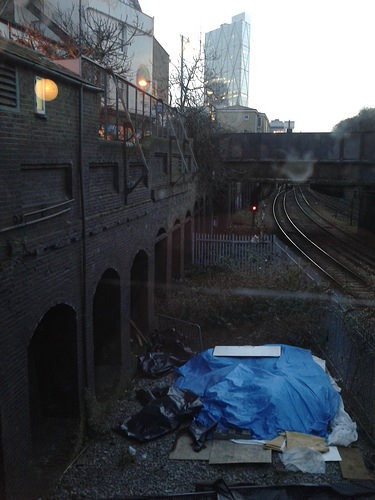
Trains still run past the station towards Liverpool Street

Originally opened in 1876, the station had only one platform and track in use towards the end of its life. It had low passenger footfall, and when it was closed, the platform and track area was filled in.

2015_0110ShoreditchUnderground10
Inside the cinema
2015_0110ShoreditchUnderground12
The arches
2015_0110ShoreditchUnderground11
The opposite wall

The cinema is located where the platform and the track used to be. You can see the walls with their filled-in arches, and the hooks on the side designed to hold the cables. I’m probably the only person who got excited by this, but I kept imagining ghostly trains moving through the space where we were sitting, one era layered upon another like Russian dolls. Pretty impressive to me.