Extinction: Not the End of the World? – Natural History Museum

2019-03-11
Natural History Museum

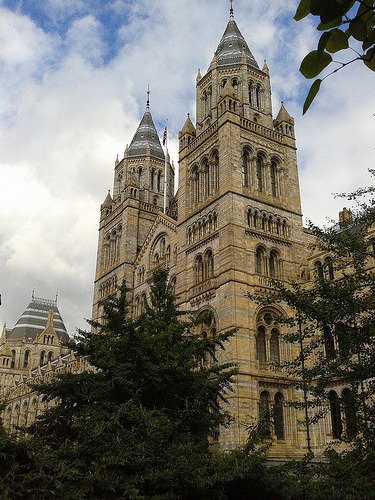
On my trip to the Natural History Museum last week, I also managed to fit in a visit to the summer exhibition, Extinction: Not the End of the World? I really enjoyed the exhibition, which was fascinating and thought-provoking.

Extinction is always thought of as a Bad Thing. However, this exhibition explores the idea that it is not always negative. Species have to die out to make way for others. We humans wouldn’t be here at all if it wasn’t for extinction.

This isn’t to say that we should become complacent about rare and endangered species, or simply shrug our shoulders and allow it to happen. If a species dies out this could disrupt the ecosystem, with lasting consequences. Human action is accelerating decline in many species and this could cause considerable problems.

This isn’t to say that humans are the only factor. Animals may die out for a variety of reasons: increased competition, changes in the environment, or slow breeding processes. The most famous of these is probably the asteroid that (likely) killed off the dinosaurs.

The exhibition offered lots of scope for interaction, and gave viewers the chance to vote on certain issues, such as whether we should make the effort to conserve all animals, or only those that benefit humans. I was pleased to see that most people took the unselfish route and believed that all animals are worth preserving, not just those that are of use to us.

This was a really interesting exhibition and well worth seeing. It’s on until the 8th of September so there’s still time to catch it.

Propaganda: Power and Persuasion – British Library

The other week I visited the British Library to see their latest exhibition, Propaganda: Power and Persuasion. Like all their exhibitions it was excellent: well laid-out, thought-provoking and fascinating.

The exhibition explored the idea and concept of propaganda, how it can be used to unify people and also how it can create divisions. It was divided into several sections, each of which looked at a different aspect of propaganda.

The first section, Origins, looked at the history of propaganda: Roman emperors plastered their images on coins and statues, while the advent of the printing press in the sixteenth century saw the spread of propaganda more widely than ever, particularly during the Reformation (the 1523 picture of ‘The Donkey-Pope of Rome’ is a particularly good example). Next, Nation explored how states establish their legitimacy via the use of symbols such as posters, stamps and flags, and through mass media.

Enemy examined the ways in which leaders demonise others to reinforce unity within their own people, creating a climate of fear and hatred. The most obvious example is the persecution of the Jews in Nazi Germany and occupied Europe during the twentieth century. Linked to this aspect, War showed how morale was maintained in societies engaged in conflict through emphasis on the rightness of the cause.

Health was one of the most amusing aspects of the exhibition, showing ways in which healthy behaviour has been promoted through the use of humour and even fear. Some of the campaign posters and videos displayed were hilarious. Finally, Today showed how the use of technology means that the volume and scale of propaganda is greater than ever, but criticism of it can also be spread more easily via social media.

I liked seeing the posters used to promote particular societies, and the other items on display such as books. One thing I found particularly interesting was the video about the London 2012 opening ceremony. Danny Boyle’s magnificent show became a brilliant example of propaganda, promoting a positive vision of modern Britain.

The exhibition is on until 17 September and I definitely recommend checking it out.

Geoffrey Farmer: The Surgeon and the Photographer – The Curve, Barbican

Geoffrey Farmer: The Surgeon and the Photographer is currently showing at the Barbican, a strange and unnerving modern work of art. It is displayed in the Curve, a long winding gallery that reflects its name, and consists of 365 puppets made up of faces, masks, limbs and accessories applied like a collage onto fabric bodies. Popular culture, the ancient world, history and fiction are all referenced. The title of the exhibition comes from an essay by Walter Benjamin, ‘The Work of Art in the Age of Mechanical Reproduction’, in which he compared the work of a magician to that of a painter and the role of a surgeon to that of a photographer. Both, Benjamin says, deal with fragments.

Creepy yet fascinating, these varied figures are rich in detail and personality. I was reminded of the song by the Doors, ‘People Are Strange’, as I wandered among them. Accompanying the exhibition was a montage of sounds, while at the end a series of pictures was presented as a film. I sat and watched these compelling images for a good few minutes.

I have ambivalent feelings towards modern art, but this is something that is worthwhile and rich in meaning. It closes on Sunday – visit beforehand if you can.

The Jewish Museum

Jewish Museum

London’s Jewish Museum opens late on Thursday evenings in July and August, so I headed there last week. The museum is located near Camden tube station, and is relatively easy to find. Entrance is free for Art Fund card holders; the normal entry price is £7.50.

The museum has four floors and each has something different. The ground floor has the cafe and the shop; upstairs on the first floor, the exhibition Judaism: A Living Faith looks at the Jewish religion and displays several artefacts relating to it. Above that, History: A British Story looks at the history of Jews in the UK, particularly in London.

Also here there is a Holocaust Gallery. I found this incredibly sad and moving. It is told through the story of Leon Greenman, an Auschwitz survivor. Though of British nationality, he was living in the Netherlands with his wife and son when the Nazis invaded and, unable to prove his nationality, he was deported along with his family. Sadly his wife and son were killed in the gas chambers, but Leon survived and spent the rest of his life raising awareness of the Holocaust and campaigning against racism.

The top floor hosts temporary exhibitions: the current exhibition is Amy Winehouse: A Family Portrait. Most of the items on display were loaned by the singer’s brother Alex, who also wrote the captions. The displays portray a normal girl who enjoyed music and clothes but dreamed of fame. The family photographs are warm and intimate. Particularly moving were the notes covering the board at the end of the exhibition, full of heartfelt messages from Amy’s fans.

FACTS

Address: Raymond Burton House, 129-131 Albert Street, London, NW1 7NB

Website: jewishmuseum.org.uk

Opening Hours: 10am-5pm (2pm on Fridays)

Prices: Adult £7.50, Concession £6.50, Child £3.50; under-5s free

David Bowie Is… at the Victoria & Albert Museum – V&A

I visited the David Bowie exhibition at the V&A last week with my parents and an old friend of theirs. Not because I am a particular fan of Bowie, but my dad is. This was the first time he had visited London since I moved here over two years ago, and it was Bowie who helped to finally lure him down.

I had booked our tickets well in advance, which was just as well as the exhibition was completely sold out and people had to queue up for their time slot. Once we were finally inside, we were given audio guides and allowed to wander freely about the exhibition.

The first section covered Bowie’s early life, musical influences and early music. While not being a particular fan, I admired him for the huge range of influences on his music and the way in which he reinvented himself so many times. It was interesting to see his costumes and early recordings, including Top of the Pops appearances.

The second section had even more costumes, lyrics, artwork and stage props on display. I admit I got particularly excited about the props from Labyrinth.

My dad stayed in the exhibition for three hours. He said he didn’t want to miss anything. Needless to say, my mam and I didn’t stay that long. We went for a cup of tea and a piece of cake instead.

The Fan Museum

2013 0323 Fan Museum 01

Yesterday I visited the Fan Museum in Greenwich, and found out more information than I ever thought existed about fans. It’s the UK’s only museum dedicated solely to fans, and has more than 4,000 fans in its collection. It opened in 1991 in a restored 18th century Grade II listed building in Greenwich town centre.

The permanent collection displays notable and interesting fans and fan-related paraphernalia, as well as information about the different kinds of fans in existence and the materials and techniques used in their construction. Interesting items include a fan painting by Paul Gaugin and a ceremonial Chinese fixed fan.

2013 0323 Fan Museum 03

The museum has a programme of temporary exhibitions and the current exhibition is called The Fan in Europe: 1800-1850. Most fans in this period were relatively small and there are some absolutely exquisite examples of fans on display. This is one of them.

2013 0323 Fan Museum 05

If you’re in Greenwich, it’s worth taking a break from the big attractions and paying a visit to this little specialist museum.

FACTS

Address: 12 Crooms Hill, Greenwich, London, SE10 8ER

Website: thefanmuseum.org.uk

Opening Hours: 11am-5pm Tues-Sat; 12pm-5pm Sun

Prices: Adults £4, concessions and children £3

Murder in the Library: An A-Z of Crime Fiction – British Library

The British Library is open late on Tuesday evenings, and I took advantage of this to pay a visit to the small, free exhibition Murder in the Library: An A-Z of Crime Fiction in the Folio Gallery. The exhibition looks at crime fiction throughout the ages, from the first crime novels in the nineteenth century, through the genteel mysteries of the early to mid twentieth century and ending with the ‘Nordic Noir’ craze of modern times. The exhibition was made up of manuscripts and early editions of some interesting crime novels, including the first book to feature a professional lady detective, The Female Detective by Andrew Forrester, first published in 1864, and a manuscript of one of Sir Arthur Conan Doyle’s Sherlock Holmes stories.  I read lots of Enid Blyton as a child and was pleased to see some of her books included too, such as the Five Find-Outers series. I was also interested to see one of Andrea Camilleri’s Inspector Montalbano novels – after watching the TV series I wouldn’t mind reading some of the books.

Manet: Portraying Life – Royal Academy of Arts

Manet: Portraying Life at the Royal Academy of Arts was the last exhibition I saw on Sunday. I had originally planned to visit on Friday night a couple of weeks ago, but like so many exhibitions recently, it was sold out so I decided to book in advance for a later date.

2013 0310 Royal Academy

This is the first major exhibition in the UK dedicated to the work of Eduoard Manet (1832-1883). It focuses on his career as a portrait painter. Although I was aware of Manet before the exhibition, I always imagined him as a landscape painter, so this aspect was interesting to me.

Manet came from a wealthy family and didn’t have to live by his art, but he still sought approval from the Paris Salon, which was, however, often rejected. He used elements of the Old Masters and the new Impressionists, creating an art that was different from both with an unique style. Though photographic portraits were growing in popularity during the time in which he worked, Manet still believed that painting offered opportunities that photographs didn’t in evoking the personality of the individuals painted.

Manet painted several portraits, including pictures of his friends and family: his wife, Suzanne Leenhoff, and stepson, Léon, appear frequently, as do a number of studies of friends including Antonin Proust (no relation to Marcel). Some of his pictures are status portraits of political or other celebrity figures; several of these are unfinished as their sitters could not offer the time that Manet required to model for them. Some of my favourite pictures are those of the writers and artists who were Manet’s friends, including Stéphane Mallarmé and Emile Zola.

My favourite Manet pictures, however, were those which included models rather than important or celebrity figures, particularly those of Victorine Meurent, who appears in the fascinating painting The Railway (1873), in which a red-haired woman gazes at the viewer while the child beside her stands facing the other way, watching the approaching steam train whose presence is indicated by a cloud of smoke. Manet’s style is modern but influenced by older painters, striking and memorable.

Manet: Portraying Life is on until the 14th of April.

Treasures of the Royal Courts: Tudors, Stuarts and the Russian Tsars – V&A

I was at the V&A yesterday in order to buy advance tickets for the Bowie exhibition (my parents are coming down at the end of May and my dad in particular really wants to see it), and while I was there I thought I might as well visit the new exhibition Treasures of the Royal Courts: Tudors, Stuarts and the Russian Tsars. I am very interested in history – I have a degree in the subject and actually studied the Tudors at A Level – and I am fascinated by anything to do with Russia, so this exhibition sounded ideal for me.

The background to the exhibition is that the Tudor era was when relations with Muscovy – now Russia – began to be established. The explorer Richard Chancellor reached Muscovy in 1553, while looking for the north east passage – his route took him over Norway and Sweden rather than via the Baltic – and this kick-started the diplomatic and economic relationship between the two powers. In 1556 the English Court House was founded in Moscow and from then until the end of the reign of Charles I, English ambassadors were a regular presence in the city. Relations soured during Oliver Cromwell’s rule – Russian powers were appalled that the English had executed their monarch (understandably, given what would happen in 1918!) – but were reinstated at the Restoration of Charles II.

The exhibition attempts to convey the nature of the treasures of the Tudor and Stuart courts via displays of armour (including an impressive suit worn by the portly Henry VIII), beautifully wrought jewels and miniatures, and impressive pictures. As soon as you enter you see a pair of magnificent stone leopards that once graced one of Henry VIII’s palaces – they reminded me of the two living leopards that attend Aslan in The Lion, the Witch and the Wardrobe. Just beyond are four large animal heralds belonging to the Dacre family – Thomas, Lord Dacre, fought for Henry Tudor at the Battle of Bosworth. Impressive as these riches all were, I did wonder what they had to do with the Russian Tsars (other than the fact that they were from the same time period) – I thought the exhibition title was slightly misleading. Maybe that was just me?

Eventually, I came to a selection of displays that did have a clear connection to Russia, including diplomatic gifts that have been kept in the Kremlin in Moscow for years. Interestingly, their presence in Russia ensured their survival during the English Civil War – had they remained in this country, they would almost certainly have been destroyed. Some beautiful silver was on display, and a small replica – alongside video footage – of a magnificent carriage given to the Tsar Boris Godunov (immortalised in Alexander Pushkin’s play). I also enjoyed looking at the manuscript records and sources, including a record that Shakespeare’s Twelfth Night was performed – possibly for the first time – on Twelfth Night 1601 in honour of the Russian ambassador Gregory Mikolin.

The exhibition didn’t take very long to go round, which in a way was a good thing as it meant there wasn’t too much to take in. Although I was disappointed that the connection of some of the displays to Russia was tenuous, I did enjoy it and I don’t regret going.

Treasures of the Royal Courts: Tudors, Stuarts and the Russian Tsars is on until 14 July.

Light Show – The Hayward Gallery

Light Show, the current exhibition at the Hayward Gallery on the South Bank, has been enjoying enormous popularity since it opened on 30 January. Tickets are selling out well in advance, so I decided to buy my ticket a couple of weeks ago in order to visit the exhibition yesterday. Setting my alarm for 8 am on a Sunday morning was torturous, but certainly worth it.

2013 0310 Hayward Gallery

The exhibition explores the use of light to shape space and experiment with different forms. Installations encompassed clear and coloured lights, fluorescent strip lighting, bulbs (including one designed to represent moonlight), mini LED lights, sparkling effects and continuous illumination. Some of the installations were enclosed in different rooms. I was amazed, impressed and enlightened (excuse the pun) by the exhibition.

I had a number of favourite exhibits. One was the very first one I saw – Cylinder II (2012) by Leo Villareal. This consists of strips of LED lights (19,600 in total) arranged in a cylinder, which move in hypnotic and evocative ways. The lights are actually controlled by a computer programme, but they are stunning. Another was Anthony McCall’s You and I, Horizontal (2005). This is in a room of its own and a projector throws out a beam of light – essentially a light sculpture that you can walk through.

Another favourite was Ivan Navarro’s Reality Show (Silver) (2010). This is a small room with four doors, around the size of a telephone box. When you are inside you can look up or down and see mirrors reflecting rows of light endlessly, as if you are in a long column or pipe. You can see yourself in the doors, but outside the sculpture, others can see you inside – a claustrophobic and unsettling experience. Navarro grew up in Chile during Pinochet’s dictatorship and the installation echoes the surveillance and control inherent in the system.

One thing that both surprised and impressed me was the extent to which children seemed to be enjoying themselves. Personally it wouldn’t occur to me to take a small child to a modern art exhibition, but there were loads there on this Sunday morning and they were fascinated by the exhibits – from the small baby amazed by the twinkling lights to the little boys excited by the rooms of coloured light.

Light Show is on until 28th April. You will almost certainly have to book in advance, and I also recommend booking the first slot available and turning up as soon as possible – in theory you can arrive at any time during the hour stated on your ticket, but even with visitor limits the space can get very crowded and early arrival gives you the best chance of beating the crowds. I’m so glad I came here – I wasn’t sure if I was going to enjoy it, but I really did.