Portals to the Past: A Crossrail Exhibition

The Crossrail Visitor Centre at Tottenham Court Road is soon to close, but before it does there’s a chance to see some of the archaeological finds uncovered during the ongoing construction works. Portals to the Past: A Crossrail Exhibition showcases assorted finds including Roman skulls and a cremation pot (which contained remains when it was discovered), flint, and bones from a plague burial pit. There is also an iron chain recovered from a dock, and a horse skull from a market.

It was fascinating to see these artefacts, although I find it a huge shame that historic buildings such as the Astoria have been demolished to make way for Crossrail. I was fascinated, though, by the process of construction and references to previous Crossrail finds such as skeletons from the old Bedlam burial ground near Liverpool Street.

The Crossrail website has more information about archaeological discoveries uncovered during the works and a number of lectures have been put up on the topic – they look fascinating.

The Great War in Portraits – National Portrait Gallery

2014 marks the centenary of the start of the First World War, and many museums and galleries are marking the occasion with events and exhibitions. The National Portrait Gallery has kicked things off with a display called The Great War in Portraits. I decided to visit one weekday afternoon, when I had some time off work: I thought, as the exhibition was free, it would be best to go during an off-peak time. I think I made the right decision: the exhibition was pretty crowded as it was, and there was a sign up warning of further crowding at peak times.

The exhibition shows widely different images of the people involved in the war, evoking their varied experiences and roles. It makes use of different mediums, including paintings, film, drawings and photographs. There is even a sculpture: the Prologue displays Jacob Epstein’s ‘The Rock Drill‘, a robotic-looking figure representing humanity’s fascination with mechanisation. This was originally created in 1913, the year before modern warfare would cause such devastation. However, the version shown here is the 1916 version, which Epstein created in response to the war. Gone is the celebration of automation, machines and the power of technology. Instead, the sculpture has had the drill removed and three limbs severed, reflecting the horror and destruction of war.

The exhibition is divided into a number of sections. Royalty and the Assassin contrasts formal, old-fashioned portraits of heads of state before the war with an image of Gavrilo Princip, the teenage assassin of Archduke Franz Ferdinand. Paintings of British, German, Russian and Austrian-Hungarian leaders evoke imperial grandeur and arrogance, while to a lesser extent photos of the President of the French Republic are designed to represent power. However, the picture of Princip is subdued and understated. Together, these images reflect the world before World War I and the political and social climate in which it began.

After war was declared, military leaders began to take on more power, and Leaders and Followers illustrates the hierarchical order, with traditional, formal images of commanding officers who often wore medals. Ordinary soldiers are also represented in more informal poses, often in groups and in a markedly down-to-earth manner. Both kinds of images were often shared as postcards.

By 1916, it was clear that the war would not be ‘over by Christmas’ and the horrific consequences were becoming apparent to many, even as those in power fought to maintain the illusion of jingoistic patriotism. The pictures in The Valiant and the Damned vary wildly in tone, with images of decorated soldiers, poets like Wilfred Owen, the infamous Mata Hari, killed or injured officers, and soldiers from all corners of the globe. For me, the most moving and striking images were the sketches made by Henry Tonks of facially disfigured servicemen. Reconstructive surgery made great strides during the war, and some wonderful achievements were made, but even so the experiences of these soldiers must have been dreadful: Tonks’ images help to give them back dignity and a sense of identity.

And then, something completely different – Fact and Fiction: The Battle of the Somme in film contrasts films by the British and German propaganda bureaus concerning the Battle of the Somme. These films were designed to evoke the ‘thrill of battle’, showing soldiers working and living together, and actually displaying images of dead and wounded soldiers. The first day of the Battle of the Somme, 1 July 1916, resulted in horrific losses including 19,240 British soldiers. Nevertheless, the film made by Geoffrey Malins and John McDowell, The Battle of the Somme, was a huge popular success, reaching an estimated 20 million people. It was truthful up to a point, but did not convey the full horrors of the battle. The German film, on the other hand, released in January 1917, enjoyed less success, partly because it used inaccurate footage and enacted scenes.

After the war, Britain and Germany largely headed in contrasting directions as far as art was concerned. In Britain, the trauma of the carnage led to a return to the comforting and familiar past, while in Germany there was a reaction against the old order and Expressionism gained ground. Tradition and the Avant-garde shows pictures from both of these widely different concepts, and how different artists reacted to the war.

This is a small but very well-presented exhibition that thoughtfully compares and contrasts different responses to the war in terms of portraits. It’s certainly worth a visit, particularly as entry is free. The exhibition runs until 15 June 2014.

The end of an era – the last wooden escalator on the Tube

Yesterday, I saw quite a few tweets linking to articles (like this one on london24.com) announcing the wooden escalator at Greenford station’s last day of operation. The escalator was first installed in 1947, and was the last remaining wooden escalator on the Underground. Most were taken out of service after the King’s Cross fire, seeing as they pose obvious fire risks; Greenford’s presumably lasted longer as it was in the open air.

A new, temporary escalator has been installed for the time being, meaning that the tube’s oldest and newest escalators were positioned alongside each other. In the longer term, the wooden escalator is due to be replaced by an innovative glass incline lift: the introduction of step-free access is obviously great news but it’s sad to say goodbye to a piece of history.

As it happened, I had the day off work, and Greenford is close to where I live, so I had time to pop down to the station hoping to ride the wooden escalator for the last time (yes, I am a massive geek). Sadly, the escalator had already been cordoned off: apparently it stopped running several days ago. This was disappointing, but I still managed to get some pictures before it vanished completely.

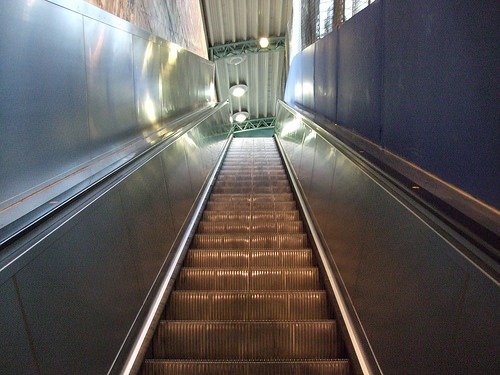
Wooden escalator at Greenford station
The wooden escalator, disappointingly out of use
Wooden escalator at Greenford station
End of an era for the last wooden escalator on the tube
New escalator at Greenford tube station
Looking to the future: the newest escalator on the tube network

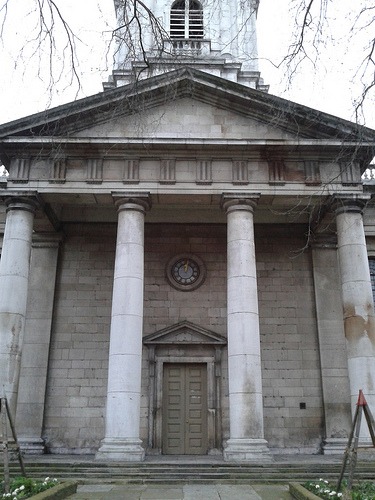
Shoreditch Church

2014_0302ShoreditchChurch00
St Leonard’s Church

A couple of weeks ago I attended a rather unusual theatre performance called Sun. I have reviewed the theatrical experience, but I wanted to write something about the location, as it was rather an unusual one.

2014_0302ShoreditchChurch04
Sign proclaiming the performance of Sun

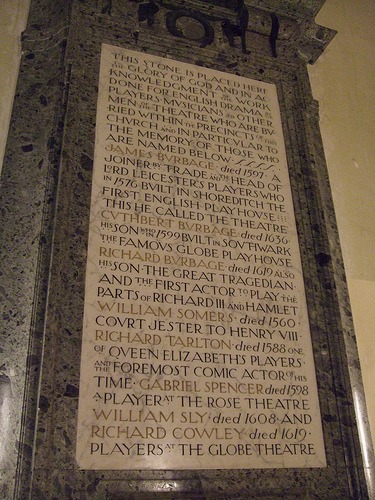
St Leonard’s Church, Shoreditch, has a long and distinguished history. There has been a church on the site for centuries, and it has been known as the actors’ church since the twelfth century, with the first English theatre located close by in New Inn Yard. Several of Shakespeare’s plays had their first performances there, and many of his associates are buried in the medieval church under the crypt: James Burbage, who built the first English theatre; his son Cuthbert, who built the Globe; and his other son Richard, the most famous actor of his time who was the first Macbeth, Hamlet, King Richard III, Othello and Romeo. A stone inside the church records this.

2014_0302ShoreditchChurch01

2014_0302ShoreditchChurch02

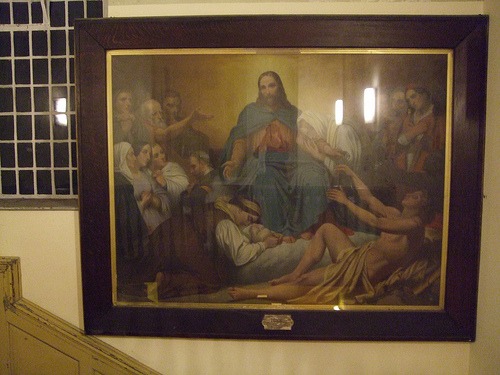
Also notable within the church is art, including this picture.

2014_0302ShoreditchChurch03

In the entrance, while waiting to go in to the performance, I had a look around and found even more interesting things, including an Alice in Wonderland-esque door and what looked like some stocks.

2014_0302ShoreditchChurch08

2014_0302ShoreditchChurch06

2014_0302ShoreditchChurch05

2014_0302ShoreditchChurch07
Looking out into Shoreditch from the church’s doorway

Haim at the O2 Academy Brixton

O2 Academy Brixton
Brixton Academy

So I went to see Haim last night and they were ace. I booked my ticket a few months back on a whim and was super glad I did. I love their album but if anything they were even better live!

Haim
Haim rocking out on stage

I was also impressed with the venue. It’s roomy and has a kind of crumbling grandeur. The floor is spacious and if the queues at the toilets and the bar are a bit big for my liking, at least they’re not out of the way of the stage, so you can still hear what’s going on. I love how the floor slopes towards the stage so you get a really good view even if you’re right at the back.

Court and Craft: A Masterpiece from Northern Iraq – Courtauld Gallery

The Courtauld Gallery is home to a particularly fascinating exhibition at the moment: Court and Craft: A Masterpiece from Northern Iraq. It is based around one of the most incredible objects in the Gallery’s collection, which is a bag made in Iraq around 1300.

The beautiful and ornate bag has been ranked as “one of the finest pieces of Islamic metalwork in existence”. Decorated in gold and silver, and covered with a complex design of a courtly scene, it is believed to have been made for a lady connected with the Mongol Ilkhanid dynasty.

The bag has been placed in context with an exhibition of manuscripts, artworks and other items exploring the society of that place and time. I particularly loved the beautiful illustrated manuscripts.

A Dialogue with Nature: Romantic Landscapes from Britain and Germany – Courtauld Gallery

After visiting the Isabella Blow exhibition at Somerset House, I headed to the other side of the building and the Courtauld Gallery, where a new exhibition had just opened. A Dialogue with Nature: Romantic Landscapes from Britain and Germany focused on aspects of Romantic landscape drawing in both Britain and Germany, covering the period 1760-1840. This kind of art is a favourite of mine, and I enjoyed looking at the beautiful and majestic landscapes of J.M.W. Turner, Samuel Palmer, Caspar David Friedrich and more.

Isabella Blow: Fashion Galore – Embankment Galleries, Somerset House

I spent Sunday morning checking out a few of the exhibitions at Somerset House. I was just in time to catch Isabella Blow: Fashion Galore, as this was the exhibition’s last day.

Isabella Blow at Somerset House

Isabella Delves Broughton was born into aristocracy in the 1950s. However, despite her seemingly privileged family and upbringing she had in many ways a difficult childhood. Her young brother drowned at the age of two, and the cash-strapped family lived in a cottage on the family estate as they couldn’t afford to live in the house itself. After leaving school, she worked at various jobs before moving to America; she ended up working for magazines including Vogue and Tatler. She married Detmar Blow in 1989, wearing a headdress by Philip Treacy – one of the first to recognise his talent. She also discovered Alexander McQueen, as well as the models Sophie Dahl and Stella Tennant.

Blow loved fashion and had a highly individual and unusual style. This exhibition, after an initial exploration of her early life, showcased some of her unusual outfits and accessories, including several hats by Treacy and clothes by McQueen. I particularly loved the hats and hair accessories – I’m not sure how wearable they would be, but they were so amazing to look at that I didn’t care. I especially loved the castle house, and the ship headdress made of feathers. Blow wore her own clothes frequently and with love: scratches, cigarette marks and tears reveal the person behind the amazing clothes. I’ve always seen high fashion as rather out of reach, but this exhibition made it human.

The exhibition focused on Blow’s life, career and relationship to fashion, and doesn’t say much about the fact that she sadly committed suicide in 2007, aged only 48. On the one hand, it seems to gloss over the truth of her life; on the other, I would imagine her friends and loved ones would rather focus on the happy times of her life than on her death. I’d never heard of Isabella Blow before seeing this exhibition advertised, but I wish I had – she sounds like she was an amazing lady.

Pink lobster necklace from Tatty Devine

On my way out, I purchased this little beauty from the gift shop. I had my eye on the large, crystal-studded version, but that was £180. This was only £40 and it was the last one left – clearly, it was fate! I am something of a Tatty Devine obsessive and this pink lobster is exclusive to this exhibition so I was very happy to snap it up (pun not intended).

The Cheapside Hoard – Museum of London

The Museum of London‘s exhibition on the Cheapside Hoard has been open for a few months now, and I got the chance to visit with my friend on Saturday morning. Security is tight: you aren’t allowed to take bags or coats with you into the exhibition area, which I can understand – but you have to pay for the privilege of storing your stuff in a locker, which I feel is a bit cheeky.

The Cheapside Hoard: London’s Lost Jewels is a major exhibition, and looks at the collection of jewellery from the late 16th and early 17th centuries that was discovered in 1912, buried under a Cheapside cellar. The reason why this amazing collection was left here is as yet undiscovered; the mystery surrounding the treasure is part of what makes it so fascinating.

On entering the exhibition we were able to grab magnifying glasses to help us take a closer look at the jewellery: this proved very handy, although we didn’t need them for the first part of the exhibition, which was about the history and context behind Tudor and Stuart London and the jewellery trade. We learned about the importance of jewellery in society, and how it was used to indicate status: a portrait of Elizabeth I showed her dripping in gems – perhaps, as Francis Bacon rather harshly suggested, to detract attention from her ageing person. We also took a look at the inside of a goldsmith’s shop, and viewed a number of jewellery chests and boxes, many of them almost as beautiful and ornate as the jewellery they once contained.

Afterwards it was on to the Hoard itself, displayed within glass cases, with similar items grouped together. So the first section was filled with chains, enamelled, bejewelled and worked in gold, designed to be worn around the neck or the wrist. Another case contained pearls, another displayed rings, and yet another concentrated on the different kinds of gemstones found among the treasure, ranging from rubies and emeralds to amethysts and garnets. There was even a handy guide to where the various stones came from.

Many of the items could be worn today: necklaces, bracelets and rings are all common items of jewellery. However, others would be less common in the twenty-first century. Small scented bags would have undoubtedly helped to combat the stench of sixteenth and seventeenth century London, and the examples here are beautiful and ornate, particularly the little frog. It’s also unusual nowadays to carry a watch (except for a wristwatch), but the emerald pocket watch is undoubtedly one of the highlights of this collection.

Some of the items follow similar designs and patterns, but a few stand out as individual gems among a collection of treasures. A parrot cameo, a ship hairpin and a butterfly necklace are particularly beautiful, as is the tiny salamander brooch complete with little feet. Photography is not allowed in the exhibition, but this brooch’s design has been expanded and placed on the Museum of London wall for the duration.

Museum of London
Extremely large version of the salamander brooch adorning the wall of the MoL

Visit the Cheapside Hoard exhibition. Marvel at how such a beautiful collection managed to survive underground for three hundred years, and wonder how on earth it got there. You have until the 27th of April. It’s worth it.

Chepik Retrospective – Mall Galleries

Sergei Chepik (1953-2011) is regarded as one of Russia’s greatest painters, which made me want to see a retrospective exhibition of his work at the Mall Galleries in central London. I was not disappointed.

When I was in St Petersburg a few years ago, I visited both the Hermitage and the Russian Museum. I found I preferred the distinctive, intense works by native painters in the Russian Museum to the European masterpieces on show in the Hermitage. I am not, and never have been, someone who is knowledgeable about art, but I just found the Russian art more… interesting.

Chepik’s work could easily belong in the Russian Museum. It is visionary, beautiful and distinctive. The artist painted religious scenes, images from his native Russia, and pictures inspired by his later home of Paris. His religious images are bleak, almost fantastical, unsettling, and moving even to an atheist (which he was himself). Many of them were based on or evoke events from Soviet Russia.

Chepik also drew on folk tales for some of his works: a painting I particularly loved showed the puppet-figure Petrushka (the Russian representation of autumn) surrounded by Russian folk figures. Other images covered sinister clowns and other circus characters, book illustrations (including for Bulgakov’s The White Guard) and portraits.

This exhibition was free and I’m so glad I went – it seems Russians still make the most awesome art!

‘The Ship of Happiness’, Sergei Chepik