Houses of Parliament

I’ve been meaning to go on a tour of the Houses of Parliament for ages. Eventually I was able to do so as part of a Library and Information Professionals Open Day at the House of Commons Library. I wrote up the LIS part of the day, including my tour of the library, on my librarianship blog; here I will write about the tour of the Houses of Parliament itself, which was delivered by a guide, just as it would have been if I’d booked the tour myself.

2014_0219HousesofParliamentCommonsLib01
House of Commons Library
2014_0219HousesofParliamentCommonsLib05
House of Commons Library

As part of the LIS Open Day, I completed a quiz about Parliament, which only served to emphasise my ignorance! I learned some interesting facts:

  • Parliament is made up of the House of Commons, the House of Lords and the Monarchy;
  • The oldest part of the Parliamentary Estate is Westminster Hall, which dates from 1097;
  • The monarch has the power to, in theory, appoint the Prime Minister, dissolve Parliament and declare war. However, in practice this would be highly unlikely – even completely unlikely – to happen;
  • The last time the monarch refused to give royal assent to a piece of legislation was in 1707, when Queen Anne refused to give assent to the Scottish Militia Bill. The reason for this was that writing the Bill took so long that by the time it was ready, it was no longer needed;
  • Currently there are 650 MPs in the House of Commons. However, shockingly, only 23% are women;
  • The First Lord of the Treasury and Minister for the Civil Service is the full title held by the Prime Minister;
  • 14 PMs have served the current monarch, Elizabeth II;
  • The only person who is allowed an alcoholic drink in the House of Commons is the Chancellor of the Exchequer, and then only during the budget speech;
  • The symbol of the owl (on the cover of the quiz) is significant because the collective name for a group of owls is a parliament.

The tour began in Westminster Hall, the oldest part of the building. This is a beautiful space; it used to be a royal palace until Henry VIII took over Cardinal Wolsey’s York Place – renaming it Whitehall – and has been used for governmental purposes ever since. It has the largest surviving single span mediaeval timber roof in Northern Europe, and has been used for many different purposes throughout its history, including coronation banquets (such as Richard I’s), trials (including those of Guy Fawkes and Charles I) and the location for monarchs to lie in state after their death. Various heads of state and individuals of note have delivered speeches here, including the late Nelson Mandela. The Hall was one of the only spaces to survive the fire in 1834 and the bombing of World War II.

2014_0219Parliament16
Westminster Hall
2014_0219Parliament14
Westminster Hall
2014_0219Parliament04
Westminster Hall
2014_0219Parliament05
Westminster Hall

When the remainder of the Palace of Westminster was rebuilt, it was built in the Gothic style to a design by Charles Barry, with considerable input from Augustus Pugin. We were taken through the Palace to the Sovereign’s Entrance, beautifully decorated, which is where the Queen enters Parliament during the annual State Opening. We saw rooms including the Robing Room, empty except for a throne and a mirror, and the Royal Gallery.

St Stephen’s Hall was designed by Barry to stand on the site of St Stephen’s Chapel, where royal families used to worship while staying at the Palace of Westminster. In 1550, the chapel became a debating chamber for the House of Commons; the confrontational arrangement of the modern House, with opposing MPs facing each other, derives from the layout here, where pews were positioned along the walls. Nearby, in the central lobby, members of the public are able to exercise their right to lobby their Member of Parliament.

From there we walked through the House of Lords followed by the House of Commons. I was surprised at how small they were in ‘real life’, having seen them only on TV, but otherwise they both looked familiar, the House of Lords decorated in red with an ornate throne at one end, and the House of Commons in green. We weren’t allowed to sit down, but we were able to walk through the seating rows and imagine what it might be like to be involved in a Parliamentary debate.

The throne in the House of Lords marks the point beyond which the monarch cannot pass, a rule left over from Charles I’s defiance of Parliament which triggered the English Civil War. The Lords are made up of the Government, the Opposition and the Crossbenches, who do not belong to any of the main parties. In this House the Bishops, the Lord Speaker and the Woolsack can be found.

In the House of Commons, we saw the Press Gallery and the space for the Hansard Reporters that sits above the main space, with the Government on one side and the Opposition on the other. Our guide also pointed out the seats for the Speaker, the clerks and the Serjeant at Arms, as well as the spot for the mace that remains in position as long as the House is sitting.

The tour was an interesting experience, definitely recommended. You can pay to join a guided tour, or if you are a UK resident you can contact your MP to tour for free.

London Literary Pub Crawl

A few weeks ago a friend invited me to come on a literary pub crawl around London – named, in fact, the London Literary Pub Crawl. Being a fan of both pubs and literature, I jumped at the chance.

The pub crawl is run by the Maverick Theatre Company, and led by one guide plus, apparently, ‘Charles Dickens’ and ‘Virginia Woolf’ – both of whom were absent from my tour, the actors having other commitments. However, I had a good time anyway, picking up fascinating snippets of information (and a couple of incorrect ones, which was slightly infuriating). I actually work near to the area where the tour takes place, and I had visited a couple of the pubs before, but a lot of the history was new to me.

I should point out that the photos were taken a couple of weeks later – I didn’t take any photos on the night as I was too busy taking in all the information (and drinking of course!).

The tour began at the Fitzroy Tavern in Bloomsbury, in the area once known as Fitzrovia. As it’s a Samuel Smiths pub (i.e. it sells cheap booze), I’d been here before and knew about the Dylan Thomas connection – the Welsh poet used to spend a lot of his time in London in the pub, and this was one he visited frequently. It was definitely a great choice to kick off the tour.

2014_0222LiteraryPubCrawl03
The Fitzroy Tavern

After a short walk, the Newman Arms was pointed out to us. I have never been in this pub, although I have walked past it plenty of times. I was intrigued to learn that George Orwell used it as the model for the plebian pub in 1984!

2014_0222LiteraryPubCrawl04
The Newman Arms

The building used to be a brothel, hence this rather interesting image in an upstairs window:

2014_0222LiteraryPubCrawl05
Upstairs at the Newman Arms

The nearby Duke of York was the scene of an altercation witnessed by Anthony Burgess, who was possibly influenced by it when he came to write his novel A Clockwork Orange. Again another fascinating piece of information that I’d had no idea about previously.

2014_0222LiteraryPubCrawl06
The Duke of York

On the way down to Oxford Street we passed the Wheatsheaf: this is another pub with a Dylan Thomas connection, as it is the pub in which he first met his wife Caitlin Macnamara.

2014_0222LiteraryPubCrawl07
The Wheatsheaf

Another pub we passed was The French House. This has a history of being a hangout for writers and artists including Francis Bacon.

2014_0222LiteraryPubCrawl10
The French House

The tour ended at the Coach & Horses near the Palace Theatre. This pub has enjoyed a long association with the staff of Private Eye magazine and its former landlord earned the dubious title ‘Britain’s Rudest Landlord’. It is also London’s first vegetarian and vegan pub so I certainly plan to visit soon!

2014_0222LiteraryPubCrawl11
The Coach & Horses

This is just what I remember from the tour, I highly recommend doing it yourself if you are interested in London’s literary past. We stopped for drinks in a few of the pubs, but the main focus is on the history so don’t be put off if you’re not a keen drinker. If you are, though, what better excuse than a culture-filled pub crawl?

Norman Stevens ARA: Selected Prints – Royal Academy of Arts

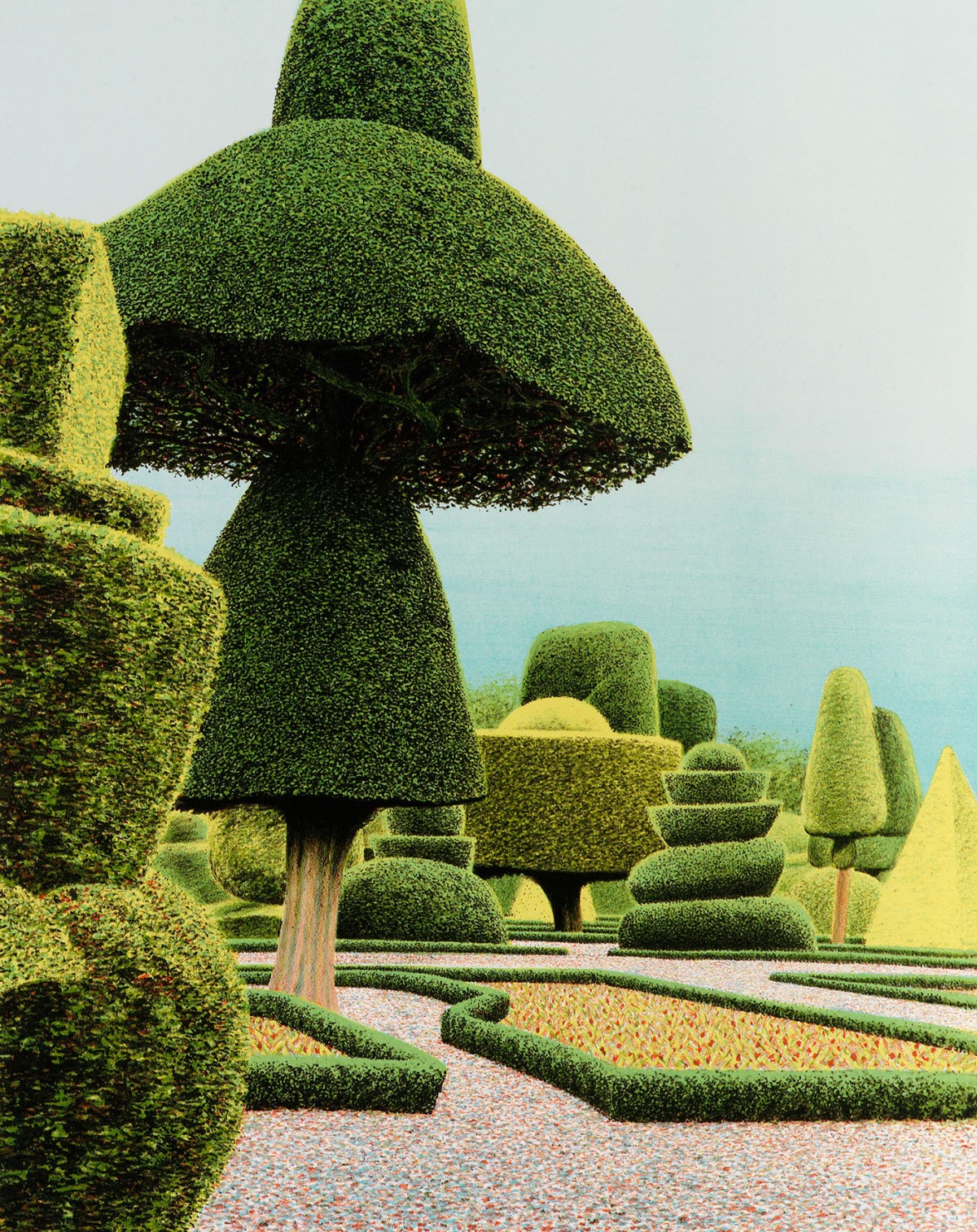
While in the Royal Academy I came across a small exhibition in the Tennant Gallery and Council Room. This was a selection of prints by Norman Stevens, and it was free with any other exhibition ticket, so I popped in. I had never heard of Stevens but I liked his prints: they were reminiscent of a dreamlike English ‘country garden’ but there was something unworldly or unnerving about many of them. I particularly liked his Levens Hall Garden, which reminded me of Alice in Wonderland.

Levens Hall Garden
Norman Stevens ARA Levens Hall Garden 1985 Screenprint Private collection © Estate of the artist

Renaissance Impressions – Royal Academy of Arts

While I was at the Royal Academy I decided to go and see Renaissance Impressions, which is running to the 8th of June in the Sackler Wing. This exhibition focuses on chiaroscuro woodcuts from the collections of Georg Baselitz and the Albertina in Vienna.

Before I visited, I had no idea what chiaroscuro woodcuts actually were, so I was happy to be enlightened. There is a helpful video at the beginning of the exhibition that shows you how they are made. They are like standard woodcuts – e.g. cut out a pattern on some wood (doh), cover with paint, and press onto paper – but you do it in layers. So you have one woodcut for the lighter tones, and you print that; then another for the highlights, and you print that; and finally, another for the outlines which is very dark. The technique results in beautiful, layered pictures full of atmosphere. Some are mainly black and white, while others involve the use of colour. There is more information, as well as a stunning selection of images, on the Royal Academy website.

Sensing Spaces: Architecture Reimagined – Royal Academy of Arts

2014_0330SensingSpaces01
Royal Academy of Arts

The Royal Academy of Arts has been doing something a little different recently – their latest exhibition, Sensing Spaces: Architecture Reimagined, has allowed architects to take over some of their galleries with innovative designs. It marks a departure from their usual kind of show, as you are able to walk around, touch and in some cases walk through the exhibits, and there were lots of children who were clearly enjoying themselves just as much as the adults.

Featuring architects from all over the globe, the exhibition is designed to show that architecture is not just a visual medium: it affects how you perceive a space in terms of scent, touch, hearing and feeling.

On entering the exhibition space you are able to go any way you like. I chose to go straight ahead and came across this installation by Eduardo Souto de Moura, a reconstruction of the wall’s archway.

2014_0330SensingSpaces03
Eduardo Souto de Moura

The next work was pretty hard to miss, and I think it was my favourite out of the lot. Diébédo Francis Kéré has created a huge plastic tunnel that visitors can add to by using the coloured straws dotted about. Children in particular were having a lot of fun with this, but I couldn’t resist adding my own as I walked through the tunnel.

2014_0330SensingSpaces05
Diébédo Francis Kéré

The bright colours were really uplifting.

2014_0330SensingSpaces06
Diébédo Francis Kéré – Close-up

Pezo von Ellrichshausen’s piece dominated one of the larger rooms, consisting of four spiral staircases encased in cylinders and topped with a platform (there was also a ramp for wheelchair users). I very much enjoyed climbing about in this.

2014_0330SensingSpaces09
Pezo von Ellrichshausen

One of the best parts was being able to get a closer look at the roof of the Royal Academy owing to the platform at the top of the structure.

2014_0330SensingSpaces14
Pezo von Ellrichshausen – At the top

Japanese architect Kengo Kuma appeared to have gone to the other extreme, pioneering what he calls ‘weak architecture’ which emphasises the fragility and beauty of his structures. These are shaped canes of bamboo which give off a lovely natural smell; the whole atmosphere of the space was calming and gentle.

2014_0330SensingSpaces15
Kengo Kuma

Li Xiaodong’s work is a maze-like room made up of twig screens, with a pebble-covered space in the centre over which your feet crunch pleasantly.

2014_0330SensingSpaces19
Li Xiaodong

Lastly. Grafton Architects have created two rooms, one light, one dark, which architect Yvonne Farrell says is meant to be like going from hot to cold in a sauna. It sounds boring but I was impressed with how the clever arrangement of these supposedly plain concrete slabs helped to alter the atmosphere and feel of the two rooms.

2014_0330SensingSpaces21
Grafton – Light room
2014_0330SensingSpaces22
Grafton – Dark room

The exhibition ended with a video featuring the architects talking about their work and how they view the role of architecture. I normally don’t bother with videos in exhibitions but I was fascinated by this one. I really knew very little about architecture and I enjoyed the way the exhibition helped me to think differently about it.

SLOVO Festival: Shishkin Lectures

As part of Academia Rossica‘s fifth SLOVO Russian Literature Festival – named In Search of Lost Reality – a number of events took place in London. Among them were four lectures by the Russian émigré writer Mikhail Shishkin. I attended two of these lectures, which took place at the King’s College Strand campus.

Shishkin, who currently lives in Switzerland, has written several acclaimed novels including The Light and the Dark (which I have read and enjoyed) and Maidenhair. His lectures focused on Russian literature of the past centuries, as well as the modern political situation in Russia. I would have liked to see all four, but unfortunately I already had plans.

Of Living Noses and Dead Souls

Nikolai Gogol and his attempt to write “a new Bible”

“Gogol and his reception are Russian literature’s greatest misconception. Collectively, his works constitute the Russian Book of the Dead, and yet he’s been consigned to the humourists’ shelf.”

The 11 March lecture looked at Nikolai Gogol, one of the most famous and pivotal Russian writers who had a great deal of influence on the development of Russian literature (though, ironically, he was born in what is now Ukraine). I believe it was Dostoyevsky who said of Russian writers, “We all came out from under Gogol’s overcoat” (or something to that effect). The Overcoat (1842) is an absurd and surreal tale of a man whose social status and self-worth hinge upon the possession of a new overcoat; it is a deeply odd story with a tragic outcome. Shishkin, however, focused in his lecture on Gogol’s religious bent, in particular his bid to write “a new Bible” with his work Dead Souls (1842).

Shishkin began with a reference to the current war in Ukraine, Gogol’s birthplace; he argued, as he would argue again later, that culture is the only thing that can unite people and fight the brutality of war. He went on to talk about perceptions of Gogol’s work: short story The Nose (1835-36) was seen as “filthy, crude and trivial”, while Shostakovich – who would adapt the tale into an opera – viewed it as a horror story. The reading public took the author for a satirist, and the first volume of Dead Souls was seen as a satire, as was the play The Government Inspector (1836) which Shishkin argued was about fear. However, Gogol had a strong religious faith, thought God’s greatest gift was the Word, and believed that a ‘higher power’ was directing his writing. He later renounced his early work, believing it to be sacrilegious, and a reader of Dead Souls Volume 2 told him, “You want to write the second Bible”.

The first volume of Dead Souls is all we have; designed to loosely resemble Dante’s Divine Comedy, it was meant to be a trilogy, but the second part suffered setbacks and the third was never written at all. Gogol burned the second volume three times, in 1843, 1845 and finally in 1852, just before he died of a mystery illness. He thought his book was not progressing because he was unworthy of it, and seemed to have a fear of being buried alive: he wrote in his will that he should not be buried until decomposition became apparent.

Shishkin argued that literature before Gogol was a child, and that his work represents the awakening conscience of a nation. His interpretation of Gogol’s work is fascinating, and I should like to reread some of it with these ideas at the back of my mind.

 “Why the devil was I born in Russia, with brains and talent!” A.Pushkin
“Черт догадал меня родиться в России с душою и с талантом! Весело, нечего сказать.” А.С. Пушкин

Literature and politics in contemporary Russia

On 25 March I attended the final lecture, in which Shishkin talked about literature and politics and contemporary Russia. I wasn’t sure if I would enjoy this, as I’m not the world’s biggest fan of contemporary politics, but I actually found it really interesting, particularly the comparisons he drew between literature and politics now and literature and politics of a century and two hundred years ago.

Shishkin began by remarking that a century ago, Russia was the centre of world literature, as hundreds flocked to Yasnaya Polyana, home of Leo Tolstoy, in spite of the fact that the writer of Anna Karenina and War and Peace “didn’t consider power to be worth a brass farthing”. Where, he asks, did Russia’s powerful literature come from?

At the time of Shakespeare there were no Russian writers of significance. Russia was surrounded by enemies, and subservience to the Tsar gave subjects a sense of higher purpose, apparently. Peter the Great, founder of St Petersburg, wanted to ‘cut a window to Europe’ but many have argued that he actually ended up weakening the Russian Empire.

Poets did not properly appear until the eighteenth century. Alexander Pushkin was unique in challenging the established hierarchy of power, helping to create an alternative power pyramid with the poet on top, the power of a free artistic spirit. It has been suggested that his muse was a “terrorist muse”, as one of his poems was passed around by the revolutionary group the Decembrists. Interestingly, though, the Tsar did not execute Pushkin – he realised that he needed him. This sentiment was echoed by the Soviets in the 20th century, who suppressed Christianity but could not give up Pushkin – they needed him to give them spiritual legitimacy.

Shishkin suggested that in Russia, the choice has always been between “bloody chaos and ruthless authority”. The bloodless revolution of 1917 could not last, and during the Soviet era, authority was certainly ruthless. Literature was preserved underground, but many writers still followed the tradition of gravitating towards power.

One of the most interesting parts of the talk came when Shishkin talked about his own memories of the end of the Soviet period. He recalled the failed coup of 1991 and the Chechen wars of 1994, and how after initial optimism – he worked in a school, hoping to play a part in changing Russia – a period of disillusionment began to creep in. The struggle for power and money led to the division of natural resources and the rise of hugely wealthy oligarchs. In Russia, said Shishkin, the government is like the mafia, and is on the path to becoming a police state. He told us of how, as a child, he spoke to his grandmother on the phone, who, confusing her grandson with her late husband, asked where they were taking him (her husband had been arrested).

Nowadays, poets can no longer align themselves with power. Unlike Tsar Nicholas, who was a keen reader of Pushkin, and Stalin, who enjoyed the work of (of all people) Bulgakov, Putin doesn’t read or seem to have any appreciation of literature. Shishkin suggested that if you are “neither a fighter or a scoundrel”, and do not wish to become one or the other, you must emigrate and escape from Russia. This is what Shishkin himself has done – he now lives in Switzerland. Russia, he suggested, is stuck in the past.

And yet the lecture ended on a relatively positive note. Dictatorships come and go, said Shishkin, but literature remains. I liked the sound of this – and I loved the passion for literature that came through in this lecture and the one before.

View from the Shard

I fear a lot of things – spiders, telephones, excessive social interaction – but one thing I do not fear is heights. This is just as well, since another thing that my friend and I did when she was staying with me was go up the Shard.

2014_0322Shard01
Ground floor entrance to the View
2014_0322Shard02
Wall of quotes celebrating London

You have to book in advance and yes, the price is extortionate (nearly £20) but the view from up there is incredible. In fairness the experience is planned really well: your ticket is timed, and you have half an hour from the stated start time on your ticket to go in. Once inside, you have to queue for a very short while in order to go through an airport-style security system. This isn’t as scary as it sounds: the staff are all cheerful and friendly. To reach the very top you have to go into two different lifts, both of which made my ears pop owing to the sheer speed of travel! I liked the moving images and videos on the ceiling of the lifts.

Once up, there are two levels: one which is fully indoors, and another, the highest, which is slightly open to the elements. Luckily the day we’d chosen was a good one, with little wind and not too many clouds, so we got a clear view over London while suffering only mild chills. The space was busy, but not too crowded, as it surely would have been if tickets weren’t timed.

And what a view it is. I’ve been on the London Eye and I’ve been to the top of the ‘Gerkhin’, but the Shard is something else entirely. My friend and I stayed up there for ages, pointing out landmarks and trying to identify random buildings. This is definitely an experience where pictures say much more than words ever could.

2014_0322Shard03
The ‘Gerkhin’, the ‘Walkie Talkie’… and I don’t know the names of the other buildings!
2014_0322Shard06
Looking approximately west towards the Thames
2014_0322Shard08
Blackfriars Bridge, the Tate Modern and the Millennium Bridge
2014_0322Shard17
The London Eye, which looks tiny from here
2014_0322Shard43
St Paul’s Cathedral
2014_0322Shard38
The Tower of London
2014_0322Shard16
Battersea Power Station
2014_0322Shard18
The BT Tower, with Wembley in the background

Jack the Ripper Tour

It’s great when my friend Elisa comes to stay, as we get to do loads of fun touristy things that I wouldn’t normally think of doing. This time, one of them was a Jack the Ripper tour. If there’s anyone out there who hasn’t heard of Jack the Ripper, he’s a killer who murdered several prostitutes in Victorian London, and despite many theories and conjectures about who he was, his identity has never been confirmed.

We met outside Aldgate East station (apologies for the terrible quality of these photos: my camera’s never been great at taking pictures at night).

2014_0321JacktheRipper02
Our guide outside Aldgate East

Our costumed guide led us down alleys, up little hidden paths and beside old history-ridden buildings overshadowed by the shiny new modern office blocks that have popped up in the last few years. We stopped beside several workhouses, factories and landmarks made significant because they were the places where the bodies were found, or where the women had been last seen before their bodies were discovered.

2014_0321JacktheRipper03
Start of the tour

Our guide made pretty good use of projections to show us images of the victims, as well as pictures of the areas we were at as they would have looked back in the nineteenth century. This was really interesting and helped us compare and contrast. Seeing the faces of the murdered women helped to bring home the fact that they were actually real people. This tour is for entertainment but it also has a serious side.

2014_0321JacktheRipper09
One of JR’s victims

One of the places we passed was the Ten Bells pub, rumoured to be the place where one of the victims drank. We were also treated to a bit of theatre, as an actor playing the drunk partner of one of the women wandered past!

2014_0321JacktheRipper06
The Ten Bells

On a lighter note, one of the alleys we walked through was pointed out as being Knockturn Alley from the Harry Potter films.

2014_0321JacktheRipper08
Knockturn Alley

I probably wouldn’t have thought of going on something like this, so I’m glad my friend got me along. Definitely something a bit different for a Friday night!

‘This bewitching poison’: Alcohol and the Royal College of Physicians

There’s an interesting exhibition at the Royal College of Physicians at the moment. ‘This bewitching poison’: Alcohol and the Royal College of Physicians is on display at the RCP headquarters near Regent’s Park, and is open until 27 June. I booked for a lecture evening to coincide with the exhibition, and headed there after work last night.

The RCP is the oldest medical college in England, founded by royal charter of Henry VIII in 1518. The current building was designed by Sir Denys Lasdun and opened in 1964. The on-site museum contains many interesting items, including 300 oil and sculptural portraits, the Symons collection of medical instruments in the Treasures Room, the RCP silver collection and the Victor Hoffbrand collection of apothecary jars. The College was given the personal library of William Harvey (1578-1657), who discovered the circulation of the blood, although most of his tomes were lost during the Great Fire of London. The College is also in possession of six rare anatomical tables from Padua, dating from the 1650s, as well as archives containing near-complete records of RCP over the last 500 years. The lectures were held in the Dorchester Library, which contains many volumes of note including some which suffered shrapnel damage during World War II, pointed out to me as I walked in. The College has a long history of reporting and advising on public health, including the recent alcohol minimum pricing debate, making the current exhibition highly relevant.

‘This bewitching poison’: Alcohol and the Royal College of Physicians

When I arrived at the College, I registered, collected my glass of wine and proceeded to investigate the exhibition. It was very interesting, looking at “300 years of drinking history through the work of artists, doctors and satirists”. Alcohol has long been a part of life for people in Britain, and has been seen in both positive and negative lights.

Historically, Britain was a beer-drinking nation, but the arrival of the Romans introduced wine. One result was that wine drinking was associated with high social class, which it still is to a certain extent. Most native Britons drank ale, which from around 1400 often had hops added to produce the stronger drink of beer. For many years, beer was seen as healthy, being drunk on a daily basis as an alternative to water which was not safe to drink for much of Britain’s history. Physicians such as George Cheyne advocated wine in moderation as a tonic – even now, it is uncertain whether a small glass of red wine might prevent against heart disease – and alcohol was often used as a medicine: for instance, the juniper in gin was thought to help prevent the plague.

On a more negative note, the health problems caused or exacerbated by alcohol have been recognised since ancient times. Cirrhosis of the liver was recognised by the Ancient Greeks, while gin was blamed for drunkenness, vice and poverty in the eighteenth century. Temperance campaigners during the nineteenth century encouraged people to sign the pledge and become teetotal. As we move forwards, many campaigners argue that the government needs to take some responsibility for alcohol advertising by the drinks industry, and do more to help combat the negative effects of alcohol.

‘This bewitching poison’: from gin palace to temperance hall

There were two lectures; the first, Dutch courage & mothers’ ruin: The London gin craze, was delivered by Dr Richard Barnett, lecturer at the Universities of Cambridge and London, and Wellcome Trust Engagement Fellow. He has written several books on the subject including The Dedalus Book of Gin, which I have on my bookshelf (as yet unread)!

18th-century London was awash with cheap, fiery gin. William Hogarth railed against it, politicians legislated against it, and doctors blamed it for destroying the health of the nation. Dr Richard Barnett explores the cultural and political realities behind this notorious epidemic of alcohol-fuelled social breakdown.
From the RCP website

I learned a lot in this lecture, including how the increase in gin consumption (which peaked in 1743) frightened those in authority and highlighted the problems with excessive consumption of spirits. In fact Jessica Warner has suggested that there were actually two gin crazes – one of the ‘public’, and one of the ‘pulpit’, decrying the sin of drunkenness. The phenomenon was largely confined to London, particularly the poorer parts such as Soho and Covent Garden. Gin was seen as socially subversive, and inspired Hogarth’s 1751 picture Gin Lane, a vivid and unforgettable picture of degradation and moral degeneration resulting from the consumption of gin. The authorities took action – the first Gin Act in 1729 doubled duty on spirits. It has been suggested that drunkenness “became less Falstaffian, and more Hogarthian” – less convivial and jovial, and more immoral and sinful.

One interesting aspect of the gin craze, I thought, was the case of the man in 1720 who was accused of killing his mother: there was a suggestion that gin contributed although this was probably not true. This link between alcohol and crime made me think of the absinthe craze in 1900s Paris; from what I recall, it inspired similar worries about drunkenness and morality, and I believe there was a similar case where someone was accused of murder, supposedly under the influence of alcohol.

The second lecture, An imperious impulse: medicine, morality and drink in Victorian Britain, was delivered by Dr James Nicholls, research manager at Alcohol Research UK and honorary senior lecturer at the London School of Hygiene and Tropical Medicine.

In the late 19th Century, alcohol was a fiercely contested political issue. While debates centred on crime and the threat to social progress, medical concerns became increasingly important. From defining inebriety to questions over the effect of alcohol on the unborn child, medicine became embroiled in a range of thorny questions with very real political implications. James Nicholls looks at these problems and asks how far they have been resolved today.
From the RCP website

This lecture explored the history of organised campaigns against alcohol, led in the nineteenth century by the temperance movement (c. 1829) and social reformers in general, who argued that it was the duty of the state to intervene. By the period 1880-1910 alcohol had become a big political issue, and behind it was the important question, is alcohol a beneficial substance with the potential to cause harm, or a harmful substance with some benefits?

The concept of addiction has also developed over the years, with the archaic To addict yourself to giving way to the 20th century To become addicted, which has in turn morphed into To become an addict. This illustrates the medicalisation of addiction and the shift in thinking about alcoholism: from being seen as a sin, it has become recognised as a disease.

I really enjoyed these lectures: they gave me a lot to think about, and the accompanying exhibition was really fascinating. The exhibition is free – do check it out if you get a chance.

The Photographers’ Gallery

2014_0316PhotographersGallery
The Photographers’ Gallery

The Photographers’ Gallery is not somewhere I’d ever thought of visiting, but I had some spare time one Sunday afternoon so decided to pay it a visit. The Gallery is centrally located, just off Oxford Street, and entry is only £2.50 for National Art Pass holders (£4 full price). It has a camera obscura, a studio floor, a shop and café, and has a rotating programme of exhibitions. When I visited, the Gallery was host to exhibitions by Andy Warhol, David Lynch and William S. Burroughs.

David Lynch: The Factory Photographs

I started at the top of the building, so David Lynch’s photographs were the first I saw. These were definitely my favourites: I loved the cinematic, almost noir-like quality of the images. Of course Lynch is a well-known filmmaker: although I have to admit I have never seen any of his films, there was a clear cinematic influence on these images. They were largely pictures of factories and abandoned industrial sites, and had a brooding and bleak atmosphere, almost Romantic in the impression they gave of decay and a bygone era.

Taking Shots: William S. Burroughs

Burroughs was an influential 20th century American writer, but much less well known as a photographer. This year marks the centenary of his birth, and the Gallery is therefore hosting an exhibition of his work. They were interesting images, varied and vivid, which told stories of Burroughs’ journeys.

Andy Warhol: Photographs 1976-1987

Warhol is famous as an artist, but his photographs are less well known. I recognised his distinctive artistic style in many of the images, which incorporated brands and celebrities. I particularly liked the ‘stitched’ photographs, combining the easily reproduced photograph and the unique nature of the stitching.

What all three photographers had in common was that photography was not their primary field. I thought that this made their photographs more interesting in many ways, as their other interests influenced their photographic work.

These exhibitions have now finished, but the Gallery has an interesting programme of events coming up, so do check it out.

FACTS

Address: 16-18 Ramillies Street, Soho, London, W1F 7LW

Website: thephotographersgallery.org.uk

Opening Hours: 10am-6pm Mon-Sat, 11am-6pm Sun, late opening Thursdays during exhibitions

Prices: Vary depending on exhibition(s)