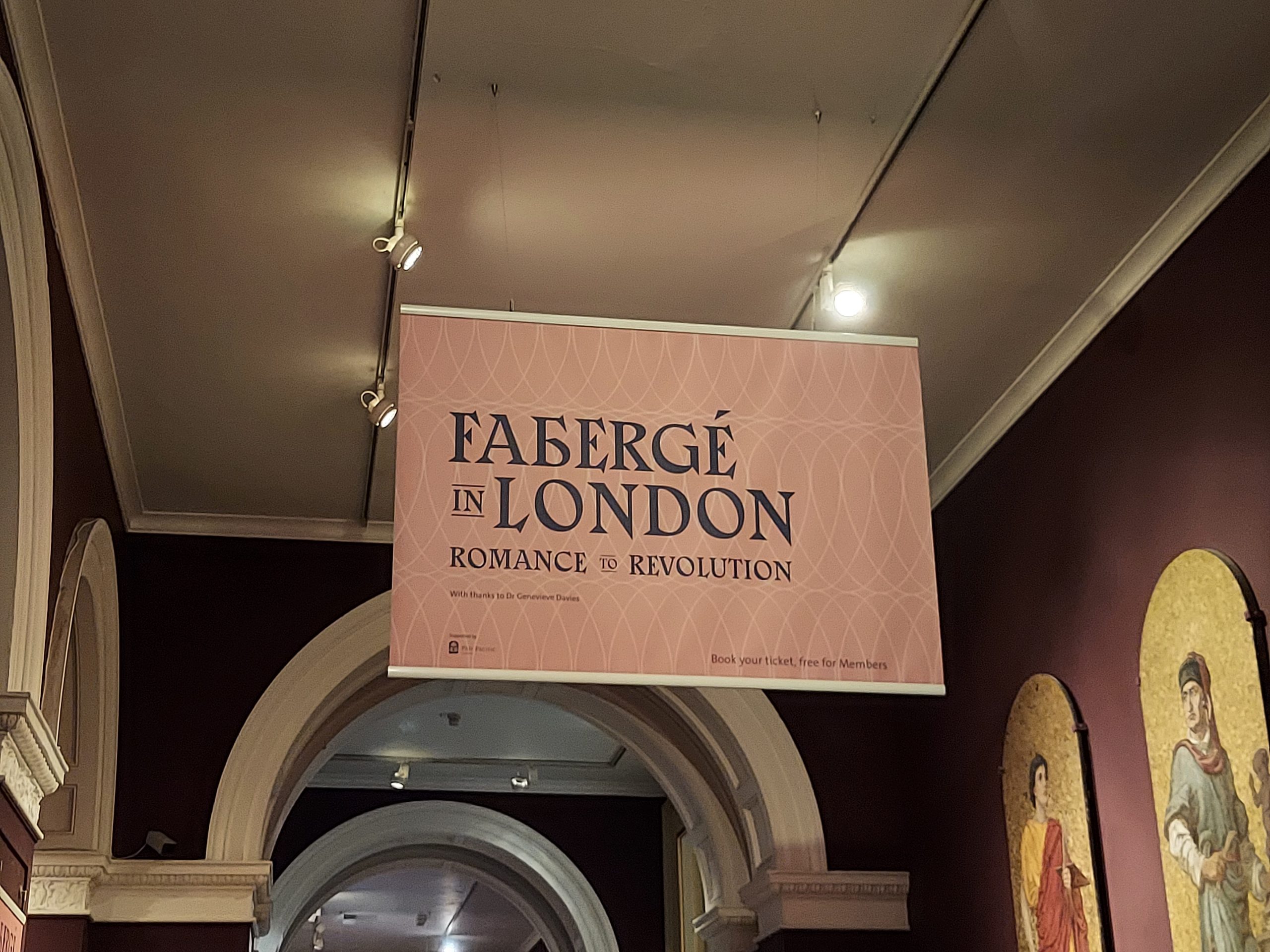
For my first exhibition of the year, I headed to Fabergé in London: Romance to Revolution at the Victoria & Albert Museum. Running until 8 May, the exhibition explores Carl Fabergé, the master goldsmith, the relationship between Russia (where his creations were partiuclarly loved) and Britain, and the establishment of a London branch in 1903.
Today, Fabergé is best known for the Easter eggs he created for the Russian royal family, but at the time his name was generally synonymous with craftsmanship, luxury and elegance. The items on display, ranging from functional items like paper knives and cigarette cases, to jewellery and ornamental figures, are stunning. The detail is astounding and there is no doubt that the pieces demanded the highest skill and artistry possible. This is especially apparent in the miniature pieces, such as the tiny piano or the enamelled coal scuttle. Fabergé’s works were popular with the Russian nobility, but their fame spread far and wide, and wealthy Americans, French aristocrats and, of course, British high society, grew to seek out his pieces.
Interestingly, it wasn’t just luxury materials like gold and diamonds that were used to make Fabergé pieces. The focus instead was on the craftsmanship, and the best effects could often be had with semi-precious stones and other materials. Some of the material was mined from Siberia and brought to St Petersburg by train.
Fabergé led the company, but several other skilled artists and designers were involved in envisioning and creating his great works. One of these is Alma Pihl, whose snowflake designs are on display here and are simply stunning. Most of the design and creation took place in the firm’s premises in St Petersburg. The London office opened in 1903, moving to the prestigious New Bond Street by 1911.
The outbreak of World War 1 led to the decline of business and the London office was closed. In Russia, the factory changed direction and started to make munitions, as well as utilitarian objects like bowls and cooking pots. After the Russian Revolution, Fabergé was forced to flee and died in Switzerland in 1920.
What the exhibition doesn’t touch on is how the luxurious lifestyle of the rich, to which Fabergé’s creations contributed, fuelled anger among the poverty-stricken lower classes and, in Russia, led to revolution. While marvelling over these beautiful creations and reading about the wealthy individuals who purchased them, I couldn’t help but think about the struggling masses below them who could barely afford to eat.
And yet, it’s impossible not to admire the skill and dedication of everyone involved in the creation of these beautiful things. This is perhaps most exemplified in the room at the end of the exhibition which displays several eggs. The detail and ingenuity represented in these creations is breathtaking. I couldn’t decide whether my favourite was the crystal egg representing ice and snow, the floral egg with its delicate enamel flowers, or the stately egg which is a reproduction of the Kremlin. It’s rare that an exhibition display leaves me gobsmacked, but this one managed it.